Developing a vocation culture on a college campus



Developing a vocation culture on a college campus

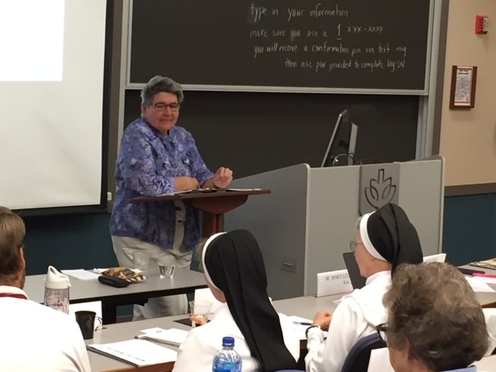
AS A CHAPLAIN AT A SECULAR UNIVERSITY on Prince Edward Island, Canada, I am quite comfortable with the language and the lens of “vocation culture”—live your baptism well and your specific vocation will become clear, whatever it might be. I hope to share here some of the ways I am present to students and accompany them in developing their awareness of God’s call in their lives.
We know from the NRVC Study of Recent Vocations to Religious Life that many of the newer members of religious institutes contemplated their calling around the time of college. “Seven in 10 (70 percent) considered religious life by the time they were 21, with half (51 percent) doing so by the time they were 17,” the study reported.
We also know that 37 percent of newer religious learned about their community “in an institution where members served.” An identical number, 37 percent, learned about religious life via campus ministry. Clearly it is important for both laity and religious engaged in campus ministry to create vocational awareness and support vocation exploration and discernment.
In my work as a campus minister, vocation is one of 12 priorities. Canadian Catholic Campus Ministry borrowed and then modified a comprehensive model of ministry, first framed by youth ministry folks. We have 12 pieces to our pie and “fostering a culture of vocations” is one. In our program planning on campus, we try to touch on each of the 12 elements. In 11 years of campus ministry, we have never hit all 12 every year. Still, I don’t feel that vocation gets left out, but rather I see it permeating everything we do. But when I say “the vocational aspect of my ministry is part of everything,” it can seem empty, in the same way that we say “when everyone does it, no one really does it.” The challenge is to show specifically what the vocational culture looks like on my campus. Following are ways we deliberately foster this culture.
I get to accompany the 60 percent of Catholic young adults who are involved in faith related groups and activities outside of attending Mass. These are students who might not attend liturgies every week but want to take part in volunteer service work, attend a prayer service, demonstrate on behalf of a social justice cause, and so on. I walk with them as they get to know their own passions and interests, an important vocational step.
Our Catholic Student Association at the university goes on an annual weekend retreat. Students are involved in the planning, and a popular topic is often prayer and vocation. My role is to tap into a network of discerners and young religious to offer input. “How did you know?” is a big question students ask the younger religious. “Why do you stay?” is more my speed. We try to offer witness talks for the four lifestyle vocations: marriage, ordained life, consecrated life, and single life. Single life as a vocation (as distinct from those who are single while looking) is a challenge for us.
Another challenge in campus ministry is that our students graduate! I have learned one year is not the same as the next. One year, our annual weekend retreat group wanted silence, even more silence than we had initially put in the schedule. The following year we almost had a mutiny when I suggested a prayer time leading to a silent break. Flexibility is important.
We also host a Lenten Busy Student Retreat, offering students the experience of spiritual direction and prayer with scripture. Our retreat directors are amazed that some of our Catholic young adults have never prayed with scripture. Many of them have a Bible from a Teen Encounter retreat our diocese hosts. They know devotional prayers. But a personal relationship with Jesus—knowing they are unconditionally loved by God—we encounter less frequently. Having a deep relationship with God is the foundation of every Christian vocation. Furthermore, some of our retreat directors are members of religious communities, giving students that all-important direct contact with religious.
Another part of my role in accompanying students on their faith journeys is to translate from English to English. An evening on “decision-making” drew a great cross section of students from various faiths and no faith. When I had presented the same material saying the evening would focus on “discernment,” far fewer people attended. For them, “discernment” is a heavy topic and more specific to religious life. But the vocabulary of decision-making is far more accessible and attractive.
A big part of accompaniment is listening. Campus ministers such as myself often are there for students during pivotal moments of decision. We listen. When appropriate, we provide accurate information and pastoral advice. Here are some examples.
• After one World Youth Day a student came back having met a religious community that is not in our diocese. She met with me, and I connected her with a spiritual director. She maintained contact with the community and joined them last fall as a postulant.
• A man in our diocese was applying for the seminary. While I was not directly involved in his discernment, he came to talk when he was asked to complete the inventory for the psychological assessment. I helped him to understand what it is, why dioceses and religious communities do this, and what to expect.
• Sometimes I get to listen to women who want to discern religious life. Some feel called to religious life but are discouraged with the limited role for women in our church or the church’s limited understanding and teaching about sexuality and inclusion. I am currently meeting with a young woman, a recent Catholic, who feels called to religious life but gets discouraged. She loves Mass and Eucharistic Adoration. She appreciates the sacrament of Reconciliation. But when the Vatican issued a document in 2021 about clergy “not blessing sin,” she stopped her discernment with my community and looked to another Christian church. She is now back, having met a few religious who are feminist theologians. Our conversation continues.
• A newer member of my community is here teaching on campus. She has also met with these three discerners I’ve named above. She offers them a more recent experience of formation, an experience that is more relevant to those I meet.
As a campus minister I often get invited to speak at social justice events. Most recently, that included a Peace in Palestine rally and an anti-homophobic-bullying candlelight vigil. I am on the program as “Sister Sue.” My presence conveys a message about Catholic vocation without saying a word on that topic. Events that are not planned by me or the chaplaincy center are as important as the ones we do plan. Our students have such varied interests and passions. Can I support their quest for meaning? Yes, by showing up! Standing in silence, speaking at the podium, even sitting in the bleachers during a basketball game—religious life can be there.
During their time as students, I can be present and accompany these young adults. However, I see a gap in the transition moments in the lives of young adults. Graduation is one. We have created a welcoming, nurturing environment here on campus. We accompany student Christian leaders in their development and strive every day to make our world a better place. And then they graduate. Whoosh … they’re gone. Some even ask to come back for our liturgies and retreats as they cannot find their niche in our local parishes.
In an effort to respond to that gap, my religious community sponsored a supportive housing project called Visitation Place. Our idea was to have University of Prince Edward Island graduates live in the other half of a duplex where our CND community lives and occasionally share with the sisters in meals, prayer, service, and outreach. I discussed the project idea with students as it was taking shape, and their response was positive. Graduates from the local area already had housing with their families, so the graduates who came and stayed at Visitation Place were mainly from Nigeria and Kenya, along with a few locals. The local pastor agreed to preside at a weekly 6:30 p.m. Mass, and the women invited friends back to the house afterward. We spread the word about this house through word of mouth, and once established, the young women used social media to publicize the young adult events and activities that emerged.
Not only were we sisters part of the home these young graduates formed, we became their community, their support network. Visitation Place was their space and became their church! We launched this project in 2017, and it was an exciting time. Today four of the six women are now married, and two have begun their young families. They are living their Catholic vocations vibrantly and sharing that vibrancy with the church.
Visitation Place offered these women and their friends a place to shape an environment that suited their needs. They formed relationships in the parish, serving in various ways: lector, Eucharistic minister, finance committee member, and hospitality committee member. We created the space, and they stepped in and stepped up. Yes, longstanding parishioners even stepped aside to allow the parish leadership of these young women to take root.
Visitation Place lasted long enough to maintain its creative energy, prayerful roots, and social outreach. The pandemic shifted that energy. After four years, the project reached completion, and the women remain involved in the parish. By staying connected to the church after graduation, these young people have a better chance of long-term commitment to the church in whatever vocation they follow.
From starting Visitation Place to listening to students in discernment, these are just some of the ways we walk alongside our young adults to help them grow in their faith and their understanding of God’s call. When I take stock of the many activities of our chaplaincy center, I admit that sometimes I don’t know whether we do enough. Part of my massive job description is a written annual report and follow up interview with our bishop. I told him one year that I was having trouble making my report sound Catholic enough. He reminded me that everything I do is Catholic enough. And today I might add everything is vocation culture enough.
Sister Susan Kidd, C.N.D. belongs to the Congregation of Notre Dame Sisters. She has been active in vocation ministry in one form or another for decades. Since 2010 she has been a campus minister at the University of Prince Edward Island, in Charlottetown, Prince Edward Island, Canada.
This article is based on the author’s presentation for the 2022 webinar series: “Religious Life Today: Learn it! Love it! Live it!” Find this presentation in video form, as well as the rest of the series, at nrvc.net/webinars.
“Accompanying college students,” by Sister Nicole Trahan, F.M.I., HORIZON, Winter 2022.
“Talking to college students: two ways to build relationships,” by Sister Paula Jameson, I.H.M. and Sister Regina Marie Fronmuller, O.S.U., HORIZON, Winter 2018.
Please be sure to assign a Layout to this page in the Site Tree before publishing it.
Deacon Patrick Winbush, O.S.B. has been active in vocation ministry for 17 years and is still going strong. His words of wisdom for those just starting out in this ministry are: Be bold! Read more...
Published on: 2022-09-23
Edition: October 2022 newsletter

NOT ALL SPIRITUAL SUPERHEROES WEAR CAPES. But mine does! Teresa of Avila is a spiritual superhero for today, and she even has a cape courtesy of the Carmelite habit of 16th century Spain. But why is she a spiritual superhero? What makes her someone that Commissioner Gordon would run to the batphone and call for spiritual help? Teresa of Avila was many things—Carmelite nun, Doctor of the Church, saint, mystic, writer, reformer. Superhero is not traditionally among those labels. What does “superhero” even mean when talking about this medieval Spanish woman?
The gold standard for understanding superheroes is none other than the legendary Stan Lee—comic book creator, Marvel founder and superhero collaborator responsible for the likes of Spider Man, Black Widow, and Black Panther. Stan, as his public always referred to him, outlines some of the key characteristics of a superhero, and in doing so, gives us some clues as to why Teresa of Avila might just be the spiritual superhero vocation ministers and their supporters need today.
In his essay entitled, “More Than Normal, But Believable,” published in the 2013 book What is a Superhero? Stan writes, “In order to be a superhero, you need a power that is more exceptional than any power a normal human being could possess.” Well, Teresa certainly fits that bill. It’s not every human being that can levitate mystically in the kitchen.
Levitation, intellectual and imaginative visions, and ecstatic experiences were all part of Teresa’s mystical experiences. These were indeed exceptional experiences, “powers” seemingly beyond any person’s capacity. Even so, they were not her ultimate superpower.
Teresa’s superpower was in fact something very ordinary, something that each of us has the capacity for without necessitating mythological parents, radioactive spiders, or a Wakandan plant. Teresa’s superpower? Prayer.
Prayer, as Teresa describes it, is “nothing else than an intimate sharing between friends; it means taking time frequently to be alone with Him who we know loves us.” In The Way of Perfection, she says that when we have “a clear realization and full consciousness” that we are engaging with God—whether speaking aloud or reading or using our imagination—we are in fact praying.
But as we know with any superhero, superpowers aren’t one and done. They have to be cultivated. Imagine young Peter Parker days after being bit by a radioactive spider. Sure, he was given superpowers, but he had no understanding of them. He had to learn about them and to train, careful not to accidentally catch an innocent bystander in a wayward Spidey web.
Teresa was intent on better understanding her superpower so that she might grow closer to God and feel more fulfilled. But that’s not all. Teresa also knew that the superpower of praying wasn’t just for her. It was for everyone. We all have the capacity of being aware of God, of listening to and talking to God, of loving and being loved by God. It takes time to grow our capacity for prayer and to deepen our relationship with God. And so, Teresa paid close attention to and wrote about her own experience of prayer so that she might encourage others in their relationship with God. Teresa’s writings are like an instruction manual on how to train ourselves to use our “superpower” of God dwelling within us.
We all want to grow in prayer, but we don’t always have time to read the instruction manual! If you are like me, you never even touch it unless something goes awry! Plus, who has the time? The demands of our ministry, our community life, our social outreach, our friends and family, our health—all these can make it feel like not only is there no time to read about prayer, but no time to pray, period!
Too often we set aside our superpower of prayer as Teresa described it, trusting that “prayer in action” is just as good. We sometimes skip the quiet time with God and instead dive right into our many responsibilities. And of course, prayer in action is good; it is a very powerful form of prayer. But it cannot replace that quiet space Teresa reminds us about.
The more we have to do, the more, in fact, we should give to prayer. Martin Luther once said in response to his plans for the day, “Work, work from early until late. In fact, I have so much to do that I shall spend the first three hours in prayer.” Three hours is not easy to come by! But Luther and Teresa are trying to remind us that we have everything we need already because God dwells with and within us. Never underestimate the superpower of the gift of simply being with God.
We all know that while superpowers are really cool, there’s more to them than that. Stan Lee writes, “You need to use that power to accomplish good deeds.” Looking at Teresa’s life, we can see how she was oriented to the good, even from an early age when she and her brother ran away from home, determined to become martyrs for the sake of the gospel. But even with her desire to do good, she was also tempted by the dark side. In her autobiography, she says she struggled often, “going from pastime to pastime, from vanity to vanity, from one occasion of sin to another.”
Teresa used her superpower of prayer to keep herself oriented toward the good, which for her was to be found in God alone. “Quien a Dios tiene nada le falta. Sólo Dios basta,” as it says in her own handwriting on a bookmark found in her prayerbook— “The one who has God lacks nothing. God alone suffices.” Teresa’s commitment to prayer, even when it was rough going, helped her grow in her relationship with God and to find solace in “the One whom we know loves us.” The greater she aligned her life with her experience of God, the more she was able to experience the goodness in herself and in the world around her.
Teresa’s superpower of prayer did more than help her individually; it also has helped a whole world of people longing to draw close to God. As Teresa grew in her own life of prayer, she wanted to help her Carmelite sisters and brothers in their lives as well. She was asked to write about her life and her new Carmelite foundations and especially about how to grow in relationship to God and to understand the interior experience of God as well as God’s activity in the world.
Indeed, Teresa used her superpowers to accomplish good deeds that the world continues to benefit from, people she never imagined she would reach. Many times it can be like this in our own lives, especially in the field of vocations. We connect with many people wondering about and discerning their vocation, though only a handful may ever end up entering a religious community. Yet in each email, chat, or visit we bring the best of ourselves and our charism. Even if we never hear from a person again, we can’t know the impact of our experience with them. I still have a holy card of Saint Scholastica sent to me by the vocation director of St. Benedict’s Monastery in Manitoba, Canada. It has nourished me deeply for over 25 years.
We just don’t know all the places that God can take our humble work, but we can trust that God will see that the good flourishes in the way it is needed most.
Now that we’ve covered superpowers, let’s look at a couple other aspects of the superhero model. Stan writes that the superhero must be “as believable and realistic as possible,” someone who lives in a realistic world that people can relate to. He says the superhero “has to have friends, enemies, people he’s in love with, people he doesn’t love—just like any human being.”
For as much as Teresa is known for her levitations and visions, she is equally known for being down-to-earth, lighthearted, and humble. Teresa tells it like it is. In one moment, she can be extolling the virtues of prayer and in the next moment be very practical about how to live in community. She knew that even with our superpowers, we still have the stuff of life to attend to. She conveys this well in one instruction to her sisters: “When obedience calls you to exterior employments (as, for example, into kitchen, amidst the pots and dishes), remember that our Lord goes along with you, to help you both in your interior and exterior duties.”
She also shares regularly about her own humanity. Her writings are not just instruction manuals for prayer. Rather, they paint a portrait of the human being before God—with all our light and darkness, color, textures, bold strokes and rough edges. Teresa was definitely not a paragon of virtue, but she kept at it and allowed herself to be fully human at the same time that she strived for uniting fully with God.
We too need to keep it real and allow ourselves to be fully human even while we are serving others. Of course this is not to say that we don’t have healthy boundaries. It just means that we can be ourselves. I remember giving what I thought was an awesome vocation talk to a Theology on Tap group. It was well researched, clever and compelling. But it flopped. In the Q&A, I made some off-handed comment about playing the video game Zelda, and that’s when the attendees lit up. It’s not that we even talked about video games, it was that I had revealed something about me personally that they could relate to. It opened the door to a great conversation about vocation and life and God.
This ability to be very human and very much ourselves is important for our own selves but also for others who are trying to see if they too can be themselves and be a religious. They want to see how we’ve integrated—not abandoned—our personalities, quirks, and passions into every dimension of religious life: community, prayer, and ministry.
I want to highlight one other thing about superheroes being relatable and relatively normal. By the way, I say “relatively” normal because in the superhero multiverse, “normal” involves a wide spectrum, including everything from human to demigod to mutant to alien to artificial intelligence and everything in between. Oddly enough, there is no one way to be “normal”! But I digress.
Stan doesn’t directly mention this characteristic in his essay, but it is something that many fans have noticed about Stan in his creation and development of superheroes. Father Jim McDermott, S.J., associate editor at America magazine, says it well in his article remembering Stan after he died in 2018:
The thing that Stan did that was truly revolutionary was not simply that he cut his characters from the everyday stuff of our lives, but that he specifically took qualities that society has often cast as shameful or embarrassing—being an orphan, being smart, being an adolescent, being handicapped or just not being white—and ascribed those qualities to his heroes.... Stan Lee showed us nerds (and Catholics) can be heroes.
Superman’s alter ego Clark Kent is socially inept and dons stereotypical nerd eyewear. Makkari, a member of the Eternals, is a deaf woman of color. Peter Parker is an awkward teen when he gets his Spidey powers.
Part of being a superhero means owning and even elevating those parts of us that have been hurt, rejected, shamed. Our ability to do this can lead to our own healing, and it can help us be more present to others who are in need as well.
For as grounded and strong as Teresa of Avila appears in her writing, she also was someone deeply wounded by others. You can see traces of this in her characteristic self-deprecating remarks throughout her writing. Some of this is a result of her humility and some was a way to subvert church inquisitors who did not like “uppity women.” Still, her words also bear the edges of suffering.
For example, Teresa writes in her autobiography, “Blessed be Thou, O my Lord, who, out of a pool so filthy as I am, bringest forth water so clean as to be meet for Thy table! Praised be Thou, O Joy of the Angels, who hast been thus pleased to exalt so vile a worm!” In today’s world where copious amounts of self-empowerment quotes are on social media, these may be strange words to hear. Yet, Teresa is not putting herself down nor asking us to feel sorry for her. Rather, she wants to show us that God delights in us, lifts us up, sets us as an example even when we feel at our smallest—a lowly worm.
We have all felt that smallness. It might be wounds from our own history or our own feelings of inadequacy as others in our communities look to us to herald in the future of religious life. It may be that we don’t feel spiritual enough, or young and relevant enough, or that we are socially awkward, or have been hurt by our own community, or have our own struggles about the unknown future of religious life.
What would happen if we saw our “smallness” or wounds as Stan Lee saw them? Or as Teresa of Avila? Or as Jesus the Christ? What would it be like to rise to our fullest potential as the wounded superheroes that we are?
No discussion of superheroes would be complete without mentioning the superhero antithesis: the supervillain. Call it an archenemy, a nemesis, an evil overlord, a mad scientist, whatever. When there’s a superhero, there’s also going to be a Lex Luthor, a Harley Quinn, a Green Goblin, or a Dark Phoenix—and all their legions of minions (not the yellow kind). The supervillain keeps the superhero on her boot-clad—or discalced, as the case may be—feet. The supervillain can match the superhero move for move and perhaps even appear to be more powerful!
Now this is where our comparison to Teresa might be stretched a bit. But let’s go with it. Teresa certainly did have the occasional adversary and, of course, she wrote regularly about the wiles of the devil. But her writings also reveal that her greatest nemesis was, in many ways, her own self.
She was self-aware enough to recognize how she often thwarted herself and got in the way of the good that both she and God were trying to accomplish! She worked at being herself thoroughly, and also she knew that she had to check her attitudes and behaviors when she wasn’t at her best.
Teresa’s writings include a great vignette in which she shares how she was going to receive Communion, normally a beautiful experience for her, but she got rather judgmental when the priest gave her the tiniest piece of the host. She wondered: What’s wrong with him? Is he trying to mortify me? But then she stopped herself from going down that rabbit hole, reminding herself that God was “whole and entire in the smallest particle.” She continues, “His Majesty said to me: ‘Have no fear, My daughter; for no one will be able to separate thee from Me,’ giving me to understand that the size of the Host mattered not.”
Like Teresa, we too have adversaries and adversarial situations that we must face, willingly or not, exteriorly or interiorly. We must activate our superpowers most especially in these situations and trust that though the other powers may appear stronger, nothing can overpower the love of Christ. As Paul the Apostle writes to the Christian community in Rome: “Will hardship, or distress, or persecution, or famine, or nakedness, or peril, or sword? … No, in all these things we are more than conquerors through him who loved us” (Rom. 8:35, 37).
We are each invited to be the “more than” that Paul writes about. Our adversarial situations may seem small and innocuous like a wafer fragment, or they may be more formidable like a room full of Kryptonite. It won’t be easy—it never is. Life is messy and uncomfortable and painful at times. But in the end we choose how we will be in the midst of it, not in spite of it.
But wait! What about the sequel?
As we near the end of our spiritual superhero saga with Teresa of Avila and a cast of characters from the multiverse, it seems important to return once again where we first started. Stan Lee gave us a good model of a superhero to work with. In the end, however, he says simply this:
Another definition of a hero is someone who is concerned about other people’s well-being and will go out of his or her way to help them—even if there is no chance of a reward. That person who helps others simply because it should or must be done, and because it is the right thing to do, is indeed without a doubt, a real superhero.
The world is longing for this kind of “real superhero.” We see it in Teresa of Avila and in so many other spiritual superheroes past and present. Our invitation is not just to look to them for guidance, but to also take up the mantle ourselves. It’s time to roll up our sleeves and don our own spiritual capes once again, equipped with good companions, insight, and passion for the world. It’s also time to activate our superpowers on behalf of the next generation of religious to help them in their own journeys to become fully themselves and fully community.
The sequel is up to us.
Sister Julie Vieira, I.H.M. belongs to the Sisters, Servants of the Immaculate Heart of Mary based in Monroe, Michigan. She is a writer, presenter, and spiritual guide currently serving as program director of the IHM Spirituality Centers.
Published on: 2022-10-28
Edition: 2022 HORIZON No. 4 Fall, Volume 47
The National Fund for Catholic Religious Vocations (NFCRV) has granted education debt assistance to six communities for 2020. Congratulations to these incoming religious!
1. Dominican Sisters of Mary Immaculate: Hien Nguyen
2. Marist Brothers: Ryan Richter
3. Daughters of Mary Salesians: Pamela Suresca
4. Bernardine Sisters of the Third Order of St. Francis: Mariette Jumet
5. Carmelite Sisters: Catherine Bier
6. Totus Tuus: Megan Christ
Published on: 2020-07-27
The board for the National Fund for Catholic Religious Vocations conducted a Strategic Planning meeting October 18-19 at Saint Meinrad Archabbey in Saint Meinrad, Indiana.
The meeting aimed to update and identify new strategic initiatives for the future. Several board members traveled to join in person and others participated via Zoom. Father Anthony Vinson, O.S.B. and his community hosted the board. "We graciously enjoyed their hospitality," says Phil Loftus, executive director of NFCRV.
The NFCRV grant application window for 2023 opens January 5, 2023 and closes April 17, 2023.
Published on: 2022-10-25
Edition: November 2022 newsletter
Sister Michele Fisher, C.S.F.N., Brother Chris Patiño, F.S.C., Father Rocco Puopolo, S.X., and Sister Donna Del Santo, S.S.J each received the NRVC's Outstanding Recognition Award at the convocation on November 6. Each has made a substantial contribution to vocation ministry beyond their member areas, lifting up all who are involved in this ministry and contributing in a profound way to those in vocational discernment. The NRVC thanks and congratulates them!
Published on: 2022-10-25
Edition: November 2022 newsletter
The NRVC annual report is now available online. It captures the good work the organization was able to accomplish during the challenging months of 2021 as the world faced COVID-19 closures and more. The NRVC is proud to report the ways it responded to member needs, helping vocation ministers do their jobs in new ways while maintaining fiscal responsibility and organizational integrity.
Published on: 2022-10-26
Edition: November 2022 newsletter
At its September 2022 meeting, the NRVC board approved amendments to the curriculum for vocation ministers. The NRVC recommends that vocation ministers complete workshops in all the core curriculum areas before starting or early on in their vocation ministry, including orientation, ethics, behavioral assessment, role of the family, psycho-sexual integration, ecclesial competency, civil and canon law, immigration law, and safe environment protocols. Other topics are part of continuing and ongoing education recommendations. Thank you to those who served on the Curriculum Update Task Force: Brother Nicholas Romeo, O.F.M. Conv., Fathers Radmar Jao, S.J., and Andrew Laguna, S.J., Sisters Deborah Borneman, SS.C.M., Caryn Crook, O.S.F., Mary Jo Curtsinger, C.S.J., Michele Fisher, C.S.F.N., Rosemary Fry, C.S.J., Colleen Mattingly, A.S.C.J., Catherine Meighan, S.S.J., Mollie Reavis, S.N.J.M., Helene Sharp, C.S.C., and Valerie Zottola, C.S.J.
Published on: 2022-11-29
Edition: December 2022 newsletter
Nearly 200 people took part in the November 3-6 NRVC convocation in Spokane. They represented every member area, including Canada, Dominican Republic, Mexico, Peru, and the United Kingdom. The NRVC expresses special gratitude to attendees, invited guests, presenters, and sponsors for taking part in keynote presentations, Conversations on the Edge with partners in ministry, the Conversation Roundtable, and the awards banquet honoring Miguel Naranjo and the Catholic Legal and Immigration Network, and four outstanding NRVC members. Participants donated $1,991 to Transitions, to assist women and children facing poverty and homelessness in the diocese of Spokane.
The three keynote presentations will be in the winter 2023 HORIZON, another good reason to renew your membership. Please note that annual subscriptions are helpful to send to all those who support vocation ministry. Consider sending a HORIZON suscription to households in your community as an affordable way for your members to learn and be inspired about vocation ministry all year long.
If you would like to suggest a theme for the next convocation—to be held in Minneapolis, Minnesota, October 31 to November 3, 2024—contact a National Board member, as the board will choose a theme at its spring meeting.
Published on: 2022-11-29
Edition: December 2022 newsletter
The NRVC Summer Institute will take place in Leavenworth, Kansas at the Marillac Center July 10 - 23. Three workshops are offered, “Orientation for New Vocation Ministers,” “Ethical Issues in Vocation and Formation Ministry,” and “Behavioral Assessment 1.” Registrations for these workshops will be available on a case-by-case basis.
The upgraded HORIZON index/archives button makes it easier than ever to scroll through recent (or not so recent) editions and look for articles. Check it out today!
Remember, subscribers and NRVC members can also search for articles by topic at the HORIZON Library.
Published on: 2022-09-23
Edition: October 2022 newsletter
Here are three proven reasons you should invest in attending the Nov. 3-6 NRVC convocation in Spokane, Washington. Remember, the early-bird discount ends after October 7, so register now!
Misericordia funds are available if you need assistance with the cost of the convocation.
Both individuals and organizations are invited to become sponsors of the NRVC convocation, to take place October 31 - November 4 in Minneapolis. The NRVC is grateful to the many people and groups who are already supporting this important gathering of vocation ministers. Learn about sponsorship levels, including in-kind contributions, by contacting Phil Loftus, development director, at 312-318-0180 or ploftus@nrvc.net.
Convocation registration is now open. Pre-convocation workshop registration is available, as well registration for the post-convocation pilgrimage "Sacred Sites, Sacred Stories. Visit our online store to make your selections, register, and make payments.

I'D LIKE TO PROPOSE that we engage youth and young adults around vocation in two primary ways: integration and growth. By integration I mean that vocational language and ideas should ideally be present throughout every aspect of the life of young disciples. Vocational language and concepts can be part of their family life, their parish experience, and their school engagement (Catholic or otherwise). A vocational lens can even be present in extracurriculars. Integration means that vocation is the thread that connects those distinct realities. For young people and families who often find the different parts of their lives disconnected, the singular thread of vocation gives a powerful sense of cohesion.
For Catholic institutions, integration is key. There was a point in the history of the U.S. Catholic Church when faith integration happened naturally as a by-product of tight-knit immigrant communities. Those who attended parishes and schools while living in culturally defined neighborhoods didn’t have to work at integration. It happened naturally. Today’s Catholics swim in much different waters. There is little that cuts across their lives from school to extracurriculars to family and beyond. A vocational thread can create cohesion in the Catholic faith across the different pieces of a person’s life.
Second, I want to look at growth into vocation. If integration is a spiral constantly coming back to the gravitational pull of vocation, then growth is about each disciple progressing forward and deepening his or her calling. Growth means identifying any barriers that keep young people from listening, understanding, reflecting, and choosing their vocation path. It begins with the conviction that all people do, in fact, have a vocation, that the vocation is multi-layered, and that people can progress toward a calling that provides them with their fullest life while meeting the needs of the world.
Now, to get practical, what does this really mean? Let’s start with integration. We first have to ask: What different communities are people part of? What communities need to integrate the language and concept of vocation? The first community is the family. Vocational language is a huge win for parents. Parents are already concerned about how to help their children be the best they can be, to maximize their talents, gifts, and abilities. They want a good life for their children. In spite of differences we may have about what leads to a good life, that desire for a good life is a starting point for parents. Vocational language calling for each person to live out who he or she is meant to be, with purpose and meaning—that is language we can use with parents.
There are moments when parents are particularly open to these conversations. The thresholds of Baptism, First Communion, and Confirmation are ideal times to ask parents to engage with these bigger vocational questions. At Baptism we can introduce questions such as: What do you want for your young person as he or she gets older? What does it look like to you to be a successful parent? At First Communion, parents can begin to ask questions like: What does my child love to do? What excites my child? What parts of my child’s character (who they are versus what they can do) are we already starting to see? When youth reach middle school and high school, the typical age for Confirmation preparation, appropriate questions include: When has my child shown the ability to work or sacrifice for something? When has he or she been part of a community using personal gifts to benefit others? How can we help our child to pray about what to say yes or no to in making choices?
Even when faith is not the primary lens for a parent, rites of passage can open up vocation-related conversations. When a young person goes to school for the first time, that transition period can open up questions about how to help guide that young person who is shifting now from parents as the primary influencers to a wider community. The move to middle school is another time of trepidation for parents. As their child enters adolescence, parents can ask questions such as: How will my young person decide who to listen to as they get older? Who will they decide to trust, and how will someone earn their trust? How will who they trust affect who they become? These are questions parents can ask young people themselves, that open up the adolescent to thinking about who they want to become and how those around them will influence that direction. Later adolescence demands another level of conversation. Again, these movements prompt personal reflection and a chance for parents to interject. Parents can ask questions such as: What do you feel passionate about? What about this world would you like to see changed? How could you begin to be a part of that right now? What kind of community would you need to be a part of to be supported in that mission?
All of these questions help ground a parent and child’s relationship within a vocational conversation. They are meant to engage parents to consider how they could encourage their child in following a path beyond financial security or professional achievement. Setting the framework for a life of service and mission early on means a young adult will be more open to such a life down the road.
When it comes to integrating a vocation culture into the parish community, we can begin with parish leaders by using their language of evangelization, community, mission, and accompaniment. All those are pressing matters for our parish leaders. Vocational language actually helps them to get at each of those areas. They want young people to think about their own encounter with Christ, what that means, and how that moves them forward, sends them on mission, and gives them purpose. The great news is that introducing vocational language to parish leaders gives them a way to address all of these different areas of concern.
How is that carried out? Parish leaders can take vocational concepts and understandings and integrate them into the things they already have going on. Many parishes already do retreats for youth and young adults. They’re already preparing people for sacramental life, be it marriage or First Communion or Confirmation. In all of these aspects of parish life, leaders can add a vocation theme without overhauling their current programs or starting anything new. They don’t have to put on a whole separate retreat just on vocations. If they’re doing a marriage preparation retreat or a Confirmation retreat, the language of vocation fits right in. What is the purpose and meaning of your marriage? What gifts do you bring to the vocation of marriage? If you’re being confirmed, what are the different ways of living out an adult faith commitment? The language of vocation is very helpful. If young people are hearing these vocational questions in youth ministry or religious education at the same time that their parents are engaging them in similar conversations, they will have an expanded ability to consider how a faith commitment affects the whole of their lives.
Another rich area for vocation language is summer or weekend service opportunities. They lend themselves easily to vocational conversations since the focus is already on how to move beyond yourself and be attentive to the other in your midst. In week-long or even one-time service experiences, youth begin to hear the stories of those they serve. They comprehend the difference between assumptions they carry into service against the reality they discover when, for instance, “homeless people” become names and experiences. This allows young people to consider how they live their life to put others at the center, rather than centering on themselves or specific accomplishments. Reflection questions on service bring these points to the forefront. How are Christians called to serve? What are your own gifts and talents, and how can you serve others with them? How is your act of giving your life to someone else embodying the gift of Jesus to the world? How could you live that ideal beyond this service experience? How can you make it part of your everyday life?
This is what is meant by integration: taking vocational concepts and introducing them to parish leaders such that they use them in every aspect of what they are already doing. The vocational culture is embedded in the approach of the parish, catechetical, or youth leader, sometimes explicitly and other times implicitly.
The 2020 NRVC Study on Recent Vocations to Religious Life reinforced again the strong correlation between Catholic school attendance and entrance to a religious community. The question for vocation ministers becomes how to engage campus ministers and teachers in the language of vocation, in vocational practices, in what they are already doing—in classrooms, service opportunities, and class retreats. Again, those are opportunities to introduce the concept and language of vocation into various aspects of the life our young people are already living.
It used to be that members of our religious communities were at the forefront of our Catholic schools and universities; they themselves would be constant reminders, models, and witnesses to religious life. They were an implicit invitation to join a community and continue the mission that young people had already experienced as students. Fewer religious are present in schools today, but in the same way that parishes can integrate vocational questions into the ministry they already do, schools, too, can knit vocation concepts into their current ministry.
Sometimes it doesn’t even require an action. The vowed religious life of sisters, brothers, and priests is a particular type of witness to young people, but so is the witness of lay teachers who have often knowingly taken a smaller salary to commit themselves to teaching in a Catholic community. The witness of lay teachers and staff can introduce young people to the reality of sacrifice along the vocational journey. It has the opportunity to move youth to see the prophetic cost of all vocations.
An advantage of the school environment is that it is easier to craft a vocation culture when youth and young adults are exposed to that ecosystem for many hours a day. The key to maximizing that potential is to reach the many adults across the school community who engage young people. Schools are predisposed to finding ways to adhere to Catholic identity without negating non-Catholic students. Vocational language and practices can be a significant asset to school leadership looking to accomplish this task.
Now that we’ve looked at these three main areas—family, parishes, and schools—for integration of vocation language, let’s turn to growth. If the message of vocation has been implanted, then how do we move young people forward so they begin to grow and develop in their own individual calling?
At the family level, parents can begin introducing their children to the concept of vocation and the different types of vocations. Often this happens in high schools when we hold a vocation day, but it actually can be better to introduce specific types of vocations at the elementary ages. Parents can explain to their kids what sisters, brothers, priests, and deacons are. At this stage, we want to expand their sense of the possibilities in life. Very few children become convinced of a particular calling between grades 1 and 5. Yet they do like to pretend what it would be like to have a certain role when they grow up. The objective here is to simply expand their imagination to include many vocational roles.
Then as children grow up, we can give middle schoolers different experiences of vocation. Certainly they’ve seen marriage being lived out in their families. Even families where parents are no longer together are still situated within one type of calling. But what about the other vocations? What about the different ways that priesthood, or life as a sister or brother get lived out? Connecting middle schoolers to the variety within the different callings just as they are beginning to discover their own passions opens them to the reality that a commitment to religious life does not mean an end to other dreams. Perhaps we can let them experience a sister who teaches at a university or a brother who ministers at a soup kitchen. Then we can ask these young people what they see and feel when they spend time with religious. Yes, it is an effort to make these real-world connections, but they are invaluable.
High school youth are ready to connect themselves to the commitment and passion they see in religious and lay adults living their calling. They are ready to start tapping into their own interests and learning what they find life giving. We want high schoolers to start asking: What am I excited about? What am I concerned about? How can I live out my passion? High schoolers are beginning to narrow their interests and make choices that demand prioritization. Too often those involved in the faith life of a young person see that process as a competition in which church or youth group activities rarely win. An alternative perspective is that this sorting out of priorities and commitments is the exact moment that young people are choosing a passion, and that experience is a healthy next step in vocation discernment.
Young adults, whether in college or the workforce, are already trying to find what particular gifts they bring to their passion. They are still discovering purposes and missions to which they feel drawn, but now with more personal awareness, they’re wondering how their own unique skills will allow them to contribute. This discernment leads quite naturally into the next, which is the question of community. Where is the community that will support them and help them to live out their vocation? Is it a marriage partner and extended family? Is it a religious institute? Is their community a collection of friends in the faith? These moments of inquiry are the points at which religious communities in particular hold a distinct advantage. Decades or even centuries of living and growing together as a community around mission provides sisters, brothers, and priests with good questions and perhaps even better practices to accompany young adults.
Vocation language and concepts are begging to be integrated into our various forms of Catholic community: family, parish, and schools. The beauty of this approach is that leaders in each of these areas can integrate vocation concepts without starting anything new but rather by consciously working at making these natural connections. Vocational language fits so much of what is already happening. Similarly, religious and lay leaders alike must commit to the long-term work of accompanying people as they grow into their God-given calling. For God does continue to call, and each one of us, with our own unique gifts and passions, continues to respond.
Craig Gould is a husband and father and director of family, youth, and young adult ministry for the Archdiocese of Baltimore, Maryland. He has also ministered in parishes, apostolic ministries, and graduate schools.
This article is based on the author’s presentation for the 2022 webinar series: “Religious Life Today: Learn it! Love it! Live it!” Find this presentation in video form, as well as the rest of the series, at nrvc.net/webinars.
Published on: 2022-07-28
Edition: 2022 HORIZON No. 3 Summer, Volume 47
NRVC’s publications, VISION and HORIZON, recently earned nine editorial awards from the Catholic Media Association. VISION was honored for its website and twice for feature writing. HORIZON won awards for essay writing, reporting on solidarity, coverage of racial inequality, its book review section, feature writing, and general excellence. Find details and links to the winning articles here.
Published on: 2022-08-01
Edition: August 2022 newsletter
In July, the NRVC online Summer Institute delivered four workshops to 107 participants, including members of four new institutes that just joined the NRVC: Sisters of Our Lady of Mercy, Preachers of Christ and Mary, Priests of the Sacred Heart, and the Archdiocese of Port of Spain (Trinidad). Thanks to scholarships funded by the Hilton Foundation, guests attended from Giving Voice, Catholic Theological Union, and the National Conference of Vicars for Religious. The NRVC extends warm thanks to the workshop presenters: Brother Joseph Bach, O.S.F., Sister Deborah Borneman, SS.C.M., Father Raymond P. Carey, Dr. Ted Dunn, Brother John Eustice, C.S.V., and Father Adam MacDonald, S.V.D.
The NRVC is most grateful to the following vocation ministers who are now stepping down after serving as member area coordinators. They cultivated networking, education, and support for NRVC members in their geographic areas. Thank you!
Brother Chris Patiño, F.S.C. (6 years) West Coast
Sister Maria Victoria Cutaia, O.S.B. (4 years) Heartland
Sister Mary O’Donovan, O. Carm. (4 years) Hudson Valley
Sister Stephanie Spandl, S.S.N.D. (4 years) Upper Midwest
Sister Jenny Zimmerman, SND (3 years) Lake Erie/Ohio River
Sister Judy Long, O.C.D. (2 years) Mid-Atlantic
Sister Barbara O’Kane, M.P.F. (2 years) Delaware Valley
Sister Kathleen Farrelly, O.Carm. (2 years) Southeast
Published on: 2022-08-01
Edition: August 2022 newsletter
The latest edition of NRVC's award-winning VISION Vocation Guide, is now available, both in print and online. Be sure to order your copies (if you haven't already) to share with discerners. You may also order multilingual bookmarks and posters that direct people to the VISION website.
Thank you to the following NRVC members who have begun their service as member area coordinators. Their efforts to help members be connected and engaged are very much appreciated. Find a full list of member area coordinators here.
Published on: 2022-09-01
Edition: September 2022 newsletter
The NRVC is offering four workshops to take place before the evening opening of the NRVC convocation on November 3 in Spokane, Washington. Don't miss the following opportunities for professional growth. Each workshop will be offered in the morning (9 a.m. to noon) and again in the afternoon (1:30 p.m. to 4:30 p.m.). Pictured here are presenters for "Vocation Promotion Insights."
Register at the NRVC online store for the conference, and pre-convocation workshops. Contact Nix conference assistants for hotel reservations; please do not contact the hotel or a booking agent.
Published on: 2022-09-01
Edition: September 2022 newsletter
Get ready for back to school! This 22-page booklet is perfect to give to college students attending Busy Person's Retreats. Students can select from among 17 themes, each with a variety of scripture passages and reflection questions. Stock up today for the coming school year. $2 per booklet for NRVC members. $3 non-members. Bulk pricing is available.
NRVC members now have a new resource: the online Member Guidebook, which has information on 24 aspects of the organization. From the history, mission, staff, and board to the full constitution and bylaws of the organization, the guidebook brings together membership details in one place. The guidebook can be reviewed online or downloaded as a 70-page pdf.
Published on: 2022-09-01
Edition: September 2022 newsletter
The NRVC extends a warm welcome to our new episcopal liaison, Bishop Austin Vetter, who is leader of the Diocese of Helena, Montana. Our episcopal liaison keeps us in communication and coordination with the bishops of the United States. We thank Archbishop Charles Thompson for his friendship and service in this role in recent years. Many of our members met Archbishop Thompson who graciously took part in several days of our November convocation in Spokane, Washington. He was recently elected as Chairman of the Committee on Evangelization and Catechesis.
The NRVC was part of a December meeting of men and women religious from 13 national organizations that serve religious life. Convened by the Leadership Conference of Women Religious, the goal of the meeting was to address the question: What will it take for all of us to serve religious life more faithfully and in bold and creative ways, given the changing landscape? The meeting started a conversation that involved listening to each group, looking at how organizations have adjusted so far, and exploring potential ways to work together in the future to benefit religious life.
Published on: 2022-12-30
Edition: Jan. 2023 newsletter
Those seeking education grants from the National Fund for Catholic Religious Vocations have until April 17 to apply. These grants are for college debt of people entering a religious community; the grants are a benefit exclusive to members of the National Religious Vocation Conference. Please go to vocationfund.org to start the application process. Questions may be answered at vocationfund.org or directed to Phil Loftus, executive director, at ploftus@nfcrv.org.
If you or your religious institute will be present August 1-6 in Lisbon, Portugal for World Youth Day, please let the National Religious Vocation Conference know so we can add you and/or your community's name to a list of NRVC members taking part. This allows pilgrims and others to network with our members. Most who visit our webpage on World Youth Day are planning to attend; many are pilgrims, youth ministers, and parents.
If you or your community will attend World Youth Day, please email Sister Deborah Borneman, SS.C.M. at debbiesscm@nrvc.net with 1) the full name of you and/or your religious institute and 2) whether you will have a booth at the Vocation Fair.
Published on: 2023-02-28
Edition: March 2023 newsletter
The NRVC board and staff will meet April 21-24, at the Carmelite Spiritual Center in Darien, Illinois. On the agenda will be the selection of new board members, a new board chair, and vice chairs. New board members will begin their terms at the autumn board meeting. With appreciation and gratitude, we thank Sister Mindy Welding, I.H.M., for serving two years as the board chair, Sister Belinda Monahan, O.S.B. for serving two years as vice chair of membership and database, and Father Adam MacDonald, S.V.D. for serving five years as vice chair for finance and development. Sisters Mindy and Belinda, along with Father Adam will conclude their terms at the selection of a new board chair and vice chairs. The board will also be selecting the 2024 convocation theme and keynote speakers.
Published on: 2023-03-31
Edition: April 2023 newsletter
The new study, "The Class of 2024: Survey of Ordinands to the Priesthood" provides an in-depth look at the men in religious institutes and dioceses recently or about to be ordained. The survey was commissioned by the United States Conference of Catholic Bishops and was produced by the Center for Applied Research in the Apostolate. Among other things, the report provides details on the approximately 66 religious-institute men to be ordained in 2024. Data about religious institute ordinands is presented alongside information about diocesan ordinands. See the report here.
At its April 2023 meeting, the NRVC board made the following changes to its leadership:
In addition, the board accepted the resignation of Sister Marichui Bringas, C.C.V.I. (2020-2023) and appointed the following individuals to serve as board members beginning in December, 2023:
Thank you to all of these NRVC members who have stepped up to help lead our organization!
Published on: 2023-05-30
Edition: June 2023 newsletter
The NRVC extends warm thanks to the following people who have served as member area coordinators and are completing their terms of service on June 30, 2023.
Eight Years:
Six Years:
Five Years:
Four Years:
Three Years:
Two Years:
Published on: 2023-05-30
Edition: June 2023 newsletter
A National Eucharistic Revival is underway in the United States, and a cross-country pilgrimage leading up to a July 2024 Eucharistic Congress will take place in the summer of 2024. Learn more here about how to get involved with this initiative to invigorate Catholics about the "source and summit" of our faith.
Meet this mother, pastoral worker, teacher, and—for the last 10 years—vocation director for the Sinsinawa Dominicans. "I have been in relationship with the Dominican Sisters of Sinsinawa my entire life as a neighbor, teacher, parish co-worker, and as a Dominican Associate." Read more...
Published on: 2023-06-01
Meet this mother, pastoral worker, teacher, and—for the last 10 years—vocation director for the Sinsinawa Dominicans. "I have been in relationship with the Dominican Sisters of Sinsinawa my entire life as a neighbor, teacher, parish co-worker, and as a Dominican Associate." Read more...
Published on: 2023-06-01
Edition: June 2023 newsletter
It is not too late to join us for one or more virtual workshops this month. Of special note is the new workshop, Virtual Accompaniment and Communication with Young Catholics taking place October 24-26. Seasoned professionals in youth and young adult ministry will lead this exploration of young Catholics and how best to communicate and engage with them.
Virtual Orientation Program for New Vocation Directors
October 9-13, 2023, by Brother Joseph Bach, O.S.F., Sister Deborah Borneman, SS.C.M., and Brother John Eustice, C.S.V.
Virtual Behavioral Assessment 1 workshop
October 17-19 2023, by Father Raymond P. Carey, Ph.D.
Virtual Accompaniment and Communication with Young Catholics
October 24-26, 2023, by Stephen Carroll, Ph.D., Charlotte McCorquodale, Ph.D., and Darius Villalobos
In addition, the NRVC will offer Behavioral Assessment 2 in Tucson, Arizona December 2-3.
Our weekly series of online Tuesday events continues through April 18 with the following topics:
Tuesday, April 4, "Expect the Unexpected: Stories in Vocation Ministry that Surprised You," presented by Brother Alan Parham, F.S.C.
Tuesday, April 11, "Striking a Healthy Balance in Hope: Prayer, Community, Mission, Ministry, Self," presented by Sister Michele Fisher, C.S.F.N.
Tuesday, April 18, "Learning the Codes: Curiosity and Cultural Diversity," presented by Sister Dina Bato, S.P.
Learn more about our members-only "Talk it up Tuesdays" here.
The new toolbox features links to resources that can be downloaded to print as needed by NRVC members. We ask that you refrain from posting any resource on social media/websites with respect to copyright and intellectual property integrity. Resources will be added as requested and time permits.
Abundant Hope Prayer Card in French
Abundant Hope Prayer Card in Spanish
Application Document Checklist
Characteristics of Newer Entrants Handout
Christus Vivit Vocation Quotes
Convocation Video Reflection Guide for Fr. Ricky Manalo, C.S.P.
Convocation Video Reflection Guide for Fr. vănThanh Nguyễn, S.V.D.
Convocation Video Reflection Guide for Sr. Barbara Reid, O.P.
Convocation Video Reflection Guide for the Roundtable Conversation
Culture of Vocation Assessment Tool Booklet
Discerning your Vocation: Religious Life and Diocesan Priesthood
Discernment Video and Song links
Fifty Fun Facts about Religious Life Handout
Handbook on Educational Debt and Vocations to Religious Life
Incorporating Cultural Diversity into Religious Life Handout
Listening to the Call Black Religious Vocation Prayer Card
Litany for Vocations with a reflection on the impact of clothes we wear
Parish Vocation Committee Guidelines
Prayer...some helpful hints Booklet by Fr. Warren Sazama, SJ
RCRI ~ CLINIC Webinar - Updates to the Religious Worker Permanent Residency Program, thank you to The Resource Center for Religious Institutes for permission to share this link with NRVC members.
Religious Life Today Infographic
Religious Life Today Infographic in Spanish
Responsibilities of Members for Vocation Ministry Handout
Role of Family in Nurturing Vocations Handout
Role of Religious Leadership in Vocation Ministry Handout
Role of Religious Leadership in Vocation Ministry FRENCH Handout
Storymap: Religious Life Today
Storymap: Bold and Faithful, meet today's religious
VISION Vocation Guide Article Index
Vocation Culture: From Reflection to Action Booklet
Vocation Culture: From Reflection to Action Booklet in Spanish
Vocation Prayer Card designed by the African American Vocation Committee
Year of Consecrated Life Prayer Card
Year of Consecrated Life Prayer Card in Polish
Year of Consecrated Life Prayer Card in Spanish
Year of Consecrated Life Prayer Card in Vietnamese
The Winter 2023 edition of HORIZON is now online, with paper copies slated to mail this week. It consists of the three keynote presentations delivered at our November 2022 convocation. The theme is "Call beyond borders." Sister Barbara Reid, O.P. addresses the topic from a scriptural lens; Father vanThanh Nguyen, S.V.D. looks at the topic from a lens of immigrants and migrants; and Father Ricky Manalo, C.S.P. lends a perspective combining culture, technology, and the Nones (those with no religious tradition).
Published on: 2023-02-01
Edition: February newsletter
"I'm living with, learning from, and relating to others one quarter my age," says Father John Schork, C.P. who, at age 73, serves as vocation director for his province. The job is "humbling and fun," he says. Learn more here.
Published on: 2022-12-30
Edition: January 2023 newsletter
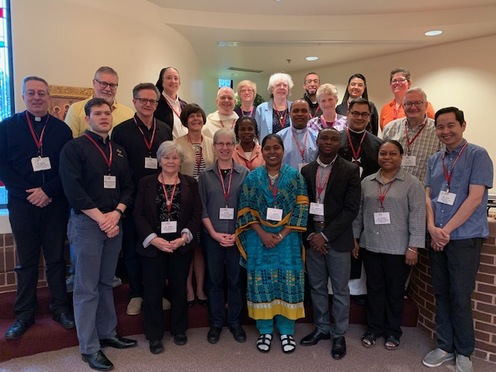
This foundational workshop is essential for all new and recently appointed vocation directors and teams. Its goal is to provide participants with the foundational skills, context, theory, challenges, and practicalities of contemporary vocation ministry. Topics will include accompaniment with inquirers, assessment of discerners; application and admission process, vocation promotion, canon law, boundaries, animating vowed membership, relevant resources, and research, along with resiliency and self-care of the vocation director.
Please note this five-day workshop begins on July 11 at 9:00 a.m. and ends on July 15 at 4:00 p.m. Central time. Overnight accommodations are included with arrivals after 3 pm on July 10 and departures before 9 am on July 16. Please note: If you are staying for the Ethics workshop, you will need to purchase an additional overnight for $115 in the online store.
Workshop fees include materials, speaker stipends, facility fees, all meals, and breaks. The workshop fee also includes overnight accommodations for 6 nights, arriving after 3:00 p.m. on July 10 and checking out by 9:00 a.m. on July 16. If you do not need overnight accommodations, please contact margyelan@nrvc.net
NRVC member: $1,700 Non-member: $2,175
Become an NRVC member here to save on workshop fees.
Cancellations for workshops must be received in writing to dinasp@nrvc.net before June 30 to receive a full refund less a $100 processing fee. After June 30, all fees are non-refundable.
 Sister Deborah M. Borneman, SS.C.M. began working for the NRVC in 2011 and presently serves as the Director of Mission Integration. A Sister of Saints Cyril and Methodius, she previously served as vocation director for her community and on her congregational leadership team. Sr. Debbie has ministerial experience in pastoral care, youth ministry, college campus ministry, and immigration advocacy. She has presented on various topics in vocation ministry in Ireland and throughout the United States. Sr. Debbie holds a Master of Divinity degree and a Master of Arts Degree in Pastoral Studies (Loyola University, Chicago).
 Father Adam MacDonald, S.V.D. is a native of Flint, Michigan, and ordained for the Society of the Divine Word. Since 2011, Fr. Adam has served as a Vocation Director for his congregation. He previously served in the Philippines, on the Provincial Council for the Chicago Province, and as Vice-Provincial. Fr. Adam holds a Master of Divinity degree (Catholic Theological Union, Chicago) and a Certificate in Spiritual Direction from the Center for Spiritual Development, California. He currently serves on the NRVC National Board executive committee and has presented with the OP team since 2017.
Our annual Summer Institute will offer four onsite workshops at the Marillac Center, in Leavenworth, KS. The nearest airport is Kansas City (MCI) and ground transportation is available through Lyft, Uber, and Super Shuttle. Home of the Sisters of Charity of Leavenworth, the NRVC has long enjoyed this venue for workshops due to its spacious grounds, private rooms/bathrooms, wi-fi capacity, and hospitality. Because of current COVID restrictions, the workshops are limited to 23 participants each.
Eucharistic Liturgy for workshop participants will be offered each day at 8:00 a.m. in the Chapel. Each workshop includes communal prayer.
To assist NRVC members with their professional development, the Misericordia Scholarship Fund is available. Scholarship funds can be applied to NRVC workshops; however, they do not cover the cost of transportation, accommodations, meals, or personal expenses. If you need financial assistance to attend an NRVC workshop, please apply here.
Please read our NRVC terms and conditions for all events and programs.
There were lots of concrete, common sense examples - personal experiences which will stay with me as I journey with discerners. There was such a breadth of experience and a willingness to be vulnerable that it gives me the confidence I can do this. Each presenter was relatable and offered common sense and yet also provided sound advice on paths to avoid difficulties.
–--Sr. Mary Jones, O.P.
The wealth of information was incredibly helpful, particularly the concrete examples that the presenters were willing to share. The resources on the ethics of vocation ministry were very helpful.
I also really appreciated the attention given to self-care and entering into our own vocation story as a way of better ministering to others.
--Fr. Johnathan Turba, O. Praem.
This workshop was more than I expected. It gave a lot of food for thought and also action steps to move forward with vocation promotion in my diocese. I am forever grateful for the friendship found and the great opportunities to connect with others in the pastoral vineyard. It is with great hope I launch out into the deep. Special thanks to all the presenters and staff who made this possible.
--- Rev. Kenwyn Sylvester, Archdiocese of Port of Spain
The workshop truly exceeded my expectations. I learned a great deal of new knowledge; as a result, I can now implement new resources in my work as a Vocation Minister and then be a better companion for our current and future candidates. The presenters were well prepared, they gave us precise information, and real examples to explain each topic.
–--Sr. Maria Amador, P.C.M.
Workshops are designed from the NRVC curriculum for those who wish to deepen their understanding of the complex theological, spiritual, psycho-sexual, ethical, and diversity issues often present in contemporary vocation ministry. NRVC recommends that vocation ministers participate in ongoing educational opportunities to attend to their own vocation and faith formation to further develop their professional competencies.
Please contact Sr. Dina Bato, S.P. at dinasp@nrvc.net
This workshop provides vocation ministers and those who accompany discerners and candidates with a solid understanding of psychological well-being and psycho-sexual development to assist them in their efforts to adequately assess a candidate’s aptitude for leading a healthy and integrated celibate life. It includes the basic elements of human sexuality: the fundamental aspect of being human, the centrality of relationships and healthy intimacy, gender identity, sexual orientation, age-related developmental tasks, and the necessity of boundaries. Potentially negative impacts are also considered, e.g., technology and social media, addictive behaviors, and unhealthy sexual expression. Helping vocation ministers determine if candidates may be at high risk of potential sexual abuse of minors is also an important element in this workshop.
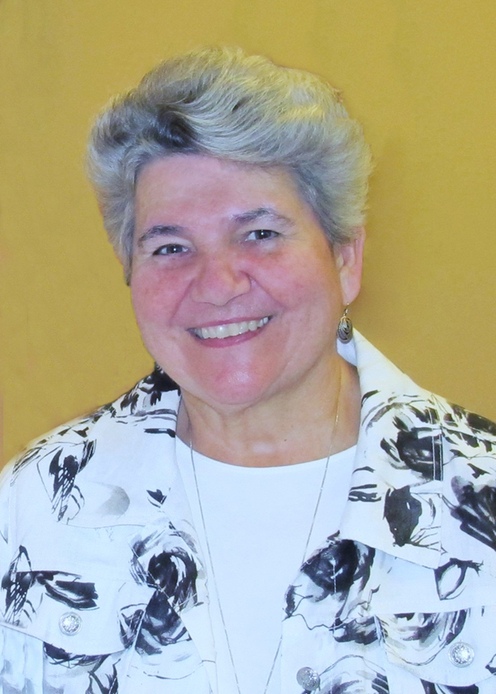 Sister Lynn Levo, C.S.J., Ph.D. is a member of the Sisters of St. Joseph of Carondelet, a licensed psychologist, consultant, and lecturer. She received her Ph.D. from the University of New York at Albany, completing her clinical training at The University of Kansas School of Medicine. After serving 12 years as the Director of Education and Editor of Lukenotes at Saint Luke Institute, Silver Spring, MD, Sister Lynn is currently a consulting psychologist in private practice, offering consultations, presentations, and workshops both in the U.S. and abroad on fostering healthy integrated sexuality, celibacy, relationships, intimacy, mutuality in community, and emotional intelligence. Sister Lynn received the NRVC Outstanding Recognition Award at Convocation 2016.
Our annual Summer Institute will offer four onsite workshops at the Marillac Center, Leavenworth, KS. The nearest airport is Kansas City (MCI) and ground transportation is available through Lyft, Uber, and Super Shuttle. Home of the Sisters of Charity of Leavenworth, the NRVC has long enjoyed this venue for workshops due to its spacious grounds, private rooms/bathrooms, wi-fi capacity, and hospitality.
To assist NRVC members with their professional development, the Misericordia Scholarship Fund is available. Scholarship funds can be applied to NRVC workshops; however, they do not cover the cost of transportation, accommodations, meals, or personal expenses. If you need financial assistance to attend an NRVC workshop, please apply here.
Please read our NRVC terms and conditions for all events and programs.
This workshop was excellent. The presenter was full of wisdom as well as authentic. She was very knowledgeable and easy to understand with her explanations, stories, and examples. Her points were clear.
–Sr. Kim Xuan Nguyen, CCVI
Every discerner I've encountered and accompanied, no matter how healthy, must address psycho-sexual matters to thrive in missionary and consecrated life. If Behavioral Assessment gives us the tools to know and understand our discerners better, "Psycho-Sexual Integration", empowers us as vocation ministers with sound lived/academic/theological understandings during the discernment process to help our discerners to thrive, whatever life path they choose. If I had to single out one thing among so many, I suppose I would name "Twelve opportunities for intimacy" -- a very enlightening overview that is useful for discerners who may assume that intimacy is just not possible without physical intimacy and/or exclusive friendships.
–Mr. Gregory Darr, Upper Midwest Member Area Coordinator
The presenter had great notes to accompany all she said, thus making it very easy to follow.
She used real-life examples to explain her points. She was compassionate and didn’t shy away from difficult topics. She knew her material well, yet she could break it down for us so we could all understand. She held our attention for three straight days - that alone is a feat!
--Sr. Colleen Mattingly, A.S.C.J.
Sr. Lynn Levo was wonderful. She was engaging, knowledgeable, and made things understandable and practical. She was open both in her sharing and in responding to our questions and input. This workshop exceeded my expectations, which were pretty high entering it! Many people told me about Sr. Lynn and they were right on. It was informative and well-organized.
–Fr. Joseph Narog, O.S.A.
Workshops are designed from the NRVC curriculum for those who wish to deepen their understanding of the complex theological, spiritual, psycho-sexual, ethical, and diversity issues often present in contemporary vocation ministry. NRVC recommends that vocation ministers participate in ongoing educational opportunities to attend to their own vocation, faith formation, and to further develop their professional competencies.
Please contact Sr. Dina Bato, S.P. at dinasp@nrvc.net
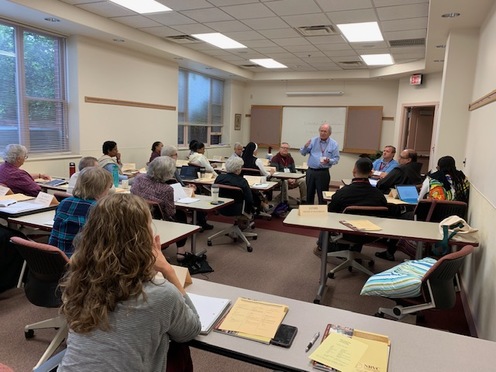
This workshop is designed to assist vocation ministers, congregational leaders, and vocation team members in understanding and articulating the basic ethical values, principles, and standards of vocation ministry. Topics include the ethical principles governing agency, confidentiality, and obligations related to positions of trust; dissemination of information; the timeliness of admissions or dismissal decisions; dual relationships; document disposition; the respect for human dignity, interculturality, and other issues related to ethical rights of candidates as well as ethical rights of those in positions of authority.
Please note this two-day workshop begins on July 18 at 9:00 a.m. and ends on July 19 at 4:00 p.m. Central time. Overnight accommodations are included with arrivals after 3 pm on July 17 and departures before 9 am on July 20. Please note: If you are attending the next workshop, you do not need to check out.
Workshop fees include materials, speaker stipends, facility fees, all meals, and breaks. The workshop fee also includes overnight accommodations for 3 nights, arriving after 3:00 p.m. on July 17 and checking out by 9:00 a.m. on July 20. If you do not need overnight accommodations, please contact margyelan@nrvc.net
NRVC member: $800 Non-member: $1,000
Become an NRVC member here to save on workshop fees.
Cancellations for workshops must be received in writing to dinasp@nrvc.net before June 30 to receive a full refund less a $100 processing fee. After June 30, all fees are non-refundable.
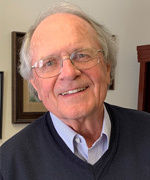 Reverend Raymond P. Carey, Ph.D. is a priest of the Archdiocese of Portland, OR. He has taught at both the secondary and university levels and presently teaches at Mount Angel Seminary Graduate School of Theology in Saint Benedict, Oregon. Fr. Carey holds a doctorate in clinical psychology from the University of Ottawa, Canada. He has presented workshops in North America, Europe, Australia, New Zealand, and Fiji. He is a recipient of the NRVC Harvest Award and a Lifetime NRVC member for his work in service of vocation ministry.
Our annual Summer Institute will offer four onsite workshops at the Marillac Center, Leavenworth, KS. The nearest airport is Kansas City (MCI) and ground transportation is available through Lyft, Uber, and Super Shuttle. Home of the Sisters of Charity of Leavenworth, the NRVC has long enjoyed this venue for workshops due to its spacious grounds, private rooms/bathrooms, wi-fi capacity, and hospitality. Because of current COVID restrictions, the workshops are limited to 23 participants each.
Eucharistic Liturgy for workshop participants will be offered each day at 8:00 a.m. in the Chapel. Each workshop includes communal prayer.
To assist NRVC members with their professional development, the Misericordia Scholarship Fund is available. Scholarship funds can be applied to NRVC workshops; however, they do not cover the cost of transportation, accommodations, meals, or personal expenses. If you need financial assistance to attend an NRVC workshop, please apply here.
Please read our NRVC terms and conditions for all events and programs.
This workshop exceeded my expectations. I thought that it was going to be boring with information and that maybe it was not going to be helpful, but I can say that it was great. I got the tools and knowledge that I need to put into practice! God bless NRVC!
–Fr. Victor Patricio, O.M.I.
I am required to take ethics courses every two years to maintain my LSW license. I have taken a lot of ethics courses over the years. I thought this was the clearest course I have taken. Thank you!
Sr Carrie Christine Zagurskie, A.S.C.J.
I am in leadership and because of the reports we receive when people are applying for vows, I was interested in the content of this program. There are three times that we can assess suitability (before entrance, temporary vows, final vows) and I wanted more content to be better able to make the assessment.
–Sister Marie Ursino, S.H.C.J., ministering in Rome, Italy
The workshop provided a framework and language to assist in thinking about ethical issues. The many stories/ examples were helpful. I feel much clearer about ethical issues and will use this knowledge in my ministry as a formation coordinator.
–Sr. Lynn Mousel, C.H.M.
Workshops are designed from the NRVC curriculum for those who wish to deepen their understanding of the complex theological, spiritual, psycho-sexual, ethical, and diversity issues often present in contemporary vocation ministry. NRVC recommends that vocation ministers participate in ongoing educational opportunities to attend to their own vocation, faith formation, and to further develop their professional competencies.
Please contact Sr. Dina Bato, S.P. at dinasp@nrvc.net
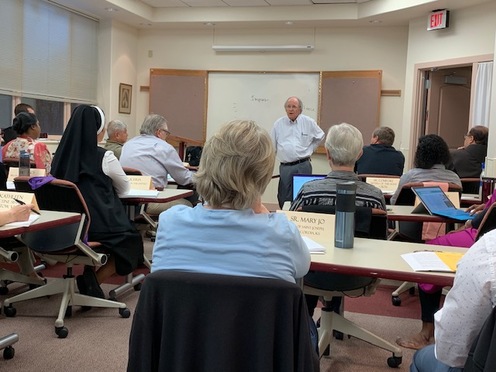
This foundational workshop teaches practical interviewing techniques in a theoretical framework of behavioral assessment. While the focus is on the initial assessment of candidates, the methodology is readily adapted to assessing candidates in other stages of formation. Interview topics include family background, educational and occupational histories, psychosexual histories and intimacy skills, faith history, Catholic practices, and other pertinent issues related to comprehensive vocation assessment.
Please note this three-day workshop begins on July 21 at 9:00 a.m. and ends on July 23 at 4:00 p.m. Central time. Overnight accommodations are included with arrivals after 3 pm on July 20 and departures before 9 am on July 24.
Workshop fees include materials, speaker stipends, facility fees, all meals, and breaks. The workshop fee also includes overnight accommodations for 4 nights, arriving after 3:00 p.m. on July 20 and checking out by 9:00 a.m. on July 24. If you do not need overnight accommodations, please contact margyelan@nrvc.net
NRVC member: $1,100 Non-member: $1,390
Become an NRVC member here to save on workshop fees.
Cancellations for workshops must be received in writing to dinasp@nrvc.net before June 30 to receive a full refund less a $100 processing fee. After June 30, all fees are non-refundable.
 Reverend Raymond P. Carey, Ph.D. is a priest of the Archdiocese of Portland, OR. He has taught at both the secondary and university levels and presently teaches at Mount Angel Seminary Graduate School of Theology in Saint Benedict, Oregon. Fr. Carey holds a doctorate in clinical psychology from the University of Ottawa, Canada. He has presented workshops in North America, Europe, Australia, New Zealand, and Fiji. He is a recipient of the NRVC Harvest Award and is recognized as a Lifetime NRVC member for his significant work in service of vocation ministry.
Our annual Summer Institute will offer four onsite workshops at the Marillac Center, in Leavenworth, KS. The nearest airport is Kansas City (MCI) and ground transportation is available through Lyft, Uber, and Super Shuttle. Home of the Sisters of Charity of Leavenworth, the NRVC has long enjoyed this venue for workshops due to its spacious grounds, private rooms/bathrooms, wi-fi capacity, and hospitality. Because of current COVID restrictions, the workshops are limited to 23 participants each.
Eucharistic Liturgy for workshop participants will be offered each day at 8:00 A.M. in the Chapel. Each workshop includes communal prayer.
To assist NRVC members with their professional development, the Misericordia Scholarship Fund is available. Scholarship funds can be applied to NRVC workshops; however, they do not cover the cost of transportation, accommodations, meals, or personal expenses. If you need financial assistance to attend an NRVC workshop, please apply here.
Please read our NRVC terms and conditions for all events and programs.
The most helpful insight for me was the importance of focusing on behavior/data and asking questions that provoke conversation about behavior and not just thoughts or ideas about something.
--Fr. Scott Surrency, O.F.M. Cap.
Fr. Ray is direct, clear, and provides depth through his stories. He tackles tough questions. He is so clear and gives salient examples. I do not have enough superlatives to describe his attributes, skills, and knowledge.
--Sr. Marie Mackey, C.S.J.Father Ray is an excellent presenter. I would attend any of his workshops and recommend him to others. Thank you!
---Brother Timothy Cahill, C.PP.S.
The workshop met my expectations in learning how to assess candidates to religious life and how to address sensitive areas as well as in gaining knowledge and a sense of what can raise a "red flag" in my interviews with candidates.
--Sr. Inga Kvassayova, ISMM
Workshops are designed from the NRVC curriculum for those who wish to deepen their understanding of the complex theological, spiritual, psycho-sexual, ethical, and diversity issues often present in contemporary vocation ministry. NRVC recommends that vocation ministers participate in ongoing educational opportunities to attend to their own vocation, faith formation, and to further develop their professional competencies.
Please contact Sr. Dina Bato, S.P. at dinasp@nrvc.net
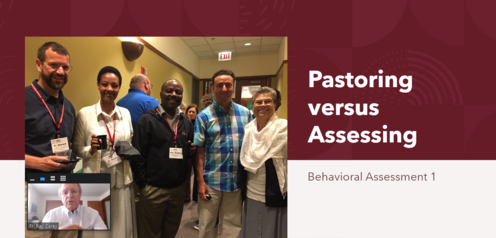
This virtual workshop teaches practical interviewing techniques in a theoretical framework of behavioral assessment. While the focus is on the initial assessment of candidates, the methodology is readily adapted to assessing candidates in other stages of formation. Interview topics include family background, educational and occupational histories, psychosexual histories and intimacy skills, faith history, Catholic practices, and other pertinent issues related to comprehensive vocation assessment.
Please note this three-day workshop begins on October 17 at 9:30 a.m. and ends on October 19 at 3:30 p.m. Central Daylight Time (CDT) U.S. There is a 60-minute break from noon - 1:00 p.m. Central Daylight Time (CDT) U.S. Workshop folders will be mailed to participants at least two weeks before the workshop begins.
Please note: This workshop is not recorded to allow the presenter and participants the opportunity to speak authentically in a learning community. Personal recording is prohibited.
Workshop fees include materials, speaker stipends, and postage.
NRVC member: $ 655 Non-member: $ 932
Become an NRVC member here to save on workshop fees.
Register for this workshop in our online store.
Cancellations for workshops must be received in writing to dinasp@nrvc.net. After October 1, all fees are non-refundable.
Reverend Raymond P. Carey, Ph.D. is a priest of the Archdiocese of Portland, OR. He has taught at both the secondary and university levels and presently teaches at Mount Angel Seminary Graduate School of Theology in Saint Benedict, Oregon. Fr. Carey holds a doctorate in clinical psychology from the University of Ottawa, Canada. He has presented workshops in North America, Europe, Australia, New Zealand, and Fiji. He is a recipient of the NRVC Harvest Award and is recognized as a Lifetime NRVC member for his significant work in service of vocation ministry.
To assist NRVC members with their professional development, the Misericordia Scholarship Fund is available. Scholarship funds can be applied to NRVC workshops; however, they do not cover the cost of transportation, accommodations, meals, or personal expenses. If you need financial assistance to attend an NRVC workshop, please apply here.
Please read our NRVC terms and conditions for all events and programs.
The most helpful insight for me was the importance of focusing on behavior/data and asking questions that provoke conversation about behavior and not just thoughts or ideas about something.
--Fr. Scott Surrency, O.F.M. Cap.
Fr. Ray is direct, clear, and provides depth through his stories. He tackles tough questions. He is so clear and gives salient examples. I do not have enough superlatives to describe his attributes, skills, and knowledge.
--Sr. Marie Mackey, C.S.J.Father Ray is an excellent presenter. I would attend any of his workshops and recommend him to others. Thank you!
---Brother Timothy Cahill, C.PP.S.The workshop met my expectations in learning how to assess candidates to religious life and how to address sensitive areas as well as in gaining knowledge and a sense of what can raise a "red flag" in my interviews with candidates.
--Sr. Inga Kvassayova, ISMM
Workshops are designed from the NRVC curriculum for those who wish to deepen their understanding of the complex theological, spiritual, psycho-sexual, ethical, and diversity issues often present in contemporary vocation ministry. NRVC recommends that vocation ministers participate in ongoing educational opportunities to attend to their own vocation, faith formation, and to further develop their professional competencies.
Please contact Sr. Dina Bato, S.P. at dinasp@nrvc.net

You are invited to join an online conversation on March 9, 6-7 pm CT, co-hosted by the NRVC and A Nun's Life Ministry. Entitled "Let's talk about it! Asking the questions, living into the answers," is an annual event starting with a few ice-breaker questions before moving into breakout rooms to treat more significant and meaningful questions. The intention is to find signs of hope through conversation and revitalizing interaction. All are welcome to this 60-minute lively interaction to celebrate Catholic Sisters Week.
What are some of the questions posed? Here's a sampling:
To participate, please register here for the Zoom link.
For questions, please contact debbiesscm@nrvc.net
The NRVC is bringing back its popular "Talk it up Tuesdays," beginning Tuesday February 21. These 60-minute Zoom gatherings are designed for NRVC members to learn together, talk together, and share ideas. Topics and presenters are listed on the NRVC website here.
Published on: 2023-02-01
Edition: February 2023 newsletter
In January the NRVC was awarded a grant by the GHR Foundation to enhance the use of data collected in its 2020 study and to use the study’s information to articulate the viability and importance of religious life. The grant is meant to aid vocation ministers, discerners, and the larger church. Among its goals is to create a user-friendly, online map to give details about religious institutes in a given geographic area. Follow this newsletter to learn more as projects related to the grant take shape.
Published on: 2023-02-01
Edition: February 2023 newsletter
If you have not yet seen our convocation presentations (which had a theme of "Call Beyond Borders"), check them out now on the NRVC YouTube channel: youtube.com/NatRelVocationConf. You might remember that the presenters were:
Members can also download discussion guides for each presentation, available in the members-only section of NRVC.net under Member toolbox.
Published on: 2023-06-27
Edition: July 2023 newsletter

The process leading up to the 2018 synod on Youth, Faith, and Vocational Discernment was full of energy. It saw young people from around the world mingling with cardinals, and bishops taking coffee with 20-somethings. This exchange of experiences and ideas led to rich reflection in Christus Vivit (Christ is Alive), the apostolic exhortation that emerged from the synod. The document covers many areas, and one of its strong themes is to encourage church ministers to be present to young people and to provide accompaniment as they navigate their path in life. HORIZON presents here excerpts from Christus Vivit that treat this theme.
YOUNG PEOPLE NEED to have their freedom respected, yet they also need to be accompanied. The family should be the first place of accompaniment. Youth ministry can present the ideal of life in Christ as the process of building a house on rock (Matt. 7:24-25). For most young people, that house, their life, will be built on marriage and married love. That is why youth ministry and the pastoral care of families should be coordinated and integrated, with the aim of ensuring a continuous and suitable accompaniment of the vocational process.
The community has an important role in the accompaniment of young people; it should feel collectively responsible for accepting, motivating, encouraging, and challenging them. All should regard young people with understanding, appreciation, and affection and avoid constantly judging them or demanding of them a perfection beyond their years.
At the synod, “many pointed to the shortage of qualified people devoted to accompaniment. Belief in the theological and pastoral value of listening entails rethinking and renewing the ways that priestly ministry is ordinarily exercised, and reviewing its priorities. The synod also recognized the need to train consecrated persons and laypeople, male and female, to accompany young people. The charism of listening that the Holy Spirit calls forth within the communities might also receive institutional recognition as a form of ecclesial service” [from the synod’s final document].
There is also a special need to accompany young men and women showing leadership potential, so that they can receive training and the necessary qualifications. The young people who met before the synod called for “programs for the formation and continued development of young leaders. Some young women feel that there is a lack of leading female role models within the church and they too wish to give their intellectual and professional gifts to the church. We also believe that seminarians and religious should have an even greater ability to accompany young leaders.”
The same young people described to us the qualities they hope to find in a mentor, and they expressed this with much clarity: “The qualities of such a mentor include being a faithful Christian who engages with the church and the world, someone who constantly seeks holiness, someone who is a confidant without judging. Similarly, someone who actively listens to the needs of young people and responds in kind; someone deeply loving and self-aware; someone who recognizes his or her limits and knows the joys and sorrows of the spiritual journey. An especially important quality in mentors is the acknowledgement of their own humanity—the fact that they are human beings who make mistakes, not perfect people but forgiven sinners. Sometimes mentors are put on a pedestal, and when they fall, it may have a devastating impact on young people’s ability to continue to engage with the church.
“Mentors should not lead young people as passive followers, but walk alongside them, allowing them to be active participants in the journey. They should respect the freedom that comes with a young person’s process of discernment and equip them with tools to do so well. A mentor should believe wholeheartedly in a young person’s ability to participate in the life of the church. A mentor should therefore nurture the seeds of faith in young people, without expecting to immediately see the fruits of the work of the Holy Spirit. This role is not and cannot be limited to priests and [those in] consecrated life, but the laity should also be empowered to take on such a role. All such mentors should benefit from being well-formed, and engage in ongoing formation” [from the document of the pre-synod gathering with young people].
The church’s educational institutions are undoubtedly a communal setting for accompaniment; they can offer guidance to many young people, especially when they “seek to welcome all young people, regardless of their religious choices, cultural origins and personal, family or social situations. In this way, the church makes a fundamental contribution to the integral education of the young in various parts of the world” [from the synod’s final document]. They would curtail this role unduly were they to lay down rigid criteria for students to enter and remain in them, since they would deprive many young people of an accompaniment that could help enrich their lives.
If we are indeed convinced that the Holy Spirit continues to inspire vocations to the priesthood and the religious life, we can “once more cast out the nets” in the Lord’s name, with complete confidence. We can dare, as we should, to tell each young person to ask whether this is the path that they are meant to follow.
Occasionally, I would bring this up with young people, and they would respond almost jokingly: “No, that’s not for me!” Yet, a few years later, some of them were in the seminary. The Lord cannot fail in his promise to provide the church with shepherds, for without them she would not be able to live and carry out her mission. If it is true that some priests do not give good witness, that does not mean that the Lord stops calling. On the contrary, he doubles the stakes, for he never ceases to care for his beloved church.
There are many priests, men and women religious, lay and professional persons, and indeed qualified young people, who can help the young with their vocational discernment. When we are called upon to help others discern their path in life, what is uppermost is the ability to listen. Listening calls for three distinct and complementary kinds of sensitivity.
The first kind of sensitivity is directed to the individual. It is a matter of listening to someone who is sharing his very self in what he says. A sign of this willingness to listen is the time we are ready to spare for others. More than the amount of time we spend, it is about making others feel that my time is their time, that they have all the time they need to say everything they want. The other person must sense that I am listening unconditionally, without being offended or shocked, tired, or bored. We see an example of this kind of listening in the Lord; he walks alongside the disciples on the way to Emmaus, even though they are going in the wrong direction (Luke 24:13-35). When Jesus says he plans to go farther, they realize that he has given them the gift of his time, so they decide to give him theirs by offering their hospitality. Attentive and selfless listening is a sign of our respect for others, whatever their ideas or their choices in life.
The second kind of sensitivity is marked by discernment. It tries to grasp exactly where grace or temptation is present, for sometimes the things that flit across our minds are mere temptations that can distract us from our true path. I need to ask myself what is it that the other person is trying to tell me, what they want me to realize is happening in their lives. Asking such questions helps me appreciate their thinking and the effects it has on their emotions. This kind of listening seeks to discern the salutary promptings of the good Spirit who proposes to us the Lord’s truth, but also the traps laid by the evil spirit—his empty works and promises. It takes courage, warmth, and tact to help others distinguish the truth from illusions or excuses.
The third kind of sensitivity is the ability to perceive what is driving the other person. This calls for a deeper kind of listening, one able to discern the direction in which that person truly wants to move. Apart from what they are feeling or thinking right now, and whatever has happened up to this point in their lives, the real issue is what they would like to be. This may demand that they look not to their own superficial wishes and desires, but rather to what is most pleasing to the Lord, to his plans for their life. And that is seen in a deeper inclination of the heart, beyond the surface level of their likes and feelings. This kind of listening seeks to discern their ultimate intention, the intention that definitively decides the meaning of their life. Jesus knows and appreciates this ultimate intention of the heart. He is always there, ready to help each of us to recognize it. We need but say to him: “Lord, save me! Have mercy on me!”
In this way, discernment becomes a genuine means of spiritual combat, helping us to follow the Lord more faithfully. The desire to know our personal vocation thus takes on a supreme intensity, a different quality and higher level, one that better respects the dignity of our person and our life. In the end, good discernment is a path of freedom that brings to full fruit what is unique in each person, something so personal that only God knows it. Others cannot fully understand or predict from the outside how it will develop.
When we listen to others in this way, at a certain moment we ourselves have to disappear in order to let the other person follow the path he or she has discovered. We have to vanish as the Lord did from the sight of his disciples in Emmaus, leaving them alone with burning hearts and an irresistible desire to set out immediately (Luke 24:31-33). When they returned to the community, those disciples heard the good news that the Lord was indeed risen (Luke 24:34).
Because “time is greater than space,” [as noted in Evangelii Gaudium] we need to encourage and accompany processes, without imposing our own roadmaps. For those processes have to do with persons who remain always unique and free. There are no easy recipes, even when all the signs seem positive, since [as noted in Pastores Dabo Vobis] “positive factors themselves need to be subjected to a careful work of discernment, so that they do not become isolated and contradict one another, becoming absolutes and at odds with one another. The same is true for the negative factors, which are not to be rejected en bloc and without distinction, because in each one there may lie hidden some value which awaits liberation and restoration to its full truth.”
If you are to accompany others on this path, you must be the first to follow it, day in and day out. That is what Mary did, in her own youth, as she confronted her own questions and difficulties. May she renew your youthfulness by the power of her prayers and accompany you always by her maternal presence.
While Christus Vivit spells out the need for accompaniment and presence, it is also practical, with specific ideas about ways and places that the church can be present to young people.
PRAYER EXPERIENCES Many young people have come to appreciate silence and closeness to God. Groups that gather to adore the Blessed Sacrament or to pray with the word of God have also increased. We should never underestimate the ability of young people to be open to contemplative prayer. We need only find the right ways and means to help them embark on this precious experience.
When it comes to worship and prayer, [the synod’s final document notes], “in many settings, young Catholics are asking for prayer opportunities and sacramental celebrations capable of speaking to their daily lives through a fresh, authentic, and joyful liturgy.” It is important to make the most of the great moments of the liturgical year, particularly Holy Week, Pentecost, and Christmas. But other festive occasions can provide a welcome break in their routine and help them experience the joy of faith.
SERVICE OPPORTUNITIES Christian service represents a unique opportunity for growth and openness to God’s gifts of faith and charity. Many young people are attracted by the possibility of helping others, especially children and the poor. Often this service is the first step to a discovery or rediscovery of life in Christ and the church. Many young people grow weary of our programs of doctrinal and spiritual formation, and at times demand a chance to be active participants in activities that benefit others.
THE ARTS Nor can we overlook the importance of the arts, like theater, painting, and others. “Music is particularly important, representing as it does a real environment in which the young are constantly immersed, as well as a culture and a language capable of arousing emotion and shaping identity. The language of music also represents a pastoral resource with a particular bearing on the liturgy and its renewal” [from the synod’s final document]. Singing can be a great incentive to young people as they make their way through life. As Saint Augustine says: “Sing, but continue on your journey. Do not grow lazy, but sing to make the way more enjoyable. Sing, but keep going…. If you make progress, you will continue your journey, but be sure that your progress is in virtue, true faith, and right living. Sing then, and keep walking.”
SPORTS “Equally significant is the emphasis that young people place on sports; the church should not underestimate the potential of sports for education and formation, but instead maintain a strong presence there. The world of sport needs to be helped to overcome some of its problematic aspects, such as the idolization of champions, subservience to commercial interests and the ideology of success at any cost” [from the synod’s final document]. At the heart of the experience of sport is “joy: the joy of exercising, of being together, of being alive and rejoicing in the gifts the Creator gives us each day” [from an address to the International Special Olympics]. Some fathers of the church used the example of the training of athletes to encourage the young to develop their strength and to overcome idleness and boredom. Saint Basil the Great, writing to young people, used the effort demanded by athletics to illustrate the value of self-sacrifice as a means of growth in virtue: “These men endure sufferings beyond number, they use many means to build their strength, they sweat constantly as they train ... in a word, they so discipline themselves that their whole life prior to the contest is but a preparation for it... How then can we, who have been promised rewards so wondrous in number and in splendor that no tongue can recount them, even think of winning them if we do nothing other than spend our lives in leisure and make but half-hearted efforts?”
NATURE Nature holds a special attraction for many adolescents and young people who recognize our need to care for the environment. Such is the case with the scouting movement and other groups that encourage closeness to nature, camping trips, hiking, expeditions, and campaigns to improve the environment. In the spirit of Saint Francis of Assisi, these experiences can be a real initiation into the school of universal fraternity and contemplative prayer.
POPULAR PIETY Various manifestations of popular piety, especially pilgrimages, attract young people who do not readily feel at home in ecclesial structures and represent a concrete sign of their trust in God. These ways of seeking God are seen particularly in young people who are poor, but also those in other sectors of society. They should not be looked down on, but encouraged and promoted. Popular piety [as noted in the synod’s final document] “is a legitimate way of living the faith” and “an expression of the spontaneous missionary activity of the People of God.”
§ § § § §
These and various other opportunities for evangelizing the young should not make us forget that, despite the changing times and sensibilities of young people, there are gifts of God that never grow old, for they contain a power transcending all times and places. There is the word of the Lord, ever living and effective, the nourishing presence of Christ in the Eucharist, and the sacrament of Reconciliation, which brings us freedom and strength. We can also mention the inexhaustible spiritual riches preserved by the church in the witness of her saints and the teaching of the great spiritual masters. Although we have to respect different stages of growth, and at times need to wait patiently for the right moment, we cannot fail to invite young people to drink from these wellsprings of new life. We have no right to deprive them of this great good.
This article is excerpted from the apostolic exhortation Christus Vivit, which may be found at vatican.va in the Apostolic Exhortation section. Reprinted with permission © Libreria Editrice Vaticana.
“Accompaniment for discernment,” by Colleen Campbell and Thomas Carani, HORIZON, Winter 2020.
Published on: 2022-07-28
Edition: 2022 HORIZON No. 3 Summer, Volume 47

IN MAY 2021 HORIZON asked the members of the National Religious Vocation Conference to answer one question: What do you wish your community’s membership understood about vocation ministry?
Most responses fell into these three categories.
1) Vocation presence, awareness, and invitation is everyone’s responsibility. This was by far the most common response.
2) Vocation ministry is a sacred, complex, and time-consuming ministry that deserves to be full-time because at heart it is about the slow process of building relationships. This type of more nuanced observation about the important nature and complexities of the ministry was the second most common response.
3) Vocation ministry is an important ministry to young adults, a service to them and to the wider church. Its focus is on helping young people discern their life’s calling. Entrance to our religious community or another is not the measure of this ministry’s value. This response was the third most common in the survey.
Following are comments from respondents, none of whom are identified here so that readers might appreciate the larger truth in their words; many survey respondents were talking about larger issues that affect all communities, not just their own. The National Religious Vocation Conference thanks all who took part in the survey. Their dedication and wisdom shine through, along with their love for their communities and for the young people they feel privileged to accompany.
• Vocation ministry is the responsibility of all of us, not just the responsibility of the vocation minister or vocation committee.
• We truly rely on membership for relational connections, for vocation outreach. We deeply need members’ engagement and intentionality in creating a culture of vocation and invitation.
• We can go to any number of events, but when I look at who came to our online events this past year and who tends to stay most in contact, often they are women who have a connection with one of our sisters or one of our ministries, or they come to us referred by someone with one of these connections.
Sisters often feel in their retirement years that they don’t have many connections to young people anymore, but everyone has a relational network that can help build goodwill and awareness of our community and its charism. We never know when or where this will have a vocational impact!
• Ongoing recruitment is not just the responsibility of the officially assigned vocation director but must be the welcomed task of each and every member.
• All members need to be involved, especially by their faithful living of our vows and community relationships.
• It is important that everyone is welcoming.
• Every single one of us is part of the vocation ministry team. It is through unique personal witness, joined with our communal witness, that women are inspired to “come and see.”
• Each member of the community should realize that we are all called to vocation ministry. All of our preaching, relationships, ministry, way of life, attitudes, etc. contribute directly or indirectly to attracting vocations. If people do not see us as joyful and fulfilled in our own vocations, they will never be attracted to join us.
• Vocation ministry is very time-consuming, especially following up with discerners and accompanying them on their journey.... Leadership does not understand the value of having the same sister (vocation director) consistently attend particular events. Consistency helps build relationships with the campus ministers and young adults they encounter.
• Not everyone is a good fit for our community. It is really hard when a vocation director has to say no to someone. Out of respect for the individual, the vocation director will not share personal information. This can feel very isolating, and the vocation director needs the community’s trust and support.
• It takes time, and the women who are seeking to be a sister today are of different ethnicities, races, and backgrounds than in the past.
• A lot of time and effort goes on behind the scenes that members do not know about. The conversations, the time spent, the building of relationships in the name of the community.
• We must think about vocation ministry differently than how it was done even just 25 years ago. Collaboration among communities and sensitivity toward a post-COVID world are musts.
• Vocation ministry assists in vocational discernment of all kinds, and it serves the wider church, not just our congregation.
• Vocation ministry is not about recruitment but about accompaniment. It’s not about simply getting more members to join the community but assisting and supporting young people in discovering their gifts, recognizing the needs of the world around them, and determining where they can most fully and authentically share their gifts in the service of others!
• Whether or not women or men enter, the vocation minister is meant to be walking with them to find their journey with God and how they are called to build the world in love.
• Just as we dedicate our lives to ending hunger, poverty, human trafficking, illiteracy, and so many other social sins, we are also called to accompany young Catholics who are seeking a deeper relationship with God and humanity. We don’t measure our ministry at the border by the number of people guaranteed a pathway to citizenship. It’s a ministry of presence and availability. Can we not approach vocation ministry from the same perspective?
• Vocation ministry is about supporting discernment of life choices; it is enlivened by a dynamic embrace of the whole of religious life.
• Often when speaking with teens and young adults, our conversations are one of the first times they feel really comfortable talking about deep, spiritual life issues. Our society doesn’t always encourage or provide a venue for these conversations. Many in my community get this, but we all forget sometimes!
• Vocation ministry is significant to all young people, not only those who eventually choose religious life.
Published on: 2021-08-02
Edition: 2021 HORIZON No. 3 Summer, Volume 46
The NRVC recently hosted the workshop "Navigating Uncertainty with Young People through Accompaniment" for over 100 participants. A recorded 90-minute presentation by Josh Packard of the Springtide Institute (dedicated to supporting youth ministry) is available on the NRVC YouTube channel for anyone interested in knowing more about what 18-to-25 year-old-Catholics say about their spiritual needs and what they seek from the church.
Published on: 2021-10-28
Edition: November 2021 newsletter
The NRVC board and staff recently met with Dr. Mylon Kirsky, founder and chief operating officer of Sidebar Education Consulting Group, for an Intercultural Development Inventory to assess the group’s level of intercultural competency. Each person received a one-on-one consultation to provide key insights and create an intercultural development plan. This initiative is part of the NRVC's strategic plan goal to "advance the field of intercultural vocation ministry" and to "engage the culturally diverse young church."
This process is funded partially through a Conrad N. Hilton Foundation grant to the NRVC to create sustainable solutions to challenges in the organizational structure and financial model needed to build for the future of NRVC.
Published on: 2021-10-28
Edition: November 2021 newsletter
On January 13, 8 p.m. Eastern Time, experienced diocesan vocation directors will present online "Creating a collaborative environment" for NRVC's third webinar in the series "Religious Life: Learn it! Love it! Live it!" This free, hour-long webinar will focus on working together with various sectors of the church to create a vocation culture and to invite young people to consider consecrated life. Presenting and taking live questions will be Father Guillermo Hernandez of the Diocese of Sacramento vocation office and Ana Bojorquez, of the Archdiocese of San Antonio, Texas vocation office. Also presenting (on video) will be Bishop Gary Janak and Sister Ana Cecilia Montalvo, F.Sp.S., both from the Archdiocese of San Antonio vocation office.
The Communicators for Women Religious is sponsoring a webinar December 7 on "Data you need to know for vocation communications," which will feature NRVC's Sister Charlene Herinckx, S.S.M.O., director of membership, and Carol Schuck Scheiber, publications editor for NRVC. The one-hour webinar, which will focus on learnings from the NRVC study in 2020, "Recent vocations to religious life," will include a presentation and Q-A. The cost is $25; registration and details are here.
Published on: 2021-11-29
Edition: December 2021 newsletter
The NRVC will be holding an in-person convocation November 3-6, 2022, in Spokane, Washington with a theme of “Call beyond borders.” Two keynoters will speak. One is Sister Barbara Reid, O.P., a New Testament scholar who is president of Catholic Theological Union in Chicago (CTU). The other is Father vănThanh Nguyễn, S.V.D., a professor of New Testament Studies and Francis X. Ford, M.M. chair of Catholic missiology at CTU. Additional details are at nrvc.net.
Published on: 2021-11-29
Wellsprings of support for vocations | March 3, 2022
Addressing parental concerns: Wisdom and advice | April 21, 2022
Call to Religious Life: New members stories | June 2, 2022
Share this flyer with your community and colleagues! Additional details are here. Registration ensures that you receive a link post-event to view the webinar session on-demand at a time convenient to you. The live webinar will combine pre-recorded material and a live Q&A.
The National Religious Vocation Conference, represented by the director of mission integration, Sister Deborah Borneman, SS.C.M., is part of a committee creating an educational video about fostering a vocation culture among U.S. Hispanic Catholics. NRVC members and staff involved with the video production are Sister Elizabeth Ann Guerrero, M.C.D.P., Brother Mark Motz, S.M., Brother Chris Patiño, F.S.C., Mrs. Carol Schuck Scheiber, and Sister Stephanie Spandl, S.S.N.D. The vocation video will be one of 28 videos to be published in 2022 by the United States Conference of Catholic Bishops as a follow-up to the V Encuentro, a synod-like process to address the needs of the U.S. Latino church.
Published on: 2021-12-28
Edition: January 2022 newsletter
Catholic Sisters Week is March 8-14, and as part of this celebration of women religious, the NRVC will co-host with A Nun's Life Ministry a special online conversation on March 9, from 6-7 p.m. Central Time. "Let's talk about it! Asking the questions, living into the answers" will begin with icebreaker questions and move into more serious topics.
Catholic Sisters Week is meant to call attention to the vibrant service and lifestyle of sisters. Find details and resources for your own commemoration here.
This workshop is intended for new and recently appointed vocation directors. Its goal is to provide participants with the skills, context, theory, challenges and practicalities of contemporary vocation ministry. Topics will include foundational elements of vocation ministry; assessment of inquirers and discerners; application and admission process; vocation promotion, ethics and boundaries, resiliency and self-care of the vocation director.
This online workshop will keep your attention with four dynamic presenters covering over 70 topics for new vocation ministers. Participant networking is encouraged throughout the workshop with small group breakout sessions. All workshop materials are mail to your home before the workshop begins.
Please note this five day workshop begins each day at 9:30 a.m. and ends at 3:30 p.m. Central time. There are 2 scheduled breaks along with a 60 minute lunch from noon to 1:00 p.m. (CT) to avoid screen fatigue.
NRVC member: $975 Non-member: $1400
Become an NRVC member here to save on workshop fees.
Register for this workshop by clicking here to access our online store.
Cancellations for workshops must be received in writing to debbiesscm@nrvc.net before June 30 to receive a full refund less a $100 processing fee. After June 30, all fees are non refundable.
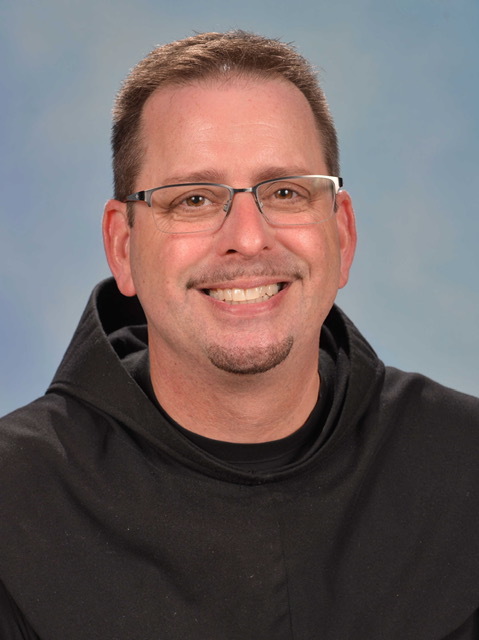 Brother Joseph Bach, O.S.F., is a Franciscan Brother of Brooklyn and currently ministers as Director of Vocations for his Congregation. Previously, he ministered in Education as a teacher and administrator on the elementary, secondary, and university levels. He holds a Master of Arts degree in Education from St. Xavier University, a graduate certificate in Franciscan Studies, and is currently completing a Post Master’s Certificate in Spiritual Formation at Boston College. He also studied at the Institute for Black Catholic Studies at Xavier University of Louisiana. Brother Joseph also serves as one of the NRVC Hudson Valley Member Area Coordinators and serves on the Council of Religious for the Diocese of Brooklyn.
Sister Deborah M. Borneman, SS.C.M. began working for the NRVC in 2011 and presently serves as the Director of Mission Integration. A Sister of Saints Cyril and Methodius, she previously served 10 years as vocation director for her community and on her congregational leadership team. Sr. Debbie has previous ministerial experience in pastoral care, youth ministry, college campus ministry and immigration advocacy. She has presented on various topics in vocation ministry in Ireland and throughout the United States. Sr. Debbie holds a Master of Divinity degree and a Master of Arts Degree in Pastoral Studies (Loyola University, Chicago).
 Brother John Eustice, C.S.V. is a Viatorian brother and has been involved in vocation ministry since 2014. He has served has as Coordinator of Vocation Ministry for five years. Br. John has an undergraduate degree in education from UNLV and holds a Master of Arts in Pastoral Studies from Loyola University, Chicago. He has served as a youth and young adult campus minister, a parish pastoral associate in Central America, and most recently, a high school administrator of mission and identity. Br. John is currently a full-time student in the Master of Divinity ordination program at Catholic Theological Union, Chicago.
Father Adam MacDonald, S.V.D. is a native of Flint, Michigan and ordained for the Society of the Divine Word. Since 2011, Fr. Adam has served as a Vocation Director for his congregation. He previously served in the Philippines, on the Provincial Council for the Chicago Province and as Vice-Provincial. Fr. Adam holds a Master of Divinity degree (Catholic Theological Union, Chicago) and a Certificate in Spiritual Direction from the Center for Spiritual Development, California. He currently serves on the NRVC National Board executive committee and has previously served on the NRVC Editorial Board and the Vocation Ambassador Design team.
To assist NRVC members with their professional development, the Misericordia Scholarship Fund is available. Scholarship funds can be applied to NRVC workshops; however, they do not cover the cost of transportation, accommodations, meals or personal expenses. If you need financial assistance to attend an NRVC workshop, please apply here.
Please read our NRVC terms and conditions for all events and programs.
I found the whole program very helpful. I appreciated the different perspectives from the speakers and the variety of examples provided. Learning about setting boundaries and the specifics about psychological testing and assessment especially helpful. I found all the presenters competent and engaging. Thank You! I didn't have a clue as to what I didn't know - things vital to my role as vocation director.
–--Sister Vickie Griner, osc
I appreciated that this workshop did not so much focus on "strategies" for recruitment as it did in "building up" our identity as vocation ministers. I also appreciated our reflections on Pope Francis's Christus Vivit. The people we minister to or we are seeking really are seeking God. There is a great desire and yearning among these sheep of God's flock to find the pasture that He calls each of them to. So, in a way, vocation ministry is an answer to a deep need to discover God's call. It is not as mechanical and business-like as it is sometimes made out to be.
--- Br. Daniele Caglioni, A.A.
Being a layperson and new to vocation ministry, I found all aspects of the program helpful. The materials and small group conversation gave me a better understanding of vowed life and the complex role of the vocation director. I was pleasantly surprised at how effective and enjoyable this online format can be. I’ve always preferred traditional classroom settings but after participating in this program I wouldn’t hesitate to sign up for this format again. It was so well done. This workshop definitely exceeded my expectations. Thank you!
–Ms. Kathryn Davis for the Congregation of Bon Secours.
Workshops are designed from the NRVC three-component curriculum for those who wish to deepen their understanding of the complex theological, spiritual, psycho-sexual, ethical, and diversity issues often present in contemporary vocation ministry. NRVC recommends that vocation ministers participate in ongoing educational opportunities to attend to their own vocation, faith formation, and to further develop their professional competencies. Please read the terms and conditions of all NRVC programs and events.
Please contact Sr. Deborah Borneman, SS.C.M. at debbiesscm@nrvc.net
To further our understanding of youth and young adult ministry leadership, the NRVC is collaborating with Ministry Training Source to support a research project that is beginning this month. The Ministry Training Source, under the leadership of Dr. Charlotte McCorquodale, is studying youth and young adult ministry leaders. Dr. McCorquodale was a presenter at a 2019 NRVC workshop on accompaniment and discernment.
Published on: 2021-11-01
Edition: November 2021 newsletter
The National Catholic Youth Conference, a biennial gathering of over 10,000 high school teens, parents, and youth ministers, will take place November 18-20, 2021 in Indianapolis. Sponsored by the National Federation for Catholic Youth Ministry, the theme this year will be "Ablaze–Enciende el Fuego." NRVC is not sponsoring the Nook gathering space this year. However, religious communities will be taking part, and volunteers will be needed. Learn more here.
Published on: 2021-09-28
Join us Wednesday, Nov. 17 at 8 p.m. ET to explore “Using all avenues to support vocation ministry.” Two seasoned vocation directors will present on effective programs and strategies for reaching prospective candidates. Father Tom McCarthy, O.S.A. and Sister Donna Del Santo, S.S.J. are the presenters. Short presentations will be followed by a live Q&A with participants. The webinar is free, but you must register to participate or to receive a video-on-demand link following the session. Download a flyer; click here to register. Funded by the GHR Foundation.
Save the date for a January 13 evening webinar on collaboration in vocation ministry!
Published on: 2021-09-29
Updated on: 2021-10-27
Note to Registrants: you will be sent a reminder email with Zoom link Thursday morning. Not registered yet? Please register now. Then tune in on Sept. 30, 2021 at 8 pm Eastern/7 pm CT/ 6 pm MT/ 5pm PT for our webinar "Fundamentals: from call to charism to community living" for insight on religious life today. The format is simple, four outstanding speakers will share their insights and then welcome questions from participants. The webinar will run one hour. It is free, but you must register to participate or to receive an on-demand link following the session. This is the first of six webinars, available thanks to the generosity of the GHR Foundation. Learn more here.
Members of NRVC have the opportunity to take part for free in a $100 online workshop on October 19, 2-3:30 p.m., entitled “Navigating Uncertainty with Young People through Accompaniment,” by Josh Packard of Springtide Research Institute. This workshop will address ways to build trust and minister to young people during this period of economic, social, and health unknowns. NRVC members can register at no cost for this virtual workshop (which includes a link to watch a pre-recorded session and a link for a live session.) Go to the NRVC store and indicate you will pay by check not credit card. The workshop fee for non-members is $100; payment by credit card is appreciated.
Published on: 2021-07-30
Edition: 2021 August newsletter
In July the NRVC completed another successful Summer Institute, helping 175 people from 12 countries receive education in vocation ministry and take part in valuable ministry support and networking. The four workshops included 22 guests from the National Conference of Vicars for Religious, the Association of Latin American Missionary Sisters/Asociación de Hermanas Latinas Misioneras en America, the National Black Sisters Conference, Vocations Ireland, and the National Association for Vocation and Formation Directors in Canada. Thank you to the Conrad N. Hilton Foundation, whose generosity allowed the NRVC to invite guests.
Published on: 2021-07-30
The newest edition of HORIZON, which is in the mail and online, presents thoughtful analysis, reflection, and advice on skills and practices for well-being. It takes up the topic at both a communal and personal level. Among this edition’s treasures are ideas for cultivating a strong communal life by Brother Seán Sammon, F.M.S. Brief but powerful words of hope for the future are provided by Brother Joseph Bach, O.S.F.
Published on: 2021-07-30
Edition: 2021 August newsletter
With National Vocation Awareness Week happening Nov. 7-13, this is the perfect time to stock up on infographic handouts. These colorful 8.5-by-11-inch sheets pack in all the most important messages from our 2020 Study Of Recent Vocations To Religious Life. Update and inspire your community and the public. Download the handout here in Spanish or English. Order them in packets of 50, printed in full color, here.
Published on: 2021-08-26
Avail yourself of NRVC’s premier resource for those considering consecrated life: VISION Vocation Guide, online and in print. Use the weblink vocationnetwork.org. Give out bookmarks with the link. Order print copies and bookmarks here. It’s also not too late to place an online ad!
Published on: 2021-08-27
Edition: September 2021 newsletter
The National Dialogue on Catholic Pastoral Ministry with Youth and Young Adults, which involved extensive gatherings of people involved in youth or young adult ministry, reaffirmed the need for broad vocation guidance and also shed light on the complex reality of what young people are experiencing and what they ask of the church. The NRVC was extensively involved the three year process. In other news, COVID-19 appears to have slightly diminished religious and diocesan seminarian numbers in the past last year.
Published on: 2021-08-27
Edition: September 2021 newsletter
Consecrated life runs in the family for Sister Jill Reuber, O.S.B. She's a triplet, with one of her sisters belonging to another Benedictine community. Find out what ideas for vocations are working for Sister Jill these days as she walks with women considering life as a Ferdinand, Indiana Benedictine. Read more...
Published on: 2021-08-27
Edition: September 2021 newsletter
Due to the global pandemic and the uncertainty of how the virus continues to spread and affect our lives, our biennial Fall Institute will be offered live through the Zoom platform. Join us in the comfort of your home, no hassles with travel or packing, just time to enjoy learning from experienced presenters who will engage participants with a reasonable schedule integrated with screen breaks, October 5-19. Don’t postpone, register today through the NRVC store for this outstanding opportunity for learning, support, and networking.
Behavioral Assessment 2—October 5-6, 9:30 - 3:00 CT
Behavioral Assessment 1—October 8-10, 9:30 - 3:00 CT
Orientation Program for New Vocation Directors— October 12-16, 9:30 - 3:30 CT
Navigating Uncertainty with Young People through Accompaniment—October 19
Published on: 2021-05-27
Updated on: 2021-08-26
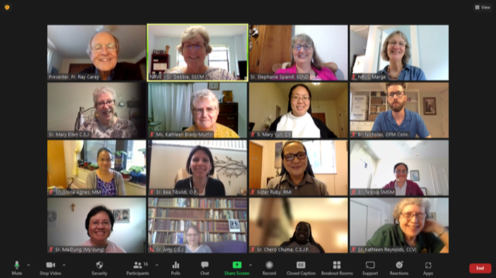
This workshop conducted via Zoom will explore ethical principles governing confidentiality, agency and obligations related to positions of trust. The workshop will also address issues related to dissemination of information, the timeliness of admissions or dismissal decisions, and other issues related to ethical rights of candidates as well as ethical rights of those in positions of authority. This workshop is essential for all those who make decisions concerning the admission of candidates.
Please note this two day workshop begins each day at 9:30 a.m. and ends at 3:00 p.m. Central time. There are 2 scheduled breaks along with a 60 minute lunch from 11:30 - 12:30 (CT) to avoid screen fatigue. All workshop materials are mail to your home before the workshop begins.
NRVC member: $450 $625 Non-member
Become an NRVC member here for reduced workshop rates.
Register for this workshop by clicking here to access our online store.
Cancellations for workshops must be received in writing to debbiesscm@nrvc.net before June 30 to receive a full refund less a $100 processing fee. After June 30, all fees are non refundable.
Reverend Raymond P. Carey, Ph.D. is a priest of the Archdiocese of Portland, OR. He has taught at both the secondary and university levels, and presently teaches at Mount Angel Seminary Graduate School of Theology in Saint Benedict, Oregon. Fr. Carey holds a doctorate in clinical psychology from the University of Ottawa, Canada. He has presented workshops in North America, Europe, Australia, New Zealand and Fiji. He is a recipient of the NRVC Harvest Award and a Lifetime NRVC member for his work in service of vocation ministry.
The material was extensive and presented well. Learning more about gender identity, sexual energy and intimacy skills was most helpful for me professionally and in living my own vocation well.
–Brother Pat Douglas, S.J.
I am in leadership and because of the reports we receive when people are applying for vows, I was interested in the content of this program. There are three times that we can assess suitability (before entrance, temporary vows, final vows) and I wanted more content to be better able to make the assessment.
–Sister Marie Ursino, S.H.C.J., ministering in Rome, Italy
Pragmatic content effectively delivered. This workshop opened a new and valuable perspective for me. Now I understand why the vocation team sets up structures and interactions the way it does. I am grateful we now have a common language and goal.
–Brother Nick Gonzalez, F.S.C.
To assist NRVC members with their professional development, the Misericordia Scholarship Fund is available. Scholarship funds can be applied to NRVC workshops; however, they do not cover the cost of transportation, accommodations, meals or personal expenses. If you need financial assistance to attend an NRVC workshop, please apply here.
Workshops are designed from the NRVC three-component curriculum for those who wish to deepen their understanding of the complex theological, spiritual, psycho-sexual, ethical, and diversity issues often present in contemporary vocation ministry. NRVC recommends that vocation ministers participate in ongoing educational opportunities to attend to their own vocation, faith formation, and to further develop their professional competencies. Please read the terms and conditions of all NRVC programs and events.
Please contact Sr. Deborah Borneman, SS.C.M. at debbiesscm@nrvc.net
This workshop will be offered again in 2023.
This workshop via Zoom presents practical interviewing techniques housed in a theoretical framework of behavioral assessment. While the focus of the workshop is on assessment of candidates for admission to initial formation, the methodology easily applies to assessing candidates in other stages of formation as well. Workshop participants study sample case reports and learn skills for interviewing as well as guidelines for organizing the information into useful reports. Interview topics include: family background, educational and occupational histories, psychosexual histories and intimacy skills, faith history, and other pertinent issues related to comprehensive vocation assessment.
Please note this three day workshop begins each day at 9:30 a.m. and ends at 3:00 p.m. Central time. There are 2 scheduled breaks along with a 60 minute lunch from 11:30 - 12:30 (CT) to avoid screen fatigue. All workshop materials are mail to your home before the workshop begins.
NRVC member: $625 $880 Non-member
Become an NRVC member here for reduced workshop rates.
Register for this workshop by clicking here to access our online store.
Cancellations for workshops must be received in writing to debbiesscm@nrvc.net before June 30 to receive a full refund less a $100 processing fee. After June 30, all fees are non refundable.
 Reverend Raymond P. Carey, Ph.D. is a priest of the Archdiocese of Portland, OR. He has taught at both the secondary and university levels, and presently teaches at Mount Angel Seminary Graduate School of Theology in Saint Benedict, Oregon. Fr. Carey holds a doctorate in clinical psychology from the University of Ottawa, Canada. He has presented workshops in North America, Europe, Australia, New Zealand and Fiji. He is a recipient of the NRVC Harvest Award and a Lifetime NRVC member for his work in service of vocation ministry.
After this workshop, I have the confidence to use the Behavioral Assessment following FDIC and direct/indirect interviewing techniques to respect each discerner's right to minimal intrusion. Fr. Ray's knowledge and his ability to share stories that drive deeper into the information is most helpful.
--Sister Jean Rhoads, D.C.
I loved his humor and stories that related to the content well. This workshop exceeded my expectations. Thank you!
--Father Derek Swanson, C.M.
What a privilege to learn from Fr. Ray! It was refreshing and validating, exemplification of our values put to the service of vocation ministry. These were long, full days but I would rather be overwhelmed than underwhelmed. Everything that was covered was relevant and pertinent to discernment and assessment.
--Sister Andrea Koverman, S.C.
To assist NRVC members with their professional development, the Misericordia Scholarship Fund is available. Scholarship funds can be applied to NRVC workshops; however, they do not cover the cost of transportation, accommodations, meals or personal expenses. If you need financial assistance to attend an NRVC workshop, please apply here.
Workshops are designed from the NRVC three-component curriculum for those who wish to deepen their understanding of the complex theological, spiritual, psycho-sexual, ethical, and diversity issues often present in contemporary vocation ministry. NRVC recommends that vocation ministers participate in ongoing educational opportunities to attend to their own vocation, faith formation, and to further develop their professional competencies. Please read the terms and conditions of all NRVC programs and events.
Please contact Sr. Deborah Borneman, SS.C.M. at debbiesscm@nrvc.net
"Addressing parental concerns: wisdom and advice" is the topic of our webinar on April 21 at 7 p.m. CT. Two young religious and two parents will discuss the questions, concerns, and emotions that parents experience when a child enters religious life. Register today to join us. For those unable to attend the live webinar, register and receive an on-demand video of the session afterward. The 1-hour program will consist of four short presentations followed by live Q&A. Our remaining webinar featuring new member stories will take place June 2. This series is free of charge, thanks to the generous support of the GHR Foundation. Details and videos of previous sessions are at nrvc.net/webinars.
Five young men and women in religious life will share inspiring stories of their call and response on Thursday, June 2, 7 p.m. CT, in the webinar "Call to religious life: Newer entrants' stories." The first half of this one-hour webinar will be short presentations by the panelists, followed by live Q&A with attendees. The panelists are: Sister Cecilia Ashton, O.C.D., Sister Thanh Pham, S.S.M.O., Sister Limétèze Pierre-Gilles, S.S.N.D., Mr. Nate Tinner-Williams, pre-novitiate student with the Josephites, and Brother Rafael Vargas, S.D.B.
Register today! If you cannot make it, register to receive a link to view this event afterward. This is the capstone of our six-part series made possible by the GHR Foundation. Videos of earlier webinars are available here.
NRVC is making all the webinars in its series "Religious Life Today: Learn it! Love it! Live it!" available to the public. Here are links to all the videos to date, which are posted on the NRVC YouTube channel:
Fundamentals from call to charism to community living
Using all avenues to support vocation ministry
Creating a collaborative environment
Wellsprings of support for vocations
Addressing parental concerns: Wisdom and advice
Published on: 2022-04-28
Edition: May 2022 newsletter
The NRVC is searching for a dynamic, motivated, tech-savvy ministry leader to join its team as the new director of membership. The successful candidate for this full-time, Chicago-based position will intentionally engage NRVC members on a wide variety of levels. The director of membership cultivates member relationships in many ways including coordinating events, developing onboarding strategies, resolving member issues, assisting members in accessing and utilizing their NRVC member benefits, and more. Apply by May 31. Details about the position and how to apply are here.
Published on: 2022-04-28
The NRVC convocation, to take place in Spokane, Washington November 3-6, will feature inspiring keynote addresses, valuable networking, uplifting liturgies, and much more—including the roundtable discussion, "Rewind the Future." This convocation event will bring together five younger religious who served as spokespersons about religious life in a video produced in 2012 highlighting the results of our 2009 study of newer entrants. These five panelists will join Sister Miriam Ukeritis, one of the authors of another important study of religious life, the 1992 Future of Religious Orders in the United States. The group will discuss the changes they've experienced in religious life and where they find hope today. Convocation participants will then continue the conversation at their individual tables. Registration for convocation will open up later in May.
Published on: 2022-04-28
Edition: May 2022 newsletter
Registration is now open for the NRVC convocation in Spokane, Washington, November 3-6. With a theme of "Call Beyond Borders," our gathering will feature NRVC's trademark excellence in workshops, liturgies, keynote presentations, networking, and more. Registration for the convocation is here. Attendees have the option to register separately for pre-event workshops and/or a post-event trip to Idaho. Rooms at our venue, the Davenport Grand Hotel, must be booked through NIX to receive our discounted rate. Travelers should book flights to Spokane Airport (GEG). For assistance with registration, contact NRVC's Marge Argyelan at 773-490-6556.
Published on: 2022-05-31
Edition: June 2022 newsletter
The NRVC extends deep gratitude to three board members who are departing because of changes in ministry, residence, and/or availability. Thank you and warm wishes to:
In honor of their crucial service in working with international candidates, at its November convocation the NRVC gave its Harvest Award to Miguel Naranjo and the Catholic Legal Immigration Network (CLINIC) Religious Immigration Services. The Harvest Award is given biennially to recognize outstanding service to vocation ministry. Many NRVC members have worked with Naranjo, director of CLINIC's Religious Immigration Services, during the admissions process of international candidates. CLINIC is one of the few organizations to specialize in this area of law.
Published on: 2022-07-05
Edition: July 2022 newsletter
Act now to register for one or more of NRVC's outstanding online Summer Institute courses. The following workshops still have space for a limited number of participants.
Orientation Program for New Vocation Directors
July 12-16, 2022, 9:30 a.m to 3:30 p.m. Central Time
Ethical Issues in Vocation and Formation Ministry
July 18-19 2022, 9:30 a.m. to 3 p.m. Central Time
Behavioral Assessment 1
July 21-23, 2022, 9:30 a.m. to 3 p.m. Central Time
Learning to Cooperate with Grace through the Inner Work of Transformation
July 25-26, 2022, 9:30 a.m. to 3 p.m. Central Time
Published on: 2022-07-05
Edition: July 2022 newsletter
Anyone can easily access online the webinars from the recently-completed series "Religious Life Today: Learn it! Love it! Live it!" which was funded by the GHR Foundation.
• Fundamentals: From call to charism to community living A cross-section of religious explain the basic elements in religious life.
• Using all avenues to support vocation ministry Seasoned vocation directors share ways to reach out to those who might consider religious life.
• Creating a collaborative environment Diocesan personnel share ways they work with religious communities to engage with those considering their calling.
• Wellsprings of support for vocations A campus minister and family-youth-young adult minister tell how they cultivate vocation culture.
• Addressing parental concerns: Wisdom and advice Two parents and two younger religious share the concerns and questions that parents have when a child enters a religious community.
• Call to religious life: Newer entrants' stories Newer entrants recount what inspired them to join religious communities.
Published on: 2022-07-05
Edition: July 2022
Don't miss this video of support for vocations and vocation ministry from Bishop Austin Vetter, the NRVC episcopal liaison. Sunday, April 30 will be World Day of Prayer for Vocations, an ideal time to draw attention to all vocations, including religious life. This day, which is also Good Shepherd Sunday, is well-suited for celebrating in parishes, where many religious first experienced church ministry. Consider offering to speak at Masses or religious education classes, inserting a prayer or prayer card into the bulletin, posting about this day on social media, etc. Find details and resources here.
Published on: 2022-05-02
Updated on: 2023-03-31

When I began interviewing sisters for my book, Feels Like Home: A Single Woman’s Guide to Catholic Religious Life in the U.S., I thought I knew what they would say. After all, I had served nearly two decades as communications director for Benedictine sisters, worked as a consultant and writer for religious institutes across the country, maintained memberships in Communicators for Women Religious and the Catholic Media Association, and written for publications like VISION Vocation Guide and Duke Divinity Faith & Leadership. My bona fides demonstrated my expertise in the area. I would just write what I knew.
What I found out, of course, was what I did not know. I’m sharing four such discoveries with you here. Taken together, they may help seed and continue conversations within your institute as you work to create a vocation program that serves the women—and there are many!—who are discerning religious life today.
Women often pursue the wrong institute, at least for a time. This is not just an early discernment issue, before inquirers have begun to identify their lifestyle needs. It occurs late in the discernment process for many. Sister Stefanie MacDonald, O.S.B., now happily with the Sisters of St. Benedict of Rock Island, Illinois, discovered her mistake—and inquirers do view it as a mistake—after having lived with the wrong institute for months.
MacDonald had begun active discernment with a group of religious who had lived across the street from her family, dined at the family table, and shared holiday traditions. When she felt God calling her to be a sister, MacDonald had turned to them, believing that life as one of them would bring her the community, peace, and purpose she craved.
Working with their vocation director, MacDonald had relocated to live with the sisters who would introduce her to the life. It would be the perfect discernment opportunity. “I was happy at first,” she said. “I thought, I’m finally where I belong.” Within a few months, however, MacDonald began to find the ministry-focused apostolic lifestyle was not a good fit for her. Anguished and dispirited, she left.
“It was like living with roommates. Their ministries kept them at work till late at night. Our paths didn’t cross a lot. We didn’t pray together or eat together. I thought, religious life must not be for me.”
After several years, MacDonald felt the call again. This time she ended up with a community of Benedictines, entered, and serves as their vocation director today.
Vocation directors say the fear of making such a mistake stops many women from progressing in their discernment. They can’t face the ignominy of what they see as a public failure. Sister Lisa Mauer, O.S.B. still can feel the pain of her own such experience. “Trying to stay [with my first community] was like forcing myself into a pair of shoes that I loved but that didn’t fit. It was painful and embarrassing to leave.”
At least a quarter of the sisters interviewed for Feels Like Home began serious discernment with an institute they joined but eventually left. Ji Kyung Choi, C.B.S. was among them, finally leaving her Korean-American community just before final vows. She had to struggle with cultural and spiritual repercussions as well as pain and embarrassment.
“I had told a priest at my parish that I might be called to religious life. He put me in touch with a Korean community. I’m Korean American so it seemed natural. They accepted me without any formal discernment. I entered after just two months. It was not a good fit. They followed a pre-Vatican II way of life, which ended up pushing me away from God. I felt my spirit and soul were getting destroyed. Today, I accept that time as part of my discernment. I learned so much about what I believe and need. I learned what I’m called to do.”
MacDonald, Mauer, Choi, and several others persevered, entering communities that have been the right fit for them, while two more women accepted their chosen communities’ request to take more independent discernment time prior to entering. How many women fail to persevere because of such obstacles is anyone’s guess. But the need to help them believe there’s no shame in changing their minds, as well as the need to set expectations about the reality of discernment, is clear.
How can you help women navigate this powerful obstacle? Sister Lynn Mousel, C.H.M. suggests engaging friends and family. “Learning how to talk to friends and family is critical. Getting feedback from loved ones will help women know what’s right and what’s not for them.” Offering printed talking points, a sort of “How to talk to your friends and family about your call,” could be valuable. It would help introduce the topic of religious life, establish reasonable expectations, answer some key questions and prepare everyone—even inquirers—for the possibility that the discernment might lead to a radically different outcome than initially anticipated. [See VISION’s “How to talk to your family about your vocation.”
As for when to bring it up? Definitely not in front of a movie, Mousel notes, or as participants parallel-scroll social media. “You have to take time for the conversation intentionally. No distractions.”
Every Catholic seems to have an opinion about how sisters should dress, but the sisters I interviewed were less dogmatic than many non-vowed churchgoers. Vocation directors from non-habited institutes were quick to point out the correlation between habits and medieval garb, while those from habited institutes spoke of the habit’s witness factor.
Having a resource available to aid such discussions might be valuable, as most inquirers will have little if any knowledge of how the habit first came to be, or how or why it has evolved over the millennia. Elizabeth Kuhns tackles those questions in her book, The Habit: A History of the Clothing of Catholic Nuns:
The story begins at the dawn of Christianity, where the first consecrated women and earliest Church authorities shaped the habit’s initial forms. Evolving from ascetic ideals, it traveled through medieval cloisters and knights’ hospitals to the rugged frontier schools of the American West, taking on many shapes. [Some] were designed as monastic uniforms, specifically intended to distinguish women who had consecrated their lives to God. Other orders’ habits, such as those that copied the “widow’s weeds” or the working costumes of their times, came about from a desire to blend into society and among those whom the sisters served.
The desire to “blend into society” referenced by Kuhns remains an urgent desire among many sisters. But there were other urgent reasons to adopt different garb. Health, hygiene, and even safety were chief among them. The full habit was often made of heavy wool, and worn in all seasons. Not only was it hot in summer, it could stay wet for days after a sudden rain. Even if covered by umbrella and raincoat, the long skirt would soak the moisture up into its folds. And the headpiece—coif, wimple, and veil—often obscured the sisters’ peripheral vision, making it a hazard to drive or even walk. When Pope Pius XII suggested in 1951 sisters choose garb to be “in keeping with the demands of hygiene … counseled by reason and well-ordered charity,” many began the process of modernizing their dress.
Happily, today’s habits are mostly fashioned of more breathable, comfortable fabric, while headpieces typically permit peripheral vision.
Many of the younger monastic Benedictine sisters interviewed said they would gladly wear a modified habit, if only the elders in their community would agree. The apostolic sisters, on the other hand, often made the question of habit part of their discernment, entering an institute on that basis. The cloistered/contemplative nuns I spoke with saw the habit as appropriate for most but not all activities (such as work).
Here’s a sampling of interviewee comments:
Sister Colleen Mattingly, A.S.C.J.: “The habit is important to me. In the very, very beginning, wearing it was hard. Used to be I didn’t leave home without mascara and lipgloss! But now I don’t even think about it. Now that I’m living for the Lord—and not trying to find a marriage partner—things like hair and clothes aren’t important anymore. I’m witnessing through it. It’s a sign of something greater. But, I agree with those who say if the habit is your prime reason for entering, it won’t sustain you.”
Sister Julie Sewell, O.S.B.: “If you want the habit to be a factor in your discernment, please know it will not be enough to sustain your vocation over a lifetime. You must take other factors into consideration.”
Sister Linda Soler, O.S.B.: “I wear black and white at school. I’m open to a unified look.”
Sister Stefanie MacDonald, O.S.B.: “If our community wore a habit, I’d be wearing one.”
Sister Amanda Carrier, R.S.M.: “Habits never gave me the right feeling. There is something special about them, a witness factor, but they’re just not that important to me.”
Sister Xiomara Méndez-Hernández, O.P.: “I was very observant, but thought I’d never become a sister because they wore a habit. The reason I didn’t want to go to Catholic school was the uniform! But then I met these two Adrian Dominicans who weren’t dressed in a habit. I entered in 2008.”
Everyone I interviewed spoke of the value and benefit of community: apostolic, cloistered/contemplative, monastic, and missionary. Whether they live with the entire institute under one roof, or alone in their own apartment, each sister placed community at or near the top of her list of desired religious-life values.
If community means something different to each woman—and it seems to—the first step in a discussion about it might be to clarify what each of you means and recognize that each definition has value.
For monastic women, community is often both the literal place, a monastery, and the metaphorical joining together to seek God. It’s a spirituality that involves sharing everything from prayer and meals to decision-making and resources. For cloistered/contemplative monastics, community takes on an even more radical expression, as they literally remain together within their enclosure for life.
For apostolic and missionary women, community can imply many different things. For some, living with another woman or two fits the bill. For others, a sense of belonging to something greater than themselves forms the heart of the concept, making community an important value even for those who prefer to live alone.
Sister Julie Sewell, O.S.B. suggests easing into discussion by first asking a couple of simple questions: “We live in a 43-woman monastery. Sound bad? Then it’s not for you. Don’t want to live in an apartment alone, or with a small group? That’s also a clue.”
The following is a sampling of comments from my interviews with both newly professed sisters and vocation directors that shows the breadth of thought around the value and definition of community:
Sister Lynn Mousel, C.H.M.: “The concept of religious life is broader than an isolated community. You are entering religious life. It’s more than an order or congregation.”
Sister Colleen Mattingly, A.C.S.J.: “Community is number one. We try to live in groups of at least three or more.”
Sister Fran Gorsuch, C.B.S.: “Searching for community? What’s that mean? Many of us live alone. What can you bring to the definition of community?”
Sister Mary Jo Curtsinger, C.S.J: “Community for many is about a shared sense of mission and belonging.”
Sister Ana Gonzales, O.P.: “I’ve been blessed to experience community since January 2014 when I became a candidate. I love living in community. There are five of us.”
Sister Nicole Trahan, F.M.I.: “Community is a very big part of our charism. At least three sisters should live together. We are builders of community in order to change the world.”
Sister Amanda Carrier, R.S.M.: “Ministry is primary but community is very important to me. The Mercy Sisters have a sense of family in community life, even among sisters who didn’t know each other. I love how they are together.”
Monastic sisters, whether in more contemplative or more active communities, often report they were drawn to the family-like environment of communal life. Their definition of community tends to be more literal, as Sister Carmella Luke, O.S.B. notes. “I was drawn to sharing of resources, working, and living together. We make decisions as a whole community. We share, discuss, decide together.”
The most commonly reported clue that an institute was the right one? It feels like home.
Nearly every woman I interviewed volunteered a piercing sense of belonging when she found the institute she would ultimately enter and remain in. It’s why I named my book Feels Like Home.
While the book is written for inquirers, many issues that may prove useful to vocation directors surfaced during my research, from cultural realities (age, institute location, ethnicity, language) to the importance of an institute’s charism. Clear communication around such issues will be key to helping inquirers navigate their call—to wherever home will eventually be for them.
Susan Flansburg writes for and about Catholic sisters, as well as a range of nonprofit organizations. Her book, Feels Like Home: A Single Woman’s Guide to Catholic Religious Life in the U.S., is a guide for women who are discerning a vocation to religious life. It is currently in the final phase of editing. Questions and comments are welcome at seflans1@gmail.com.
Published on: 2022-04-28
Edition: 2022 HORIZON No. 2 Spring, Volume 47

"HERE COMES EVERYBODY!" Many will recognize this description of the Catholic Church found in Finnegans Wake, the final work of Irish writer James Joyce. It describes the church, the Body of Christ, formed of its many parts, called to life. Indeed, without the vibrant diversity of each gifted and limited person brought into oneness, life is not possible at all. Both Christian theology and modern cosmology teach us this truth.
I hope to suggest here that the work of vocation ministry today, in its varied settings, is grounded in this reality of “all and one.” It is a work of informal leadership, the primary purpose of which is to animate the gifts in individuals and in the whole to foster life in response to the love and call of God to each person and to each community.
Everybody! Everybody has gifts. As Brother Loughlan Sofield, S.T. pointed out in a 2015 address to the Religious Formation Conference, leadership that brings life begins with the identification, affirmation, and animation of the gifts of each person. Traditionally vocation ministers have done this as they have walked with individuals in discernment, and it is appropriate that they continue to do so. They encourage in others the most important question, “Where is God calling me?” Vocation ministers, in light of the Spirit, call out and affirm the gifts of discerners to enable them to reflect upon their particular call. In doing so, vocation ministers exercise the leadership skills of listening, reflection, values clarification, and invitation as a process of mutual discernment takes place. Focusing on, calling forth, and affirming the gifts of individuals is a critical part of this process.
Today, however, this is not enough. Younger people rarely reach a point of truly discerning a particular vocation because the language of vocation in the church is absent, misconstrued, or limited. Moreover many religious communities lack visibility; people no longer even know we exist, and we have ceased to invite others to consider our way of life. Besides, many younger people no longer go to church on a regular basis, and while they may attend Catholic educational institutions, awareness and discussion of vocation is often largely absent from school and college curricula. (See “How universities can cultivate vocations,” by Father Vincent O’Malley, C.M., 2016 HORIZON, Number 2.)
This situation now invites the vocation minister to work in a wider context and to assist in leading initiatives that help people recognize, claim, and live their gifts. For, as Brother Loughlan emphasized in his talk to formation directors, “Gift and call always go together.” In other words, gift recognition is essential to understanding and living out one’s vocation, and a vocation is about using one’s God-given gifts for the sake of the whole and for mission. I am reminded of the beautiful definition of vocation offered by writer and theologian Frederick Buechner: “Vocation is the place where our deep gladness [and I would add here, gifts] meet the world’s deep need.”
So, I suggest that vocation ministers are called today as leaders who first help create, with others, initiatives in parishes, schools, colleges, coffee shops, and youth gatherings that facilitate the claiming of gifts to introduce healthy vocation awareness. Initiatives may include worship experiences, social events, relaxed discussions, retreats, hiking days, movie evenings, creative writing and art projects, social media events, and ecological and justice programs. The goal of such initiatives is to help people identify their gifts and ways in which their gifts have relevance for their relationship with God and significance for service in the contemporary church and world.
In his book, Let Your Life Speak, Parker Palmer emphasizes this important first step in vocation leadership. He says: “Discovering vocation does not mean scrambling toward some prize just beyond my reach but accepting the treasure of my true self I already possess. Vocation does not come from a voice ‘out there’ calling me to be something I am not. It comes from a voice ‘in here’ calling me to be the person I was born to be, to fulfill the original selfhood given me at birth by God.” Vocation leadership finds a starting point in facilitating self-discovery, giftedness, and call.
This approach presupposes that all are gifted and called. All have a vocation, and until this is fully realized, processes relating to the discernment of particular vocations are, at best, weak. Vocation ministry today entails that ministers take seriously the importance of working together to create a culture of vocation.
The Third Continental Congress on Vocations to Ordained Ministry and Consecrated Life in North America, which met in Montreal in 2002, made clear the varied vocations in the church which “express in diverse ways the universal call to holiness implicit in baptism.” The congress further emphasized “a deep respect for the complementarity and interdependence of all vocations.” As community and communion of vocations, “its members need to be concerned about and committed to the flowering of all vocations in the church.” The congress thus called for the development of a culture of vocation. The importance of this direction was demonstrated in NRVC’s 2015 study conducted by the Center for Applied Research in the Apostolate showing the positive impact of the family in nurturing ordained and consecrated vocations.
Despite considerable attention to the need for a culture of vocation, however, programs are not yet widely developed. Experienced vocation ministers have an exciting opportunity to capture the energy and to partner in initiatives to bring about a lively sense of vocation. This is not about a vocation minister doing it all him or herself. Rather it entails letting go of traditional models of leadership, as management consultant Margaret Wheatley, puts it, “Goodbye, command and control.” Here the vision of leadership implies a model of cooperation and empowerment.
What a vocation minister may be able to offer at a direct level to begin are general presentations and workshops on vocation. These can create a deeper vocation awareness for all. Thereafter particular leadership skills are needed:
• facilitation and dialogue for the unfolding of a vision that can be widely embraced,
• motivational skills to engage all with passion and commitment,
• listening and reflective skills to clarify the will of the group necessary for collaborative decision-making,
• invitational skills to include a wide range of people, mobilizing the gifts of all in practical plans and in future shared leadership.
Perhaps most needed are leaders who recognize that the visioning and work belong to all. They generously contribute and share their special gifts and experience; they respect others and their unique contributions; and they are appropriately aware of their own limitations such that the project truly engages vocational diversity for service in the church and world to nurture all types of vocations.
These approaches to vocation leadership are consistent with certain general theories of leadership. Adaptive leadership models suited to our changing times emphasize the importance of “giving the work back to the people” by garnering the gifts of all, encouraging personal empowerment, getting people to own greater responsibility, listening and respecting various viewpoints, even those most difficult to hear, and challenging self and others to transformation. One of my teachers during novitiate would say it is “calling one another to greatness.”
The servant leadership model articulated by Quaker Robert Greenleaf also calls for valuing the contributions of all, listening, discussing, and assisting others to achieve their potential and to assume responsibility. It is leadership in the model of Jesus who received the raw material of his followers and who formed them over time in prayer, vision, and action for the sake of the reign of God.
Building a culture of vocation throughout the church truly enriches all vocations. But what of a culture of vocation within our religious communities? Internal vocation ministry is a vital context in which urgent and dedicated leadership is now needed.
We have long known that for a vibrant vocation ethos in religious communities, everyone (and not just the vocation minister) has a responsibility. Revitalizing an internal culture of vocation is urgent if we are to invite new membership. In this context, as in the situations described above, a vocation minister exercises leadership through the gift of animation of individuals and of charism and community.
Each member has something to bring to the vision, ethos, and work. This was movingly brought home to me when the Federation of Sisters of St. Joseph of Canada organized a weekend pilgrimage for young people to various community sites. The pilgrimage was entitled “Living Joy,” and 24 young women and men participated. Part of our time together was spent at one of our residences where senior sisters are living. One sister in particular, who has early stage dementia, remains true to her social personality and joy in life. She greeted the pilgrims on arrival, showed them her room, joined them for a barbecue, and generally entertained them with warmth and kindness, though her struggles with dementia were obvious. At the end of a weekend, full of prayer, presentations, ministry participation, and social gatherings, the young people were asked where they had found “living joy” during our days together. Immediately the group named their time with this particular sister. For them, she represented the joy and call of the gospel and of “living vocation.” She continues to be an inspiration for their personal discernment journeys.
These things become possible within a wider context. The vocation minister as leader is also called, as proponents of adaptive leadership would say, to “get on the balcony.” This calls the leader to view the larger landscape and to see emerging patterns that yield essential questions concerning the whole: What is the essence and gift of the charism of the community? What is the call to live it fully today? What are the unmet needs in the church and world that invite change and transformation in how we understand and live the charism with relevance and renewed passion?
To do this the leader builds warm and sometimes challenging individual relationships and facilitates conversation, shared reflection, and story telling. The leader recognizes his or her personal gifts and limitations and thus affirms others in their contributions. For this task the leader is gifted by “the wisdom of the ages”—all that he or she receives from the community’s history, spirit, expertise, and witness.
At a practical level, communal gift identification can be achieved through reflective questionnaires, workshops, or spirituality days designed to intentionally call forth the gifts of all to enhance community and contribute to the vocation climate.
Motivated by a need to discern and help create conditions for inviting and attracting new life, the vocation leader may initiate processes of communal discernment that seek to refine understandings of identity and role in light of call and charism. In such communal discernment, Sister Maria Cimperman, R.S.C.J. points out, “Our deepest values, hopes, priorities, and identities are named, and what is no longer the deepest value or priority or keenest identity is gently let go.” (Find Cimperman’s article, “Inviting thresholds: How communities might respond to shifting times” in 2009 HORIZON Number 2.)
Group discernment first invites the contributions of all in order to surface existing goods and build upon them together. It entails creating prayerful opportunities that inspire individuals and communities to “dream a future,” whatever that future may look like, under the guidance of the Spirit.
As Marty Linsky of Harvard’s Kennedy School of Government says in Transformational Leadership: Conversations with the Leadership Conference of Women Religious, “Our experience is that when you are inventing the future and searching for next practices, rather than looking for best practices, the more voices that you can bring to bear in that conversation, the more likely it is that you will be able to generate ideas and options that will be accepted broadly and deeply and will get you where you want to go.”
Of course, communal discernment of this kind already takes place at community assemblies and General Chapters. When such discernment is initiated as part of the work of vocation ministry, however, its primary intent is to energize the community and thus to create an invitational environment for new membership. Processes of communal discernment that take place at assemblies and Chapters are more broadly motivated. Nonetheless they must also maintain a mindfulness for vocation. After all, there are limits to identifying and naming inspiring directives to carry us into the future if there are no new members partnering with others to carry these out.
I am not denying that some communities will come to a natural end, as is the right order of things, having served well the building up of God’s work in their time. Nor am I denying that others outside the community, given their particular vocation and gifts, may also live the charism of a religious community and carry on some continuity. However, for religious to neglect explicit discussion and discernment of religious vocation at any of our major communal events, is arguably to choose, inadvertently, our own demise. This preempts the work of the Holy Spirit, closing ourselves off from outcomes best entrusted to the Spirit.
Anecdotally, it is clear, as international vocation leaders have attested, that even for communities experiencing considerable diminishment, when vocation is discussed at a General Chapter, it is taken seriously once again, even if it is ultimately for the benefit and growth of religious life in general. This observation suggests that the leadership work of the vocation minister involves positive and proactive communications with formal congregational leadership as they discern the future together with members and with Chapter preparation teams. This proactive communication allows possibilities for vocation animation to be integrally incorporated into discussions for wider well-being and mission.
To “stand on the balcony” observing the wider context may also be a dangerous task and one that may not be welcomed! For the view from the balcony today is revealing emerging patterns that are not necessarily in harmony with one another. Take, for example, the great desire of those presently attracted to religious congregations for community living and communal prayer. Meanwhile many existing members have come to differing views of what it means to live in community and to pray.
The heart of the problem here may well be a question of interpretation. What existing members may think discerners are asking for is “institutional security.” Discerners and new members may actually be saying that for them, given their reality and today’s societal ethos, community is the counter-cultural witness. Community, in different forms in the past, and for many of us now, was and is the attractor to religious life.
While the length and substance of this article precludes any in-depth discussion of this particular difficulty, the existence of such challenges does invite vocation leadership to create pathways of dialogue and to act sometimes as “translators,” to bring all to threshold moments of discernment. This role of translating what newcomers are seeking may require the vocation leader to propose challenges to him or herself and to the community. Sister Constance FitzGerald, O.C.D. discussed these concerns in the video “A Future Full of Hope from the Religious Retirement Office.” FitzGerald says of the case in point, the crux is that this is “going to call for sacrifices. And sacrificing things that we may legitimately have … we are going to have to be on call to mentor … to provide a model for [new members] of how the life needs to be lived. And unless communities can offer this, they are not going to have and keep new [members].”
The leader must sometimes have the courage, integrity, and commitment to suggest sacrifice for the sake of new life. He or she may need to face frustration and receive the criticism or even anger of others. It is not an easy task, but FitzGerald knows whereof she speaks given the courageous challenge taken on by her community, the Discalced Carmelites of Baltimore, who entered into a process of discerning, letting go, sacrificing, and real change. The reward was the gift of remarkable new vocations to the community and a gift of hope.
Above all at this time, vocation leaders need to communicate and engender hope through affirmation and sometimes challenge. Sessions in community that generate seeds of hope, even in difficult days, can be invaluable in creating a context for inviting new life. In saying this I am reminded of our own community’s ecology center where each fall we plant the garlic for the new season. Given the Canadian climate, it takes an act of outrageous faith annually to believe that in the spring, after being buried so long in the snow, the garlic shoots will appear. But they always do appear, and faith and hope meet once again. The vocation leader must provide such hope for the regeneration of an invitational climate so that the shoots of new life appear.
Hope is essential for creating a context that is attractive to new members. In recent years of diminishment, however, it has become a difficult virtue and context to create. So I suggest that leaders in vocation ministry, indeed all leaders formal and informal, need to look for ways to engender hope in all they do. Otherwise our lack of hope will send out negative messages and may itself become a self-fulfilling prophecy with respect to vocation. In my experience offering hospitality in our homes, opportunities for praying with our members, open houses and social events not only provide an opportunity for visibility and witness, but in turn bring hope. One of our larger communities once held a young adult open house that included contemplative prayer, a vocation DVD, discussion, and a pizza supper. It brought great vitality to all the sisters who participated, both younger and older members.
Vocation leadership that includes affirmation and development of charism and community has the capacity to re-create a sense of grateful identity and an attractive context. For while a new generation has been deeply exposed to change and instability and are, thus, flexible, it is paradoxically those same conditions that attract them to ventures and groupings that know and name clearly who they are and to what they are called. Identity, albeit an identity in transition, is critical. Reclaiming who we are and who we are becoming may well lead us to actively invite women and men to consider the possibility of a religious vocation.
Finally, which one of us, I wonder, doesn’t “come alive” when our gifts are affirmed and called upon or when we are engaged in seeking and claiming the gifts of communal identity? Through these leadership processes, vocation ministers, with others, call out a lively and engaged joy, an essential component for a community that attracts. At a 2014 gathering of religious men and women in Korea, Pope Francis said: “Joy is a gift nourished by a life of prayer, meditation on the Word of God, the celebration of the Sacraments, and life in community. When these are lacking, weaknesses and difficulties will emerge to dampen the joy we knew so well at the beginning of our journey.” Above all, together in mission and in shared leadership, we are called to witness to living joy and to be joy-makers! For, as Pope Francis continued, “Only if our witness is joyful will we attract men and women to Christ.” Leadership indeed!
A version of this article appeared in 2016 HORIZON, Spring, Number 2.
Sister Mary Rowell, C.S.J. is vocation coordinator for her community, the Sisters of St. Joseph of Toronto. She also serves as president of the National Association of Vocation and Formation Directors in Canada. In addition, she teaches theology at two universities and is on the team of the Villa St. Joseph Ecology and Spirituality Centre in Cobourg, Ontario.
Published on: 2022-04-28
Edition: 2022 HORIZON No. 2 Spring, Volume 47
Register today to take one or more Summer Institute online courses offered July 12-26. The NRVC and its experienced presenters have tailored the learning experience for your maximum professional development. Orientation Program by a team of presenters, July 12-16 | Ethical Issues in Vocation and Formation Ministry by Father Raymond P. Carey, Ph.D., July 18-19 | Behavioral Assessment 1 by Father Raymond P. Carey, Ph.D., July 21-23 | Learning to Cooperate with Grace through the Inner Work of Transformation by Ted Dunn, Ph.D. , July 25-26.
Published on: 2022-01-26
From what it's like to accompany college students to how sexuality and gender are seen by a new generation, the latest edition of HORIZON has important information and analysis for anyone serious about ministry with young adults. The electronic edition is now available online to logged-in subscribers. Non-subscribers can sample the following: "Accompanying college students," by Sister Nicole Trahan, F.M.I., an experienced campus minister and vocation director. Subscribe (or give a subscription) at nrvc.net/signup. NRVC members automatically receive a subscription; they also get a deep discount on additional subscriptions.
Published on: 2022-01-27
Edition: February 2022 newsletter
When he's not sharing the charism of his Divine Word Missionaries community, Father Adam MacDonald, S.V.D. likes to share a home-cooked meal to bring people together. Learn more about this active member and leader with the National Religious Vocation Conference. Read more...
Published on: 2022-01-27
Edition: February 2022 newsletter
Thirty years ago in 1992, Sr. Miriam Ukeritis, C.S.J. and Fr. David Nygren, C.M. conducted the first in-depth study of women's and men's religious institutes, the Future of Religious Orders Study. They gathered data from more than 10,000 members of women’s and men’s religious institutes to generate a picture of possible futures. This seminal research examined what changes must occur if religious life is to remain a vital gift to the Church in the next millennium. This study called for a radical response to the Gospel and a life more aligned with serving those who are poor and living on the margins.
Ten years ago in 2012, the NRVC produced a video with eight newer entrants to religious life highlighting the key themes from the benchmark 2009 NRVC/CARA Study on Recent Vocations to Religious Life among women and men who entered from 1993-2008. The video was part of a larger program called, Moving Forward in Hope: Keys to the Future, where almost 100 participants participated in a 2 day workshop to lead their own congregations in moving forward in hope.
This lively roundtable conversation will provide time to ponder: In hindsight, what would they say today about their insights, lived experiences, and understanding of religious life? What changes have they experienced in religious life since 1992 and 2012? Are they still moving forward in hope? What do they perceive to be the keys to the future for religious life? Time will be allotted for presentation and table conversation on November 4 at Convocation to integrate the 2020 NRVC/CARA Study on Recent Vocations to Religious Life. This presentation is included in the Convocation registration.
 Father Kevin DePrinzio, O.S.A., is an Augustinian Friar of the Province of St. Thomas of Villanova. He entered the community in 1998 and professed solemn vows in 2003. He has served in campus ministry at both Merrimack College and Villanova University. In addition, he was also vocation director and a member of the initial formation team for his province, while also completing a term on the board for NRVC. Father Kevin holds a doctorate in Christian Spirituality from the Catholic University of America and currently serves as Vice President for Mission & Ministry at Villanova University.
 Sister Ana Dura, C.R., is a native of Northern California, and initially served as an Occupational Therapist in the Congregation's health care ministry and in their transistional housing facility for women and children experiencing homelessness. She has served as director for the Province's vocation and formation ministry and was elected to serve on the Province leadership team. Woven throughout these ministries Sister Ana has followed a call to care for creation by initiating a community garden that has evolved into a small farm that seeks to raise awareness of our connectedness and dependence upon creation. Currently she serves full-time in this ministry.
 Sister Angela Gertsema, A.S.C.J., is originally from St. Joseph, Missouri. She joined the Apostles of the Sacred Heart of Jesus in 2002 and professed perpetual vows in 2010. Sr. Angela has a Bachelor’s degree in Elementary School Education from Iona College, a Master’s degree in Special Education from Fordham University; and a certificate in Spiritual Direction from Fairfield University. She served as an elementary school teacher, a missionary in Taiwan, and vocation director. Sr. Angela is currently a formation directress and a provincial councilor.
 Sister Sarah Kohles, O.S.F. is a Sister of St. Francis of Dubuque, entering the community in 2003 and professing perpetual vows in 2011. She earned a Ph.D. in Biblical Studies from Graduate Theological Union in 2019. She has served as an adjunct professor at Loras College, St. Mary's University in San Antonio, and the Franciscan School of Theology. Sister Sarah is a coeditor and contributor to In Our Own Words: Religious Life in a Change World, and a contributor and editor for the book, Creating Spaces for Women in the Catholic Church.
 Sister Miriam D. Ukeritis, C.S.J. is a Sister of St. Joseph of Carondelet. She ministered as a member of her Province Leadership Team from 1996 to 2004 and on her Congregational Leadership Team from 2014 to 2019. From 2003 through 2013, Sr. Miriam served as Director of Research, then as CEO, at the Southdown Institute in Ontario, Canada. Her professional background includes masters and doctoral degrees in clinical psychology from the University of Pittsburgh. Sr. Miriam, with Fr. David Nygren, CM, engaged in research on the Future of Religious Orders in the United States in 1992. She currently ministers as co-Director of Vocations for her province and co-Director of Novices for their congregational novitiate.
 Brother Patrick Winbush, O.S.B. was born in 1980 in New Jersey. After completing his freshman year at Saint Peter’s University, Brother Patrick entered the Benedictine Abbey of Newark at the age of 18. In 2005, he professed his solemn vows. Brother Patrick has served as a teacher, assistant dean of discipline, level coordinator, campus minister, and group moderator. In 2015, he was appointed Principal of Saint Mary School in Newark. Patrick has served as vocation director since 2007 and in 2012 was appointed Sub-Prior of the monastery. He is currently studying for the priesthood at Immaculate Conception Seminary in N.J.
Please read our NRVC terms and conditions for all events and programs.
Register for Convocation, and pre-convocation workshops, in our online store.
Among NRVC's online Summer Institute offerings this year will be the workshop "Learning to Cooperate with Grace through the Inner Work of Transformation," presented July 25-26 by Ted Dunn, Ph.D. During this period of uncertainty and volatility in religious life, this workshop will focus on listening to one's inner experiences, reflecting on them, and exploring together pathways to inner transformation. Dunn is a psychologist and author of The Inner Work of Transformation. Our other Summer Institute workshops will cover orientation, behavioral assessment, and ethics.
Published on: 2022-03-29
Edition: April 2022 newsletter
The NRVC convocation, slated for November 3-6 in Spokane, Washington, will feature four half-day, pre-event workshops, including "Dynamic Communication Strategies." This workshop will be presented by vocation communicators Nancy Costello, Carol Schuck Scheiber, and Chris Swain. It will focus on three areas: internal communications, inquirer/discerner communications, and online/social communications. Participants will learn principles, see examples, and begin to develop strategies for their own contexts.
A second pre-event workshop, "Vocation Promotion Insights" will also be presented, with details to come on the third and fourth workshops. Registration will begin in May.
Published on: 2022-03-29
Edition: April 2022 newsletter

You are invited to join an online conversation on May 15, 1:30 p.m. CT, co-hosted by the NRVC and A Nun's Life Ministry. Entitled "Let's talk about it! Asking the questions, living into the answers," the event will start with ice-breaker questions before moving into breakout rooms to treat more serious questions about contemporary religious life. The intention is to find signs of hope through conversation and revitalizing interaction. All are welcome to this 60 minute lively interaction about religious life.
What are the questions posed? Here's a sampling:
To participate, please register here for the Zoom link.

One way vocation directors exercise leadership is by stepping back and evaluating what’s happening with new membership efforts, and, when needed, naming a new vision. Father Tom McCarthy, O.S.A. presents how he teamed up with other members to take such steps. He also shares some of the practical ways his community conducts vocation ministry today. This article is based on McCarthy’s presentation for the NRVC webinar “Using all avenues to support vocation ministry.” Find the hour-long webinar, which includes two presentations and a live Q&A, at nrvc.net/webinars.
DISCERNMENT IS A WORD we vocation directors like to use. The young (and not so young) people we work with have the word drilled into them by us and every vocation brochure, magazine, and website they encounter. But do we practice discernment when it comes to our own vocation ministry? Do we first discern our personal call to this ministry and then delve into all the ramifications of it?
I say this from my own experience. In 1998 I was summoned to the provincial’s office for a Saturday meeting. As a young religious, I felt being summoned to the provincial’s office at any time was not necessarily good. I was there with four other younger friars, and we were told that one of us was going to be the new vocation director. To say I was nervous is putting it mildly. I was terrified! I had been ordained four years and was loving my ministry as chaplain in one of our high schools. I wanted to be the vocation director like I wanted to stick a needle in my eye. I did not want to do either! Vocation directors in our province tended to be friars who were yanked out of a ministry they loved and put in the vocation office at the provincial center to stare at a phone that never rang. After two years of misery, another sucker—I mean friar—was put in and the cycle continued. As I said, I was terrified. Happily, I was not appointed, and I continued my ministry at the high school.
The story might end there, but it does not. Ten years later, to the day, I volunteered to become the vocation director with two other friars and a lay staff member using a completely new model of vocation ministry. We all kept our primary ministries and formed the Vocation Team. I am happy to say that 13 years later this model is still working for us, and we are going strong.
Why did this work? Because we discerned. We discerned about what we were doing and concluded it was not working. We discerned that we had a lifestyle as Augustinians that was attractive, life-giving, and worth living. We were willing to change and try something new. St. John Henry Cardinal Newman once said, “To change is to grow, and to be perfect is to change often.” (Winston Churchill made the saying even more well known.) We knew what we were doing as a province was not working, so we discerned a new way that was risky and went against all we understood about how to do vocation ministry. We risked, and it worked, and it continues to work today.
I begin with this story because I believe all of us in vocation ministry need to discern why, how, and what we do. I challenge us to discern, to look honestly at how we are doing this incredibly necessary and beautiful ministry. If we are continually discerning the best practices and are willing to change if necessary, let’s keep doing that. If we are doing things the way we did them 10, 20, 30, or more years ago, we need to openly delve into discernment and see where we need to go and what we need to change.
None of us has all the answers or the perfect way to do vocation ministry. That said, we can all learn and grow and maybe even change. I am simply sharing with you from my heart and my lived experience. Some things work and some things do not work. That is OK. The NRVC named its webinar “Using all avenues to support vocation ministry.” That means we all have something to share and we all can and must learn from each other.
Not every new idea works. When I was principal of St. Rita of Cascia High School in Chicago, we tried something new. We were going to implement a House System. Following what other schools were doing, and inspired by the Harry Potter movies, we decided to put every student, faculty member, and staff member into one of eight different “houses.” The houses were randomly assigned with students from each class year mingled with faculty and staff members. We presented it to the whole student body as they returned to school in August. A committee of students and faculty members had worked all summer and were excited to unveil their new creation that was going to transform the school and let us get closer to each other.
Well, it was a disaster. The more we pushed it, the more they pushed back. No matter what we tried, the students rebelled and wanted to go back to the old class year system. At the end of the school year, we dissolved the houses and went back to the ways that worked.
I tell this story to show that we tried something new. We discerned that we would try something different. It did not work, but I am so glad we tried. If I were back at St. Rita, I would try it again, but, learning from our experiences, we might introduce it incrementally, starting with the freshman class and adding a class each year. Remember, we can learn, grow, and change even from failures. We need to discern, grow, and change!
With this as a background and challenge, let us look at some things that have been effective. Our first and most powerful action has been to update and adapt our online presence in social media and on our website. We decided we needed a person who understood technology and the way younger people use social media. We started by hiring someone 10 hours a week and have moved to 20 hours a week. I cannot stress enough that your website is open 24-7-365. It is open when young people look at websites, on their time, which usually doesn’t mean office hours of nine to five. Young people take study breaks at 2:30 in the morning, and your website may be what they look at. Is it welcoming? Is it user-friendly? Is it up-to-date? Is it informative? The same goes for our presence on social media. Some platforms I have never heard of and am not using, but our vocation office better be using them.
Material on social media needs to be relevant and eye-catching. In a ridiculously small number of seconds, a person either is or is not attracted enough to view our information. If it is not attractive to young people, they will move on to the next website or social media platform. And we will be left in the dust.
I never heard of QR codes until a few years back. But if you’ve gone to a restaurant during COVID-19, you encountered one to get your menu. Is a QR code on your posters and other print material? Young people may not take the time to type in a website but they will scan a QR code. If they do look for a website address, is it unique and easy, or is it so difficult that it takes three tries to finally get there?
We used to buy all kinds of trinkets as giveaways for our tables at vocation fairs. How many pens have you ever lost? How many flashlight keychains does one person really need? We have all tried these giveaways, and to a certain degree, having some is good, but don’t think they are the end-all and be-all. We have found that rubber wristbands have been the most effective. Many young people actually like them and will wear them if they are attractive. Find a short question or quote that is relevant to your community and put it on the wristband with your website. At 2:30 in the morning when they are bored with studying and take a break, they may look at the band on their wrist and go to your website.
Our bands simply say, “Restless?” and give our website. On our site we explain the prayer of Saint Augustine, “You have made us for yourself, Oh Lord, and our hearts are restless until they rest in you.” We tell people to wear the band or put it somewhere they will see every day and ask if they are truly restless in their search for God in their lives. It has worked beyond belief for us. We buy the bands in various colors in bulk and pay about 12 to 20 cents each.
Another bit of practical advice comes from what we’ve learned about tracking inquirers and discerners. First, every single person gets a response, no matter how far out or undesirable. They reached out, and they deserve the courtesy of an email response. We’ve developed 34 form letter responses for inquirers, from men who are 78 and bored with life—so why not become a priest?— to those who ask if their wife can attend a discernment weekend with them. We have to say no to a lot of people, but it doesn’t take much to say no charitably.
We also keep electronic files of names because people can come back years later. We put a sentence or two about each person to jog our memories. For instance, we took note of the guy who said if he joined, he’d get three meals a day and a place to sleep. It actually happened!
Beside the turndowns are people who are viable. We send them an appropriate email from our 34 form letters. If we haven’t heard back in three weeks, we send another email saying, “You might have received a lot of material at once, we just want to check in.” If they did get a lot all at once, now they get our email separately. After another three weeks without a response, we send a third and final email. My assistant in the vocation office, Father Jack Tierney, O.S.A. found us through VISION and did not reply until the third email. It does pay off.
Visits are also critical for us. I like to visit discerners on their territory and then invite them to come to us. And we always include our lay employees and associates, asking them to get to know these discerners.
My final piece of advice is to not do this ministry alone. Have members of your community to support you in prayer and presence. Let’s invite young people into our homes for prayer, fellowship, and some good food. We need to be present to them and actively engage in their life journeys. They need to know we care before they will care what we know. Walk with them and enjoy getting to know their stories.
These are simply a few thoughts based on how I’ve learned and changed in this ministry. I don’t know it all, and that’s why we need to talk to and learn from each other. Young people are restless for meaning and purpose, and we in religious life have wisdom and a way of life to share. Let’s discern, go forth, and minister.
“Our vocation culture project,” by Father Tom McCarthy, O.S.A., HORIZON, Fall 2018.
Father Tom McCarthy, O.S.A. is the vocation director for the Augustinian Midwest Province. In addition he is director of St. Rita of Cascia Shrine Chapel in Chicago and prior of the Pre-Novitiate Community of St. Clare of Montefalco Friary in Chicago. He serves, too, as a papal Missionary of Mercy.
Published on: 2022-04-28
Edition: 2022 HORIZON No. 2 Spring, Volume 47

During two decades as vocation director, Sister Donna Del Santo, S.S.J. has led her community to new places by always listening to young people and the needs they express. With a team of members she has formed over the years, the sisters continuously ask how they might respond. The result has been to open their doors ever wider, finding creative, meaningful ways to connect with young people who very much want to learn from the sisters about prayer, service, and life direction. This article is based on Del Santo’s presentation for the NRVC webinar, “Using all avenues to support vocation ministry.” Find the hour-long webinar, which includes two presentations and a live Q&A, at nrvc.net/webinars.
The following words of Father Pedro Arrupe, S.J. are core to who I am as a woman religious and core to who I am as a vocation director because this life is a wonderful love story, one in which we love and serve God, and love and serve our neighbor.
Nothing is more practical than finding God,
that is, falling in love in a quite absolute, final way.
What you are in love with, what seizes your imagination,
will affect everything.
It will decide what will get you out of bed in the morning,
what you will do with your evenings,
how you spend your weekends,
what you read,
who you know,
what breaks your heart,
and what amazes you with joy and gratitude.
Fall in love, stay in love,
and it will decide everything.
I believe what people are seeking from us is guidance on how to live a loving and meaningful life rooted in God. However, today’s youth and young adults have little opportunity to get to know us because we have fewer members than in the past, and we no longer are in the places we once served, such as schools. Thus, a big part of our work is what I call loitering with intent. We need to ask ourselves: How are we present in places where youth and young adults gather?
I have a team of 10 other Sisters of Saint Joseph called the Vocation Think Tank. This is a group of sisters who, one-by-one, I have taken with me to the NRVC convocation where they all got turned on to vocation ministry, and now we minister together. They are counselors, members of our leadership team, a surgeon, teachers, and spiritual directors. They, too, are in love with our life and want to share it with others.
They and other sisters spend time with young adults in a variety of settings. For example, I volunteer in campus ministry at our former college, assisting with music at Mass and going on service trips with the students. In addition, my local community invites students to our home for what we call a Mass and a Meal, working closely with the campus minister (who, by the way, is a wonderful cook. I always sign up to cook when he does!). We can have up to 20 students in our chapel for Mass, which we follow with dinner together. After suspending Mass and a Meal during COVID-19, we just resumed them in February and had a great response.
The pandemic has shown us that being present doesn’t always mean being physically in the same place. We’ve been doing Busy Person Retreats for many years on college campuses throughout our region. Under COVID-19, we discovered that doing things online expanded our reach to places too far for us to drive to. As a result, we’ve expanded our outreach to colleges further away because we can visit with our students one-on-one online. This positive experience prompted us to offer an online retreat series exclusively for young women. In spring 2021, we created an online series on the Year of Joseph. Later, in light of our Ignatian spirituality, we presented an online, four-part series called “Finding God in all things.”
We’ve had up to 28 participants in our online retreats, and only three were from our Rochester, New York area. The rest came from across the U.S. and Canada. We would never have met them if we had limited ourselves to retreats done live and in person.
I live in a community that has welcomed over 1,000 youth and young adults into our home over the last 25 years through the SSJ Volunteer Corps. In addition, we welcome young adults who wish to live in an intentional community, and we are now welcoming college students who are housing and food insecure to live with us. These young people come for different reasons, yet, what they hold in common is they all agree to live life with us, sharing prayer, food, chores, conversation, and more. They get to see us up close and personal—and to be quite honest, having them in community with us helps us to be the best Sisters of Saint Joseph possible because we strive to be our better selves. This endeavor is not about age, as we range from age 67 to 92, and our oldest sister is the one young people often are most attached to. First and foremost, this ministry is one of presence, encounter, and invitation into the spaces where we live and carry out our daily lives.
If we look at the summary statements from the Bishop’s Synod on Young People, Faith and Vocational Discernment, we will find a road map on how to reach out, support, and invite youth and young adults to our lives.
The synod made clear that we need to:
• Be a listening church.
• Recognize the gift of youth to the church and the world.
• Recognize the mystery of each person’s vocation.
• Mentor youth in the art of discernment.
• Walk together in daily life.
We will see some of these elements in the key findings of NRVC’s 2020 Study on Recent Vocations. For example, there is an endless call to women and men to say yes to religious life. Yet even before that yes, there is a call to live a meaningful, authentic life, and unless we have encounters with youth, and let them get to know us in a real way, they will never develop a call to religious life.
The respondents to the 2020 NRVC study stated they were drawn to religious life by prayer, spirituality, charism, community life, and mission. By offering young adults hospitality in our homes and ministries, they have an opportunity to experience us up close and personally.
Study respondents also stated they are looking for cultural diversity and embrace intercultural and intergenerational living. So don’t be afraid of your age; it’s the vitality of our lives they are attracted to. Additionally, we need to ask: Who is not at our table who may not look like us? How are they experiencing our welcome?
Those who consider religious life are looking for a lifestyle that is committed to simple living in solidarity with those who are poor, and, I might add, solidarity with creation. What is our community life like, and how are we living a life that speaks to this desire?
Newer members have abundant hope for religious life. How are we living our lives? Are we full of hope for this life as well?
These ideas lead us back to the question: how do we meet the desires of those who seek us because of how we embrace and live our consecrated lives?
Again, I repeat the ways we Sisters of St. Joseph have tried to connect with young people who are seeking to know their call in life:
• Loiter with intent.
• Invite our community members to NRVC workshops and events.
• Spend time with young adults.
• Welcome young people into our home for a community experience, and welcome them to join us in ministry.
• Use online tools to connect.
• Remember that this is a ministry of presence, encounter, and invitation.
Let’s return to the guidance found in the words of Father Arrupe:
Nothing is more practical than finding God,
that is, falling in love in a quite absolute, final way.
Fall in love, stay in love,
and it will decide everything.
Sister Donna Del Santo, S.S.J. has been a member of Sisters of St. Joseph of Rochester since 1992 and has served as her congregation’s director of vocations since 2003. Much of her work has focused on creating a culture of vocation in which it is easy to ask, “What does God want, and what do the church and the world need from me?”
Published on: 2022-04-28
Edition: 2022 HORIZON No. 2 Spring, Volume 47
The two keynoters who will reflect on "Call Beyond Borders" at the NRVC convocation November 3-6 will speak from deep expertise in Scripture and the wisdom of their own lived experience as members of religious communities.
Sister Barbara Reid, O.P. belongs to the Dominican Sisters of Grand Rapids and is president of Catholic Theological Union. She is also the Carroll Stuhlmueller, C.P., Distinguished Professor of New Testament Studies and the author of 12 books.
Father vănThanh Nguyễn, S.V.D., is a missionary priest of the Society of the Divine Word and has served on the Catholic Theological Union faculty since 2005. He is a professor of New Testament studies and the holder of the Francis X. Ford, M.M., Chair of Catholic Missiology.
Learn more about other activities and professional development to be offered at the 2022 NRVC convocation, which will be held in Spokane, Washington.
Published on: 2022-07-04
Edition: July 2022
hosted by the Mid-Atlantic Member Area
Wyatt Olivas, a youth minister and music education student at the University of Wyoming, will join the NRVC on opening night of the convocation, October 31, to share reflections on the theme of "Walking Humbly Together." Olivas will be coming to the convocation shortly after serving as the youngest voting member of the Synod on Synodality in Rome. Olivas serves as youth minister at St. Paul’s Newman Center in Laramie, Wyoming and grew up with parents who served as parish confirmation ministers.
Published on: 2024-09-25
Edition: October 2024 newsletter
Beaverton, OR
Short-term volunteer stints have proven to be a good way for Sister Jenny Wilson, R.S.M. to get to know women who might consider religious life. Building a relationship with those in discernment is key, she says.
Wilson is a vocation minister for the New Membership Team of the Sisters of Mercy of the Americas. She also serves as the Hudson Valley Member Area coordinator. She is now in her third year of vocation ministry. Previously she taught theology at Mount Mercy Academy in Buffalo, New York. Read more...
Short-term volunteer stints have proven to be a good way for Sister Jenny Wilson, R.S.M. to get to know women who might consider religious life. Building a relationship with people is key, she says, and the volunteer experience allows time for that. Read more...
Published on: 2024-10-24
Edition: November 2024 newsletter
NRVC members gathered in early November in Minneapolis for our 19th biennial convocation, with a theme of "Walking Humbly Together." The board and staff extend gratitude to members, liturgical leaders, music ministers, presiders, presenters, exhibitors, event sponsors, and Nix Conference and Meeting Management staff, for coming together to galvanize our 2024 theme of walking humbly together!
Published on: 2024-10-28
Edition: November 2024 newsletter
Congratulations to the following people for their contributions to vocation ministry. On November 3, at the start of National Vocation Awareness Week (November 3-9), the NRVC board will bestow the following awards for outstanding service in vocation ministry.
Published on: 2024-10-25
Edition: November 2024 newsletter
The Winter edition of HORIZON, due out in February, will carry the text of several convocation speakers. In 2025, two presentations will also be available on video. Follow this newsletter or the NRVC news column for updates.
Evaluations are still being accepted. Turn in yours today to help the NRVC optimize the convocation experience.
See convocation photos on our NRVC Flickr page.
Shirts, sweaters, and more with the NRVC logo and convocation logo are available for order here. The NRVC does not profit from these sales, but it appreciates that this apparel helps promote a vocational message.
Published on: 2024-11-20
Edition: December 2024 newsletter
How will you and your community be celebrating Jubilee Year 2025? Pope Francis has declared 2025 a Jubilee Year with the theme "Pilgrims of Hope." Check out the NRVC site, JubileeYear2025.org to learn more.
Note that The Jubilee Year of Consecrated Life is a section of the site dedicated to a Jubilee that religious communities worldwide are commemorating during the 2025 Jubilee Year. On October 8-9, 2025 religious communities will celebrate a type of "jubilee within a jubilee," noting ways that religious are "Pilgrims of hope, on the way of peace."
The Center for Applied Research in the Apostolate recently released a study about the Vietnamese Eucharistic Youth Movement (VEYM), a popular organization among Catholic Vietnamese youth in the U.S. Learn why VEYM members often consider (and sometimes join) religious life. The full study is posted on nrvc.net.
Image from VISION's profile of NRVC member Father Duy Henry Bui Nguyen, S.C.J.
Published on: 2024-09-23
Edition: October 2024 newsletter
At its September meeting, the NRVC board selected three members to receive the Recognition Award, which is given to members who have demonstrated outstanding service and leadership in vocation ministry:
Congratulations to each of them for their commitment and expertise in this important ministry. The awards will be given during the forthcoming NRVC convocation.
For the NRVC Mustard Seed Award—also to be given during the November convocation—the board selected the University of Mary Vocations Jamboree. This North Dakota annual event began in 2016. It is carried out through a partnership between the University of Mary, the Diocese of Bismarck, North Dakota, Annunciation Monastery, and Assumption Abbey. The Vocations Jamboree is described by proponents as a “welcoming and dynamic vocation event.”
Details about the convocation, to take place October 31 through November 4 in Minneapolis, are at nrvc.net.
Published on: 2024-09-22
Edition: October 2024
Convocation participants are asked to bring two photos or statues of their favorite patron saints for the opening prayer ritual and two mementos of people who have died. We will collectively display these items in the conference ballroom to focus our time and prayer together during the convocation.
Published on: 2024-08-27
Edition: September 2024 newsletter

“THERE IS NO SUCH THING as maintenance mode anymore. If you are not in mission mode, then you are in free fall mode.” I heard this said about religious life not long ago. While I do not remember much about the talk where I heard it, that sentence jumped out at me and gave me a great deal to reflect on.
Many religious communities are currently in maintenance mode, that is, simply operating on autopilot, maintaining what has always been. Some may even be in free fall mode, not knowing what to do and spiraling out of control. Perhaps the free fall happens because of age, low energy, complacency, or simply because many are so involved in ministry that there is little time to think about what gives life to the community, what sustains our life, or how our life gives witness in a way that people will want to join us. If we are in maintenance mode, how does that impact our mission, and, more specifically, our charisms? How do we move from maintenance mode to full-on mission mode so that we do not end up in free fall? I think it has to do with the fire of our charisms.
In her address to our NRVC membership at our virtual Convocation 2020, Sister Addie Lorraine Walker, S.S.N.D., said: “When we rediscover the fire, young people will again be interested in joining us—they will flock to us!”
The fire of our charism is what gives us reason to hope. Those that went before us responded to God so that hope was not diminished. When others look at us, what do they see? Do they see hopeful women and men who are on fire with the charism of our institute? When we look at ourselves, what do we see? I think the answer to why women and men are responding (or not) to our invitations to join us is found in the answer.
Perhaps it is too simplistic to think that our spirit is simply the answer alone. Many factors are at play. Still, there has to be a belief in the future of the community by the membership—from the sister or brother in the infirmary to the members of the leadership team. If members believe in their future, then the work of rediscovering the fire of the charism becomes easier, as does the task of moving from maintenance mode to full-mission mode and avoiding an out-of-control free fall to completion.
Reflecting on mission in light of charism, how can we be in full mission mode? The Dicastery for Institutes of Consecrated Life and Societies of Apostolic Life released a message for the World Day for Consecrated Life. It highlighted mission:
“Mission is the oxygen of the Christian life: it invigorates and purifies it” (Pope Francis, General Audience, January 11, 2023).
To live mission in God’s way as consecrated persons, we need the breath of the Spirit, who oxygenates our consecration, who widens our tent, who does not allow the desire to go out and reach out to others to proclaim the Gospel fade or be eclipsed, who rekindles the missionary fire in us. He is the real protagonist of the mission and at the same time the one who maintains the freshness of our faith so that it does not wither away.
This day prompts us as consecrated persons to ask ourselves questions: do we powerfully and frequently invoke the Spirit and ask [the Spirit] to rekindle in our hearts a missionary fire, apostolic zeal, passion for Christ and for humanity? Are we impelled to “speak of what we have seen and heard” (1 John 1:3)? Do we feel a longing for Christ? Do we suffer and risk in harmony with his pastoral heart? Are we willing to “widen our tent,” to walk together? Above all, we ask ourselves: is it the Person of Jesus, his feelings, his compassion, that excites our hearts?
As we think about ways to involve membership in vocation promotion, we must ask ourselves if we are willing to allow the Holy Spirit rekindle the missionary fire of our charism in our hearts so that we may “speak of what we have seen and heard” (1 John 1:3), and also show it, so that others may be inspired to come and live our charism and mission with us. I believe that in order to get all of our members involved in vocation promotion, we have to ignite the fire of the original fervor of the charism that caused each of us to say YES!
Our communities have weathered many challenges and roadblocks from the time of our founding to the present. Yet we have survived because our consecrated life was born of the Spirit and we are guided by the Spirit of the Lord, and sustained, even in the midst of great hardships, by the Spirit’s steadfast hand. (Vita Consecrata 92) We survived because our members, filled with this same Spirit, continued in full mission mode with a joy that drew others to our life.
In the words of Pope Francis, “Let us rather allow the Holy Spirit to animate us, and a sign of this is joy: the joy of observing, of walking within a rule of life; the joy of being led by the Spirit, never unyielding, never closed, always open to the voice of God that speaks, that opens, that leads us and invites us to go toward the horizon” (Pope Francis, World Day for Consecrated Life, 2014). It sometimes seems as if this joy that Pope Francis speaks about has withered and faded. Our call is to keep this joy alive by keeping the fire of our charism lit and shining brightly for all to see.
Living in mission mode takes us to the horizon of possibilities for a future filled with abundant hope. Someone once told me that for a community to have abundant hope, maybe start first with unwavering hope. Whatever words you use, the word hope is constant. This hope requires us to live in full mission mode as our rules and constitutions remind us.
It is easy to come up with reasons why we do not promote vocations or why we feel uncomfortable talking to younger people about our life. Perhaps people feel as though no one would want to hear a story from someone old enough to be their grandmother or grandfather, great-grandmother, or in some cases, a great-great-grandmother! But that could not be farther from the truth. I have seen many older consecrated women and men completely win over a room full of high school or college students. The truth is that many are in awe of a life-long commitment to God and they want to hear the stories of our members no matter how old our sisters and brothers may be. This speaks to them of a life worth living, a life commitment that is still relevant and needed today.
As we look for ways to involve members in vocation ministry and to keep them involved, here are some ideas.
Invite members to reflect your Rule of Life along with your constitutions using reflection questions and action steps that look at creating a culture of vocations in your congregation. The National Religious Vocation Conference has two excellent resources for this process: Culture of Vocations Assessment Tool for men, and Culture: Reflection to Action for women. These tools allow you to adapt and personalize them to reflect your own community.
Many times when we tell our story, our narrative is one of our members in the past. While it is important to reverence our past and share stories of those on whose shoulders we stand, it is also important to tell our current stories and celebrate our members today. To do this, I invite members to complete various sentences: “Because I am a Franciscan Friar, Sister of Charity, De LaSalle Christian Brother, etc…” “When I professed my first vows…” “When I celebrated my jubilee…” and so on. Give personal invitations to members to tell their vocation stories. The purpose is to be able to have information to tell the story of today, the current narrative.
Celebrate the current narrative of your congregation by using social media to share how your members completed the sentences above. Use their words, their stories, their smiles, and their laughter in quotes, pictures, and short videos to show others there is joy in our lives and specifically in our particular community. God has not given up on us and we have not given up on ourselves either. Invite leadership to mention vocations in their communications to the community, to sponsored institutions, in newsletters, in recorded messages. The more it is at the forefront of members’ minds, the more it becomes part of daily vocabulary, whether in prayer, in community, or in ministry. The goal is also to have associates, coworkers, students, board members, or anyone else with a connection to your community know that this is the Year of Vocations and we are all invited to actively participate in this most important work that continues to give life to our charism in the world. People desire to associate themselves with us—our lives, our charism, our ministry, our past and present. A year of vocations is a great way to invite them to be part of our future.
Encourage members during this year to pray, invite, and create.
As we say yes each day to God, we can also remind ourselves to say yes to being the light of our charism in the world—and to invite others to join us.
Hope is bold; it can look beyond personal convenience, the petty securities and compensations which limit our horizon, and it can open us up to grand ideals that make life more beautiful and worthwhile. Let us continue, then, to advance along the paths of hope! —Fratelli Tutti, 55
It is easy to give up. It is a challenge to allow new ways of thinking and being to become the norm. If there is hope, if there is joy, then there is willingness to allow new life to grow from the established roots of the community. I see communities that are currently witnessing this new life. They believe enough in their charism and purpose that they are open to new life through new members. They were not threatened by it. This is a challenge not easily overcome, I know. It can be scary for members because of the change that is required. Allowing a new generation to nurture the charism of the community is causing a renewed interest and a renewed common life. Regardless, we find hope and joy in rediscovering the fire of our charism. People are taking notice!
“Responsibilities of Community Members for Vocation Ministry,” handout at nrvc.net/products/show/104.
Brother Joseph Bach, O.F.M.Conv., is a Conventual Franciscan Friar from the Province of Our Lady of Consolation. He has served in vocation and education ministry and now directs the Franciscan Outreach Ministry at Our Lady of Guadalupe Shrine in San Antonio, Texas. Additionally, he is on the board of the National Religious Vocation Conference and chairs its cultural diversity committee.
Published on: 2024-07-26
Edition: 2024 HORIZON No. 3 Summer

I REMEMBER BEING APPOINTED promoter of vocations and simultaneously being assigned to the Provincial Care Center. This is the place where our elder brothers in assisted living find the special care they need as they complete their active ministries and take up a ministry of prayer and limited sacramental duties. Barely at the threshold of middle-age, I wondered: “Do they know something that I don’t know?! Are they trying to tell me something about this ministry and what it is going to do to me?” Later, the provincial explained that he was encouraging some younger brothers to come to the center so that the elderly friars would not feel “warehoused.” Hence at 40 years of age I became “junior” again and took up my place in the chapel with brothers double my age or more.
Now I realize the wisdom of letting people interested in our life glimpse the end at the beginning. I recall bringing a candidate to visit with the elderly friars. What the candidate, now a priest (Father DePorres Durham, O.P.), realized was that the men he was interacting with at the Provincial Care Center represented over 1,000 years of lived religious experience. He was touched by their cheerful sense of humor, perseverance, and lifelong fidelity—all of which he found contagious. He later admitted that he initially thought it was strange that his first invitation to a Dominican priory would be to visit the “retirement home.” In his words, “I just figured that you were a brand new vocation director and therefore very green.” But after spending a wonderful weekend with the faith-filled, joyful elderly religious, he thought that his vocation director was not so short-sighted after all!
In fact, my eldest brothers have now become a significant part of our vocations ministry. They are the “poster children” to those discerning for the order’s vitality, credibility, and continued flourishing.
In A Theology of Ministry, Dominican author, Thomas O’Meara, O.P. notes that: “New Testament ministry is not simply organization and work but the activity of the Spirit in coworkers.” This is a truth vocation directors need to remind themselves of again and again. From the very beginning of their term in the vocations office, they are exposed to various ministerial needs and opportunities in which they can collaborate with others. Vocation directors have the opportunity to learn right from the start what it means to be animated by the Holy Spirit so as to animate that Spirit in others for a ministry that in truth is a collective, not individual, charism. Recognizing and making vocations ministry a communal effort, in word and deed, goes to the heart of what is best in our Catholic tradition. The hearing of the call is legitimized when affirmed by the larger church community, and the invitation to answer that call follows naturally as a communal responsibility.
Entering into my seventh year as a vocation director, one of the most frequent and disconcerting questions other vocation directors asked me was: “How do you get your community interested in your province’s vocation ministry?” Too often the approach in some religious communities, according to those in charge of vocations, is an attitude of “total concern, no involvement” or “That’s your job.”
To my mind, communities that take themselves and their mission seriously should be eager to aid the vocation director in any way possible. If we truly don’t want to bring people in merely to turn off the lights (not the most attractive image), religious provinces and congregations have to take ownership of vocation ministry as not only a province-wide priority, but a communal stewardship they are entrusted with collectively. One person may be officially running the office with the overall responsibility for the direction of vocation ministry, but the entire community must be a part of recognizing the call in others and inviting them to courageously embrace it. To be fair, sometimes we vocation directors can treat the ministry like our own turf, and when we do, we limit its effectiveness significantly. Like other ministers, we have to step back from time to time to examine our professional posture and be sure we are leaving our egos at the door of the ministry’s needs.
“Doing more with less” makes sense here, but not from the perspective of the “less is more” adage. Rather it focuses our attention on the nontraditional “more” all around us in the natural constituencies who are stakeholders in the mission of our ministries. These people are natural partners in the effort for successful returns in our usually one-person operations. These stakeholders are first and foremost our own members, our “coworkers” in our particular corner of the vineyard. My oldest brothers at the Provincial Care Center are an example. A variety of other volunteers and lay persons are other constituents who have a stake in our work as Catholic religious, as those we directly serve or as those to whom we give an opportunity to help serve the larger mission. It may be a hackneyed metaphor at this point, but what comes to my mind with regard to effective vocations ministry is that “it takes a province.” The reality is there are people both within and beyond our communities who are true believers in our mission and who could play important roles in helping us carry out our vocations ministry, a ministry that acts for the larger mission at the heart of the church: calling all to participate in building the kingdom of God.
In Redemptoris Missio, John Paul II writes: “The Church’s mission consists in essentially offering people an opportunity not to ‘have more,’ but to ‘be more,’ by awakening their consciences to the Gospel [and thus] opening one’s eyes to the truth of one’s existence.” The same is true of vocation work; it gives everyone, not just the discerning candidate, the opportunity to “be more” in the mission to awaken consciences. A vocation ministry is never one person’s job, but the whole congregation acting as a microcosm of the church fulfilling its mission as a whole: calling, inviting, supporting those who take up the invitation. Inviting others to be coworkers with you in vocation ministry is not merely about leveraging your limited resources, but a recognition, quintessentially Catholic, that God speaks via the larger community, and likewise, the effort to invite into community should be communal.
Great! So how do we go about it? Let’s review some of the basics of vocation ministry (what I call “The Three C’s”) and then provide some suggestions for practical engagement of community members, laypersons, friends of the congregation and family.
Sometimes people ask, “Just what do vocation promoters do?” The question generally doesn’t make me nervous except when it is coming from my provincial! The daily work of a vocation office is essentially threefold, and here are the Three C’s: creating interest, cultivating interest, and closing on that interest.

Creating interest in religious life does not mean creating a vocation! That’s the work of the Holy Spirit. What it does mean is making religious life visible as an option for living out of one’s vocation. This is true both in terms of your unique mission as an order and the structure of your vowed life that allows for the fulfillment of that mission.
Creating interest is about inviting potential candidates to come to know you through practical mediums, such as your website, your newsletter and printed information packets, VISION Vocation Guide Network, as well as through opportunities to meet with you, the promoter of vocations.
These opportunities present themselves, however, not only by e-mail, phone, and meetings with you, but in visits to your religious houses, houses of studies, or at encounters during regional vocation fairs, youth retreats, college campus ministry events, and local and national meetings of campus ministers, who often are the first to hear of a student’s vocational interest. Thus, the promoter of vocations will often attend meetings of groups that support the faith of young people in some way and that promote a climate for vocational discernment—groups such as the Fellowship of Catholic University Students (FOCUS) and the Catholic Campus Ministry Association (CCMA). In all of these standard tasks of vocation directors, you can relinquish any concerns or assumptions about exclusive turf by involving a whole host of volunteers, especially community members, young and old, in formation and out of formation. Specifically this might occur if you try some of the following ideas.
Consider your other houses and ministry sites potential “branch offices” where prospective discerners could be identified and events or visits set up.
Ask those who truly believe in your community’s charism to be unofficial liaisons to the office, to meet with candidates near their geographical area, or simply be a person to personally represent your congregation. These true believers are not only from within your community but friends, benefactors, or discerners open to talking about their experience of your order’s impact on their lives.
Develop an EACH ONE REACH ONE campaign for your congregation or province and hold a raffle to include all those community members who turn in a sheet with a name and contact information of a potential candidate. Hold a campaign as well among your lay friends and volunteers.
Link your vocation website to the websites of all of your ministry sites, whether campus or parish ministries, schools or small not-for-profits where religious work.
Establish a speaker’s bureau composed of community members as well as a variety of volunteers to respond to requests for presentations at high schools and colleges, the local Knights of Columbus, Serra Clubs, and Parents Clubs.
Nurturing the interest that surfaces through e-mail, referrals from fellow religious or campus ministers, and phone calls or letters to the office is a matter of prompt response to inquirers, as well as attentiveness to the unique journey of the person discerning. Nurturing and nourishing anything starts with respectful and consistent attention and presence. But just as you can’t pressure a seed to grow without causing damage, you can’t and should not pressure a vocation. You can only give it all the light, food, and water it will take, as well as be available and present.
One way of cultivating interest in your community is to introduce religious life in a more direct way through semi-annual Come and See days or weekends. On these retreats, prospective candidates directly experience an institute through a 24-hour (or longer) immersion into the community’s religious routine and ritual. They learn first-hand what religious life is like from members young and old.
Let those in formation help design and present the talks for the vocations weekend, peer talking to peer.
Consider a presentation by friends or benefactors of the congregation, highlighting the difference a young person can make today as a religious in your particular group.
Spread out individual stories and have them reflect each step of the decision-making process, i.e. “Why I applied to the Dominicans” given by someone in the application process; “Why I became a Dominican” given by a temporarily professed brother or sister; “Why I remain a Dominican,” given by a member in his or her 80s.
Following the same logic as fundraising fundamentals, make “a move” a month for those seriously discerning your order and “a move” every several months for those interested, but in no hurry to make a decision. These “moves” can be a nice note with a book; a visit; an e-mail from someone your province has touched through ministry of one kind or another and is willing to share this with the seeker; or an invitation to attend a profession of vows ceremony. (A benefactor might underwrite the cost of attending the ceremony.)
Use calendar events such as Vocations Awareness Week and World Day of Prayer for Vocations to your full advantage. These are opportunities to showcase your congregation by having those in formation preach or give reflections at liturgy. Or you can invite volunteers within and beyond to participate in roundtables on vocations or vocation panels. Encourage friends and benefactors to hold and sponsor publicity events, and be sure to notify the local media.
To “close” on interest in religious life after it has been created and cultivated is a matter of helping a candidate come to an informed decision one way or the other regarding the next step toward entering the community or not. This is important to communicate. I once heard it said somewhere that people who like to keep all the doors open spend their life in the hallway. You also cannot keep the door open to vocations stalled at the University of Perpetual Discernment. That drains your time and energy away from other priorities. There comes a point where people in discernment need to step up or step away, at least from active engagement until they are serious about coming to a decision.
Request a summer intern in the office from your house of formation and allow that person to follow up one-on-one with candidates. Give the intern solid speaking opportunities on behalf of vocations as well. That way you multiply the representative “voices” in your vocations ministry.
Develop a Parents Club especially for the parents of those in formation and provide a quarterly newsletter asking their support and help in “getting the word out” and sending names to you. The club could foster communication between parents and friars, especially those new to the order, share your traditions, and give parents an opportunity to better understand and participate in the work, not only of their child’s vocation but in encouraging other vocations through spiritual, moral, and financial support.
Determine what the obstacles are to a candidate’s moving forward and think broadly about who among your volunteers could be an effective bridge to a decision, whether it is to enter or not enter.
Finally, “if you build it, they will come.” In vocations ministry we deal with our own field of dreams: God’s dream realized in our congregations’ charisms and the dreams of candidates, community members, and volunteers to be part of something larger than themselves. If we build the kind of field in which everyone has a place to play and is a member of the team, they will come. All those who believe in you and what you are about will help. They will come and help you and your vocations ministry become larger than your own efforts. But the ministry has to truly welcome and be built around their participation, and they have to be invited onto the field sincerely and with real enthusiasm. At the end of the day, the call of the church is communal. Together, with a vast array of true believing volunteers, we can fulfill the promise that we are about in any vocations effort: “raising up men and women outstanding in holiness,” as this time-honored prayer from a Eucharistic preface captures so eloquently:
...all powerful and ever living God, we do well always and everywhere to give you thanks.
You renew the church in every age by raising up men and women of outstanding holiness, living witnesses of your unchanging love.
They inspire us by their heroic lives, and help us by their constant prayers to be the living sign of your saving power. We praise you, Lord, with all the angels and saints in their song of joy.
A version of this article appeared in HORIZON Spring 2009, Vol. 34, No. 3.
Father Andrew Carl Wisdom, O.P. is novice master for the Dominicans, Province of St. Albert the Great and director of the Society for Vocational Support. A former vocation director, he is author of Tuning in to God’s Call (a vocational discernment book) and Make of Your Life a Gift: Letters of Gratitude.
Published on: 2024-07-26
Edition: 2024 HORIZON No. 3 Summer
El Paso, TX
via Zoom
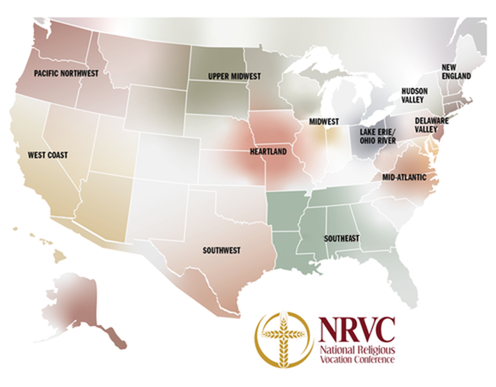
Please do not publish this information as it is for NRVC members only.
Member Directory and interactive map
Minutes from February 12, 2025
Minutes from October 3, 2024, December 10, 2024
Minutes from January 23, 2023, March 2, 2023, June 5, 2023, August 29, 2023
Sister Michele Fisher, C.S.F.N. | sorellamichele@aol.com
Sister Anita Quigley, S.H.C.J. | quigley@shcj.org
Sister Réjane Cytacki, S.C.L. | rcytacki@scls.org
Ms. Michelle Horton | mhorton@sinsinawa.org
Minutes from May 6, 2024
Minutes from March 7, 2024
Minutes from October 28, 2023
Minutes from June 10, 2023
Minutes from April 25, 2023
Sister Gloria Agnes Ardenio, M.M. | gagnes@mksisters.org
Sister Jenny Wilson, R.S.M. | jwilson@sistersofmercy.org
Minutes from October 23-25, 2023
Minutes from February 23, 2023, May 8, 2023
Sister Caryn Crook, O.S.F. | ccrook@sosf.org
Mrs. Teri Iverson | tiverson@cppsadmin.org
Sister Jean Rhoades, DC | jean.rhoades@doc.org
Friar Emanuel Vasconcelos, OFM Conv. | friaremanuel@gmail.com
Sister Heather Jean Foltz, O.S.B. | heatherfoltz@benedictine.com
Sister Jill Reuber, O.S.B. | jreuber@thedome.org
Minutes from November 28, 2023
Mrs. Sandy Piwko | sandy@assumptioncenter.org
Sister June Fitzgerald, O.P. | jfitzgerald@oppeace.org
Minutes from April 30-May 2, 2024
Minutes from Planning Meeting, November 1, 2023
Sister Chero Chuma, C.S.J.P. | cherochuma@gmail.com
Sister Paz Vital, OSB | pvital@stplacid.org
Minutes from November 28, 2023
Mrs. Renee Dee | lsvocationsoffice@gmail.com
vacant
Minutes from September 17, 2024
Minutes from May 14, 2024
Brother Mark Motz, SM | mmotz@marianist.us
Sister Kim Xuan Nguyen, CCVI | knguyen@ccvi-vdm.org
Minutes from September 24, 2024
Minutes from February 27, 2024
Sister Carmella Luke, OSB | cluke@yanktonbenedictines.org
Brother Larry Schatz, F.S.C. | lschatz@cbmidwest.org
Minutes from November 28, 2023
Father Radmar Jao, SJ | UWEVocationDirector@jesuits.org
vacant
Register for the Zoom link here.
Mrs. Margaret Cartwright | info@vocationsireland.com
Sister Mary Rowell, CSJ | mrowell@csjcanada.org
75 NRVC members live in Bangladesh, Belize, Canada, the Democratic Republic, Egypt, France, Ghana, Guatemala, Guyana, Haiti, India, Ireland, Italy, Kenya, Peru, Philippines, Trinidad and Tobago, Uganda, United Kingdom, and Zambia.
Register today to save $100 on attendance at our fall convocation in Minneapolis. Don’t delay—this gathering will be an inspiring, informative, enriching event for vocation ministers and those who support new membership to religious communities. To receive the $100 discount, you must register before October 1. Learn more.
Published on: 2024-08-27
Edition: September 2024 newsletter
Welcome to Sister Eileen McCann, C.S.J. and Brother John Skrodinsky, S.T., who are joining the NRVC board. Farewell to departing board members Nancy Costello and Sister Mary Yun, O.P. The new NRVC board members begin their terms with the September meeting. Departing members will attend their final board meeting in September. We extend thanks to all of them for their commitment to vocation ministry.
Published on: 2024-08-28
Edition: August 2024 newsletter
The Center for Applied Research in the Apostolate recently published its annual Entrance Class Report, providing important information about those who began formation with a religious community in 2023. The report tells the demographics, reasons for entering, and more about the 153 men and 126 women who entered religious life in 2023.
A total of 99 religious institutes in the United States had at least one person enter initial formation as postulant or candidate. The majority of entrants were born in the United States, with 18 percent born in another country. About one quarter of them speak two languages fluently. Seventeen percent earned a master’s degree before entering religious life.
Starting a conversation about their vocation discernment was easy for about half of the newer entrants (63 percent for men and 42 percent for women).
Contact with institute members continues to be the most significant factor in discerning a calling to religious life. The spirituality and example of members of the institutes attracted 91 percent of newer entrants to their religious institute. Learn more here.
This month's NRVC treasure is the Bold and Faithful Storymap. If your community is not on this specialized website, please make sure it is. Find the map here: tinyurl.com/Bold-and-Faithful-storymap. Scroll down until you get to a map. Instructions appear just below the map for adding a ministry site or community residence. You are assisting discerners and supporters of religious life by helping make this resource as comprehensive as possible.
Published on: 2024-12-17
Edition: January 2025 newsletter
Gerard Gallagher, executive director of the Association of Missionaries and Religious of Ireland, recently addressed the International Member Area. His talk on Christus Vivit, "Takeaways from Christus Vivit through the Lens of Vocation Ministry," can be viewed on the NRVC YouTube channel. Consider watching this 32-minute video with your community, vocation team, or discerners. Perhaps your group would want to re-read Christus Vivit prior to viewing; or review selected quotes.
Published on: 2024-12-17
Edition: January 2025 newsletter
The NRVC is searching for a director of communications to join its national office leadership team. A primary aspect of the job will be to edit and produce the award-winning journal, HORIZON, as Carol Schuck Scheiber, publications editor, will be retiring in July 2025. Members and friends are encouraged to spread the word. Details about the position and how to apply are at nrvc.net.
Published on: 2025-01-28
Edition: February 2024 newsletter

AT THE NATIONAL RELIGIOUS VOCATION CONFERENCE, we specialize in vocation ministry with confidence that God continues to call women and men to holiness. Ours is a ministry of active listening, of helping people to hear and respond to God’s endless call. Over the past two decades, I have come to believe vocation ministry is both timeless and desperately needed in a world filled with brokenness and beauty. Just as people dedicate their lives to ending food insecurity, generational poverty, human trafficking, and illiteracy, vocation ministers are missioned to accompany women and men who seek a deeper relationship with God and humanity, who are searching for meaningful service, and look to us to provide direction on how to respond to God’s call.
Vocation ministry beckons us to hear God’s voice throughout our lives, not just once in vocation discernment. God’s call is precious and sacred in a world filled with digital devices and automated voices like Alexa and Siri. Vocation ministry asks each of us to pay attention to our own story of call to be able to invite others to follow the Risen Christ. Hearing and responding to God’s call requires a lifelong attentiveness to the voice of God. Pope Francis elaborates in Christus Vivit (257), “Your vocation inspires you to bring out the best in yourself for the glory of God and the good of others. It is not simply a matter of doing things, but of doing them with meaning and direction.” In an age of constant app alerts and instant technology, we can forget the sound of God’s timeless voice. When we get too busy, we can gradually lose our desire to dream, to hope, and to invite others to be with us. Yet, our very vocation is a living reminder to each generation to work for justice, build community, and listen to God’s dream for us, for our community, for the church, and the world.
In our North American culture, which stresses achievement and growth, vocation ministers must counter the narrative that equates numbers of applicants with success or failure. Yet numbers can ground us to face fierce realities about changing demographics for all vocations, institutions, and organizations. The NRVC-CARA Study on Recent Vocations to Religious Life asserts that religious life is a vivid story of emergence and transformation. The grace of perseverance is not a cliché. The study shows that our newest members often see the oldest members as role models. It further reveals that the diversity of women and men religious is one of the hallmarks of consecrated life. With varying spiritualities, missions, and charisms, the incentive to promote vocations is a belief that the charism of a religious institute is relevant in the 21st century and that new members want to enter religious life even as it continues to evolve.
Although the NRVC challenges the notion that the number of new members is the way a community should evaluate vocation ministry, the aggregate numbers for the United States are telling a positive story that we don’t want to miss. Since the start of the global pandemic in 2020, over 1,500 (1,554) women and men have entered religious life. The number of entrants increased from 279 in 2023 to 362 in 2024 (a 30 percent increase!). Newer entrants began initial formation in 123 religious institutes in 2024.
In addition to the many people who have entered religious life, we can also take heart in those who have stayed with it all the way through final vows. The “Profession Class of 2024 Report” by the Center for Applied Research in the Apostolate (the most recent available) indicates that in 2024, 194 women and men made perpetual profession, 50 more than the previous year! Since the pandemic shutdown and shelter in place in 2020, we can collectively celebrate that 860 women and men professed final vows.
Of course, we can focus on how many religious institutes did not have someone enter, but vocation ministry reminds us to collaborate, not compete, for entrants. Most seasoned or former vocation directors can recall discerners who decided to enter a different community for a variety of reasons. Most will also recall discerners who moved forward to choose the beautiful vocation of being single or married. Accompanying discerners to make informed decisions is always a success and never a failure on the part of the vocation director and community.
Although I’ve just presented important numerical facts, this constant counting of entrants and vowed members can easily reduce us to data points with anticipated expiration dates that miss the narrative of a lifetime commitment to vowed communal life. Religious life has been changing since it started, and transformation is never complete. We have built and closed missions; we have started ministries and let them go, and, yes, many of us have attended more funerals than professions. In workshops and publications over the past 50 years, religious are told repeatedly that religious life is diminishing, and now the narrative is that religious life is coming to completion. At the same time, these words are not used for the vocations to marriage and the priesthood, both of which are also experiencing declines. Sometimes we can get stuck using phrases that paralyze our minds and limit our invitations instead of cultivating what is possible.
Let me compare two common phrases: The “diminishment of religious life” and the “shortage of priests.” With all due respect to our ordained priests, I have not heard the phrase, “the diminishment of the priesthood.” I hear about the “severe shortage of priests,” which implies a collective urgent request to involve everyone. In reality, the number of priests has not increased, but no one is talking about the completion of the priesthood.
Who would ever consider telling an engaged couple to reconsider marrying because Catholic marriages are coming to completion? Catholic marriages have declined 63 percent in the past 30 years. Pope Francis wrote in Christus Vivit, (44) that “[Mary’s yes] was the “yes” of someone prepared to be committed, someone willing to take a risk, ready to stake everything she had, with no security than the certainty of knowing that she was a bearer of a promise.” Today’s applicants to religious life, like Mary, are willing to take a risk, ready to stake everything they have on a future that will be as uncertain as their friends who are walking down the aisle in a Catholic church to be married. When we see a broader picture of how words and phrases affect our mindset, isn’t a narrative of emergence and transformation more fitting for religious life?
Vocation directors are steeped in skills of accompaniment, assessment, and application. Yet, one of the most difficult responsibilities is to animate members of the community to assist in vocation ministry. What members do matters! Members should never underestimate the power of their prayer with inquirers, the impact of their invitations, and the value of their encouragement. When a member invites a person to consider a vocation to religious life, that person is twice as likely to consider it as compared to someone who never receives such an invitation. And when three different people invite someone to consider religious life, a person is five times more likely to consider it.
Fears related to inviting and accepting new members seem to fall into the following categories.
In recent years, some religious have been sounding the alarm about whether it is ethical to accept new entrants based on the median age of the community, the size of the religious institute, and the ability to welcome new members. The 2024 CARA report on new entrants shows that 16 percent of major superiors say that their religious institute no longer accepts new entrants (115 out of 723).
Some say the young will not have anyone to relate to, and yet of those who entered religious life between 2003-2018, only 16 percent stated that the age of members influenced them “very much” (other factors like charism and community life were much more influential). Likewise, the majority of newer entrants are not influenced by the size of the religious institute. Only 11 percent said the size of the institute “very much” influenced their decision. (These last two points about age and size come from the 2020 NRVC-CARA Study on Recent Vocations to Religious Life.)
The CARA Profession Class of 2024 report backs up this data about the size of a community not being a major factor. It indicates that among the institutes with perpetual professions in 2024, three in 10 (31 percent) have fewer than 50 professed members, four in 10 (42 percent) have 51-150 professed members, and just three in 10 (27 percent) have more than 151 professed members.
The more disconcerting reason to not accept new entrants is inadequate community life to welcome new entrants. Vowed communal life is the distinguishing factor of our vocation. If there are not enough households with quality community life for new entrants, perhaps the priority needs to be improving community life for those living it now, rather than using that issue as the reason to no longer accept new members.
A reality check is helpful, too. Think back to your own experiences of initial formation. Was it paradise, a genuine utopia of welcome from everyone? Ask anyone who entered religious life, and you are bound to hear real and exaggerated tales of formation. While most of us either thrived or survived initial formation, we are charitable enough to forgive the people who hurt us with their unconscious biases, inappropriate behavior, or poor hospitality. All of us can also remember members who genuinely cared, faithfully nurtured, and authentically formed us despite any oddities we endured. Our communal life flaws do not have to become our reason for not accepting new members, especially given the collaborative formation programs across congregations.
Entering alone or with a few others has been common for the past 50 years. It is not a new concern. Talk to current golden jubilarians, and you may well hear stories of coming alone or being among the few who stayed. Discerners are more likely to experience jubilees than professions as an entry point for meeting members of religious institutes. They can see us as we are—smaller and older—yet can still decide to come if our door is open. The majority of new entrants are already networking across congregations at vocation discernment events before they enter. Many attend intercommunity formation programs, and they network across congregations in ministries after profession.
Some communities feel it’s wrong to accept new members while they focus on downsizing properties. However, newer members are less stressed than their older counterparts about right-sizing buildings because most had to dispose of significant belongings like cars, homes, and financial investments before entering. Older members had to purchase items to fill their trunks at entrance, accumulated belongings over the years, and witnessed the growth of community buildings.
We do need to resize our properties and simplify our belongings, yet we can become so preoccupied with planning for an emerging future that we can forget to be attentive to young people who are searching for a meaningful way of life. Our charism may be what they seek.
Vocation ministry is a ministry; it is not a sales job with a quota. No one can be forced or pressured to complete an application for entrance to religious life. Canon 219 in the Code of Canon Law states, “All the Christian faithful have the right to be free from any kind of coercion in choosing a state of life.” Vocation directors understand through canon law and the NRVC Code of Ethics, that theirs is a ministry of invitation, not manipulation.
What if the easiest answer is to no longer accept new entrants? What if you have the audacity to accept new entrants? We all know valiant community members who stay active in ministries beyond the typical retirement age because they have a passion for it, the physical ability to engage in it, and a capacity to serve. As with any serious discernment about continuing a ministry, a community considering letting go of vocation ministry and ceasing to accept new members will want to ask itself important questions. Here are four significant questions for a community in these circumstances.
1. Do you believe God is still calling women and men to holiness? If not, stop accepting new members.
2. Does your congregation believe in religious life for the future and the relevance of your charism? If not, stop accepting new members.
3. Is there at least one member willing to be a vocation minister on a part-time basis? If not, can the congregation either partner with a community that has a similar charism or hire a vocation director? If not, stop accepting new members.
4. If there is at least one member willing to be a vocation minister, or if the community can hire one or partner with another community, why not be open to new entrants?
When communities make the decision to end vocation ministry for their religious institute, one less person is available to be present with young people. One less person with ministry skills is able to assist those discerning God’s call. As mentioned earlier in this article, counting members and ages to determine whether to accept new members is not helpful because newer entrants are less influenced by size or age than by other qualities. They are attracted to the charism, community life, prayer life, Gospel values, form of living the vows, and the vitality of members. Seeing vocation ministry as a ministry reminds us it is never about our numbers. A response to the call to religious life is neither hollow nor ridiculous. Religious life is about our continuous response to God’s endless call.
Vocation ministry is focused on accompanying the next generation of Catholics in discerning their response to God’s call, regardless of the path they choose. Vocation is a mystery and a gift, for it is God who calls and we who invite. This involves risking hope because our invitations can be ignored, dismissed, and minimized in a culture that finds it difficult to pause and ponder. Perhaps vocation ministers see with a different lens because they are immersed in relationships with young people who are searching for significance, representation, and purpose. Vocation ministry invites every member to be intentional about making invitations, to participate in the events and activities of vocation ministry without expecting to acquire a list of contact information from inquirers.
In the United States, the average age a person first considers a vocation to religious life is 18. The average age of entrance—and of marriage—is 28. This means today’s discerner was born in 2007 and only knows who we are today, not who we were in 1980 or 2000. The majority of discerners take at least one year to discern; 35 percent take more than two years. During this time, who is praying for them, inviting them, encouraging them? Most come without being steeped in Catholicism or religious life, so they ask questions out of curiosity. We know that the information they seek can be easily accessed on their many devices. Toddlers are using tablets before they can say complete sentences, and they learn to swipe before they can read. For young people, conversation by phone or in person may cause anxiety, so patience is necessary. The upside is that young adults are searching to belong and be connected beyond a screen, but some struggle with the lost art of small talk and introductions.
God is still calling women and men to holiness, so how are we encouraging them before and after they enter? Over the years, without steady entrances into our communities, we can become discouraged and weary, yet none of us answered a call to complacency. Vocation ministry is less about creating programs and events than about building relationships. Vocation directors cannot be lone rangers, rather they need the community.
The NRVC’s research indicates that newer members rank “meeting with members” of the institute as the most helpful action in their discernment process—more than talking with their pastors or using websites or social media. Likewise, the “example of members” is more influential than the ministries of the religious institutes. Certainly, advertising, social media, discernment events, and talks with parish personnel help discerners connect initially with community members, but once connections are made, positive interactions with members are essential. During initial discernment, newer entrants received the most encouragement from members of their institute, their vocation director or team, and their spiritual director.
At the 2024 NRVC convocation, members and guests gathered from various religious institutes to share the deep rewards and inevitable difficulties in vocation ministry. Among the many conversations, one caught my attention: a vocation director congratulated someone in a different community on their recent profession, asking to see their profession ring. I smiled at their shared delight. We really do celebrate each other’s new members. Here was vocation ministry at its finest.
Take a closer look at your profession ring. This poignant symbol reminds us of our public profession of vows. Similar to a wedding ring, a profession ring is circular, symbolizing connection, community, and unity. It has no beginning or ending but encompasses both what is ending and what is emerging. While we may retire from ministry, this unending circle suggests that our vows are meant to be lived until our last breath.
Thus, regardless of age or year in profession, we are meant to be a living advertisement for religious life, not with a fake joy but with vitality in how we live the charism, engage in community, pray, and minister. Vocation ministers remind the world that God’s call is endless. The impact of our ministry goes beyond our religious institutes and provinces to the entire church and the life of the world.
Sister Deborah Borneman, SS.C.M. belongs to the Sister of Saints Cyril and Methodius. She has served in vocation ministry for more than 20 years and has been part of the National Religious Vocation Conference team since 2011. She currently serves as NRVC’s director of mission integration.
Published on: 2025-07-30
Edition: 2025 HORIZON No. 3 Summer
We are excited to announce that our Summer Institute participants have chosen a Convocation logo to beautifully complement our inspiring theme selected by the National Board: Bearers of Hope/Portadores de Esperanza/Sứ Giả Hy Vọng. Join us as we celebrate this spirit of hope together! Mark your calendars to attend Convocation in Orlando, Florida, next year, November 19-23, 2026!
Plans are underway to select presenters, and many levels of sponsorship are available. We kindly encourage you to consider supporting the NRVC as we continue to create a culture of encounter and accompaniment that showcases the vitality of religious life throughout the year.
We welcome your support and questions by contacting Sister Debbie at debbiesscm@nrvc.net.

YOUNG PEOPLE TODAY CARRY a quiet but undeniable longing: they want to be heard. The world around them is loud—filled with screens demanding their attention, institutions that have let them down, and a culture moving too fast to notice their stories. They aren’t asking for quick fixes or perfect answers. They want someone to sit with them, take them seriously, and listen as they wrestle with doubts and share their dreams.
This longing is not a challenge to ministry—it is the starting point. The church, particularly through the lens of synodality, has made clear that listening isn’t just part of its mission. It is the mission. Pope Francis describes synodality as a way of walking together in dialogue, with an openness to hear how the Holy Spirit speaks through each person. Listening isn’t just where the journey starts; it is the path itself, and this is particularly true for ministry with young people.
This vision lies at the heart of Listen, Teach, Send (LTS), the United States Conference of Catholic Bishops’ new framework for youth and young adult ministry. The authors of LTS didn’t make listening the first step by accident—they made it the foundation. If we don’t listen, nothing else we do will matter. Before we teach, before we send, we have to stop and listen.
We have spent years exploring the transformative power of listening in ministry and founded Future of Faith to help dig even deeper into the connection between listening and faith formation. Our research reveals a single truth: listening is not just a step in the process—it is the process itself. It isn’t the way to gain trust to tell the truth. It is the way the truth is revealed to people in their own hearts.
Last year, we set out to try to understand the exact role that listening plays in a young person’s faith formation. In research that is central to our mission at Future of Faith, we began by surveying over 1,000 people using a nationally representative sample, and what we found was astonishing.
We’ll explore some of the findings from that study below, but pause here and consider these top-level effects of listening for young people 18-25:
• 85 percent agreed that when someone listens attentively, it makes them more likely to engage in meaningful conversations in the future.
• 77 percent agreed that when someone listens without judgment, they feel more connected.
• 70 percent said that when they feel listened to in a conversation about faith or spirituality, it makes them more likely to be open about those topics in the future.
• 72 percent indicated that being listened to helps them process doubt, disillusionment, and grief.
• 68 percent said being listened to deepens their faith.
When young people feel heard, they open the doors to their hearts, making space for authentic relationships and spiritual growth. It is not a stretch to conclude that listening changes everything.
Unfortunately, church and religious settings are not where young people feel listened to. When we asked them to list their top places where they feel heard, only 26% of self-identified religious teenagers selected “faith community (e.g., church)” as among their top three.
This mismatch between the importance of listening and the frequency with which it occurs in religious settings means that Listen, Teach, Send couldn’t be more timely and vital for the future of the church and, more importantly, for the future of our young people.
During our time at the National Catholic Educational Association, Lincoln Snyder, former president and CEO, often reminded us, “You cannot catechize somebody who hasn’t been evangelized.” This is where we find ourselves with many young people today. The church has strong systems for catechesis, but many young people have not been introduced to the foundations of faith. They grow up in households embedded in a culture that is often disconnected from the transformative power of religion and belief. Many of them only know religion based on what they see on social media, movies, and television. They have never experienced the transformative love of Jesus. Listening is our starting point for everything. It is the way we evangelize—by meeting young people where they are and accompanying them in love.
Young adults are navigating a world where trust in traditional institutions—including religious ones—has significantly eroded, with most, including religion, at or near all-time lows. Surveys reveal that younger generations are far less likely than previous ones to trust established institutions and their leaders, citing reasons such as perceived hypocrisy, scandals, and a culture of institutional failures. The church is no exception to this trend, as many young people see it as disconnected from their lived experiences.
While institutional trust has declined, relational trust remains a powerful force. Young people may hesitate to trust the church as an institution, but they often place immense trust in individuals who take the time to know them personally. In our study, over 68% of young adults (18-25 years old) have high levels of trust in people they know personally and low levels of trust for large organizations (20%) and their leaders (31%). This shift from institutional authority to relational credibility presents a challenge for churches and other religious groups.
Many of the standard ways of doing ministry were developed on the assumption that people trusted religious organizations and leaders. This was true as recently as the 1950s and 1960s, when institutional trust was high. In that environment, it made sense to lead with institutional markers such as titles, expertise, large campuses, and central authority.
In our modern, low-trust world, these approaches are not as effective. The more we lean into our institutional identities and markers, the less influence we gain among people skeptical of us and the institutions we work in. To regain trust with generations where it has been lost or was never present, we need to lean more into relational approaches rooted in the transformative power of listening.
For young people, trust does not come from titles or roles. It is earned in the quiet moments of being with another person, fully present and fully attentive. Today’s young adults trust relationships far more than institutions. They look for leaders who care about them as people, not projects.
This approach mirrors the ministry of Jesus, who did not demand trust based on his authority but earned it through personal encounters. From healing the blind man to dining with Zacchaeus, Jesus built trust by listening to people’s deepest needs and showing them that they mattered. Just as God listens to our prayers and accompanies us through joys and struggles, the social science indicates that ministers in the modern era would do well to embody that same patience and presence. Listening becomes an act of participating in God’s work.
Listening might sound simple, but its effects are profound. Pope Francis describes listening as “an act of love,” a posture that transforms the listener and the one being heard. The theological roots of this approach run deep. In every young person, we see the Imago Dei—the image of God. Listening becomes a sacred act of recognizing their inherent dignity and worth. It’s no wonder, then, that listening resonates so strongly with today’s young people when so many “voices” in their lives try to convince them of their worthlessness daily.
Although we are social scientists at Future of Faith, we believe that starting from this fundamental theological position of Imago Dei is critical. If we begin with the assumption that every opportunity to interact with a young person is a chance to encounter the presence of the divine, then it makes it much easier to be interested when your kid talks to you about Minecraft for 20 minutes straight (okay, we may be speaking from personal experience here!). The theological posture of Imago Dei reminds us of how transformative it can be simply to sit and listen to the divine in one another. This foundation is at the core of the synodal process. Synodality calls the church to rediscover its role as a community that listens. As articulated in the preparatory documents for the Synod on Synodality, “Listening is the first step, but it requires having an open mind and heart, without prejudice.” LTS echoes this, urging ministers to embrace listening as a transformative act of evangelization and accompaniment. This call for listening relies on the basic agreement that other people are worth listening to, and Imago Dei helps to remind us of this basic truth.
However, despite calls from religious leaders, helpful theological positions, and fancy surveys, true listening is not easy. At Future of Faith, we have come to understand that listening is a skill, not a passive act, and that when done correctly and with intention, it can be sacred work.
With this in mind, we have developed an approach to listening that is both rooted in a particular interaction and scalable to support entire ministries of listening. We call this Sacred Listening. Sacred Listening builds on three core principles: intentional presence, alignment with the speaker’s needs, and pattern recognition. These practices create a space where people feel safe enough to share, trust enough to explore, and are seen enough to believe in their own worth.
Sacred Listening begins with intentional presence, the act of showing up fully for the person in front of you, free from distractions or preconceived solutions. In a culture saturated with noise and constant demands for attention, this kind of deep presence feels countercultural—almost radical. Yet, for a young person longing to be seen and understood, it is transformative. Sacred Listening requires putting aside the urge to fix or judge and simply being with the other person in their story.
The second principle, alignment, means that the person listening must orient themselves in a way that makes the speaker feel heard. Deep empathy is required to understand that what makes you feel heard might not be true for everyone across cultures and backgrounds. Our survey with young adults, however, points to some behaviors which are deeply resonant with young people and make them feel like you are listening...or not. Interrupting, appearing distracted (e.g., checking your phone), and jumping to conclusions were all signals that most of our respondents said made them feel unheard. On the other hand, demonstrating empathy by listening to understand, withholding judgment, and asking follow-up questions all communicate to most people that you are listening and paying attention to them.
The third core element, pattern recognition, helps listeners discern recurring themes in conversations. These patterns often reveal not only individual concerns but also broader movements of the Holy Spirit within a person’s life. Sacred Listening is not just about the immediate encounter; it equips listeners to notice deeper spiritual currents. For example, patterns of doubt might reveal a young person wrestling with questions of identity, belonging, or purpose. It is sociological and sacred work to track your conversations and interactions with young people, look prayerfully and empirically for the patterns that emerge, and respond accordingly. This is also the key to making relational approaches to ministry sustainable for large groups of people in your care.
Pope Francis reinforces this approach in Evangelii Gaudium, where he writes, “The Church is called to be the house of the Father, with doors always wide open…Frequently, we act as arbiters of grace rather than its facilitators. But the church is not a tollhouse.” This openness, he insists, begins with listening. It invites dialogue and ensures that those who feel distant from the church are welcomed with love and understanding. Sacred Listening models this openness, creating spaces where every voice is honored as a reflection of the divine.
This shift from transaction to transformation mirrors the way Jesus engaged with those he encountered. Think of the Samaritan woman at the well, whose entire life was changed not because Jesus gave her quick solutions, but because he truly listened and spoke to her deepest thirst. Sacred Listening invites ministers to emulate this approach, entering into conversations with a posture of openness, curiosity, and reverence for the sacredness of the other person’s journey.
Finally, Sacred Listening is not only about hearing words but about creating a sanctuary for vulnerability. Young adults today live in a culture that often prizes performance and perfection over authenticity. Sacred Listening offers them a space where they can be honest about their doubts, grief, and hopes. When a young person shares, “I feel like I don’t belong,” or “I’m scared I’ll make the wrong choice,” the act of listening—without judgment or agenda—becomes a way of embodying God’s unconditional love. This love, reflected in the listener’s attentiveness, has the power to heal wounds and ignite faith. In other words, listening is not simply something you do to understand the other person better, though it is useful for that. Our research is uncovering what we have been hearing anecdotally for years, namely, that listening is, in and of itself, a way to deepen another’s faith and bring them closer to the divine. It is not a means to an end—it is the end itself for so many young people.
Listening can be uncomfortable. It asks ministers to set aside their agendas and step into the uncertainty of someone else’s story. Yet it is precisely this discomfort that creates space for transformation.
Our survey revealed that young people often feel silenced by authority figures who dominate conversations, offer unsolicited advice or judgment, or constantly correct. These barriers are opportunities for ministers to reimagine their role—not as lecturers but as companions. As true accompanists. One of the biggest challenges in our work with young people is to sit and listen even when a young person reveals alarming things about their behavior or beliefs. The inclination is to step in and correct, but if the trust is not earned through listening, then the correction is felt as judgment and as an indication that you are not willing to get to know them and their realities.
Our research shows that if you lead by listening, you will earn the right to be heard. Alexandria, a 24-year-old we interviewed, said, “If I know that someone listens to me, then at the very least, I can reciprocate that.”
Even with a strong relationship with Jesus, a 20-year-old might still mistrust institutions. Invite them to shape, not just join. Affirm their faith, listen with genuine curiosity, and share leadership. Transparency builds trust, revealing how God works through imperfect structures. Make space for real stories, consistent follow-through, and continued presence. Skepticism of institutions does not necessarily indicate a disinclination toward service.
Pope Francis reminds us that true accompaniment doesn’t mean sitting and listening without direction or condoning every thought or behavior of another person. Rather, a person must be accompanied into a relationship with Jesus. The question of how long that takes will be different for every person and rely much more on the Holy Spirit than on social science. Sacred Listening takes the simple act of being present and elevates it into a sacred encounter. This is the promise of Listen, Teach, Send. It is an invitation to step into ministry with open ears and open hearts, trusting that the God who listens to us will work through us. It is a call to accompany young people on their journeys, not as fixers, but as companions who listen with love and help guide the way.
Megan Bissell is the co-founder and executive director of Future of Faith, as well as an applied sociologist and researcher. Josh Packard is the co-founder of Future of Faith and an expert in the spiritual lives of American youth and religious trends in the United States.
Published on: 2025-11-06
Edition: 2025 HORIZON No. 4 Fall

Since vocation ministers work closely with youth and young adults, it helps them to understand the direction that American bishops are encouraging in ministry with young people. In 2024, the bishops released the 48-page pastoral document, “Listen, Teach, Send: A National Pastoral Framework for Ministries with Youth and with Young Adults.” Two of those involved in shaping the framework offer an overview of its approach to youth and young adult ministry.
Several realities spurred the United States Conference of Catholic Bishops (USCCB) to craft a new framework for youth and young adult ministry. Among them were the declining number of young people considering consecrated religious life and the sacraments of holy orders and marriage. The increasing rates of institutional disaffiliation and a mental health crisis affecting millions of youth and young adults also fueled the bishops’ initial discernment in this area. The USCCB felt the time had come to respond to these realities in a proactive and pastoral way. The process leading to the eventual passage of “Listen, Teach, Send” (LTS) was couched in intentional listening to women and men who have a heart for youth and young adults (including vocation ministers) and young people themselves. These groups communicated a mixture of frustration and struggle fused with joy and hope (not unlike the experience of the disciples on the way to Emmaus). In response to what they heard, the U.S. bishops crafted a framework “as a summons to local faith communities across the country to renew their efforts.”
The audience for LTS is wider than previous pastoral statements from the bishops around youth, collegians, and young adults. Lay people, consecrated religious, and ordained pastoral ministers in Catholic parishes, college campuses, dioceses/eparchies, and organizations are certainly intended readers, but so are parents and families of young people, peer ministers within the youth or young adult demographic, and any Catholic leader whose ministry or work intersects with young people. The bishops were mindful that this should include vocation directors and ministers, whose efforts regularly involve conversations, pastoral care, and accompaniment of those between 13 and 39.
This is the opportunity the bishops put before all who read and reflect on the framework: carefully and prayerfully consider how you listen, teach, and send forth each youth or young adult the Lord places before you at any given moment.
So that this framework is not a theoretical ideal or the property of a select few professional ministers, we begin this summons in the home and with our loved ones. We are not imagining an abstract concept, group, or data demographic; rather, we have in mind the young women and men we know or interact with on a regular basis. Each of them has a unique name, face, and identity: beloved by God and integral to the mission of the Catholic Church.
As you read this article, we encourage you to pause for a few moments to reflect on the name, face, or identity of a youth or young adult whom you know or encountered recently. Start there and dive in.
When we listen to another, do we receive their words in our ears, or do we stop, pause in reflective silence, and strive to understand the story or perspective that person wants to offer us? This is a key challenge that the bishops offer us: to approach all youth and young adults with a listening heart. The first step in engaging a young person is authentic listening. Anticipating concerns about the overuse of the word “listening” in recent years, the bishops broke open the experience in four intersecting ways: encounter, presence, understanding, and healing.
For vocation ministers, the encounter and full presence can occur the instant an individual steps into your community, office, or activity. Even more so, recognizing that many youth and young adults are not walking in our direction, listening exercises also mean going out to them and taking note of their lived realities. The U.S. bishops echoed Pope Francis in noticing that a growing number of young people are struggling, suffering, and navigating difficulties. How, then, can we more intentionally encounter young people “with loving and generous pastoral concern” before we ever mention work with vocations? How can we stop and listen to them without interjecting, fixing, or filling the silence? Many times, young people just want to be heard. When a youth or young adult knows you are simply there because you care, it can help establish trust that is foundational for further formation and engagement in the faith.
In LTS, the bishops challenge us to still our incessant need to react or respond immediately. This can allow for a better understanding of the young person in our midst–across the generational, cultural, or experiential lines that may exist. Such acts allow us to witness the uniqueness of each person by directing our focus on the individual before us. We can appreciate his or her story because it is indicative of the human story, which we also share.
Finally, knowing someone’s story can (and often does) reveal deeper pains or hidden wounds, which can hinder a relationship with Christ or the community. The vocational journey of a young woman or man could be rooted in a sensitive element of her or his story. If it is not addressed or if there is no movement toward healing brokenness, a young person’s wounds could fester and grow, potentially eclipsing a mature and fruitful relationship with Christ and the People of God. A vocation minister has a prime opportunity to accompany youth or young adults in their midst through grief or anguish; not to fix or resolve the pain, but to become a trusted and concerned companion. How can you be that person? How can your community’s charism or spirituality offer hope for a youth or young adult who may be struggling, isolated, or uncertain?
In all this, practice patience and gentleness. The listening process takes time and effort, as trust needs to be built up slowly. However, it can yield a strong and fruitful bond when the young person recognizes he or she is listened to and cared for as a son or daughter of God.
How many of us recall with fondness a teacher or mentor in the faith who saw us as we were and welcomed us? We reflect kindly on many teachers and mentors we have had in the faith throughout the years who saw us and welcomed us into a deeper relationship with Christ, modeling virtue and joy. Their examples of virtue, and especially their patience with us, as we grew in deeper understanding of what it means to be a disciple of Christ, formed a foundation for our faith to blossom. These teachers and mentors guided us towards a stronger relationship with Christ by sharing the truth, beauty, and goodness of the faith and inviting us to ponder the meaning of these things for our own lives and our relationships with Christ and others.
As vocation directors, you are spending much time investing in men and women who are discerning the call of the Lord in their lives. The relational aspects of your ministry are rooted in the same relational aspects of Christ’s ministry. Your accompaniment of these young men and women serves as an intentional teaching dialogue on the ways that God is working in their lives. You have been invited to patiently walk alongside others and share the truth, beauty, and goodness of Christ and the Catholic faith with them. The question of, “How am I inviting people to enter more deeply into a personal relationship with Christ to hear His calling for their lives?” can at times feel urgent. However, in looking to the example of Christ from Scripture, you can be encouraged that He is also there accompanying you as you journey with others.
The bishops provide insights and encouragement for this teaching role of accompanying others in the faith, and specifically, in your work as vocation directors. In your ministries, there is a beautiful opportunity to provide formation that anchors young people discerning consecrated and religious life in the teachings of the church and to see these young people as collaborators in this work. In LTS, the bishops remind us that the development of the kerygma and a growing atmosphere of community life and fraternal love are foundations for this work to flourish. It is beneficial to have strategic conversations with members of your religious communities, fellow priests, seminarians, sisters, or brothers in formation about how you live out community life and fraternal love and share the kerygma.
Consider spending time in prayer and conversation, asking the following questions. Does our community live in such a way that the love of Christ is known and reflected to one another? Would young people be attracted to our community life? What liturgical and sacramental celebrations are part of our community life? How do we invite young people to participate in our family of faith as priests, sisters, brothers, consecrated men and women, etc.? These are important areas to reflect on with others so that your accompaniment of young people discerning God’s will can find a home that engages their gifts and talents in service to the larger church.
Is your heart burning to serve Christ in your ministry as a vocation director? What a joy and a gift it is to share the love of Christ with others in your daily work. You have been called to this ministry at this time for a particular purpose in service to the Lord. How do you share the Good News of Christ in your work as vocation directors with young people? How do you witness to Christ in your daily conversations and routines? We can become so focused on all the things that need to be done in our ministries that we don’t spend time reflecting on how we live as we do these things. Are young people attracted to the joy that is shared in your ministry?
The bishops provide guidance on how to send out the young people we accompany on mission to the larger world. They remind us that we do not need to keep young people in long training programs for many years before we encourage them to proclaim the love of God. We can overcomplicate daily tasks and unintentionally add complexity to the processes of discernment and formation.
Take a moment to reflect on the message from the bishops and how it is manifested in your ministry and community life. The bishops specifically mention this, saying, “Pastoral leaders, vocation ministers, and families can invite young people to consider all the ways God may be calling them in life.”
In doing so, you can be a witness for young people to the dynamic joy of being sent on mission. Consider spending time in prayer and conversation, asking the following questions. How do we encourage the young people who are discerning God’s will for their lives to have an enthusiastic spirit? How do we serve the Lord with charity and justice in our particular state of life? How do we encourage the men and women who are discerning God’s will to take the lead in serving our local communities? What opportunities do we provide for young people to discern serving and leading in the church as a consecrated or religious man or woman? Do we share the stories of our founders, foundresses, and saints from our religious communities and dioceses as beautiful witnesses for our young people? How do we witness through our partnerships with various ministries with young people?
§§§§
Vocation directors are invaluable collaborators with families and the church’s ministries with young people. As the bishops noted, those who accompany youth and young adults are most effective when they work in collaboration with the entire community. The church in this way works together across an interconnected network of ministerial fields for the good of the mission entrusted to us by Christ. As such, the church moves forward in these ministries as a “community on a journey.”
Like so many others in this community, you are a tremendous gift to all members of the Body of Christ, especially young people who are discerning God’s call. Thank you for your faithfulness as vocation ministers accompanying youth, young adults, and their families. To continue the journey ahead, we encourage you to build in time for your own reflection, conversation, and reevaluation to prayerfully engage with youth and young adults. You are living out a beautiful calling in service to the Lord, modeling for young people what it means to be sent out enthusiastically on a holy mission by pointing to Christ, who listens, teaches, and sends each of us with a love beyond compare.
For a PDF (English and Spanish) of Listen, Teach, Send: A National Pastoral Framework for Ministries with Youth and Young Adults, as well as supplemental resources and media tools, go to: tinyurl.com/ypw6t6zu
Paul E. Jarzembowski is the associate director for the laity at the United States Conference of Catholic Bishops and a Bernardin Scholar in Practical Theology. Maria R. Parker is the assistant director for the laity at the United States Conference of Catholic Bishops. She is dedicated to helping youth ministers.
Published on: 2025-11-06
Edition: 2025 HORIZON No. 4 Fall
This workshop builds on the skills acquired in Behavioral Assessment I and is designed as a seminar. Because it is intended for those with experience conducting assessment interviews, all participants must have completed Behavioral Assessment 1. Workshop participants are asked to come prepared with topics, discussion questions, or case studies to consider during this workshop.
This workshop builds on the skills acquired in Behavioral Assessment I and is designed as a seminar. Because it is intended for those with experience conducting assessment interviews, all participants must have completed Behavioral Assessment 1. Workshop participants are asked to come prepared with topics, discussion questions, or case studies to consider during this workshop.
Please note this two-day workshop begins on May 11, 2026, at 9:00 a.m. and ends on May 12, 2026, at 4:00 p.m. Central time. Overnight accommodation is included with arrivals after 3:00 p.m. on May 10, 2026, and departures before 10:00 a.m. on May 13, 2026.

Woman, why are you weeping?” Jesus asks Mary at the tomb. These words seem pertinent now, considering the challenges many religious communities are facing. The realities of smaller communities, relinquished ministries, and painful losses of beloved members are there. And yet, we can hear Jesus asking us, “Why are you weeping?” It is a reminder that Christ Jesus is our Lord, and he has the future in his good hands.
Most of us tend to grieve the way life was. We want back that person, that community, that ministry, that projected future. Even the person with an addiction wonders what life will be like in recovery without the addiction, which was like a friend, and without the people who were involved in the addictive behaviors. Will life really be better without the substance that helped soothe depression, anxiety, perfectionism, or another condition?
Change is difficult for a lot of us. We fear the unknown, and no matter how well we strategize, the future is ultimately unknown. We must plan ahead, and religious communities are very good at that. It is the emotional upheaval of grief and loss that can cause sadness, isolating behaviors, hopelessness, or languishing. Jesus asks, “Why are you weeping?” He does not command, “Stop weeping.”
“Grief must be expressed,” says David Kessler, author of Finding Meaning: The Sixth Stage of Grief. The healthy griever finds avenues for expressing grief, sharing it, and learning from it. This might be through counseling, in a grief support group, by writing a letter to a soul-friend, in prayer and journaling, or through many other options. We find resilience in a community of grievers because loss can function as a great people-connector. With others who have endured a loss, we can experience our grief in a safe place and recognize that we are not the only ones feeling as we do, even if we have our own unique experiences.
Grief is part of the human experience. It is a powerful emotion and a mystery. We never get to the bottom of it. Grief can be faced, coped with, and suffered through. There can be new life on the other side of it. Grief cannot be ignored, delayed, or abbreviated. If it is, it can become a dangerous emotion surfacing at unexpected times and in unrecognizable ways, such as angry outbursts, depression, or addiction. These can disrupt caring relationships, backfiring on the griever who needs those compassionate relationships more than ever.
Grief takes time. It has its own calendar. We must be attentive to our grief and not be told we should be over it. And yet, we need to listen if someone close suggests that we might see a counselor for our grief. It can become depression if we are not careful. Everyone grieves differently, and it takes different amounts of time for the acute grieving process to move forward.
Jesus asked Mary, “Woman, why are you weeping?” and he also asks, “Whom are you seeking?” We could ask ourselves, “Whom or what am I seeking?” Are we being invited to seek God and God alone? Is it helpful to seek the way life was? In his book, The Five Things We Cannot Change and the Happiness We Find by Embracing Them, David Richo names the first of what he calls the five givens of life: everything changes and ends. Life changes. We cannot stop that.
In our Christian contemplation, we might ask ourselves if God is inviting us to something new. We might ask God for eyes to see new life and hearts to appreciate it fully. Those in vocation ministry have the opportunity to meet young people who are sorting out their life direction. As young people work through how to offer their lives to God—wherever that takes them—can vocation ministers relish the “something new” that is emerging? Can they value and celebrate their role in young people’s lives? Can communities join them in affirming the gifts of new life received in accompanying the young (and sometimes the not-so-young)?
These questions change the perspective. We might focus our energies in the grieving process on what God is creating in us. There might be suffering; it might be very painful, and yet, there might be some new life that comes from the separation, loss, or death. Is that not resurrection? Could it be that letting go of prior ministries, properties, and ways of being can let a new generation in religious life create new ways for our charisms to be alive in the world? Vocation ministers can keep these questions before their communities and encourage them to look at the broad picture of religious life.
This is part of the great mystery that grief is. It is a precious, faith-strengthening, and yes, life-giving mystery. Not one we wanted, and perhaps not one we chose, but still life-giving. God sends surprises to help us through. Along the path, there can be new insight, new purpose, new meaning, and gratitude. We may find deep gratitude for what was and hopefulness about what is to come—all of it part of being alive, vital, and human. Jesus calls our name as he called Mary, and we can recognize him and help write the new chapter of our story.
—Nancy Santamaria
In the current context of religious communities in the United States, there are unmistakable absences of what was known, beloved, and cherished. Many works, ministries, traditions, and—most importantly—beloved persons have now passed on. These absences are felt by those in religious life not only physically and institutionally, but also spiritually, emotionally, and psychologically. Faith assures us that resurrection is part of our story as Christians. But being human requires us to acknowledge that the death is a death. We can only keep vigil with each other in the space between these two understandings.
Before I share my own experience of faith and loss, allow me to reflect theologically on death and the very foundation of Christianity. Christianity’s origin is intimately bound up with the death of Jesus of Nazareth, and thus, with grief and loss. The potential of this rich insight for our Christian, human lives has been regrettably weakened by the legacy of Enlightenment-era modern thinkers who pathologized the grief response of early Jesus followers to create a reductionist version of Christian origins. This view of grief created a discomfort around our faith tradition’s primal relationship to the human experience of loss, and perhaps led to shyness or even avoidance of the centrality of grief in the birth of the Christian experience.
Yet, it is undeniable that in Roman Catholicism especially, grief is integral to many of the tradition’s most cherished aesthetic treasures: Michelangelo’s Pieta, Palestrina’s “Lamentations of Jeremiah,” and the Passion Façade of La Sagrada Familia, to name just a few. The contemporary reimagining of traditional devotions—such as a Stations of the Cross for the Earth and Stations for the University of Central America martyrs—were born from a proper theological instinct: that the wider Body of Christ is inscribed in the self-same Paschal Mystery of Jesus, which is itself sealed into creation.
Of course, there remains the danger of phrases like Paschal Mystery becoming pseudo-entities, cut off from our very human lives. However, death and dying are not only aesthetic elements of Christian art. Instead, they point back to the disorientation and disillusionment of loss, and they must remain so if the Eucharistic celebrations are to be true liturgies of the people. For we congregate, pray, and minister in a world saturated in loss, a world we are integrally part of, and it is as part of this world that we make our “spiritual sacrifice of praise” (Heb. 13:15).
Absence is an enduring feature of this world, and accordingly, it is part of the context for the presence of God. Thus, for the French sacramental theologian Louis-Marie Chauvet and the American biblical scholar and theologian Carey Walsh, absence and presence are two sides of the same coin, inseparably linked. Sacramental presence, Chauvet suggests, is mediated through Christ’s absence, and he points to the Emmaus story as an illustration (Luke 24:13-35). It is only because of this absence that sacramental presence is made possible, and one might dare say, humanly credible.
“But I tell you the truth, it is better for you that I go,” Jesus says (John 16:7). We could put this another way: grief and loss bear divine and human presence. There is no direct, immediate realization of presence, but only one where we must struggle with the strangeness of that presence as mediated through absence. “He has been raised; he is not here,” says the angel (Mark 16:6). Other scriptural texts come alive under this hermeneutic. Did Jesus not say he would be found in the suffering and the stranger (Matt. 25:31-46)? Did Jesus not disappear from the disciples after they consumed him? (Luke 24:31) Were the disciples not admonished by the angel for looking at the sky for Jesus’ return? (Acts 1:11). Or what of Saint Teresa of Avila and her lovely poem that begins, “Christ has no body now but yours”?
In my own experience, I spent hours upon hours, year upon year, in the pew gazing at the Crucified One before Mass. While visiting loved ones in the cemetery as a child—always on a gray, overcast day it seemed—I was confronted by large, melancholic depictions of Calvary. Jesus on the Cross. Mary, the Beloved Disciple, and the women surrounding him. Mourning and weeping. At times, as a child, this was too much for me to take in; yet I was drawn to it. Mysterium tremendum et fascinans.
This is the Catholicism of the “Stabat Mater,” the hymn to the suffering Virgin Mother. Some argue that this Catholic theological aesthetic privileges death rather than resurrection. Yet, it formed me interiorly to receive events of loss and absence in my life. I would not have known then that the long time my mother would have us in church before Mass each Sunday, with quiet time to behold images of Christ’s body, would inculcate this sensitivity. I am aware each time I sit in a church before a crucifix to be present to death in its many iterations, and not only physical death.
This perspective itself becomes complicated, for if I presume that the grief and darkness bear a gift, I am by that fact shielding myself from the tomb, which reveals itself as a womb only in that mysterious convergence of time, desire, and healing.
The Triduum of our lives knows no shortcuts.
—Erik Ranstrom
Throughout my life, I have had the honor and privilege to be impacted by vowed religious. Before I left for college, I sat down with Father Harold, a priest at my home parish who was a dear friend of my family. I was apprehensive about moving away from home and being in full control of my spiritual life for the first time. I was born and raised Catholic, and going to Mass on Sunday was never a question for me. This was a ritual I was determined to keep up, but I was nervous about getting caught up in the college scene and letting my faith fall to the back burner. His advice to me that day was to receive the Eucharist as much as I possibly could, and the rest would follow.
Taking that advice to heart, I went off to college and started going to daily Mass. That is where I met Father Philip, the university chaplain. He met me where I was and made the chapel feel like it was my second home. He gave me space to ask questions, seek healing for parts of myself I didn’t realize I had buried, and helped me find the true grace in the sacrament of Confession.
I then started getting more involved in campus ministry and got to live out my faith by serving at soup kitchens, going on mission trips, and becoming the head sacristan of the university. I developed a deeper relationship with the sisters and lay campus ministers, and their impact truly made me the person I am today. Through their guidance and encouragement, I went on a pilgrimage to Rome and Assisi to follow the lives of Saint Francis and Saint Clare, and it was there that I had a true spiritual awakening and experienced a desire to pursue my vocation in ministry.
I have been blessed with incredible role models of faith to turn to throughout my life, and I am eternally grateful for the ways they exemplify God’s love and mercy to me each day. The quotation popularly attributed to Saint Francis of Assisi, “Preach the gospel at all times, and when necessary, use words,” is a Franciscan value that I keep in the forefront of my mind. For me, Franciscans have been the Gospel personified. They have been a constant presence, inviting me to enter more deeply into relationship with God by attending Mass and having open and honest conversations about faith. Franciscans made me feel part of the community.
I am a product of what is possible when extraordinary collaboration among priests, religious, and laity is encouraged. I hope to be part of that continued collaboration of faith for all those I encounter.
I know fear and grief can be wrapped up in the changes and loss that religious communities are experiencing today. Our church is changing, and that can be scary, especially for those who have dedicated their entire lives to service and the church. As a laywoman who has been shaped by those in religious life, I hope this message can provide hope: your legacy lives on in me and in all those you’ve touched.
—Jillian Tutak
Nancy Santamaria is a spiritual care advisor at Saint John Vianney Center. She holds a master’s in holistic spirituality and in art.
Erik Ranstrom is the manager of spiritual care at Saint John Vianney Center. He holds a Ph.D. in theology.
Jillian Tutak is a spiritual care advisor at Saint John Vianney Center. She holds a master’s degree in theology and ministry.
Published on: 2025-07-30
Edition: 2024 HORIZON No. 3 Summer
After seven years as development director for the NRVC, starting July 1, Mr. Phil Loftus is leaving the NRVC to continue his full-time role as executive director with the National Fund for Catholic Religious Vocations. Thank you, Phil, and we wish you well as you continue to build a robust future for religious life. Moving forward, the NRVC leadership team will fulfill development responsibilities.
Published on: 2025-06-25
Edition: July 2025 Newsletter
Sharpen your communication skills at the workshop "2025 Vocation Promotion for Today’s Discerners," to be held July 19 and 20 in Leavenworth, Kansas. Three vocation ministers with communications expertise will lead this hands-on exploration of strategic planning for communications, social media development, creation of messages for young adults, selection of communication outlets, and more. Register now to receive an early-bird discount.
Published on: 2025-05-23
Edition: June 2025 newsletter
The U.S. Conference of Catholic Bishops has assembled information about the forthcoming Jubilee of Consecrated Life, to take place throughout the global church October 8-9. We are grateful that the bishops named the NRVC as a key resource, along with our publications, VISION and HORIZON. The bishops' information packet has an overview of the jubilee, suggestions for ways religious communities can celebrate it, reflections, and more.
Published on: 2025-01-28
Edition: February 2024 newsletter
Consider using the Jubilee Prayer to enrich your Lenten prayer life and ministry. The prayer is available at NRVC's Jubilee site, along with the logo you may wish to copy and use along with it.
Published on: 2025-02-25
Edition: March 2025 newsletter
Videos of two convocation presentations, along with viewer guides, are now available online. Consider sharing the following talks with your members to help engage them in vocation ministry. Viewer guides are a member-only benefit of the NRVC and are available in the Member Toolbox. Both presentations were also published in the Winter 2025 HORIZON.
Published on: 2025-02-25
The NRVC has made available a number of articles from VISION, HORIZON, and other sources on themes of the 2025 Jubilee Year. Consider using these articles with young people or community members to deepen their understanding of the Jubilee themes, including forgiveness, prayer, peace, migration, and more. Find them here.
Published on: 2025-03-25
Edition: April 2025 newsletter
Being connected to others doing similar ministry is a big reason that Friar Emanuel Vasconcelos, O.F.M.Conv. is part of the NRVC. He is vocation director for the Franciscan Friars Conventual, Our Lady of the Angels Province. He is also a Mid-Atlantic Member Area Coordinator, along with Sister Jean Rhoades, D.C. Read more...
Published on: 2025-03-25
Edition: April 2025 newsletter
NRVC personnel and membership are part of an online youth ministry training series starting May 8 for those ministering to young people as they graduate high school. At the invitation of the National Federation of Catholic Youth Ministers, the
NRVC personnel and six members are part of a digital conversation series starting May 8 called "Momentum IX: Life After High School." The National Federation of Catholic Youth Ministers (NFCYM) invited the NRVC to participate in this series for ministers who accompany young people during transitions following high school. The following NRVC members pre-recorded two video panel discussions led by Sister Deborah Borneman, SS.C.M., director of mission integration: Friar Andre Miller, O.F.M.Conv.; Brother Luis Ramos, F.M.S., Father Joshua Warshak, O.SS.T.; Sister Laura Suhr, O.S.B., Sister Karina Montes, S.C., and Sister Symphonie GIao-Huong Ngo, C.C.V.I.
To take part in "Momentum IX: Life After High School," register here. To receive $10 off of the $25 price, use the discount code NRVC.
Published on: 2025-04-23
Edition: May 2025 newsletter
At its April meeting the NRVC board elected the following members to its executive committee: Friar Mario Serrano, O.F.M.Conv., board chair; Sister Eileen McCann, C.S.J., vice chair; and Brother John Skrodinsky, S.T., vice chair. Deep thanks to Mr. Len Uhal for his service on the board, including as vice chair; he will attend his final board meeting in September.
Published on: 2025-04-24
Edition: April 2025 newsletter
via Zoom
It is not common for a Catholic sister to be a men's football coach, but vocation director Sister Lisa Maurer, O.S.B. has, in fact, been both things at once.
Her coaching days go back about a decade, and today her ministry has her involved in something closer to life coaching. She is the vocation director for St. Scholastica Monastery in Duluth, Minnesota. Nonetheless, Sister Lisa continues to play sports and follow her favorite teams.
Published on: 2024-07-23
Edition: Aug. 2024 newsletter
The Catholic Media Association gave eight awards to VISION Vocation Guide and HORIZON vocation ministry journal at its June 2023 awards ceremony. Click here for details. Many thanks to our talented writers, editors, translators, and graphic designers for their outstanding work!
Published on: 2023-06-27
Edition: July 2023 newsletter
Please do not publish this information as it is for members only.
Member Directory and interactive map
Minutes from January 23, 2023, March 2, 2023, June 5, 2023, August 29, 2023
Minutes from May 18, 2022, November 21, 2022
Minutes from April 27, 2021, Minutes from January 19, 2021
Sister Michele Fisher, C.S.F.N. | sorellamichele@aol.com
vacant position
Minutes from October 13, 2022
Sister Réjane Cytacki, S.C.L. | rcytacki@scls.org
Ms. Michelle Horton | mhorton@sinsinawa.org
Minutes from June 10, 2023
Minutes from April 25, 2023
Minutes from June 22, 2022
Sr. Maria Amador, P.C.M. | info@sisterspcm.org
Sister Gloria Agnes Ardenio, M.M. | gagnes@mksisters.org
For more information, see this flyer.
Minutes from February 23, 2023, May 8, 2023
Minutes from October 28, 2021, Minutes from April 22, 2021
Sr. Caryn Crook, O.S.F. | ccrook@sosf.org
vacant position
Minutes from December 6, 2021, Minutes from May 4, 2021,
Minutes from February 24, 2021
Sister Kathy Persson, O.S.B. | kpersson@osbva.org
Sr. Jean Rhoades, DC | jean.rhoades@doc.org
Presentation on Depression and Anxiety in New Members
For more information, click here.
Sister Kathleen Branham, O.S.F. | kbranham@oldenburgosf.com
Sister Jill Reuber, O.S.B. | jreuber@thedome.org
Minutes from October 14, 2021, Minutes from March 18, 2021
Mrs. Sandy Piwko | sandy@assumptioncenter.org
Sister June Fitzgerald, O.P. | jfitzgerald@oppeace.org
Sister Chero Chuma, C.S.J.P. | cherochuma@csjp.org
vacant position
Mrs. Renee Dee | lsvocationsoffice@gmail.com
Sister Regina Hlavac, DC | regina.hlavac@doc.org
Minutes from December 21, 2021, Minutes from September 21, 2021, Minutes from May 4, 2021, Minutes from February 2, 2021
Brother Mark Motz, SM | mmotz@marianist.us
vacant position
Sr. Carmella Luke, OSB | cluke@yanktonbenedictines.org
Brother Larry Schatz, F.S.C. | lschatz@cbmidwest.org
Minutes from October 25, 2022
Minutes from March 8, 2022, May 26, 2022
Minutes from December 2, 2021, Minutes from April 21, 2021,
Minutes from February 9, 2021
Father Radmar Jao, SJ | UWEVocationDirector@jesuits.org
Father Vien Nguyen, SDB | vocations@salesiansf.org
Mrs. Margaret Cartwright | vocationsireland1@gmail.com
Sister Mary Rowell, CSJ | mrowell@csjcanada.org
Over 100 NRVC members live in Australia, Bangladesh, Belize, Brazil, Canada, the Democratic Republic, Egypt, France, Ghana, Grenada, Haiti, Honduras, Hong Kong, India, Ireland, Italy, Kenya, Korea, Mexico, Peru, Philippines, Rwanda, Singapore, Trinidad and Tobago, Uganda, United Kingdom, Zambia and Zimbabwe.
"Walking humbly with God," will be the theme of the 2024 convocation of the NRVC, to take place in Minneapolis, Minnesota October 31 - November 3. In addition, Member Area Coordinators recently chose the logo design for the convocation.
As plans move forward, religious communities are invited to become sponsors to help ensure an outstanding and affordable event for every vocation minister. To learn more about sponsorship, contact Phil Loftus, NRVC's development director, at ploftus@nrvc.net.
Published on: 2023-10-27
Edition: November 2023 newsletter
The Annual Global Celebration of Youth and Young Adults will take place on the Solemnity of Christ the King, November 25-26. Catholic communities around the world are invited to celebrate and reflect on young people. The U.S. Catholic Conference of Bishops has published a National Pastoral Resource Guidebook for the Global Celebration of Young People, in English and Español to provide background, prayers, suggestions, and more for this event.
Published on: 2023-10-27
Edition: November 2023 newsletter
NRVC has many resources to assist parishes, youth ministers, campus ministers, and vocation teams in promoting religious vocations.
National Vocation Awareness Week is November 5-11. The NRVC encourages members and friends to take advantage of this week to celebrate and promote both religious life and the foundational calling to discipleship that every Christian has. We've produced two new videos that anyone can repost. They feature our Member Area Coordinators reflecting on the gifts religious life brings to the world and the gifts religious life brings to them. For our other ideas and resources for National Vocation Awareness Week, click here. To see resources for this occasion from the USCCB Committee on Clergy, Consecrated Life & Vocations, click here.

As you prepare for Advent and your 2024 NRVC Membership, please accept with our compliments our Walking Humbly Through Advent calendar.
We welcome our journey together!
When the NRVC board meets in Tucson, Arizona December 4-8, it will welcome five new members and thank three members who will meet for the last time. The NRVC extends deep thanks to outgoing members:
The NRVC is grateful to the following incoming board members:
Published on: 2023-11-28
Edition: December 2023 newsletter
Renée Dee says the best compliment she's received lately was hearing: "We haven't talked this much about vocations in years!" As national vocation director for the La Salette Missionaries, she is focusing on developing a culture of vocations throughout the community's parishes, schools, and ministries. Read more...
Published on: 2023-11-28
The National Fund for Catholic Religious Vocations (NFCRV) is accepting applications for grants to pay education debt of candidates to religious life. The applications must be submitted online by April 12, and only members of the National Religious Vocation Conference may apply.
Since it was founded in 2014, the NFCRV has assisted 51 candidates to religious institutes. Details and application forms are at vocationfund.org. Please direct questions to executive director Phil Loftus at ploftus@nfcrv.org or 312-318-0180.
The NRVC is seeking a new director of database administration because of the retirement of Marge Argyelan on June 30. This full-time position emphasizes ministry-oriented strategic thinking, as the new director will be part of a leadership team that serves as the organization's executive director. The NRVC hopes to fill this position early in 2024 to allow time for the incoming person to train with the current director. A job description and application details are at nrvc.net.
Published on: 2023-12-27
Edition: January 2024 newsletter
There is still time to join the over 40 religious institutes of the NRVC that have signed up to be part of the November 16-18 National Catholic Youth Conference being held in Indianapolis, Indiana. This biennial gathering involves young people in prayer, community, evangelization, catechesis, and service. Over 10,000 people are expected. NRVC members can give witness to religious life while volunteering and exhibiting. Learn more, including which communities will be part of this event. For details about getting involved, contact Sister Deborah Borneman, SS.C.M. at debbiesscm@nrvc.net
Development of ecclesial vocations is one of nine priorities highlighted in the Hispanic/Latino Pastoral Plan recently released by the United States Conference of Catholic Bishops. The document, also in Spanish, calls an increase of such vocations "essential for the Church to carry out its mission."
The V Encuentro developed a low-cost, practical ministry-training series to help with pastoral efforts among Latinos, including vocation outreach. NRVC leaders helped shape the vocation segments.
Published on: 2023-08-28
Edition: September 2023 newsletter
The roundtable discussion about growth and development in religious life, "Rewind the future"—which took place at NRVC's 2022 convocation—is now on the NRVC YouTube channel. Six men and women religious previously featured in vocation resources talk for 60 minutes about their experiences in and hopes about consecrated life. This resource could be a discussion starter for communities or an education tool for discerners. NRVC members can download a "Convocation Video Reflection Guide for the Roundtable Conversation" at the Member Toolbox.
Published on: 2023-08-28
Edition: September 2023 newsletter

IT SEEMS TO ME that the Synod on Synodality has something to teach religious communities that are encouraging new membership. The synod—with its concept of “synodality”—is showing all who care about religious life an approach, attitude, and culture that makes sense for religious institutes that continue to invite new life.
Religious life in North America is in a challenging moment. In the last three recorded years, 2019 to 2021, over 1,000 people entered initial formation in U.S. religious institutes. The significance of those new members cannot be underestimated. Despite hand-wringing in popular media, Catholic media, and even among Catholics and religious themselves, religious life is alive. However, the large, older generation of religious is over age 75 now, and those demographics of many elders and few under age 40, feel unsettling, even for the most dedicated religious and friends of consecrated life. And, of course, those inside and outside religious life know that these demographic realities mean many shifts in ministries, properties, etc. We also must remember that the demographic reality in the United States—across the board—now skews older, to greater and lesser degrees.
In the face of this complex reality—new life and a large older cohort—a cornerstone of Catholic belief remains: the Spirit is alive under every circumstance, urging us to be good disciples. Perhaps the Spirit’s sign of the way forward for consecrated life is revealed in the very nature of the Synod on Synodality, which began in 2021 and culminates in October 2024. The form of the synod and the type of Catholic culture it is meant to foster may have messages for religious communities concerned about attracting new members. Perhaps the synod is reminding religious of what they already know and might sometimes take for granted in the way they live, lead, and invite. Let’s look at how synodality provides insights for vocation ministry.
The synod preparation incorporated a consciously grassroots form, allowing Catholics at many levels to participate. Religious institutes are organized in a form that likewise allows for grassroots involvement. Chapters, assemblies, convocations, and other forms of coming together to check the pulse of the community are common in religious life.
I have noted over 25 years of observing religious life from the outside that institutes with a healthy vocation ministry consciously listen to and involve both their members and young people—including listening to and involving members in questions of new membership.
These communities believe in their future, prioritize vocations, put resources into new membership, and work toward it. They are open to involvement in the lives of young Catholics, and they are open to inviting young Catholics to connect with them. There are no guarantees, but synodal, grassroots, respectful listening/conversing is an excellent starting point for any initiative, including efforts to invite new entrants.
The deep, respectful listening that occurred in many places in preparation for phase two of the synod is healthy and helpful at many levels. Many lay Catholics felt heard, and they sometimes completed the synodal listening process with a renewed sense of belonging to a community that cared to listen to them.
It stands to reason that listening is foundational in Christian communities, including religious institutes. Professed religious tend to understand well the necessity of listening since the vow of obedience is central to their lives. The word obedience comes from the Latin ob audire, which means to listen intently. This listening involves attentiveness to God, major superiors, and to one another in community. Listening takes an incredible amount of time in a loud, fast-paced world demanding our attention. Some of the best listeners in religious communities are the elders, and they may enjoy the role of encouraging younger members. Conscious listening to members in many forums and for many reasons can help build a positive community, a community a person wants to come home to.
Synodal listening builds up the loving bonds that attract others. This is not listening as an exercise that is required of everyone, such as an administrator calling a mandatory meeting of employees who are expected to play along with corporate’s latest initiative. This is the kind of listening that a mom, dad, sibling, spouse, aunt, uncle, or friend does out of love, out of a desire to invest in the relationship, out of a commitment to be family, to maintain a marriage, to enjoy a friendship, to know one’s children, nieces, and nephews. That’s the kind of synodal listening that seems like a good thing in a Catholic ministry, board of directors, parish council, or religious institute.
Vocation ministry itself is based on synodal-style listening, whereby candidates and the vocation director listen to each other and the Spirit to discern God’s call.
Another key aspect of synodality is discernment. Synodality is a new word for Catholicism, and the concepts and behaviors it embraces will take time to parse out, be put into action, and form new structures and ways of being. Discernment, on the other hand, is an old church concept and practice. Many people in religious life see discernment as a lifelong practice for personal and communal decision making. The synodal processes of listening, discerning, and acting are symbiotic. Each process impacts the others, and each one is ongoing. Synodality encourages discernment, which takes time and follows listening—that is, listening to movements of the heart, stirrings of the Spirit, analysis of needs, understanding of strengths, and, of course, the voice of God present in all these things, as well as in the quiet of one’s heart.
Synodal discernment can, at times, be overlooked if decisions are made in haste. At a time when many religious institutes are discerning their future, members and leaders may need to remember to not miss the moment before them. Living in the precious present can be neglected when schedules become crowded. Discernment begs Catholics and religious to collectively slow down, to be as intentional in building community as they are in right-sizing buildings.
Religious who are concerned about new membership can walk the synodal path of discernment. They can individually and communally discern how best to invite and welcome new members.
Closely linked to the possibly inefficient, possibly slow processes of listening and discernment is the process of involving others, with all stakeholders taking “co-responsibility.” It won’t do to simply talk, listen, and spin ideas, as beautiful as those things are. There is a time to listen lovingly and generate ideas and build bonds. And there is a time to take one’s discernment and put it into action. In the language of the synod, there is a time to take “co-responsibility.” These actions—conversing, discerning and acting—flow seamlessly back and forth.
Taking responsibility for the mission is a major part of the synod. In fact, leaders say that the synod is meant to foster a Catholic Church lifestyle of co-responsibility. Governance in religious life is meant to build on co-responsibility, as professed members vote for their congregational leaders and work in tandem for the mission.
For communities concerned about vocations, perhaps co-responsibility involves acknowledging the need for and accepting responsibility for spending time with young people and others open to religious life. These activities are a critical part of vocation ministry, and they have enduring value for young people, apart from possible “fruit” in the form of new membership. Ministries directed at the young who are making vocational decisions are often ministries of presence. Ministries of presence are not measured in quantifiable results. What vocation directors frequently seek are community members who will take time to be present among young people, simply for the sake of being present and allowing relationships to develop.
Ministries of presence may lead some to question the value of the time involved. While some religious may wonder if it is even worth it to show up if no one enters the community, religious might instead ask what their presence means to those they spend time with. Religious have sometimes been surprised to learn what a difference their presence makes to young people and their parents. Co-responsibility beckons religious to recognize exactly how valuable time is to young people who are searching for direction in their lives, who desire to be around caring, wise adults, and who can also teach religious themselves how to be in the moment. What vocation directors frequently seek are community members who will take time to be present among young people, to engage in the art of conversation, to build intergenerational relationships—simply for the sake of being a caring presence and developing relationships.
When it comes to vocation ministry, synodal co-responsibility might take various forms: attending Mass at a campus parish, supporting a weekend retreat, sending hand-written cards to confirmandi, offering skills as a musician or graphics artist—the list is long and will vary by community.
An ongoing presence is more important than one-time contact. An example of co-responsibility in the form of presence is Sister Jean Dolores Schmidt, B.V.M., who at 103 years of age, has been showing up on the Loyola University-Chicago campus for decades. Because vocation directors cannot be everywhere, they value community members who keep showing up at specific schools, parishes, and places young Catholics gather. Even members who are unaccustomed to contact with young people can likely shoulder some sort of responsibility.
The time involved with vocation ministry might come at a price. When members invest their time in building up their religious community, they may have to give up other opportunities. The price may be having to reign in a busy ministry schedule in order to make time. It might mean turning down a tantalizing activity. Like the dad who sacrifices evenings and weekends to coach track so his daughter can have a track team at her school, co-responsibility might have a cost. But the dad does it out of love, and the burden will seem light when he and his daughter come to know each other in new ways and grow in love. So too for the community members who sacrifice so they can take part in nurturing new life.
Taking time for others is the essence of religious life. While balance is critically important to avoid burnout or fatigue, as a friend in religious life tells me, the vows are meant to be lived for the life of the world, not for one’s own self-actualization.
Synodal co-responsibility, then, goes beyond, “I’ll pray for you.” Vocation ministers need and want prayer, as do members immersed in any active ministry. Mutual prayer is a given in religious life. The synodal way is for all parties to take co-responsibility for fulfilling the church’s mission. And what is a more foundational mission than putting in time so that one’s marriage, family, or religious community can thrive? Synod leaders say no matter what role one plays (lay, cleric, consecrated) a synodal church shares a mission to follow Jesus Christ and build the kingdom of God. This vision for the church is aspirational, but we’re on our way—or we hope so. We are not there yet.
As tempting as it is to give in to cynicism or despair about the utility of building a better church community, parish community, or religious community, the Spirit prompts us. Leaving room for the Holy Spirit to work is a key part of being a synodal church. If we still believe in the Holy Spirit, we may need to give over space so the Spirit can enter in. Perhaps we simply stay neutral if that’s the best we can do. Or maybe we lend a helping hand or reconsider our despair—just in case something good can come of it.
Here’s an example from the work world. Once I was assigned to work with someone I thought had corrupted his role and really should be done with work in his chosen field. I was disgusted and expected failure. As I didn’t have much choice, I went through the motions until one day, I realized my cynical attitude was wrong. Maybe I needed to give him a chance, as my assumptions were not entirely accurate. This slow change in my attitude taught me to leave room for grace. It was not a church setting, but the Spirit still showed up when I least expected it, and I believe that is a truth worth applying to the church and religious life in this moment of dynamic change. What may religious have to rethink about vocation ministry? Have religious collectively abandoned a vision that sees vocation ministry as a ministry?
I have my concerns about the Catholic Church. Reading the results of the synodal process of participation opened my eyes to the fact that the issues I’m sad or angry about are things that dismay millions of other Catholics. There are tensions and lots of them. And some days I don’t have the patience or desire to persist. But that is where the community kicks in, and I think the same could be true for others who grow weary with their own church community, including those in religious institutes. We need to support each other. Remember how Moses’ arms grew tired in the battle with Amalek (Exod. 17)? If he kept his arms raised, Israel prevailed, but if he lowered his arms, Israel began to lose the battle. Moses needed Aaron and Hur to stand with him and hold his arms up high when they felt heavy, which was probably about five minutes after he started!
This kind of support for each other as we figure out how to be a better church, how to be a more authentic, welcoming, inviting religious community, is also part of the synod. One pillar of the synodal process is communion, and communion is nothing if we cannot support one another when we are weary. Vocation ministry is similar to child rearing: it takes a village. The whole village (or at least a critical mass) has to leave room for the Spirit, for hope for the future. Villagers—community members—are asked to care about the young people, the new generation, who are both the today and the tomorrow.
This invites each of us to realize that for each new person we meet, there is a two-way encounter. It means that our efforts are focused on recognizing that each new person who has never met us before comes with their own hopes, fears, and dreams. In a two-way encounter, our own hearts may be stretched and renewed.
Synodality calls for respectful listening and conversation. It calls for forging a vision together. It calls for co-responsibility to carry out the mission of Jesus Christ. Every Catholic must decide for herself or himself what that means in their own context.
Religious communities, as essential parts of the Catholic Church, likewise are called to consider this idea of synodality. What are its invitations? How could it shape the way communities function? Can the culture of synodality affect how religious think about vocation ministry and how they build the future?
The leaders of the Synod on Synodality remind Catholics that the synod is a spiritual process. “If the Spirit is not present, there will be no synod,” Pope Francis has said. In the same way, religious communities can invoke the Spirit—the Holy Spirit and the spirit of their founders and foundresses—as they follow the synodal path.
Carol Schuck Scheiber is the editor of HORIZON and the managing editor
of VISION for the National Religious Vocation Conference. She has worked with
the NRVC for more than 25 years.
Sister Deborah Borneman, SS.C.M. contributed to this article. She is the director of mission integration.
Published on: 2023-07-24
Edition: 2023 HORIZON No. 3 Summer

AS WE DISCUSS the seven keys to Christ-centered collaboration, we want to encourage you to begin your initiatives with collaboration in mind from the very beginning. In that way, you can proceed in an inclusive and communal fashion that engages those who want to be involved—those who recognize the need to act, who are prepared to analyze the situation, discern how best to act, and who are ready to collectively move forward. Ideally the collaborative approach is the starting point.
While starting with collaboration is the ideal, sometimes people encounter resistance to collaboration and resistance to the possibility of change associated with it. Often such pushback comes from a lack of familiarity with one another, fear of the unknown, or simply from the comfort people have with how things are now. So we need to keep in mind that there can be resistance to collaboration.
Sometimes when we look at change, a single person might try to impact a situation. A person might try to change things on their own by making decisions and then trying to get others to agree and work with them on a particular effort. That approach describes collaboration for something, which focuses on the task.
Another approach involves gathering influential people and those with a stake in the outcome of a project. That describes collaboration with, where the emphasis is on who is around the table helping make decisions. In both approaches, if we think about collaboration from the beginning of a project, it becomes a more wholistic method for working together. A third way engages all those who want to play a part, especially those impacted by the decisions to be made. Let’s unpack some keys to this third approach.
The first key to collaboration is, of course, Christ, the one whom we, the baptized, want to place at the center of our lives, the one in whom we live and move and have our being. Christ is the center of all we do, and he is the one who sends us out and accompanies us. Being centered on Christ helps us to recognize that we are part of his body, the church. We are not just individuals on our own journeys, separate from one another.
As a project begins, we might ask ourselves whose mission we are on together. Certainly, we are on the mission of Christ. That is apparent in the gospels and also in the history and teachings of the church. We need an ongoing encounter with Christ in order to move forward in service to him, together with one another.
We might think of the Cenacle as a particular way we experience this idea of collaboration. In the image of the Cenacle by El Greco on this page we see Mary, the Holy Spirit (in the form of a dove), and the disciples and apostles gathered together. All are in the presence of the Spirit. It is that communal experience of prayer, discernment, and action that should root our collaboration. It is the upper room experience where we receive the Spirit and are sent out with the gifts we have been given. Collaboration is meant to be done in unity with the Holy Spirit.
Sometimes, the differences between people and between communities prove uncomfortable. But it is the Holy Spirit who transforms the experience of fragmentation and even conflict into an experience of unity. We might look at how we promote inclusion when we try to incorporate the full diversity of the church into our efforts. If we become too self-focused in that process, we can lose the larger picture. If we’re overly focused on representing each difference, we can end up magnifying what divides us. Pluralism and diversity are great things, but when we cooperate with the Holy Spirit, the Holy Spirit can transform our diversity into a unitive experience.
The third key for Christ-centered collaboration is communio. The icon [on page 12] is by the Russian iconographer Andrei Rublev and it depicts the Terebinth at Mamre. It shows the angels who visited Abraham in the form of travelers seeking food. Christians have always seen these angels as a theophany, a visible manifestation of God, and a prefiguring of the Trinity collaborating together. And so, we too collaborate with the Trinity. We see this relationship of love among God, Jesus, and Holy Spirit that is poured out in the incarnation. Christ has come into the world, and the Word is made flesh. We are drawn into relationship with each other with and through Christ. The Trinity draws us into relationship. Living in cooperation with the Trinity, everything we do reflects this communion. Everything we do is a communion. As Christians we are in communion with one another. Saint Paul refers to the communion among the Trinity in his words to the early church: “The grace of the Lord Jesus Christ and the love of God and the fellowship of the Holy Spirit be with all of you” (2 Cor. 13:14). We are called to communion, and that calling is core to our collaboration.
Let’s turn now to cooperation, our fourth key to Christ-centered collaboration. There can be a certain functionality to cooperation. I (Father Frank) have traveled and worked in a variety of ministerial settings that represent a wide ecclesiological spectrum of our church, and I wonder if we honestly take time to truly know one another and seek avenues of cooperation. Or do we prefer to work strictly with people who are just like us? Are we willing to cooperate and work with those whose vision of the church is different? Do we take time to understand their perspective?
Jesus calls us to go to the margins, and Pope Francis has emphasized this. We’re encouraged to be with people who are not necessarily like us, to share our gifts and to be open to the gifts of the other. I (Barbara) once worked to help create a leadership institute for campus ministry, and one of my best experiences of collaboration in ministry was when the national team came together to develop that project. We had six campus ministers from all over the country, each with a student leader from their campus. In our work to prepare the institute—which was essentially a leadership-in-ministry training program for students and campus ministers—we brought our best efforts to the table. We brought our best thinking, our best experiences, and these enriched our work. We shared and critiqued each other’s ideas toward a constructive end. Through that openness, trust, and willingness to accept and give criticism, we were able to achieve a good result.
Another perspective on cooperation comes from Pope Francis, who talks about the disease of poor coordination, that once members of a church group lose communion and cooperation among themselves, the body loses its harmonious function, its equilibrium. It then becomes an orchestra that produces noise. There’s not a harmony among the members of the group creating an effective, enjoyable experience. Harmony comes from cooperation.
Communication is another important key to collaboration centered on Christ. We’re talking about communication that is more than a dialogue between two people, rather a trialogue, communication that includes God. We don’t necessarily recognize that God is in the midst of our communication. In collaboration we’re meant to stop, recognize God’s presence, and bring it into our discernment. Sometimes we begin a meeting with a prayer, but then that’s it. God doesn’t really come into the picture unless we stop for a moment and recognize that is the case.
Again, Pope Francis provides insights on this topic. He talks about the “disease of excessive planning and functionalism.” In a 2014 address to the Roman Curia, he wrote : “When the apostle plans everything down to the last detail and believes that with perfect planning things will fall into place, he becomes an accountant or an office manager. Things need to be prepared well, but without ever falling into the temptation of trying to contain and direct the freedom of the Holy Spirit, which is always greater and more flexible than any human planning.” Pope Francis invites us to recognize that the Holy Spirit is active in our time together. We can make our plans, but many times we have to risk in order to move forward, going beyond “business as usual.”
When we take risks in our efforts at collaboration, we do so in a spirit of compassion. You may recall the times that Pope Francis washed the feet of prisoners during Holy Week. In 2016, the Jubilee of Mercy called us to remember how to live mercy in our daily lives, and that call continues. We are called to witness the compassion of Christ to one another. We’re called to live as Jesus proclaimed after washing the feet of his apostles: “As I have done for you, you should also do” (John 13:15).” What we do as ministers of the church is not about us; it’s about Christ and his mission.
Consider those tender moments. There are days when it takes all we have to simply be in the room at a particular meeting, let alone continue with some collaborative effort. There are difficult days. We might not have much to say at a meeting because we’re struggling with a personal issue. We might not be comfortable sharing our thoughts but instead turn to a friend or confidante to talk about them. It is amazing the number of people we encounter in our day-to-day lives who just below the surface struggle and suffer. On any given day, their burden can be particularly difficult. The key is compassion, our willingness to accept and embrace that people carry grief or anger or anxiety or any number of other burdens. How we share compassion with one another is very important in pastoral work, including how we treat our fellow ministers.
Now there are still those who come to the church with a desire for power—and that can disrupt our efforts at collaboration—but that power is not really our focal point when we are working together. We may find it strange but it happens often: we can move the focus away from power and back to our ministry priorities when we operate out of a sense of compassion, when we ask how we can assist each other in sharing a sense of God’s mercy. How do we live compassion?
Our final key to Christ-centered collaboration is co-responsibility, the idea that we are all co-responsible for the mission of Christ. That concept, while preached from the Second Vatican Council onward, has not necessarily permeated the church community. We have been invited in recent years by Popes Benedict and Francis to engage even further in carrying out the mission of Christ. But there is a reluctance among many of the baptized to do so. Partially it may stem from an unwillingness to follow these keys as a way to greater co-responsibility.
We are all called to co-responsibility for the mission of Christ and the church, starting with our encounter with Christ, who accompanies us, draws us into communion with one another and then sends us out. That sending out involves everyone, not just a certain few.
Co-responsibility does not diminish the diversity of roles. Not everybody has the same role; in reality people have different roles. There are many roles but one mission. Whose mission? Christ’s mission. What mission? The evangelization, by the baptized, of all people. Pope Francis tells us we are all called by the Holy Spirit who enriches the entire evangelizing church with different charisms. These gifts are meant to build and renew the church. All the baptized in their diversity of roles and gifts and charisms are drawn into collaboration with one another and aided by the development of co-responsibility.
§ § § §
We encourage church ministers to choose the path of collaboration from the very beginning of their projects and to recognize the role of the seven keys we’ve outlined here. Healthy church collaboration is founded on three fundamental aspects: a Cenacle spirituality, a communion or communio ecclesiology, and a cooperation that includes communication and compassion. These elements, when combined, integrate the spiritual, the ecclesial, and the human dimensions in mission, resulting in a wholistic and pastoral way of being church that is truly Christ-centered. These six keys are critical to the final key, which is co-responsibility.
This framework fosters collaborative and co-responsible action that advances the work of the church. Remember, the mission of the church isn’t simply the work of the baptized, it is also the work of the Holy Spirit. We’re doing this together. A small portion of the baptized are going to be involved as full-time ministers in the church as laity, priests, or consecrated persons. But these are not the majority of the church. The majority of the church are the baptized who are sent. Equipped with these seven keys for Christ-centered collaboration, all the baptized can be co-responsible for the mission of Christ in the world.
This article is drawn from a presentation originally given by Father Frank Donio, S.A.C. at a J.S. Paluch Vocation Seminar and later presented by him and Barbara McCrabb as a webinar of the Catholic Apostolate Center. View it at: catholicapostolatecenter.org/collaboration-in-ministry.
Father Frank Donio, S.A.C. is the executive director of the Conference of Major Superiors of Men and is the founding director of the Catholic Apostolate Center. He also serves on the leadership team of the Immaculate Conception Province of the Society of the Catholic Apostolate (Pallottines). Barbara McCrabb is the Assistant Director for Higher Education in the Secretariat of Catholic Education at the United States Conference of Catholic Bishops.
Published on: 2023-07-24
Edition: 2023 HORIZON No. 3 Summer

By Father Memo Hernandez
I AM HONORED TO SHARE my experience of working together in collaboration with religious sisters and brothers as a diocesan priest. But before that, I want to say that the presence of religious men and women in my life journey has been crucial for me to become the Christian man and priest that I am.
The first memory I have of a person dedicated to God, is the memory of religious sisters that ran the Catholic school I attended back in Mexico during my school years. Their joyful presence and homemade sweets remain in my mind as a very positive memory.
Then, in my years of faith formation at my home parish, the constant presence of a group of religious sisters was key in my faith. However, I became more aware of religious life and the work they did for the church when I was in high school.
It so happened that I studied in an institution run by Marist priests and brothers, and at the same time a group of missionary religious priests called Missionaries of the Holy Spirit came to help the pastor at my parish. They worked as youth and young adult ministers. So I had the opportunity to see how these men dedicated to God brought so much energy and joy to the people around them.
I can say that my whole life has been accompanied by the presence of religious men and women. I knew that religious people had something special to offer to the church and to me. I knew that they carried a unique strength and courage that I didn’t see in many diocesan priests.
As a young man, my idea of church and parish life was a community formed of priests, religious men and women, and the people of God—each person in those three groups doing God’s will and answering God’s call to holiness and evangelization.
When the time came for me to discern the call the Lord had for me, the three vocations (priest, religious, and married layman) each held beautiful possibilities for me. I had the chance to explore each one of them. In the end, God put me on the diocesan priest path, even though it was the life-form I thought would be the least likely for me.
This personal experience, plus the knowledge that I acquired through theological studies, convinced me that it is indispensable for the healthy life of the people of God and the parish, to work, pray, and hang out in a fraternal atmosphere with religious communities. And that is what I did when I became a pastor.
At St. Rose parish in South Sacramento, California I had the privilege to work directly with four religious communities. Two of them worked as teachers in the parish school, the Sisters of Our Lady of Notre Dame and the Servants of the Blessed Sacrament. A sister from the Catechist Sisters of the Crucified Jesus served as the Spanish director of religious education. Lastly, the Missionaries of Charity served as a spiritual presence, organizing summer camps for children and being spiritual guides. In addition to these four religious communities working at the parish, every day I presided at the 6:30 a.m. Mass for a community of Vietnamese sisters, whose prayerful attitude attracted many people.
The Sunday Mass attendance at my parish averaged close to 3,000 people. For this medium-sized parish, the presence of religious organizations was powerful.
I constantly invited religious orders to come and share their talents with us by guiding retreats or giving talks. This was the case, for instance, with the Verbum Dei Community sisters. And in regards to the celebration of the Sacraments, it was great to count on the support of ordained religious priests.
Regarding the latter, I need to say that the male congregations in my diocese have offered me not only a helpful hand in the ministry, but also an honest and sincere friendship. I sometimes go out with some of them for a meal and a beer.
As a pastor, I wanted my people to have the experience of knowing that the church has different members who are dedicated to serving the whole family of faith; and each one of them is needed for the well-being of everyone. We can function as a real body when all the parts are working together and are united by the link of love for God and commitment to God’s people. This makes us truly the Body of Christ.
Now as a vocation director for the Diocese of Sacramento, I have the joy of working with religious institutes in the diocese in order to promote vocations. For instance, I organize events in which religious sisters and priests are invited to be present and speak about their charism.
Even though my focus is to promote and accompany men who are called to the diocesan priesthood, the Lord gives me the opportunity to meet young people who discover in their discernment process that God is calling them to belong to a religious community. For me it is a great joy whenever I am able to introduce a young man or woman to a religious community. It makes me feel I am fulfilling my job in the charism that I have received as a diocesan priest: to be a shepherd for all and accompany them in their life journey.
By Bishop Gary Janak, Sister Ana Cecilia Montalvo, F.Sp.S., and Ana Bojorquez
The vocation office of the Archdiocese of San Antonio, Texas has a rich history of collaborating with parishioners and the roughly 80 religious communities of men and women that serve here. Like the readers of HORIZON, those of us who staff the vocation office greatly understand the need for such collaboration. The archdiocese is not in competition with religious communities. Rather, we work together with them to assist the people who are being called to serve as ordained and consecrated leaders. In recent months the need for this type of collaboration has been highlighted even more by Pope Francis in his call for us to be a synodal church, seeking to listen more effectively to the Holy Spirit and to one another.
Our vocation office has two auxiliary groups that help to build the culture of vocations: a Vocation Committee and a group called Lay Vocation Promoters. Presently the Vocation Committee consists of 27 different religious congregations and more than 50 vocation directors and vocation promoters. This large representation did not come about overnight. Three religious sisters founded this group in 1978 in an effort to reach out to a broad audience and to have an official recognition by the archdiocese of varied vocation efforts.
These sisters desired a relationship with the archdiocesan vocation office. That fact inspired the vocation director at that time to hire a Catholic sister as an associate vocation director, a practice that has continued until today.
Ever since the Vocation Committee was founded, the collaboration with our local religious communities has played a very important role in fostering priestly and consecrated life vocations here. It is worth noting that collaboration in ministry is emerging as a favored style in religious life. The NRVC 2020 study refers more than once to the fact that newer members of religious orders see collaborative ministry as the path forward in consecrated life.
It is also important to note that our Vocation Committee is multicultural. The fact that it is formed by sisters and brothers of different cultural backgrounds offers the people of God a picture of our Catholic Church that is universal, embracing all cultures.
At a practical level, the committee meets every other month to plan, evaluate, and vision vocation promotion in our archdiocese. These meetings help us cultivate a network among ourselves, share best practices and new ideas, and together create discernment opportunities and resources for our youth.
We work together on projects such as:
• Parish vocation presentations
• Catholic schools visits
• Youth group visits
• Service and presence at different youth and young adult events
• Vocation displays at different archdiocesan conferences
• Vocation radio program in Spanish
• Life Awareness Discernment Retreat
• Discernment opportunities for women
• Discernment opportunities for men
In addition to working with religious communities on the Vocation Committee, we also use our vocation office social media to publicize events, photos, promotional videos, and other information about our different religious communities. Our Facebook page (facebook.com/SAVocations) has more than 3,000 followers, and we’re also present on Twitter, Instagram, YouTube, Spotify, and more. In addition, the communications department of the archdiocese supports us by posting, livestreaming, recording and promoting all our initiatives.
Besides a robust presence on social media, another important part of our vocation culture is to ensure that our resources and events are bilingual in English and Spanish. We want to address the people of God in their own language, and we know that the San Antonio Archdiocese has a significant number of Spanish speakers, including some young men and women who prefer Spanish when talking about their vocation.
When it comes to events, one of our largest gatherings each year is the Life Awareness retreat, a three-day weekend retreat for those considering religious life. The Vocation Committee organizes it. Another important event each year is the Advent Gathering, where religious sisters, brothers, priests, seminarians, and laity come together to pray, share a meal, and have fun. Archbishop Gustavo García-Siller—himself a member of the Missionaries of the Holy Spirit—and our two auxiliary bishops usually join us as well.
In recent years, we’ve seen young men and women enter our seminary and some seven different religious communities. Oftentimes these young people first meet their community through one of our discernment events, particularly through the Life Awareness retreats.
In vocation ministry we often hear “everything is about relationships,” and this is true. The relationship of the vocation office with our shepherds, our archbishop and auxiliary bishops, is strong. They support our many efforts to cultivate vocations.
Another relationship that our staff nurtures is with the Office for Consecrated Life, directed by Sister Elizabeth Ann Vasquez, S.S.C.J. Our two offices support each other in the different initiatives that each one sponsors. Sister Vasquez attends some of our vocation events, and we include her in the agenda to give a message to our youth. Additionally, someone from our staff is always present at events organized by the Office for Consecrated Life.
Building a culture of vocations in our archdiocese, has been a process, a process that involves not just the vocation office but all the different departments, parishes, and ministers. This is our dream: that through this collaborative work all the baptized may be aware of their own vocation and their responsibility to foster vocations to the priesthood and consecrated life.
The other major auxiliary group that helps us further our dream of full vocation awareness is our Lay Vocation Promoters (LVPs), made up of lay men and women of all ages who are dedicated to promoting and fostering vocations to the priesthood and consecrated life. The LVPs started in 2012, originally as a Serra Club, and we now have more than 50 members representing more than 30 parishes.
Our LVPs promote priestly and consecrated vocations through prayer, service, and support of the archdiocesan vocation office. They work with parishes throughout the archdiocese to establish and support vocation committees.
LVP members understand that ecclesial vocations begin in families and that our San Antonio parents require bilingual tools and support from the parish and the different religious communities to help them discuss, pray for, and encourage vocation discernment among their children. Our archdiocese has been blessed with about 80 different religious communities. Therefore, it is essential that lay people support the many initiatives and programs sponsored by these communities and our vocation office. In addition, we take time to nurture and grow in our own lay vocations through speakers, programs, and days of reflection. The vocation office also offers monthly formation days to all the LVPs.
True vocations to the priesthood and religious life will occur when all the people of God realize their vital role in modeling their faith and inviting young people to follow. These many forms of collaboration—among religious communities, laity, diocesan departments, and vocation office staff members—are the way we spread a vocation culture, an invitation to all Catholics. How else will our youth be able to hear the call of the Lord or the challenge of our Blessed Mother to, “Do whatever He tells you”? (John 2:5).
Father Memo Hernandez is the director of vocations for the Diocese of Sacramento.
Bishop Gary Janak, Sister Ana Cecilia Montalvo, F.Sp.S., and Ana Bojorquez work together to promote Catholic vocations within the Archdiocese of San Antonio.
This article is based on the webinar by these individuals, “Creating a collaborative environment.” The webinar was one of a series of six sponsored in 2021-22 by the National Religious Vocation Conference with support from the GHR Foundation. This webinar and the full series, “Religious Life Today: Learn it! Love it! Live it!” are at youtube.com/NatRelVocationConf.
Published on: 2023-07-24
Edition: 2023 HORIZON No. 3 Summer

AFTER SEVERAL YEARS of using the valuable resource, God, grant me a discerning heart (published and distributed by the National Religious Vocation Conference), I began to innovate with adaptations, techniques, and accompanying resources. The following ideas helped me and—even more important—they helped the candidates I was meeting with. This article is my attempt to gather up what I’ve learned from my own experience and also tap into the wisdom of six other vocation directors, three women and three men. I present these ideas with the hope that they might aid others who practice this ministry of vocational accompaniment. The effort to listen to God’s call is supremely important, and it is our privilege as vocation directors to be part of this sacred journey with people in discernment.
Of course, many meetings with discerners over the pandemic years were online. Although we have discovered this style of conversation can be helpful, most of us in vocation ministry are relieved to again meet in person. Most of us pace our frequency of meetings according to where discerners are in their own busy lives. Sessions vary, from monthly to bi-weekly. One vocation director commented that the frequency tells him how eager the person is to discover and make a decision. All of us expect discerners to do their own reflection ahead of time on the chosen topic and to share the fruits of that reflection once they arrive at the session.
Art in any form calls on a different sense of ourselves and of life. This is especially true of someone with artistic skills, but creating simple artwork can be useful to any discerner, along with the assurance that no one will judge the art. The point of creating a drawing is simply to help the person think differently. Here’s how one vocation director uses art. While reading through a scripture reference, the discerner chooses a word or phrase that stands out as she reads it. Much like lectio divina is a process called visio divina, by which the person writes down that chosen word or phrase and then draws around it or decorates it. The process of drawing allows a discerner to linger with the Word and allows the Spirit room to take the reflection further into their heart.
This technique may not resonate with every person considering religious life, but it can be a fruitful exercise, opening up new insights and emotions.
“Zentangles” are another simple artistic expression. They can be drawn while praying the rosary or another prayer. It is a relaxing and fun way to create beautiful images by drawing structured patterns, or “tangles.” By combining dots, lines, simple curves, an individual creates shapes known as Zentangles. This kind of art is unplanned but happens within an easy, structured framework so discerners can focus on each stroke and not worry about the result. The discerner doesn’t need to know what a tangle is going to look like in order to draw it. The result is a delightful surprise, much like the outcome of one’s discernment.
Sometimes using a relevant page in an out-of-date reflection booklet, such as Give Us This Day (Liturgical Press) lets a person circle words that stand out, or draw or doodle around the letters. Another idea is to choose words from fable books. One vocation director copies a page from The Velveteen Rabbit by Margery Williams and uses the page with a discerner in the same fashion.
Following the advice of poet Mary Oliver, “Instructions for Living a Life: Pay attention. Be astonished. Tell about it,” at the end of the day, a discerner can recall where they noticed or experienced God acting that day and write about the observation in a journal.
Many communities have members who have created art, such as paintings, sculptures, tile work, creative writing, or music. These, too, can be used with discerners to see through the eyes of the artist how God is working in the world and is available to each of us as we discern our next steps in life.
Images and stories can help us as vocation directors to accept discerners where they are, but not leave them there. Christus Vivit (the document from the 2018 Synod on Young People, Faith, and Vocational Discernment) mentions the stories of what was happening in Jerusalem when Jesus encountered disciples on the road to Emmaus. Discerners’ reflections on images, whether they are verbal or visual images, can move their awareness a step further as they approach the insights they need.
For this kind of reflection process a vocation director might say, “Imagine how Mary was different after God visited her and called her.” (Pause.) “Now imagine how any person is different after they sense a call from God.” (Pause.) “How do you sense you might be called to more than your current involvements in your everyday life?”
One vocation director says, “I’m always ready to plug in the booklet, God, grant me a discerning heart where it fits into the process. Since I don’t consider myself all that creative, it offers me a steady guide on where to move next with a discerner. I feel free to skip around in the booklet depending on what the discerner needs.”
Instead of going through the booklet page by page, several vocation directors are selective about which pages to use. Some copy a relevant page and give it to a discerner struggling with or curious about some aspect of his or her life. Another director chooses one of the topics, its quotes and questions as the theme for a college reflection day. Another leads small groups that reflect and share together their responses to the questions.
Several vocation teams brought forward scripture stories about call for discerners to use in personal prayer. Discerners who have never been part of a campus ministry setting sometimes ask questions about how to choose which scripture to use. For this the NRVC office and website store have prayer cards with quotes and scripture references to stories of calling in the Bible. These prayer cards (called “I hope you come to find” cards) are ideal to use in conjunction with God, grant me a discerning heart.
Other vocation ministers find that some discerners need instruction about what is meant by the question “What speaks to you in this scripture?” Discerners seem to find it helpful to learn that not everyone is touched in the same way by scripture quotes. The director can ask, “What it is about this scripture that speaks to you, touches you, or means something to you?” Questions from discerners can convey a willingness to risk being touched by the scripture and be a sign of the person’s inner development through prayer and silence. Keeping the conversation going requires attentive listening and creative questions from the vocation director.
Another vocation director says God, grant me a discerning heart is a handbook to use with all discerners. A life-long nurse used to keeping meticulous medical records, he encourages discerners to write down their responses to the questions and reflections. When he meets with a young man, they discuss the questions, and the person in discernment leaves his written reflection behind, eventually creating a portfolio that can be used if he applies for entrance. This director finds that having the discerners’ written response takes their time together to a deeper level and makes the accompaniment relationship that much more profound.
Another vocation director has developed short reflection questions, pertinent scripture passages, and a lectio divina process as a way to accompany discerners. He acknowledges that many topics are the same as in the booklet but treated in a way he can use more effectively. He begins with personal and family information, follows with an introduction to discernment and what spiritual direction should be, and then uses the first six of his 12 modules.
If all signs indicate moving forward after session six, the discerner is encouraged to begin the application process. The way he uses the final six modules depends on the relationship he has established between himself and the discerner. This vocation director also holds key discussions based on readings from the community’s founder and spirituality.
With each module, this vocation director invites the discerner’s questions and asks the man what his preparation for the session was like. Did any scripture reference seem vital to the process? He continues to ask about the experiences the discerner has had of the community. What attracts him? What concerns came up that surprised him? This vocation director has found it important to bring to each session fresh questions so the discerner doesn’t arrive overly prepared.
Another fruitful area of discussion is what meaning church has for candidates. This includes discussion of ways candidates interact with their local parish community and questions about the influence of the parish community. Some discerners have not been exposed to much understanding about the church beyond the concept of church as people of God. This is especially true since most adults considering religious life were born well after the close of Vatican II in 1965. One vocation director primes the pump for these conversations using magazine articles: “Pope Francis’ critics are dividing the church and families—including mine” (from America) and “Two very different parishes point to divisions in the church” (from U.S. Catholic).
These and other articles can be used for discussion. Much depends on a discerner’s background and involvement with the institutional church. The vocation director will also want to point out how his or her particular congregation lives and ministers within the church. It may benefit discerners to clarify the distinction between the church and its practices and the current political discussions in the media about church teachings. The vocation director can model a way to respond to differences in beliefs and expressions, noting the emphasis on certain teachings at different times in history and among different members of congregations.
One vocation director comments: “Discernment is often between a choice that is good and another choice that is good. That’s why discerners are left wondering which good calls them more.” Here is where it helps if the discerner knows his or her gifts and sees where they can best be used. It’s also valuable to know why the discerner is drawn to some things and not others. Paying attention to what attracts them is an asset in this process, as discerners benefit from feedback on what they are saying.
The vocation director often acts as a coach on the skills of decision-making; how to narrow the options and what to look for in the process. As mentors we tune into what truly matters to the individual. We also bring these parts of ourselves into the relationship. When we know our own strengths and motivations, we can support our discerners in knowing theirs.
When discerners ask us questions, do we have answers for them? It’s usually not hard to respond to questions about our congregation’s incorporation process, and it can help to give candidates something in writing about this process and then walk through it with them.
Deeper questions can challenge even experienced vocation directors: Will I know what God wants? Can I join a religious community even if my parents don’t approve? One vocation director says that she wants to respond at some level to every question, but then she also worries whether the discerner understands the answers she gives. She finds it hard to sense whether they grasp some concepts. It takes reflection on the vocation director’s part afterward to determine whether more conversation will make things clearer.
Another vocation director struggles with how to make questions not sound clinical but instead seem conversational. Discerners will perceive our own genuineness, both in how we phrase our responses and in our timing. For instance, when in the process do you ask, “What do you like about serving in the soup kitchen / being on parish council / reading at Mass?” “If you have discretionary funds, give an example of how you tend to use them.” “Describe your favorite way to pray.”
One director uses the booklet with a young man who had originally discerned very quickly to enter the community, then left. A few months later, he returned asking to be re-admitted. The vocation director wisely decided to use God, grant me a discerning heart in a series of bi-monthly sessions to slow him down and help him take time to consider the decision more fully. This approach was effective in keeping him from entering since his call seemed to be to another way of life. Sometimes our work with candidates leads them to not choose our way of life, and that’s important too.
I hope these ideas spark your own imagination and help you to develop new approaches for accompanying those in discernment. Life decisions are critical, sacred moments for every Christian.
Sister Tarianne DeYonker, O.P. is a member of the Adrian Dominican Vocation Team and lives in Adrian, Michigan. She also offers creative writing workshops.
“Accompaniment for discernment,” by Colleen Campbell and Thomas Carani, HORIZON, Winter 2020.
“Ignatian discernment: insights for you and those you serve,” by Father Timothy Gallagher O.M.V., HORIZON Summer 2018.
Published on: 2023-07-24
Edition: 2023 HORIZON No. 3 Summer

This article is based on the handout, “Role of Religious Leadership in Vocation Ministry.” The suggestions are based on the 2020 Study of New Vocations to Religious Life conducted by the Center for Applied Research in the Apostolate for the National Religious Vocation Conference. Find the study and many related resources at nrvc.net.
WHILE EVERY VOCATION is grounded in a unique call and response, some general guidelines for successful new membership promotion can be gleaned from research, including the 2020 Study on Recent Vocations to Religious Life. This study was carried out for the National Religious Vocation Conference by the Center for Applied Research in the Apostolate. Based on this study and other data, the NRVC recommends that those in consecrated life leadership take the
following steps.
Religious institutes that make vocation ministry a priority and believe in their role in creating a future in their congregations attract and retain new members. Ways to do this include:
• Have a deep commitment to inviting, incorporating and supporting new members in the congregation. Believe in the vitality of the institute’s charism and foster this belief among the membership. Recognize that the best way to support the vocation of a new member is to ensure that it is strengthened by a solid formation experience.
• Stay abreast of current vocation trends, especially the fact that there are still Catholics discerning and entering religious life. The 2020 study showed that most religious institutes promote vocations, accept new members, and have serious discerners.
• Celebrate major vocation promotion days: World Day for Consecrated Life (February 2), World Day of Prayer for Vocations (Good Shepherd Sunday), National Vocation Awareness Week (first full week in November), National Catholic Sisters Week (March 8-14) and Religious Brothers Day (May 1).
• Encourage professed members to participate in discernment events to build relationships with inquirers to religious life. The example of members is more influential than the ministries of the institute in attracting new members. Likewise, 95 percent of new members report that meeting with members of the institute was the most helpful piece in discerning a call to religious life.
Religious institutes with a full-time vocation director and support from clerical and communications personnel have a higher number of new members than those with fewer human resources dedicated to the ministry.
• Ensure that inquirers and discerners receive the highest standard of care from capable people appointed to this important congregational ministry. Vocation ministers are entrusted with the privileged and sacred responsibility of accompanying inquirers and assessing candidates as they discern their baptismal call.
• Choose vocation team members who are outgoing, resilient, and responsible. Women’s institutes are more likely than men’s to include a member of the leadership team or a council liaison on the vocation team.
• Appoint perpetually professed members as vocation directors, as it can be difficult for someone who is still being evaluated in initial formation to be assessing the suitability of discerners. Naturally, those in temporary profession may still be part of a vocation team and attend NRVC workshops.
• Select a vocation director who focuses on possibilities, who is a collaborator (not a competitor), a person of prayer, both personally and communally. The average length of service for vocation directors is seven years.
Communities whose leadership team meets regularly with the vocation director tend to receive more new members.
• Ensure opportunities for peer supervision and spiritual direction for vocation directors and teams. Vocation ministry requires continuous commitment to ethical and professional standards. Vocation directors with sufficient resources usually remain in the ministry longer.
• Encourage vocation ministers to tend to their own vocations, further develop professional competencies, and participate in continuing education.
• Allocate adequate resources for vocation ministry, including time, budget, clerical support, and a network of spiritual, emotional, and professional support.
• Outline a clear set of responsibilities for vocation ministers written in a job description with established channels of accountability to religious leadership. An annual performance review assists vocation ministers in achieving goals. It is smart to name goals beyond simply the number of applicants, such as specific outreach activities, communications, and spiritual accompaniment.
4. Facilitate a corporate responsibility for promoting the future
All religious institutes with new members have vocation information on their website or a distinct website specifically for vocations. These communities use social media and print materials to promote new membership.
• Ask every member to promote vocations directly. People are twice as likely to consider a vocation to religious life when invited by another person. The effect is additive. People who are encouraged by three persons are five times more likely to consider a vocation than someone who was not encouraged by anyone.
• Encourage vowed members to be present among youth and young adults. The average age a person first considers religious life is 19. The average age of entrance to religious life is 28. Encouragement from members of their institutes was highly valued by new members when they first considered entering religious life.
• Sponsor vocation discernment events. Host discernment retreats, such as Come and Sees, online discernment experiences, and opportunities to mingle at prayer, meals, and community gatherings. Communities that sponsor vocation discernment programs directed at college students and young adults are more likely to have new members than those who do not. Post events on NRVC’s VISION Vocation Calendar at: vocationnetwork.org/en/events.
• Consider a team approach. Expand a single NRVC membership to a license for up to five members so that all five members receive the HORIZON vocation journal, monthly newsletters and updates, and membership discounts on resources and workshops. Attend the biennial NRVC convocation with your vocation team or send others to support the vocation director at NRVC member area events.
• Reserve time on leadership agendas and congregational assembly days for vocation information.
• Access studies about vocations to religious life and related reports and analyses at NRVC.net.
• Refer regularly to the NRVC’s Vocation Directors Manual, which contains over 700 articles on topics essential to vocation ministry. It can be accessed by NRVC members at https://nrvc.net/ vocation_directors_manual.
• View continuously updated VISION Vocation Network discerner demographics and engagement statistics at:
vocationnetwork.org/en/statistics/response_statistics. NRVC’s print VISION Vocation Guide and its website, vocationnetwork.org, both allow religious communities to connect with new discerners.
“How we organized a day of discussion for leadership and vocation directors,” by Vocation Ministers of the Milwaukee Archdiocese, HORIZON, Fall, 2008.
“Leadership makes the difference,” by Sister Mary Rowell, C.S.J., HORIZON, Spring 2022.
"Put your chapter to work for vocations," by Brother Paul Michalenko S.T., HORIZON, Spring, 2021.
“Involve your whole community,” by Father Andrew Carl Wisdom, O.P., HORIZON, Spring, 2009.
Published on: 2023-07-24
Edition: 2023 HORIZON No. 3 Summer
Staff and members of the NRVC thank the following new Member Area Coordinators (MAC). They are joining a dedicated group of coordinators who oversee local activities and who will gather this September to, among other things, further develop their cultural understanding and humility. This intercultural effort will be guided by Dr. Mylon Kirksy through the generosity of the Conrad N. Hilton Foundation. The new MACs are:
If you live in the following areas, please consider becoming a Member Area Coordinator: Delaware Valley, Lake Erie/Ohio River, Pacific Northwest, and Southwest. Contact Sister Deborah Borneman, SS.C.M. for details: debbiesscm@nrvc.net. Learn more...
Published on: 2023-07-28
Edition: August 2023 newsletter
Together, over three years, 100 NRVC members shared the experience of participating in a virtual Orientation Program for New Vocation Directors (OP) in the midst of a global pandemic. It was a new learning environment for all of us navigating through Zoom. Then, they were commissioned as vocation directors to minister in new and unique ways because of COVID protocols. At the same time, over the past three years, almost 1,000 women and men entered religious life, and over 500 made perpetual profession. This points to the ongoing need to accompany inquirers, assess discerners, and animate your congregations to pray for, invite, and encourage all those discerning their vocation to respond to God’s endless call.
This fall, the NRVC is trying something new by inviting the '20, '21, and '22 cohorts to the OP Drop-in Days while a new group of vocation directors takes the entire 5-day workshop. Is there a topic(s) that you may want to revisit or learn more about? Would you like to hear updated information or network with other newer vocation directors? All workshops are from 9:30 am to 3:30 pm U.S. Central Daylight Time, come for the entire day or just the topic.
Rather than charging a set fee, it is up to you how much you want to donate towards your OP drop-in day (for reference, all NRVC workshops are $185 per day). The amount is up to you, we just ask that you drop in for just one day. We are going to evaluate this experience afterward to consider offering it again in the future.
For the Fall OP schedule and for more information on how to register, please contact debbiesscm@nrvc.net
Sister Rejane Cytacki, S.C.L. thinks big when it comes to vocation ministry. She converses with women from around the world who are interested in “a nun’s life,” which is also the name for the longstanding ministry that she heads up, A Nun’s Life Ministry. She is also part of a five-person vocation ministry team for her community, the Sisters of Charity of Leavenworth, based in Kansas. Read more...
Published on: 2023-07-28
Edition: August 2023 newsletter
Do you have a podcast, video, event, or resource to share with those exploring religious life? NRVC's recently released storymap, Bold and Faithful: Meet Today's Religious, welcomes potential material. Please send your contribution to Patrice Tuohy of VISION Vocation Network at pjtuohy@truequestweb.com.
We continue to encourage you to spread the word about the storymap, especially in connection to National Vocation Awareness Week, November 5-11. Consider:

IT HAS BEEN FOUR LONG YEARS since I last watched the sun come up and the tide roll in along the Atlantic coast. It is indeed one of my “happy” places, and my heart and spirit sing when I am in the company of this great blue cathedral. Being in this place, on this piece of holy ground, helps me to breathe and to clear my head and my heart of both the good and the bad, the joys and the sufferings, the questions, concerns, and creative ideas. We all need time and space to do this very essential act.
As I write during my time along the coast, some members of the National Religious Vocation Conference have just completed workshops to begin vocation ministry. Others are across the ocean accompanying young people at World Youth Day in Lisbon; others are making their annual retreat and planning the coming year. At the same time, some are feeling overwhelmed with increasing responsibilities and multiple ministry roles. Some are struggling to discern the future of their institutes and whether to invite new membership. Some are feeling the pain of emotional, spiritual, and physical burnout and the lack of peers with whom to connect to rekindle the fire inside. Wherever you find yourself on this spectrum, I hope my thoughts about maintaining balance in the midst of vocation ministry will speak to you.
A foundational step toward equilibrium is a question. Ask yourself: Do I love myself enough to ___? Fill in the blank with what you most need, be it extra sleep, time with a friend, or a day of prayer. Showing ourselves the necessary and life-altering love and tenderness that is God’s gift to us is not selfish or ego-serving. Rather, it is essential for our continued growth in wholeness, which is ultimately, holiness. As earthen vessels, our potter-God wants to mold and shape us to be the Christ-bearers we are meant to be. How do we lean into this God who is holding us gently as we turn and move through the seasons of our lives?
I get the feeling that many of us have a love-hate relationship with the “B” word: balance. It’s such an easy thing to say, yet so difficult to achieve. Perhaps we are going about it the wrong way. Author Jana Kingsford suggests, “Balance isn’t something you find, it’s something you create.” We spend a lot of time seeking solutions, as if the secrets and mysteries of healthy balance are outside of us. If we can begin by seeing ourselves as the protagonists in our own stories and in our own efforts to live happy, passionate, harmonious lives, we may rekindle a friendship with this word.
Motivational speaker and writer Danielle Orner reminds us, “Life is a balance between what we can control and what we cannot; learn to live between effort and surrender!” What wonderful wisdom. Daily, we face situations and circumstances that lie beyond our control, yet others are very much in the realm of things we can act upon. Being willing to wade through the murky waters, only seeing the next right step, is a good way to approach our daily realities.
Part of the key to keeping balance is knowing when we’ve lost it. If you’ve ever had the fun of watching a squirrel attempt to keep his footing while hanging upside down on your bird feeder, you know that squirrels seem to beat all odds, but every now and then they slip and take a tumble. Amazingly, they know how to gracefully stick a landing! Can you think of these little creatures when you feel like you are slipping out of balance? Remember that it’s not about falling but about how you land and get back up again.
Yesterday morning, as I enjoyed watching the sun rise over the Atlantic from my perch high up on a pier, I noticed a man paddle boarding. From far away, he appeared to be simply standing on the water and moving with the tide. As he got closer to me, I saw how perfectly he was balanced on his board with a paddle in one hand, keeping rhythm with the waves, seeming to skim the surface and float above the water. As he passed close to the pier, he looked up, and we shared a smile. This little glimmer reminded me of two important facts. The first, which I learned after months of physical therapy, is that if you want better balance, you have to strengthen your core. Yes, that means discovering and working muscles you never knew you had. Second, as learned from the great Albert Einstein, “To keep your balance, you must keep moving.”
On a purely human level, we know that our most basic needs are for nourishment, shelter, sleep, and movement, but equally essential are the needs for bonding, relationship, and love. Moving higher on the list are needs for purpose, meaning, direction, and generativity. These needs constitute our “core,” and giving them proper attention enables us to live a vibrant, dynamic, passionate life. What are some of these core areas that need to be strengthened and nurtured in you at this time? Where do you feel a tightness or resistance? Taking time to do an inventory might help you understand what you need to do to move toward greater harmony and balance.
As you look at your core, you might discover some areas of stagnation, feeling stuck or mired in a particular pattern of behavior or thinking. Perhaps it’s a feeling of helplessness at not being able to meet expectations or to use the gifts and talents you possess to minister as you feel called. What do you need in order to keep moving? Ironically, it might mean stepping back, resting, and taking time out for your spiritual and emotional health.
This stepping back is an essential movement that many of us in vocation ministry don’t nurture until we feel exhausted and burned out. Movement is not equal to busyness. Movement is a much gentler way to keep us in life’s flow, to keep us connected to the movements and rhythms of God’s Spirit in our lives. Even if the movement comes in the smallest of steps, it’s still movement. Having someone in your life to help you to keep moving is a great blessing, whether it is a good spiritual director, counselor, peer minister, or soul friend. If you are blessed to have this kind of person in your life, take a minute to write him or her an old-fashioned thank you note. Expressing gratitude for goodness received is one of the best fuels to rekindle your inner flame.
Besides emphasizing movement, a focus on hope is also essential for balance. Hope is a little orphan with curly red hair singing, “The sun’ll come out ... tomorrow! Bet your bottom dollar that tomorrow ... there’ll be sun.” Hope is a caterpillar that asks, “How do I become a butterfly?” And a butterfly who responds, “When you want to fly so much that you’re willing to give up being a caterpillar!”
Wikipedia tells us that hope is an “optimistic state of mind based on an expectation of positive outcomes” and Merriam-Webster tells us that hope means “to cherish a desire with anticipation: to want something to happen or be true.” Scripture tells us that hope is a strong and confident expectation; a trust in what is yet unseen.
Striking a balance in hope is honoring the process as much as the outcome, seeing each step along the way as the way, and believing that the providence of God is always greater than our limited vistas. With this in mind, I used the letters in the word hope to share some of the elements I find helpful in striking a healthy balance in prayer, community and family, ministry, mission, and self-care. Those elements are home, help and humor, order, outlook, peace, and expect.
Striking a healthy balance in hope begins at home. Where is your home? I am not only referring to your physical address on the GPS, but what constitutes home for you in an expansive sense of the word? When I was in full-time vocation ministry, I was grateful to live in a large community with sisters of diverse ages and ministries and with living space for me to host small groups for retreats and activities. Hospitality was one of the defining characteristics of our home, whether it was welcoming friends and family members of our sisters, housing employees from our hospital during weather emergencies, or making room for giggling groups of high school girls for an after-school evening with the sisters. Creating and respecting healthy boundaries; inviting others into activity and prayer; and showing genuine empathy, care, and support to one another and to others made this a sacred place for me that I will forever treasure.
Even when my ministry kept me on the road, I knew that upon my arrival back home, I would be warmly welcomed and expected to pick up where I left off. The anchor of a life-giving, nurturing home life sustained me through many joys and challenges, losses, disappointments, and successes. What is the quality of your home life? Is the time you spend there quality time where you participate actively in the life of those with whom you live? Does the quality of your home life nourish you for ministry?
Help and humor are essential in striking a balance in hope as a vocation minister. When I start to feel locked in on my needs, wants, ways, and desires, I realize it’s time to get out of myself and to look around for opportunities to help others. For me, helping others in small, often unnoticed ways helps me to re-focus and widen my lens. Helping others helps us to gain necessary perspective and can re-energize our efforts for things that are more challenging and time-consuming.
Helping can take many forms, but one in particular that I’ve found especially meaningful is visiting with my sisters in our infirmary, listening to what’s on their minds and hearts and being refreshed by their wisdom and authenticity. When I am with them, there is usually a lot of laughter, even in the midst of their aches, pains, and burdens. Humor is a most beneficial medicine, and we would all do well to take a daily dose of it. A good belly laugh actually burns calories and releases endorphins, making for good feelings and positive vibes. It’s even more valuable when shared with a friend. Surrounding yourself, whenever possible, with light-hearted people who can laugh at their own foibles and imperfections and spread joy by their very presence can turn around even the worst of days.
I often joke about being a pile versus file kind of person, and it works well for me, but there are times when even with the greatest amount of resilience, I can’t take another minute of my piles. Whether it’s rearranging the spice rack or balancing the house checking account, putting things back in order is a non-negotiable. Keep order in your living and working spaces, not with museum-like rigidity but to foster an atmosphere that is peaceful and inviting when you or others are in that space.
When you feel frustrated and don’t have energy for the task at hand, go and “make order” somewhere—weed the garden, clean out a closet, or reorganize your workspace. Making physical order helps forge a way for us to make spiritual and emotional order as well, leaving us feeling more connected and balanced.
Ordering the hours of our day also helps us to stay in rhythm. The song “In Every Age” by Janet Sullivan Whitaker includes the line, “Teach us to make use of the time we have; teach us to be patient, even as we wait.” These words are like medicine for me when I start to feel like there aren’t enough hours in a day to accomplish all the tasks. We all have the same 24 hours. Try to keep certain daily or regular routines, especially prayer and worship, sitting at a table to eat, planning time for fun, going to bed and getting up at a consistent time, and pre-determining the amount of screen time you can handle in a day. All of this contributes to a healthy balance.
So much of our self-concept centers around our outlook. How I understand myself is often a reflection of how I see the world around me and vice versa. Do you sometimes see through a narrow lens, one that sees scarcity, impossibility, and diminishment? Other times can you see through a wide lens that sees abundance, possibilities, and opportunities for growth? Which is the lens that you most consistently look through? If your outlook leans toward the narrow lens, what can you do to expand your view?
Striking a healthy balance in hope requires peace of mind, body, and spirit. Remember, Jesus breathed on his disciples and said, “Peace be with you!” Who breathes peace on you? Do you breathe peace to your world? Peace isn’t simply a passive virtue that helps you maintain stability, but it is a generative gift that sustains you in difficult times and allows you to support and encourage others.
As you look at your life, are you checking your expectations? Are they realistic? Too high? Too low? Here are two challenges to consider. First, expect that no matter what comes your way, there will always be an open door or window—maybe even just a crawl space—for possibilities to bear fruit and bring joy. Second, expect that there will be chaos; that’s what the universe was born from! Let these two expectations permeate your mindset and learn to live within the necessary tension, suspending judgment long enough to really listen to your life speaking.
Expectation also has to do with how you think about your ministry. When ministry seems overwhelming and all-consuming or unfulfilling and lifeless, it’s good to remember that you are more than your ministry. As Pope Francis proclaims: “I am a mission on this earth; that is the reason why I am here in this world.” Opportunities to be mission abound in the most ordinary experiences of our daily lives. There is never a moment when we are not in mission. Claiming this reality for ourselves gives us permission to see everything we’re about as sacred mission, as a bush afire. If you are struggling to see successes in your ministry and are beginning to lose hope, wake up to the mission that you are by simply being a child of God.
In Evangelii Gaudium (Joy of the Gospel) Pope Francis reminds us: “We have to regard ourselves as sealed, even branded, by this mission of bringing light, blessing, enlivening, raising up, healing, and freeing.” These words are full of hope and can restore us to healthy balance. Remember, no matter what your ministry, you are always in mission. Go, be mission: in prayer, in community, in relationships, in service, and in caring for yourself.
Sister Michele Vincent Fisher, C.S.F.N. belongs to the Sisters of the Holy Family of Nazareth. She is the continuing formation minister for her province, a member of the vocation team, coordinator of the Delaware Valley Member Area for the NRVC, and a board member of the National Fund for Catholic Religious Vocations.
Published on: 2024-01-30
Edition: 2024 HORIZON No. 1 Winter

"KEEP CALM AND CARRY ON” is one of those slogans that lingers because it can be applied to so many situations. The phrase originated in the spring of 1939 in Britain as the country anticipated the dark days of World War II. The government designed the famous poster and printed more than two million copies, but according to Brittany Fowler, author of a history of the phrase for Business Insider magazine, “not one of them was posted, as officials had last-minute doubts about whether the content was too patronizing or obvious.”
Most of the posters were destroyed, but more than 60 years later, one of them surfaced when a bookseller found it hidden in a book he bought at an auction. He put it up over the cash register at his bookstore and customers began asking where they could purchase the poster. The shop owner started printing copies, and a craze was born.
The phrase has been adopted, adapted, and some might say exhausted over the years. But its truth is timeless because it captures an essential quality of faithfulness, steadfastness, and resolve in difficult situations.
So how do we apply this truth to vocation ministry? I’ve spent time as a vocation director myself, and I’ve given my share of retreats for worn-out ministers. Putting together the wisdom I’ve acquired from these experiences, I offer six ideas to encourage thriving among vocation ministers and other wanderers, wayfarers, and dreamers of God’s realm. I hope these thoughts will help us to keep the faith and carry on when the road seems treacherous and we discover more dead ends than expressways, more roadblocks than rest stops.
Thomas Merton once mused, “Time is given to us not to keep a faith we once had but to achieve a faith we need now.” Time passes quickly, and with so much suffering in the world, we are often advised to “keep the faith.” But what faith are we keeping? Is it the faith that served us as children when we were spoon fed without questioning? Is it the faith that leaves little room for doubt and often fails to give others the benefit of the doubt?
What kind of faith do I need now? The older I get, the more doubt crowds in. I need a faith that leaves room for doubt and gives others the benefits of my own doubt, understanding that the opposite of faith is not doubt but certainty. I need a faith that helps in those times when fear threatens to get the best of me.
The kind of faith we need today is one that reminds us that no matter the bitter disappointment or the beauty too stunning to describe, life goes on. Perhaps the work of faith is to simply know and believe that life goes on.
I once heard an episode of National Public Radio’s Wait, Wait, Don’t Tell Me. The guest was the late Norman Lear, who is credited with changing television from a “Father knows best” attitude to “Father knows least” through the character of Archie Bunker on All in the Family in the 1970s. The host asked Lear about his longevity. At the time, Lear was in his 90s and still working, still creating. Lear said essentially that he is guided by two words, “over” and “next.” The image he suggested is hanging a hammock between two poles marked “over” and “next.” So how does he remain creative? When one project is finished, whether it is a success or a failure, he moves on to the next. He doesn’t dwell on what happened before; it’s over. It’s on to what’s next.
Then there is the image of the hammock. To some it might be a symbol of a lazy summer’s day. But it also speaks to the creative process. Taking time to listen, to rest one’s mind, to calm one’s heart, to allow the new to emerge in the gentle rocking back and forth allows one to stay focused, stay faithful, remain calm, before carrying on to the next project, the next person, the next possibility.
When we apply this to religious life, and particularly vocation ministry, if we dwell only on our losses, we’ll get stuck. We must allow time for quiet to invite the Spirit to stir our creativity. And then we move on to what or who is next.
The New York Times publishes a column on leadership called “Corner Office,” which carries interviews with CEOs of successful companies. In one such column, the CEO of a software company says he learned many life lessons from his rowing coach in college who gave him this image: “When you are driving and rain is pouring down, with the windshield wipers going, you can either watch the windshield wipers or you can watch the road. Which is going to be more successful?”
When we are going through difficult stretches on our journey, if we pay more attention to the rain, the storm, and the wipers, instead of keeping our eyes on the road, we’re going to be in trouble. And yet, how easy it is to lose our focus or compromise our vision when the storms of life move in around us.
Keeping our eyes on the road is what spiritual writers call mindfulness. It is the ability to center oneself, to pay attention to what is most important, rather than being distracted by the worries and fears that can cause us to lose our way. We can be “attentive and compassionate toward our own fear without being paralyzed by it,” spiritual activist Robert Gass writes. Awareness of fear “while cultivating … a capacity to think and act with clarity and power” is at the heart of the matter of mindfulness.
Cultivating this inner silence is an absolute necessity when confronted with a culture that is impatient and prone to shame and blame in public ways. Thus, if we are less than enthusiastic about our mission or ministry, we might check the pulse of our prayer life. Keeping our eyes on the road affords us the opportunity to pay attention. Our time in solitude will lead us to connect with others who share a passion for our community mission.
Author and pastor Rick Warren has noted that most people fall into three categories: caretakers, undertakers, and risk takers. Our communities are filled with people who dwell in each of these categories. Which category do you dwell in?
Most of us are caretakers—that is the nature of religious life. We take care of one another and those we are called to serve. We take good care of those we love and even those we find difficult to love.
But we also know some undertakers in our communities—those who take us under, whose cynicism and sarcasm serve as sharp shovels to dig a grave and bury us. Sometimes we are the undertakers and we dig our own graves with our negativity. We sense the life drain from us as our energy is depleted by the shadows of doom and gloom that often shroud our world. When we feed on this negative energy of those who take us under, we will experience an acid reflux disease of the soul. Its symptoms are anger and bitterness.
We need to surround ourselves with people who are not bitter, who do not suffer from lethargy of spirit, with people who remain grounded in hope. We need to surround ourselves with risk takers, people who enlarge our minds, hearts, and imaginations and instill hope.
The biblical tradition is filled with risk takers. From Abraham and Sarah through Elizabeth and Zechariah, from Jacob and Sarah to Mary and Joseph, from the prophets of old to the first disciples and witnesses to the Resurrection, we have numerous examples of ancestors in faith who took the ultimate risk to trust God and say yes to what seemed incomprehensible and unimaginable.
What allowed them to be risk takers? It has something to do with this understanding that we are formed, known, dedicated, and appointed by God. Those are the verbs expressed in the call of the prophet Jeremiah (Jer. 1:5). He could be the patron saint for vocation directors because he thought he was too young to be a prophet. He needed more time in community to understand the history and spirituality, and to deepen his relationship with God.
In reflecting on the call of Jeremiah, we often focus on his excuse instead of the original call of the prophet. Notice the actions taken by God: formed, knew, dedicated, and appointed. God forms us and has a purpose for us before we are born. Our vocation reaches back to the very mystery of life. We are formed and known by God.
Jeremiah’s call to be a prophet was his purpose in life. Discerning one’s purpose is at the heart of vocation ministry. When times get tough and losses mount, it is important to return to the original source of our call and to ask ourselves: What risks are we willing to take to promote and propel the reign of God in our lives? What risks are we willing to take to make our charism, spirituality, community, and ministry known to those who seek to belong? What risks are we willing to take in calling forth from our congregations a deeper and wider commitment that will shake, rattle, and roll those undertakers in our community who have their sights set on death rather than life?
Returning to our original inspiration allows us to preserve our perspective. We keep our perspective by focusing on the question, “Are we living our charism in the most relevant way possible?”
I once heard an interview with a British historian who interviewed a survivor of a Nazi death camp for a book he was writing. After the interview, the historian called a cab and waited on the curb. He had a plane to catch and the cab was late. As he kept looking at his watch and no cab showed up, the historian became increasingly angry. He paced back and forth on the sidewalk, kept calling the cab company and yelling into his cell phone. At one point, the survivor of the Holocaust who had been watching him from her apartment window came downstairs to wait with him. She gently touched his arm and said, “What does it matter? Why worry about missing your plane? There will be another plane. When you have lived in a Nazi concentration camp these daily annoyances don’t matter so much.”
The prophet Micah put our lives in proper perspective when he wrote about what God requires of us. Three things, the prophet said: do justice, love goodness, and walk humbly with your God.
One of my favorite films is The Best Exotic Marigold Hotel, about a group of older folks who go to India to spend the twilight of their lives in a sort of resort-like paradise. But once they arrive, the hotel turns out to be less than they expected. Upon their arrival, Sonny, the young entrepreneur who is more of a dreamer than a manager but is trying to save the hotel that his father bequeathed to him, tells one of the guests who finds the accommodations substandard that there is a saying in India, “Everything will be all right in the end. And if everything is not all right, then it’s not the end.”
Life is often a matter of perspective. We keep our perspective by asking the important questions. Since so much in our world doesn’t make sense today, Father Timothy Radcliffe, O.P., former master general of the Dominicans, believes religious life must be the answer to the question, “What is the sense of human life today?” One image he offered that serves as a possible answer is that of a nun in Venezuela singing the “Exsultet” at an Easter Vigil he attended. “People must be able to recognize in our lives an invitation to be human in a new way,” he wrote. For him, the image of that nun singing in the dark to the paschal candle reflects the present and the future of religious life.
As we seek to stay calm and carry on in the work to which we are called, we need to avoid getting caught in the roundabout of perfectionism. Or else we will just be going around in circles.
We confuse perfection with holiness or wholeness. It is easy to do since so much of our religious training has focused on perfection. That word, perfection, occurs early in Matthew’s gospel when Jesus talks about discipleship in the Sermon on the Mount. In the context of loving one’s enemies, Jesus says we must be “perfect as our heavenly Father is perfect.” (I prefer Luke’s version where he says we must be “compassionate as our God is compassionate.”)
The pursuit of perfection can stifle our growth and development as a human person because we are called to be human, not perfect. We must be who we are and stop trying to live up to an ideal that we or others (parents, family, church, society, profession, and our own false self) place before us. In her book, Being Perfect, Anna Quindlen reflects on her desire as a young girl and high school student to be perfect by living up to the expectations of others. “Trying to be perfect may be inevitable for people who are smart and ambitious and interested in the world and its good opinion,” she writes. “What is hard, and amazing, is giving up on being perfect and beginning the work of becoming yourself.”
Helping a candidate to religious life become him or herself within the parameters of a congregation’s charism and spirituality is at the heart of the process of discernment. If we are still living up to the expectations of others—of church or family or community or Wall Street or the people down the street—how can we help candidates discern their place in religious life if they are dealing with the same issues? It is important to ask ourselves if we are still trying to shape our lives in response to what other people think of us, of how they define us, of who they want us to be. Are we still trying to be perfect in an imperfect world? Or are we seeking to be whole and holy?
In discernment with potential candidates for our communities, we must pay close attention to this question of perfectionism because, as Quindlen points out, one of the many downfalls of pursuing perfection is that it “makes you unforgiving of the faults of others.” But the main reason to avoid the path of perfection is that moment in our lives when we fail at something we truly wanted to succeed at, or we’ve lost a loved one who meant the world to us, or a dream has turned to dust—then “you will fall into the center of yourself” and “will look for some core to sustain you,” Quindlen writes. “And if you have been perfect all your life and have managed to meet all the expectations of your family, your friends, your community, your society, chances are excellent that there will be a black hole where the core ought to be.”
Embracing our imperfections reminds us that we are not invincible and teaches us to be vulnerable. When we are in touch with our own vulnerability, we learn a little more about compassion. Creating an environment for discernment where the candidate experiences a compassionate presence and feels safe enough to share his or her story is one of the most important gifts a vocation minister can give to a person sensing a call to religious life.
To be a compassionate presence in a world where there is so much apathy and indifference, to practice such kindness, we must first go inside and sense the fire of God’s love burning within us. This is where compassion begins because as Henri Nouwen wrote, “When I really bring others into my innermost being and feel their pains, their struggles, their cries in my own soul, then I leave myself, so to speak, and become them; then I have compassion.”
Kindness is born when we learn compassion. And we learn to be compassionate from our losses. Not long ago I met the widow of a 50-year-old man who died suddenly of a heart attack. She and her two children, one in high school and the other a freshman in college, were devastated and grieving this most unacceptable loss. To help with her grief, she came to a retreat I was leading. She told me the story of her son, the freshman in college, who at his father’s funeral said to the brokenhearted congregation, “Dad, you gave me your name. It is the greatest gift you gave me. I will do my best to carry your name with the integrity, compassion, and love that you lived.”
That young man is farther along the path of compassion than most. What will keep him going in the aftermath of such a great loss is the memory of his father’s integrity, compassion, and love, and the desire to live up to the name his father gave him.
The memory of those who have loved us, encouraged us, and challenged us; the love and compassion we have experienced with God in silence and prayer, in the faith communities we serve, and in the people we have met along the way; and the name we carry that expresses the charism and spirituality of the life to which we are called—these will keep us going in our vocation ministry as we seek to create safe places for those we accompany.
As we journey forward in faith, may these six points fuel our souls to keep the faith, stay calm, and carry on.
A version of this article originally appeared in the Summer 2017 edition of HORIZON.
Father Joseph Nassal, C.PP.S. is a Missionary of the Precious Blood currently serving as vice provincial of the U.S. Province and living in Berkeley, California. He has worked in retreat, renewal, and reconciliation ministry since 1988. He also has published eight books and has served in justice and peace ministry and in formation, vocation, and leadership ministry for his congregation.
“Finding strength to uphold the dream of religious life,” by Brother Paul Bednarczyk, C.S.C., HORIZON, Fall 2022.
“How I stay healthy and hopeful as a vocation minister,” by Sister Renée Daigle, M.S.C., HORIZON, Fall 2006.
“Hope in an anxious age,” by Sister Doris Gottemoeller, R.S.M., HORIZON, Spring 2011.
Published on: 2024-01-30
Edition: 2024 HORIZON No. 1 Winter
In January, the U.S. Conference of Catholic Bishops (USCCB) released its latest report detailing characteristics of those making a final profession in the past year. On behalf of the USCCB, The Center for Applied Research in the Apostolate (CARA) identified 144 adults who professed final vows in 2023 (68 women and 76 men, from 67 institutes). Among other things, the downloadable survey of this group showed:
Published on: 2024-01-25
Edition: February 2024 newsletter
The NRVC puts effort into networking on behalf of members; you can develop similar mutually beneficial relationships by learning about and attending conferences and events.
A pro tip: communities that are intentional about nurturing an intercultural future often connect to events that are important to Asian, Black, and Latino Catholics. This allows them to build relationships and to learn. Find such events here.
Published on: 2024-05-27
Edition: June 2024 newsletter
As part of the NRVC commitment to intercultural understanding, the forthcoming convocation (October 31-November 4) will include a pilgrimage bus trip on Monday, November 4 to local sites, with guides providing Native American historical and contemporary perspectives, opportunities for prayer, and more. Learn more about this additional opportunity.
Published on: 2024-05-27
Edition: June 2024 newsletter
NRVC publications recently earned 5 awards from the Catholic Media Association. These recognitions of our editorial excellence include:
Congratulations to our talented team of writers, editors, translators, proofreaders, and graphic designers! See links to the award winning materials and lists of winning writers, etc.
Published on: 2024-06-27
Edition: July 2024 newsletter
The Oct. 31-Nov. 4 NRVC Convocation in Minneapolis will include special recognition for groups and people who have made outstanding contributions. The NRVC will present the following:
Published on: 2024-06-27
Edition: July 2024 newsletter
Thank you to the following Member Area Coordinators who completed their terms of service on June 30:
• Hudson Valley: Sister Maria Amador, P.C.M. (2 years)
• Mid-Atlantic: Sister Kathleen Persson, O.S.B. (3 years)
• Midwest: Sister Kathleen Branham, O.S.F. (4 years)
• Southeast: Sister Regina Hlavac, D.C. (2 years)
We appreciate your good work to animate NRVC members in your area and look forward to seeing you at future vocation events. The August newsletter will announce the newly selected Member Area Coordinators.
Published on: 2024-06-27
Edition: July 2024 newsletter

IN THE GOSPEL OF MATTHEW, Jesus tells a parable about how seeds depend on the quality of soil. Jesus wants his listeners to know that sometimes the “seed” of the Word falls on fertile soil, other times on rocky soil, with consequences according to soil quality. To create good soil in the field of vocations, it is critical to till the “soil” of relationships with our sisters and brothers in community to maximize our actions as vocation ministers. The “soil” of young adult relationships must also be prepared.
My vocation team and I have been working this soil for years, and I hope to share steps that we—the Dominican Sisters of Adrian, Michigan—have taken to involve all our members in this ministry of engaging women to consider religious life.
To bear fruit, the soil must be rich enough to support growth. This takes preparation, enrichment, time, and nurture. Gardeners and farmers in relationship with the land care about how it’s doing. Alongside members themselves, our “land” in vocation ministry is young adults. The advice we have all heard from many knowledgeable sources is to go where young adults are and not wait for them to come to us. Some of our sisters do go where they might meet young adults in the course of their ministry. We have asked members to do for vocations what they can do. Some are able to host discerners, touring with them when they visit our motherhouse campus. Others can share a meal or pray with or for them. Some can mentor. Whatever sisters are able to do, we ask them to do. We assume our current members want new members, but we don’t assume that every sister can do everything it takes to initiate someone into the life. This assumption has worked, although it takes some creativity from the vocation team.
Religious life as it is expressed in many religious congregations is not the same as it was when our members were engaged in the same few sponsored ministries as in previous decades. Young people today usually are not familiar with contemporary expressions of religious life. They get a more accurate idea of us by spending time with us. As we interact with young adults, we try to tickle their imaginations and stir possibilities in them. As they witness our communal spirit and our solidarity with those who are poor or on the margins, they may see possibilities for themselves and their gifts.
Sisters in various parts of the country have the experience of meeting regularly with young women in groups known originally as the Nuns and Nones, which today is becoming better known as Sisters and Seekers. These young women, some of them graduate students and young professionals, are in search of something more in their lives, and many have found rich sharing in gathering with Catholic sisters. Conversation with these young women is an example of the accompaniment Pope Francis encourages. These may not be women who will join us as members, but we sense that our conversations are impacting their vocations, which makes our time with them very much a part of our expansive understanding of vocation ministry.
Another way to “work the soil” has been to invite young women to celebrations such as jubilees. These days can inspire them, not only by the experience of community and the joy among participants, but by the many years our jubilarians and other members have remained faithful to their commitment to religious life. One young woman marveled about her aunt who is a Dominican, “I can’t imagine doing anything for that long!”
We put effort into cultivating the vocational soil of our sisters. Sometimes our sisters say, “I don’t understand young people today.” It’s true young people have been formed in different ways and are dealing with many different pressures and influences than what our members remember from their long-ago ministry years. This reality is why our team has livestreamed workshops on characteristics and cultural influences on young people today. In an effort to understand better, one of our team members committed to listen to current music of the younger generations as one way to keep her abreast of their culture and issues.
Two books by the renowned researcher Jean Twenge, iGen and Generations, have been helpful for our community. Springtide Research Institute, located in Minnesota and accessible online at springtideresearch.org, is another helpful resource. These resources formed the basis of several livestream presentations our team gave to the whole congregation. From the feedback we received, we concluded that sisters were hungry for this awareness. These presentations helped demystify who young people are today and how they approach life and religious practice. A new resource we will be using is the book God’s Call is Everywhere. This is a well-researched book that compiles studies from various parts of the world about women who have recently chosen religious life. It highlights elements they considered as they made their vocational choices.
When it comes to multimedia as a way to convey a synopsis of these resources, we’ve learned that shorter is better. Our team put together several half-hour presentations that we delivered to both live and online audiences of sisters.
We’ve worked hard to educate our membership, and we also consciously give them opportunities to supplement their prayers. The following concrete actions helped our members get involved.
To involve our retired sisters initially, we created a system of monthly sign-ups to be Prayer Partners with the young women who were discerning with us. While not disclosing personal information about the discerners, we asked sisters to sign up each month. This allowed them to opt out in a given month or sign up knowing that we were strictly asking them to pray for a young woman and nothing else. We stopped at the end of a year as interest waned. However, we plan to restart this effort. Being responsible for praying for an individual is something retired sisters can do for vocations.
Like many congregations, ours developed a prayer for vocations that was simple and short, fitting easily on the back of a card picturing Saint Dominic, our founder. It included our desire to be welcoming to new members. Periodically we distribute them, as throughout the year we use different prayers together at the end of Mass.
During the 2018 Synod on Young People, the Church, and Vocational Discernment, we asked sisters to pray with and for those gathered in Rome. The resulting document, Christus Vivit, holds some key recommendations and talking points for us as religious, but also for the whole church as we accompany young people in their faith journey. Pope Francis recommends in Christus Vivit (241-242) that accompaniment is one gift older adults can offer to younger members of our parish communities.
Our sisters who minister or are involved in parishes can find out if there’s an active youth group or outreach to youth in the parish. While sisters may be too busy to get involved in the youth group themselves, there are ways to support it. A simple one is to just ask about it and find out what they do when they are together. If the parish is fortunate enough to have a youth minister, a conversation with that person shows interest and support of his or her ministry. From these simple conversations, we may see a way the community can get involved.
For our members who already feel too busy, we suggest these less time-consuming actions. At Mass, try sitting next to the young adult representative on the parish council and see if you can get to know him or her. Ask a young adult to be a reader or Eucharistic minister at one of your parish Masses. Ask a college age young woman to teach or co-teach one of your parish’s religious education classes. High school age young people can be asked to tutor younger children in grade school, to read stories to the kindergarten class, or help coach a team. Talking with them after Mass or after these activities helps the young person know you see something in them and trust them to carry out a ministry of which they are capable. This could even be a gift to them—helping them be aware of talents they might not recognize in themselves.
A popular activity with our sisters is taking part in our Come and See discernment Retreats. Various sisters talk about their own calls to religious life and their ministries. Some sisters are part of a gospel sharing group, or they have meals and social conversations with the young women who attend the Come and Sees. Still other sisters give presentations about our charism or about how to discern. Some sisters bring in meals when our retreat center needs help; they play a sort of “Sister-Dash” service role.
When discerners come for weeklong visits, sisters readily agree to meet with them for meals or focused conversations or tours of campus. Away from the motherhouse campus, sisters on mission have invited local young women for meals with the community and meet regularly with discerners, helping them think through their choices and praying with them. They also serve as a sounding board when discerners return from visits to the motherhouse.
Adjacent to our motherhouse is one of our sponsored universities, making it relatively easy to secure spiritual companions for Busy Person’s Retreats. Several sisters partnered with these young adults as they progressed through the retreat.
As Siena College’s campus ministry was welcoming new students to campus in the fall, it seemed natural to host a game night at the University Center. Several sisters came to have fun playing board and card games with the students in a relaxed atmosphere.
During Catholic Sisters Week, the university regularly invites sisters for lunch in the student dining room. A section is reserved so students always know this is the day for sisters to come to lunch where students, faculty, and staff members can gather.
Over the past 20 years, our sisters have been part of the preaching conferences for Dominican high schools and colleges across the country. For a week, sisters accompany students in small reflection groups, workshops, activities, prayer, Masses, and service experiences that enhance student understanding of themselves as preachers of God’s Word, or as Pope Francis calls them, “missionary disciples.” One evening is devoted to meeting sisters for an ice cream social and conversation.
We use several means to keep members aware of what’s happening in vocation ministry. One is a bi-monthly article in our Congregation Communique that lists happenings and mentions sisters who have been involved in a vocation activity. Our team and other branches of the community send out periodic emails requesting actions at vocation-related events. We also highlight actions members have already taken. We regularly ask for prayers for upcoming Come and See Retreats.
As small governance groups meet, we ask the sisters to talk about what they have done to promote vocations since they last met. Each of these efforts keeps new membership on sisters’ minds. These communications garner positive feedback and often result in follow-up actions.
I once took a course to learn to walk a tightrope, and while making the walk, I heard my teammates shout encouraging remarks to me all along the way. I believe our sisters may need just such verbal reassurance from our team, so when members agree to reach out to young adults or attend parish events to meet them, our team encourages these sisters. When sisters agree to accompany discerners on their journey, we offer guidelines that help in the conversations, suggesting they be themselves, reminding them that authenticity is the most important asset they bring to the relationship. Whether addressing life in community, communal prayer, or ministry choices, many ideas come out of our own experience. Whether discerners are interested in social justice issues, theology, scripture, earth literacy, or religious education, the team tries to match them to have conversations with sisters in those specific interest areas.
In our experience, the following activities draw young people together to feed their spirits and uplift them. Young adults tend to be drawn by the idea of a community gathering for a purpose.
Weekly, our university students meet for an evening of Eucharistic Adoration in the university chapel. This draws a group of students, not all Catholics. Sisters join when possible. A limiting factor for our sisters is the time, which is 8 p.m. Students also pray the Rosary together. Additionally sisters invite students to something we call Peace Prayer in our chapel.
Dominican Youth Ministry-USA is part of an international organization of young adults engaged in their faith, reaching out in justice activities and meeting primarily online. An annual service week draws an additional set of young people to spend a week in some part of the country in need of help. The organization also offers a Leadership Component for six weeks during summers to work the land, pray, and receive spiritual input.
Although our universities offer regular retreats, there is always the option to offer only an evening or day of reflection. These Step Away Days build in quiet reflection time, input, exercises in decision-making, and suggestions for short readings and supportive podcasts. These days are meant to have lasting effect as the young people go through their school year.
A relatively easy experience to organize is an Emmaus Walk, in which several pairs of people walk together, talking and listening to one another share what is important to them. This can be part of a reflection day or a separate event beginning with the story of the two disciples walking from Jerusalem to Emmaus after the resurrection of Jesus (Luke 24:13-35).
Engaging deliberately with young adults is not always smooth. A familiar pattern for many congregations is that our members are now older adults—the large majority above age 70. As older adults, most are retired from active ministry with young people and have little day-to-day contact with them. However, even those in our healthcare facility have contact with young adult nurses and other caregivers. Recently two newer arrivals at our healthcare center invited two aides to attend a Come and See Retreat. Sisters were already in relationship with them, and the invitation was offered. Sisters have nieces and grandnieces with whom they are very much in relationship. It’s also important for sisters to realize they don’t have to be in relationship with every young woman in the country but rather to pay attention to the young women already in their lives. God may be calling those young women to our life.
Many of our members have learned to be self-sufficient—except when it comes to social media. Some of us feel lost or far behind. This is a place where younger people are glad to be asked for help. They rather enjoy being ahead of us when it comes to technology.
Technology aside, another stumbling block for sisters is that many young (and not-so-young) adults have stopped attending Mass regularly. This gives sisters and associates less access to them even if sisters are active in their local parishes. However, the young adults they do meet at the parish may be just the ones God is calling. It helps to stay alert for young women with the qualities our congregations are seeking.
Each spring after our two sponsored universities complete the academic year, a group of students arrive on our campus for a 10-day intensive Environmental Leadership Experience at our campus permaculture site. Students learn about the principles of permaculture gardening and how they align with our congregation’s values of preserving and honoring Earth and her gifts. As part of this experience, several segments of evening time are dedicated to reflecting on these same principles and the values of preserving and caring for our Earth and its gifts. At the end of these 10 days, students gather for a presentation to sisters and participants about what they did with the Earth and why it was important.
This year, we are inviting young women interested in religious life to join us a weekend ahead of this permaculture experience to learn more about religious life and reflect on vowed life as a way to communally commit to justice for the Earth.
A commonality in all of these efforts to cultivate the soil is that we need to use ordinary, secular language when talking to people outside of religious life, including Catholics. We’ve received feedback from young people asking us to translate our language into terms they can understand. For instance, until they get used to us, we want to say foundations or gifts instead of charism when speaking about our gifts for the church. We want to say goals or priorities instead of Chapter enactments. We may even say pray about life decisions instead of discern. This insight came from young people who felt free enough in a conversation to say, “I don’t get it. What are you talking about?”
As we move further into a post-COVID world, we are aware that young people need caring adults in their lives. Research by the Springtide Institute found that if a young person has at least one caring adult in her or his life, that young person does better in school and in reaching life goals. In this post-COVID world, attention to relationships is more important than ever. God has given us this moment in the church to be involved in vocation ministry, and we must enrich the soil, till it, and plant all the seeds we are capable of planting. n
“Building relationships with young people” by Sister Tarianne DeYonker, O.P., HORIZON Spring 2020, Vol. 45, No. 2.
“Using all avenues to support vocation ministry.” Publicly available video of a one-hour interactive webinar about communal involvement in vocation ministry. Part of the Religious Life Today series supported by the GHR Foundation. tinyurl.com/544rwtk7
2020 Study on Recent Vocations to Religious Life. Sixteen-minute video summary of the study. tinyurl.com/4dbdskvc
Sister Tarianne DeYonker, O.P. is a member of the Adrian Dominican Vocation Team and lives in Adrian, Michigan. She also offers creative writing workshops.
Published on: 2024-07-26
Edition: 2024 HORIZON No. 3 Summer
The NRVC gives thanks to the U.S. Council of Serra for its outstanding support of vocation ministry at the National Eucharistic Congress (NEC) in Indianpolis in July. The Serrans generously sponsored 50 vocation booths, including the booth of the National Religious Vocation Conference. Vocation ministers appreciated the Serrans’ warm welcome, thoughtfulness, and encouragement.
Over 50,000 Catholics passed through the Convention Center, many showing interest in learning more about vowed communal life. Questions varied from curiosity about the vows, where we minister, how we pray, how to hear God's call, and how to contact a vocation director to begin discernment.
Members of the NRVC served as volunteers, were ushers at Mass, and took part in the Eucharistic pilgrimage. NRVC members also attended the daily morning and evening sessions in the Lucas Oil Stadium, hearing more about the Eucharist. The next National Eucharistic Congress will be in 2033.
From left to right are Anne Roat (U.S. Serra Council president), Greg Schweitz (past president of Serra International), Sister Deborah Borneman, SS.C.M. of the NRVC, and John Liston (U.S. Serra executive director).
Seven new member area coordinators began two-year terms of service on July 1:
The Southeast Member Area is seeking a member to serve as a coordinator with Mrs. Renee Dee (Missionaries of Our Lady of LaSalette). Consider volunteering for this leadership role by contacting Renee Dee at lsvocationsoffice@gmail.com or Sister Deborah Borneman, SS.C.M. at debbiesscm@nrvc.net.
Published on: 2024-07-23
Edition: Augustl 2024 newsletter
Since it was established in 2014, the National Fund for Catholic Religious Vocations (NFCRV) has helped 52 individuals to pursue their dream of religious life. Dozens of religious communities have benefited from NFCRV grants which cover the cost of education debt. The most recent beneficiary is Alyssa Sidelka, a candidate with the Sisters of the Third Order of St. Francis of Penance and of Charity in Tiffin, Ohio. She was inspired to join the Tiffin Franciscans by their charism to adhere to Jesus' words: "whatever you did for one of these least brothers of mine, you did for me."
Alyssa attended Cuyahoga Community College, Cleveland State University, and Cleveland Marshall College of Law. She has earned both a Bachelor of Arts and J.D. and hopes to serve those most affected by the criminal justice system, both victims and defendants. She is also interested in restorative justice programs. Additionally, Alyssa hopes her vocation may help guide others into a relationship with God.
Published on: 2024-07-23
Edition: Aug. 2024 newsletter
Are you aware that, like most professions, the practice of vocation ministry has a code of ethics? The NRVC code of ethics has been carefully developed by ministers and ethicists to maintain the highest possible standards of ministry. By reading and following the code, the NRVC intends to protect vulnerable adults and minors (those considering a church vocation), to minister free of bias, and to ensure that ministers and religious communities themselves can flourish in an atmosphere that maintains proper boundaries and good conduct. Even if you have already taken our ethics workshop, we encourage you to download and read the code and adhere to it. It's a well-written document worthy of sharing with your leaders and all involved in vocation ministry in your community.
Published on: 2024-05-27
Edition: June 2024
This year’s keynote presentations, liturgies, and conversations are important for everyone to experience together. We recognize that vocation ministry needs more than one person per community, so the NRVC is offering an incentive to all its members to bring along a guest to walk humbly together. Convocation begins with an opening reception and ritual on Thursday evening, October 31, and ends after the awards dinner on Sunday night, November 3, 2024. At Convocation, expect to:
Every NRVC member can invite a non-member of their choice. Guests can be from leadership teams, formators, communicators, newer entrants, families, or anyone supporting vocation ministry. In other words, the guest is not a current member. When a member brings along a guest who pays the non-member rate, the member will receive $300 toward their 2025 membership renewal! For each license member who brings a non-member, $300 will be applied to your 2025 license membership renewal. This means potentially if all five license members each bring a guest at the non-member rate, your community receives $1,500 towards your 2025 license renewal!
Please note, after October 1, registration is $700 for members and $1,000 for non-members.
The Doubletree Hotel at 1500 Park Place Blvd, Minneapolis, MN, is in Saint Louis Park, across from The Shops at West End. There's free car parking, free Wi-Fi, an indoor swimming pool, and a fitness center. There are several restaurants within walking distance from the hotel. The NRVC has contracted a block of rooms for three days prior and 3 days after Convocation for a reduced rate of $129 per night plus 10.525% taxes. Check-in is after 3:00 pm and check-out is before 10:00 am.
Please do your part to help defray the NRVC's meeting expenses by reserving your hotel room through our link with Nix Conference and Meeting Management. While it may be cheaper for reservations elsewhere, the NRVC depends upon your reservations to keep the overall rate of the conference affordable. Room rates are guaranteed until October 6, 2024. Please use this link for your hotel reservation.
Download the Convocation draft schedule. October 31st Pre-Convocation workshop information can be found here. All Convocation questions can be directed to Sister Debbie Borneman, SS.C.M. at debbiesscm@nrvc.net
NRVC members are encouraged to attend the final two sessions of "Talk it Up Tuesdays" on April 1 (focusing on charism) and April 8 (focusing on inspiration). These free online sessions consist of a short presentation followed by small-group and large-group discussion. Learn more and register here.
Sister Carmella Luke's vocation ministry includes some built-in time for fun. She looks forward each year to hosting "S'mores with the Sisters," an event that builds relationships with students and staff at Mount Marty University. Apart from her ministry, she enjoys raising chickens so much that her sisters have dubbed her the "Chicken Whisperer." Read more...
Published on: 2024-01-26
Edition: February 2024 newsletter
All vocation and formation ministers are invited to a “Synodal Consultation for Formators and Vocation Directors” Zoom event sponsored by the NRVC and the Religious Formation Conference on March 20, 6:30-8 p.m. Central Daylight Time.
The General Secretariat of the Synod is encouraging further consultation ahead of October’s Second Session of the Synodal Assembly in Rome. This consultation will be focused on the question: How can we be a synodal church in mission? Sister Tere Maya, C.C.V.I. will begin the Zoom gathering by sharing her insights about the synodal process of listening to one another. More than 200 people are already registered for this event. Further details and a registration link are here.
Published on: 2024-03-02
Edition: March 2024 newsletter
Please do not publish this information as it is for members only.
Member Directory and interactive map
Minutes from January 23, 2023, March 2, 2023, June 5, 2023, August 29, 2023
Minutes from May 18, 2022, November 21, 2022
Minutes from April 27, 2021, Minutes from January 19, 2021
Sister Michele Fisher, C.S.F.N. | sorellamichele@aol.com
vacant position
Minutes from October 13, 2022
Sister Réjane Cytacki, S.C.L. | rcytacki@scls.org
Ms. Michelle Horton | mhorton@sinsinawa.org
Minutes from October 28, 2023
Minutes from June 10, 2023
Minutes from April 25, 2023
Minutes from June 22, 2022
Sr. Maria Amador, P.C.M. | info@sisterspcm.org
Sister Gloria Agnes Ardenio, M.M. | gagnes@mksisters.org
Minutes from October 23-25, 2023
Minutes from February 23, 2023, May 8, 2023
Minutes from October 28, 2021, Minutes from April 22, 2021
Sr. Caryn Crook, O.S.F. | ccrook@sosf.org
Mrs. Teri Iverson | tiverson@cppsadmin.org
Minutes from December 6, 2021, Minutes from May 4, 2021,
Minutes from February 24, 2021
Sister Kathy Persson, O.S.B. | kpersson@osbva.org
Sr. Jean Rhoades, DC | jean.rhoades@doc.org
Sister Heather Jean Foltz | heatherfoltz@benedictine.com
Sister Jill Reuber, O.S.B. | jreuber@thedome.org
Minutes from November 28, 2023
Minutes from October 14, 2021, Minutes from March 18, 2021
Mrs. Sandy Piwko | sandy@assumptioncenter.org
Sister June Fitzgerald, O.P. | jfitzgerald@oppeace.org
Minutes from Planning Meeting, November 1, 2023
Sister Chero Chuma, C.S.J.P. | cherochuma@gmail.com
Sister Paz Vital, OSB | pvital@stplacid.org
Minutes from November 28, 2023
Mrs. Renee Dee | lsvocationsoffice@gmail.com
Minutes from December 21, 2021, Minutes from September 21, 2021, Minutes from May 4, 2021, Minutes from February 2, 2021
Brother Mark Motz, SM | mmotz@marianist.us
vacant position
10:30 a.m. - noon Meeting, Presentation from 1:00 - 3:00 p.m.
Sr. Carmella Luke, OSB | cluke@yanktonbenedictines.org
Brother Larry Schatz, F.S.C. | lschatz@cbmidwest.org
Minutes from November 28, 2023
Minutes from October 25, 2022
Minutes from March 8, 2022, May 26, 2022
Minutes from December 2, 2021, Minutes from April 21, 2021
Minutes from February 9, 2021
Father Radmar Jao, SJ | UWEVocationDirector@jesuits.org
Father Vien Nguyen, SDB | vocations@salesiansf.org
Presentation on the Synod and takeaways for vocation directors
by Sr. Elizabeth Davis, R.S.M.
Mrs. Margaret Cartwright | info@vocationsireland.com
Sister Mary Rowell, CSJ | mrowell@csjcanada.org
Over 100 NRVC members live in Australia, Bangladesh, Belize, Brazil, Canada, the Democratic Republic, Egypt, France, Ghana, Grenada, Haiti, Honduras, Hong Kong, India, Ireland, Italy, Kenya, Korea, Mexico, Peru, Philippines, Rwanda, Singapore, Trinidad and Tobago, Uganda, United Kingdom, Zambia and Zimbabwe.
The speakers for the NRVC convocation in Minneapolis Oct. 31 - Nov. 4 will be:
Ms. Ann Garrido, D.Min. an associate professor of homiletics at Aquinas Institute of Theology in St. Louis. She will lead a workshop on healthy communication and conflict management in a vocation context.
Brother Christopher Patiño, F.S.C. is general councilor for the Institute of the Brothers of the Christian Schools (De La Salle Brothers). He will speak on a global view of religious life and vocations, moving beyond a United States-only narrative to define who we are.
Sister Patricia Chappell, S.N.D.deN. has served on her community's Provincial Leadership Team and was elected to the U.S.-East-West Unit Provincial Team. She works in anti-racism efforts and will address anti-racism spirituality, nonviolent communication, and ways vocation ministers can navigate change toward interculturality.
Note: for those concerned about travel plans and voting in the Nov. 4 election, usa.gov/early-voting provides details on ensuring your ability to vote. Other details on the convocation are here.
Published on: 2024-03-28
Edition: April 2024 newsletter
Sister Tarianne DeYonker, O.P. is part of the vocation team for the Adrian Dominican Sisters headquartered in Michigan. Her six-person vocation team initiates and nurtures relationships with many young adults, especially those making life decisions about how to use their gifts. Read more.

This year’s keynote presentations, liturgies, and conversations are important for everyone to experience together. We recognize that vocation ministry needs more than one person per community, so the NRVC is offering an incentive to all its members to bring along a guest to walk humbly together. Convocation begins with an opening reception and ritual on Thursday evening, October 31, and ends after the awards banquet on Sunday night, November 3, 2024. At Convocation, expect to:
Every NRVC member can invite a non-member of their choice. Guests can be from leadership teams, formators, communicators, newer entrants, families, or anyone supporting vocation ministry. In other words, the guest is not a current member. When a member brings along a guest who pays the non-member rate, the member will receive $300 toward their 2025 membership renewal! For each license member who brings a non-member, $300 will be applied to your 2025 license membership renewal. This means potentially if all five license members each bring a guest at the non-member rate, your community receives $1,500 towards your 2025 license renewal!
The Doubletree Hotel at 1500 Park Place Blvd, Minneapolis, MN, is in Saint Louis Park, across from The Shops at West End. There's free car parking, free Wi-Fi, an indoor swimming pool, and a fitness center. There are several restaurants within walking distance from the hotel. The NRVC has contracted a block of rooms for three days prior and 3 days after Convocation for a reduced rate of $129 per night plus 10.525% taxes. While it may be cheaper for reservations elsewhere, the NRVC depends upon your reservations to keep the overall rate of the conference affordable. (If we do not meet our contracted rooms, the NRVC will be penalized financially.) Check-in is after 3:00 pm and check-out is before 10:00 am. All hotel reservations will be through our conference planners at NIX. Please use this link for your hotel reservation.
The Early Bird Convocation registration rate of $600 for members and $900 for non-members ends on October 1. After October 1, registration is $700 for members and $1,000 for non-members. Thank you to the Upper Midwest Member Area for serving as hosts for our 2024 conference.
Sister Kathleen Branham, O.S.F. will be the next director of database administration for the National Religious Vocation Conference beginning May 13. The current director, Marge Argyelan, will be retiring in August to onboard Sister Kathleen and integrate NRVC's new database.
Sister Kathleen joins the NRVC leadership team as an active NRVC member with varied ministerial experiences, including service as an NRVC Member Area Coordinator for the Midwest since 2020.
Thank you Marge, for your outstanding leadership in database and web services. Your kindness and expertise have benefitted all of our members. Welcome, Sister Kathleen.
Published on: 2024-04-30
Edition: May 2024 newsletter
This incredible bus pilgrimage begins by departing at the hotel at 8:30 a.m. on Monday, November 4 after Convocation. We return to the hotel at 7:00 p.m.
We must regain the conviction that we need one another, that we have a shared responsibility for others and the world, and that being good, and decent are worth it. Laudato Si, 229
It is an opportunity to learn about Upper Midwest history from the perspective of its Indigenous Peoples through encounters in listening, storytelling, and experiencing sacred sites with time for individual and communal reflection. In the morning, we will be walking around the confluence of the Mississippi and Minnesota rivers, what the Dakota refer to as Bdote Minisota, or “meeting place of rivers,” including the Historic Fort Snelling State Park, Dakota Internment Camp following the Dakota-U.S. War, and Pilot Knob Hill (Oheyawahi).
Lunch prepared by a Native American Restaurant will be served at the Church of St. Peter, the oldest Catholic Church in the state of Minnesota. In the afternoon, we will go to the Mdewakanton Shakopee Museum, (Hoċokata Ṫi [ho-cho-kah-tah-tee) is the Shakopee Mdewakanton Sioux Community’s cultural center and gathering space that is used to interpret and encourage traditional Mdewakanton Dakota cultural heritage, language, and history.
Without disembarking, the next stop will be the George Floyd Square, while en route to a catered supper by a second Native American restaurant served at the Church of Gichitwaa Kateri. Afterward, we will humbly pray our stories together and with insights from local leaders in the Church before returning to the hotel at 7:00 pm.
The cost of $175 per person includes bus travel, meals, tips, etc. The pilgrimage is sold out. If you want to be on a waiting list in case of cancellations, please call Sister Kathleen at 513.504.4276 as registration is closed in the store.
Please note that cancellations are non-refundable for the pilgrimage as everything is pre-ordered for this pilgrimage. If you must cancel, please email debbiesscm@nrvc.net.
Be sure to check out the October 31 workshops that will precede the NRVC convocation. These workshops will take place from 9 a.m. to 4:30 p.m. at the convocation hotel in Minneapolis. They are designed for vocation ministers, leadership teams, and those responsible for the admissions process. Learn more and register today. (For more on the overall convocation, click here.)
Preconvocation workshops
1. Requirements of Immigration Law in the Discernment Process
2. Requirements of Civil and Canon Law in Candidate Assessment
3. Navigating the Maze of Psychological Assessment in the Application Process
4. Are you Really Woke to the Opportunity?
5. God’s Call is Everywhere: A Global Analysis of Contemporary Religious Vocations
Published on: 2024-07-24
Edition: August 2024 newsletter
Be sure to mark your calendar and prepare your budget for the November 3-6, 2022 Convocation of the NRVC. It will take place at the Davenport Grand Hotel in Spokane, Washington, and be hosted by the Pacific Northwest Member Area with a theme of “Call Beyond Borders.” NRVC.net will carry details as the date draws closer.
Published on: 2021-06-28
The members of NRVC voted in October to approve the proposed changes to the constitution, with 95 percent favoring the new language. These changes bring the organization's constitution into line with current realities. Thank you to all who gave these issues their attention and took part in voting.
Published on: 2020-11-02
Whether your community events are virtual or in-person, spread your net widely by posting them on the VISION Vocation Guide free event calendar. Prayer services, retreats, learning or service opportunities, and more are welcome to be listed. Events need not be specifically related to vocations. The main criteria is that an event be sponsored by a religious community.
Published on: 2020-06-01
Updated on: 2021-05-27
In a recent survey, NRVC members showed creative persistence in the way they have adapted to restrictions under COVID-19. The majority reported that they continue to be in touch with young people, to listen, provide guidance, and help them with life vocation decisions. The full report will be published in the forthcoming edition of HORIZON, but members and subscribers can access it now. READ MORE.
Published on: 2020-06-26
NRVC is delighted that its unique Summer INstitute has attracted larger than normal participation, with 190 people registered to attend web-based workshops in ethics, generational, and psycho-sexual issues as well as new vocation directors orientation. READ MORE.
Published on: 2020-06-01
The NRVC extends gratitude to the member area coordinators who have served generously and are stepping down, effective June 30.
Sister Maria Brizuela, O.S.F. of the Midwest member area completed a six-year term of service.
Sister Marie Mackey, C.S.J. of the Hudson Valley member area completed a four-year term of service.
Sister Maryanne Tracey, S.C. of Delaware Valley member area completed a three-year term of service.
All three plan to continue to be active members of NRVC.
On July 1 Sister Kathleen Branham, O.S.F. (Midwest), Brother Joseph Bach, O.S.F. (Hudson Valley), and Sister Barbara O'Kane, M.P.F. (Delaware Valley) will begin serving as member area coordinators. We extend a warm welcome to them and thank them for taking on this responsibility.
Published on: 2020-06-01
The National Religious Vocation Conference (NRVC) is pleased to announce that a generous grant recently received from the Conrad N. Hilton Foundation Catholic Sisters Initiative, will support ongoing efforts toward the achievement of two major objectives from the NRVC’s 2019-2023 strategic plan. Read more...
Published on: 2020-05-19
Find information and statistics on religious vocations and links to over 50 professional studies here.
Twenty resources are available for sale in our on-line store to help parishes, college campuses, schools, and vocation teams to promote vocations throughout the year, especially during events such as World Day for Consecrated life. All resources are affordable, NRVC members receive discounted rates as a benefit of membership. Bulk rates are available by calling the NRVC office. Order now.
The NRVC 2020 Study on Recent Vocations to Religious Life and its companion infographic are now available in Spanish, thanks to the translation efforts of the Mexican American Catholic College and funding from GHR Foundation. Find the full study here and infographic here. READ MORE.
Published on: 2020-06-23
Attleboro, MA
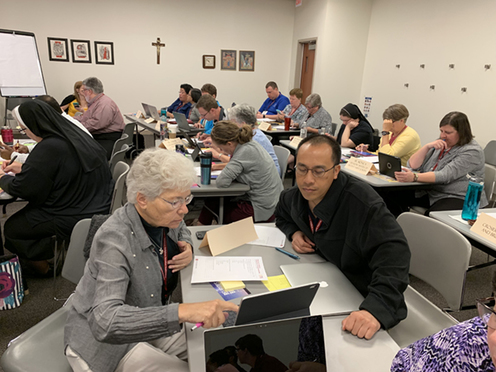
Vocation ministers need to understand psychological well-being and psychosexual development so that they may adequately assess a candidate’s ability to lead a passionate, healthy and integrated life. In this workshop we will explore: well-being, an integrated understanding of sexuality, the centrality of relationships and intimacy, the necessity of personal boundaries, the impact of one’s past, especially physical, emotional and sexual abuse on one’s ability to relate, emotional awareness and integration, living a healthy sexual and celibate life as well as the impact of social media on personal development.
This workshop is being presented by reknown speaker, Sr. Lynn Levo, CSJ, who has presented online workshops for religious sisters, brothers and priests around the world to keep participants engaged.
Please note this workshop begins at 8:30 a.m. on Monday, July 20 and ends at 4:00 p.m. on July 22. There are 2 twenty minute breaks and a 90 minute lunch to avoid screen fatigue.
NRVC member: $450 Non-member: $675
Become an NRVC member for reduced workshop rates
Registrations received after June 30 incur a $25 late fee.
Cancellations for workshops must be received in writing to debbiesscm@nrvc.net before June 30 to receive a full refund less a $100 processing fee. After June 30, all fees are non refundable.
Sister Lynn Levo, C.S.J., Ph.D. is a member of the Sisters of St. Joseph of Carondelet, a licensed psychologist, consultant and lecturer. She received her Ph.D. from the University of New York at Albany, completing her clinical training at The University of Kansas School of Medicine. After serving 12 years as the Director of Education and Editor of Lukenotes at Saint Luke Institute, Silver Spring, MD, Lynn is currently a consulting psychologist in private practice, offering consultations, presentations, and workshops both in the U.S. and abroad on fostering healthy integrated sexuality, celibacy, relationships, intimacy, mutuality in community, and emotional intelligence. Lynn received the NRVC Outstanding Recognition Award at Convocation 2016.
This workshop gave me a greater understanding of the experiences I have had in ministry and how to work with/in specific areas of need of candidate assessment. Sr. Lynn was very clear and straightforward with sharing her wisdom with us.
–Michelle Horton
The material was extensive and presented well. Learning more about gender identity, sexual energy and intimacy skills was most helpful for me professionally and in living my own vocation well.
–Br. Pat Douglas, S.J.
I am a post-novitiate formator and work closely with the formators and vocation personnel on our team. This workshop will help us integrate the material throughout the formation process. Sr. Lynn is an expert on this topic as well as religious life. She is wise and knowledgeable, and very respectful, knowing the realities of humanity.
–Fr. Tom Carkhuff, O.S.C.
Workshops are designed from the NRVC three-component curriculum for those who wish to deepen their understanding of the complex theological, spiritual, psycho-sexual, ethical, and diversity issues often present in contemporary vocation ministry. NRVC recommends that vocation ministers participate in ongoing educational opportunities to attend to their own vocation, faith formation, and to further develop their professional competencies. Please read the terms and conditions of all NRVC programs and events.
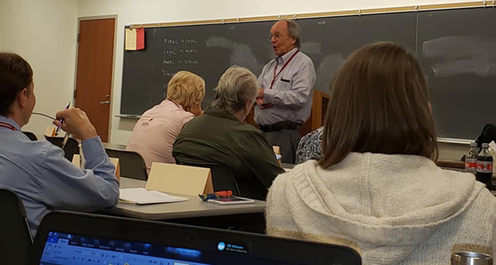
This workshop presents practical interviewing techniques housed in a theoretical framework of behavioral assessment. While the focus of the workshop is on assessment of candidates for admission to initial formation, the methodology easily applies to assessing candidates in other stages of formation as well. Workshop participants study sample case reports and learn skills for interviewing as well as guidelines for organizing the information into useful reports. Interview topics include: family background, educational and occupational histories, psychosexual histories and intimacy skills, faith history, and other pertinent issues related to comprehensive vocation assessment.
Please note this three day workshop begins each day at 9:30 a.m. and ends at 2:30 p.m. Central time. There are 2 scheduled breaks along with a 60 minute lunch from 11:30 - 12:30 (CT) to avoid screen fatigue.
NRVC member: $450 $675 Non-member
Become an NRVC member for reduced workshop rates.
Registrations received after June 30 incur a $50 late fee.
Cancellations for workshops must be received in writing to debbiesscm@nrvc.net before June 30 to receive a full refund less a $100 processing fee. After June 30, all fees are non refundable.
Reverend Raymond P. Carey, Ph.D. is a priest of the Archdiocese of Portland, OR. He has taught at both the secondary and university levels, and presently teaches at Mount Angel Seminary Graduate School of Theology in Saint Benedict, Oregon. Fr. Carey holds a doctorate in clinical psychology from the University of Ottawa, Canada. He has presented workshops in North America, Europe, Australia, New Zealand and Fiji. He is a recipient of the NRVC Harvest Award and a Lifetime NRVC member for his work in service of vocation ministry.
After this workshop, I have the confidence to use the Behavioral Assessment following FDIC and direct/indirect interviewing techniques to respect each discerner's right to minimal intrusion. Fr. Ray's knowledge and his ability to share stories that drive deeper into the information is most helpful.
--Sister Jean Rhoads, D.C.
I loved his humor and stories that related to the content well. This workshop exceeded my expectations. Thank you!
--Father Derek Swanson, C.M.
What a privilege to learn from Fr. Ray! It was refreshing and validating, exemplification of our values put to the service of vocation ministry. These were long, full days but I would rather be overwhelmed than underwhelmed. Everything that was covered was relevant and pertinent to discernment and assessment.
--Sister Andrea Koverman, S.C.
To assist NRVC members with their professional development, the Misericordia Scholarship Fund is available. Scholarship funds can be applied to NRVC workshops; however, they do not cover the cost of transportation, accommodations, meals or personal expenses. If you need financial assistance to attend an NRVC workshop, please contact srcharleneh@nrvc.net for an application.
Workshops are designed from the NRVC three-component curriculum for those who wish to deepen their understanding of the complex theological, spiritual, psycho-sexual, ethical, and diversity issues often present in contemporary vocation ministry. NRVC recommends that vocation ministers participate in ongoing educational opportunities to attend to their own vocation, faith formation, and to further develop their professional competencies. Please read the terms and conditions of all NRVC programs and events.
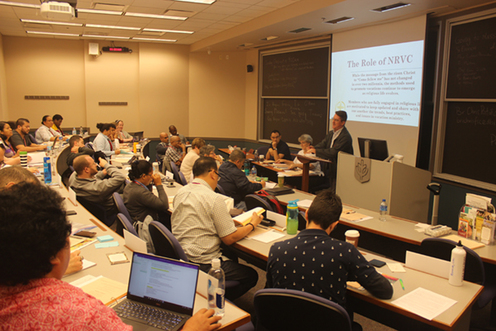
This workshop is intended for new and recently appointed vocation directors. Its goal is to provide participants with the skills, context, theory, challenges and practicalities of contemporary vocation ministry. Topics will include foundational elements of vocation ministry; assessment of inquirers and discerners; application and admission process; vocation promotion, ethics and boundaries, resiliency and self-care of the vocation director.
This online workshop will keep your attention with five dynamic presenters covering over 70 topics for new vocation ministers. Participant networking is encouraged throughout the workshop with small group breakout sessions.
Please note this five day workshop begins each day at 9:30 a.m. and ends at 3:30 p.m. Central time. There are 2 scheduled breaks along with a 60 minute lunch from noon to 1:00 p.m. (CT) to avoid screen fatigue.
NRVC member: $750 Non-member: $1125
Become an NRVC member to save on workshop fees.
Cancellations for workshops must be received in writing to debbiesscm@nrvc.net before June 30 to receive a full refund less a $100 processing fee. After June 30, all fees are non refundable.
Sister Deborah M. Borneman, SS.C.M. began working for the NRVC in 2011 and presently serves as the Director of Mission Integration. A Sister of Saints Cyril and Methodius, she served 10 years as vocation director for her community and is currently serving on her congregational leadership team. Sr. Debbie has previous ministerial experience in pastoral care, youth ministry, college campus ministry and immigration advocacy. She has presented on various topics in vocation ministry in Ireland and throughout the United States. Sr. Debbie holds a Master of Divinity degree and a Master of Arts Degree in Pastoral Studies (Loyola University, Chicago).
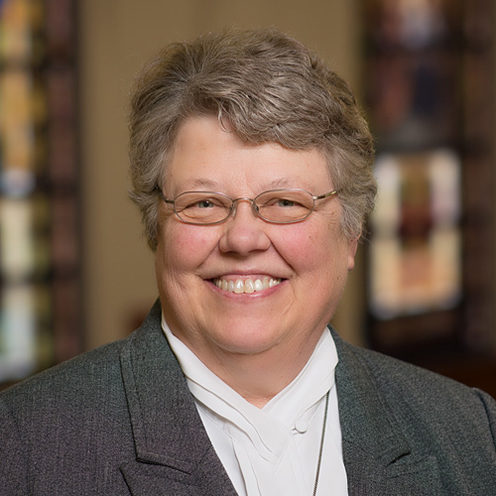 Sister Charlene Herincxk, S.S.M.O. currently serves as the NRVC Director of Membership and previously served as the NRVC Coordinator of Programs and Projects from 1999-2005. A Sister of St. Mary of Oregon, her ministry experience includes middle and high school teacher, school administrator, community vocation director, assistant Archdiocesan vocation director, and community leadership. She holds a Master of Arts in Private School Administration (University of San Francisco) and a Master of Education (University of Portland). She was recognized with a Lifetime NRVC Membership in 2014.
Father Adam MacDonald, S.V.D. is a native of Flint, Michigan and ordained for the Society of the Divine Word. Since 2011, Fr. Adam has served as a Vocation Director for his congregation. He previously served in the Philippines, on the Provincial Council for the Chicago Province and as Vice-Provincial. Fr. Adam holds a Master of Divinity degree (Catholic Theological Union, Chicago) and a Certificate in Spiritual Direction from the Center for Spiritual Development, California. He currently serves on the NRVC National Board executive committee and has previously served on the NRVC Editorial Board and the Vocation Ambassador Design team.
 Brother Chris Patiño, FSC is a De La Salle Christian Brother and currently serves as Director of Vocation Ministry for the Christian Brothers’ U.S.A. western province. He previously served in education and on his Provincial Council. Br. Chris holds an undergraduate degree in Religious Studies (University of Arizona) and a Master of Arts in Pastoral Studies (Loyola University, Chicago). In addition to his responsibilities as vocation director, he serves on the Board of Trustees of De La Salle North Catholic High School in Portland, the Religious Brothers Conference Board, and as NRVC West Coast Member Area Co-coordinator.
 Sister Minnette Welding, I.H.M. is a Sister, Servant of the Immaculate Heart of Mary, Scranton, PA, and ministers as the Director of Vocations for her IHM Congregation. She has spent her religious life ministering to adolescents and young adults in college campus ministry, secondary education and parish youth/young adult ministry as well as Diocesan vocation ministry. She is also a spiritual director and retreat director. Sister has a Master of Arts Degree in Pastoral Care and Counseling from Neumann University concentrating in Spiritual Direction and a Master of Science Degree from Fordham University in Youth and Young Adult Ministry/Religious Education.
To assist NRVC members with their professional development, the Misericordia Scholarship Fund is available. Scholarship funds can be applied to NRVC workshops; however, they do not cover the cost of transportation, accommodations, meals or personal expenses. If you need financial assistance to attend an NRVC workshop, please contact srcharleneh@nrvc.net for an application.
Please read our NRVC terms and conditions for all events and programs.
I found the whole program very helpful. I appreciated the different perspectives from the speakers and the variety of examples provided. Learning about setting boundaries and the specifics about psychological testing and assessment especially helpful. I found all the presenters competent and engaging. Thank You! I didn't have a clue as to what I didn't know - things vital to my role as vocation director.
–--Sister Vickie Griner, osc
A great experience; it came at a perfect time since I’ve been at this for a few months and a new academic year is starting soon. There’s alot to digest, but the manual and on-line resources are a Godsend. THANK YOU!
–Brother Larry Schatz, F.S.C..
Being a layperson and new to vocation ministry, I found all aspects of the program helpful. The materials and small group conversation gave me a better understanding of vowed life and the complex role of the vocation director. I was pleasantly surprised at how effective and enjoyable this online format can be. I’ve always preferred traditional classroom settings but after participating in this program I wouldn’t hesitate to sign up for this format again. It was so well done. This workshop definitely exceeded my expectations. Thank you!
–Ms. Kathryn Davis for the Congregation of Bon Secours.
Workshops are designed from the NRVC three-component curriculum for those who wish to deepen their understanding of the complex theological, spiritual, psycho-sexual, ethical, and diversity issues often present in contemporary vocation ministry. NRVC recommends that vocation ministers participate in ongoing educational opportunities to attend to their own vocation, faith formation, and to further develop their professional competencies. Please read the terms and conditions of all NRVC programs and events.

Members of NRVC—like people the world over—have experienced the pandemic restrictions in a variety of ways, both good and bad. Emotionally and practically, life has been harder for some and not particularly burdensome for others. In terms of work, most members report in a recent survey they have adapted to greater reliance on technology without too many bumps in the road. Some are enjoying newfound competence and success in ministering via virtual technology.
Emotionally, our members have experienced a wide range of responses, each according to their individual circumstances and pressures. Some have endured a ramped up and tiring workload, with additional caregiving, administrative, and fundraising duties. Grief and anxiety have hit some individuals hard because some have lost loved ones--family and community members and friends--to coronavirus or other illnesses, and social distancing makes funerals and mourning practices less satisfying. Many members miss hugs, handshakes, and the social contact of being with other people in real life. Furthermore, members are disturbed at the heightened level of the country’s social and racial injustices and the resulting unrest.
The pandemic has had a silver lining for some, as some members have enjoyed a lighter workload and additional time for prayer and self care (a great deal of time was freed up initially by travel restrictions and event cancellations). Some members find themselves coping with their COVID-19 lives with equanimity, knowing themselves to be less burdened than others. The communal social structure of religious life has freed many NRVC members of the burden of social isolation, although it has in some cases intensified difficult relationships.
Even though many members are unable to worship and celebrate the sacraments as they normally would, a large number report that faith and prayer has been a fortress from which they’ve drawn strength. A number have even reported better balance in work-prayer-community time.
Although the pandemic has psychologically impacted NRVC members in widely different ways, members agree on one truism: human encounter, free of technology, is the ideal way to establish and nurture relationships of all types, including those cultivated in vocation ministry. Many members report that they’re glad to have phoning, texting, video-conferencing, etc., but screen-free human contact is better. They find it more informative, energizing, and lifegiving. With virtual contact at an all time high and much human contact happening from a six-foot distance (at best), NRVC members, like many others, fiercely miss real human contact.
Nonetheless, vocation ministers have revealed that they are adaptable and creative. Many are trying new techniques. Members now rely more heavily than ever on technology-assisted connections with discerners and co-workers. Even with its limits, the forced move to technology has allowed many NRVC members to have broader and more frequent connection than otherwise would be possible. Some say that attendance at virtual events seems to have been larger than if the events had been in person. This finding may encourage many to keep using virtual technology after the pandemic in order to make contact with inquirers, discerners, pre-postulants, and others more affordable and less time consuming for those considering religious life.
NRVC members report using all the alternative forms of connection at their disposal to make contact with women and men inquirers and discerners.

• Network with NRVC members: you may have a local expert! Most regions have multiple members who are adept at using technology. Don’t be shy about asking your member area coordinators for suggestions about who might be able to provide knowhow on things like socially distanced assessments, video-conference retreats, Zoom meetings with discerners, etc. The member area coordinators have met many of the members in their geographic area and can likely share with you names and contact information as well as their own wisdom on many topics. A members-only list of member area coordinators and details of member gatherings is at: nrvc.net/502/publication/4349/article/7809-member-area-news
• Use online learning to educate yourself about technology. Search YouTube using different keywords until you find helpful materials. Remember, some posts are made by professionals and others have been made by amateurs. In any case, you may find visual, step-by-step answers about exactly what you need. For sustained training, you may want to see if your library offers free online courses about video-conferencing (or a host of other topics) through a provider such as Lynda.com.
• Focus on possibilities, and attend to the needs of young people. Members who offered tips for coping with coronavirus ministry repeated the need to focus on what CAN be done and to be open to innovation and creative solutions to problems One of the most common types of advice is to do whatever possible to maintain relationships with young adults and other contacts. Many vocation ministers noted that they were forced to go outside their comfort zone and use techniques and technologies that they are not drawn to. “Be creative and think outside the box. Talk to young adults about what they desire. Be willing to be uncomfortable and try new things!” Another wrote: “Engage with young adults even if they aren’t explicitly thinking about religious life. They are looking for ways to connect to a church they love. They are looking to connect with one another.”
§ § § § §
The COVID-19 season of our lives and ministry will last for an undetermined length of time. A great deal about the virus and its impact is simply unknown. We don’t know when a vaccine will be available. We don’t know if a additional “waves” of infections will happen. Through it all, vocation ministers work, pray, listen, unite, and hope.
It’s a good time to remember the words of Sister Thea Bowman, F.S.P.A., who knew something about the persevering spirit of so many NRVC members: “Sometimes people think they have to do big things in order to make change. But if each one would light a candle, we'd have a tremendous light.”
Published on: 2020-06-26
More than 390 people attended the NRVC virtual Convocation held October 28-31, including dozens of newer religious and leaders. The interactive event included diverse presentations, prayer time, small group discussions, an awards ceremony, and more. Participants donated $5,200 to the National Black Sisters Conference, the largest amount ever raised during NRVC's traditional offertory collection during a convocation liturgy. The NRVC is grateful to Convocation speakers and participants and to the many sponsors whose support made it possible. The Winter edition of HORIZON, which mails in February, will carry selected presentations.
Published on: 2020-11-02
The NRVC ended its virtual convocation October 31 by presenting awards for outstanding contributions to vocation ministry to seven individuals and the Notre Dame Vision program. Mary Lou Rafferty, owner of the J.S. Paluch Company, Inc., was given the Harvest Award. Rafferty and her company have lent support to vocation efforts in numerous ways for decades, most notably by hosting an annual seminar for diocesan and religious life vocation personnel. Father Ray Carey, who has conducted workshops on ethics and assessment for decades, was presented a lifetime membership. Five members of NRVC who have gone above and beyond in service to vocation ministry received the Outstanding Recognition Award: Sister Michael Francine Duncan, S.S.M.O., Brother Ronnie Hingle, S.C., Sister Marie Mackey, C.S.J., Sister Priscilla Moreno, R.S.M., and Brother Sean Sammon, F.M.S. The Notre Dame Vision program—a summertime faith development program for high school students—received the Mustard Seed Award. Learn more here.
Published on: 2020-11-02
The 2019 Annual Report is now available for viewing online. With a theme of sustainability, the report reviews key accomplishments. In outward-focused ministry, the NRVC took part in World Youth Day, began a study of newer members, took part in and co-hosted webinars, continued its tradition of excellence in publishing and workshop offerings, and launched the blog "Catalyst." At the same time, the organization secured its future through the Team Leadership Model of staffing, board restructuring, and financial structure improvements. Learn more here.
Published on: 2020-09-28
Thank you to all who practice vocation ministry or support it. The NRVC extends appreciation to its members who focus on walking with inquirers and their families, assisting candidates through the application process, and animating membership to embrace those who enter. We encourage you to celebrate National Vocation Awareness Week. Resources are available on nrvc.net.
On October 7, NRVC members will be emailed an electronic ballot for voting on the proposed changes to the NRVC constitution. The changes—which were shaped with member feedback—are intended to bring our organization in line with current realities. NRVC sent members the proposed changes in September and is now asking them to kindly use the ballot emailed to them, even if abstaining. Results will be announced at the Convocation business meeting on October 31.
Published on: 2020-09-01
Updated on: 2020-09-24
This 63-page booklet is an affordable resource for those who want to use pandemic solitude to pray more about their vocation. It is written as a 30-day retreat using scripture, reflection, activities, and questions. Authored by Father Tat Hoang, C.S.s.R., these booklets are just $4 for members, $6 for non-members. Read more.
Published on: 2020-09-01
Congratulations to the five NRVC members who were selected by the board in August to each receive the Outstanding Member Recognition Award at the NRVC virtual Convocation, taking place October 28-31.
• Sister Michael Francine Duncan, S.S.M.O.
• Brother Ronnie Hingle, S.C.
• Sister Marie Mackey, C.S.J.
• Sister Priscilla Moreno, R.S.M.
• Brother Sean Sammon, F.M.S.
Each recipient has served the cause of vocation ministry in a way that has lifted up all of religious life. The NRVC extends deep thanks and congratulations to them all.
Published on: 2020-08-26
The NRVC thanks three departing members of the national board for completing a full six-year term of service in August 2020:
• Sister Gayle Lwanga Crumbley, R.G.S.
• Sister Anita Quigley, S.H.C.J.
• Sister Anna Marie Espinosa, I.W.B.S.
As these board members stepped down with the gratitude of NRVC, three new members are beginning service. We welcome them!
• Sister Marichui Bringas, C.C.V.I.
• Sister Jean Marie Fernandez, R.G.S.
• Brother Brian Poulin, F.M.S.
Published on: 2020-09-01

THE COVID-19 PANDEMIC has put travel of all types on hold, but knowing that religious communities usually plan large-scale events far in advance, we present this outline of a pilgrimage program to inspire and aid readers to consider this possibility. The author’s community began working with young people to organize the first pilgrimage two years in advance.
A pilgrimage is a time of inner and outer exploring, learning, renewal, and recommitment. For young people who are exploring their gifts and talents and their place in the world, a pilgrimage can be a sacred time of spiritual growth and even vocational discernment. The Sisters of St. Joseph of Canada and their lay ministries have found that sponsoring pilgrimages has been a beautiful way to forge relationships with young adults and introduce them to our rich spiritual traditions.
Over the last several years, young men and women in a group called Faith Connections—a lay run ministry sponsored by the Sisters of St. Joseph of Toronto—have asked for and collaborated in organizing three pilgrimages with the sisters. The experience has been life-giving for all.
Our pilgrimage concept began in 2012 when Faith Connections collaborated with St. Bonaventure Parish, in Toronto, and the Conventual Franciscans to take 10 young adults to a “Francis Fest.” This was a gathering of 45 young adults (from Toronto, Ontario; Raleigh, North Carolina, and Syracuse, New York) who met at the Franciscan Church of the Assumption in Syracuse, New York. Father Eric de la Pena, O.F.M. Conv. led the pilgrims in a weekend program that sought to give them a “glimpse of the great spiritual wealth of the Franciscan Order, so that these values can be transmitted into the future.”
During the weekend the young people learned the pillars of Franciscan spirituality, prayed the Divine Office with the friars, visited the shrine of Sister Marianne Cope, a recently canonized Franciscan sister, and participated in the ministries of the friars to the poor in the neighborhood.
Afterward the Faith Connections ministry team, inspired by the experience in Syracuse, began to dream and ask whether they could organize something similar—perhaps a “Joseph Jam”—in collaboration with various communities of Sisters of St. Joseph. The team considered inviting young people on a weekend journey to visit a CSJ community, learn about the charism, participate in ministry, enter into prayer, eat together, and laugh together? Could young adults be gathered from diverse geographical regions to participate?
The idea was presented to the leadership of the Federation of Sisters of St. Joseph of Canada by the Faith Connections team. Possible ways to be involved were participating on a visioning team, being part of the event planning team, being a host congregation, bringing a group of young adults, or simply sharing pilgrimage information with one’s congregation. The Federation leaders were interested, and planning began.
During the next two years the Faith Connections ministry team and members of the Federation of the Sisters of St. Joseph of Canada met with several young adults to determine the schedule, format and content of a pilgrimage based on the spirituality and ministries of the Sisters of St. Joseph.
This process resulted in three pilgrimages over the next six years, with a fourth for 2020 that was held, in part, by Zoom, with the full pilgrimage to take place later. Each pilgrimage was evaluated and the next one adjusted accordingly.
Faith Connections publicized the pilgrimages, and the sisters hosted the pilgrims. For each pilgrimage, a booklet was prepared for every pilgrim containing the prayers, music, presentations, reflection questions, and prayer methods for the pilgrimage. The booklets left space for pilgrims to write notes and observations.
The theme for each pilgrimage was based on a recent writing of Pope Francis. We chose a destination from among the cities with CSJ foundations established by the Sisters of St. Joseph of Toronto. Following is a description of what happened on the pilgrimages.
The pilgrims who were able to met at a retirement home of the Sisters of St. Joseph of Toronto, where the sisters gathered to greet them and give a blessing as they set out on the first part of their journey in car pools. Individual sisters also “adopted” one of the pilgrims and wrote him or her a personal note and promised to pray for their pilgrim during the weekend. Pilgrims identified this as one of the important moments of the event.
Leaving Toronto, the young people followed a prepared guide that pointed out the early foundations and present ministries of the Sisters of St. Joseph that they passed on their route.
Pilgrimages have been held to London, Ontario; Hamilton, Ontario, and North Bay, Ontario. Each pilgrimage imparted information about the foundation of the Sisters of St. Joseph in that particular city and region, their ministries, and how the sisters lived their spirituality as CSJs according to the particular theme of the pilgrimage.
The theme for our first pilgrimage to London, “Living Joy,” was based on Pope Francis’ encyclical Evangelii Gaudium (The Joy of the Gospel). In Hamilton, during the Year of Mercy, the theme was “Living Mercy,” and in North Bay the theme was “Living Faith”—based on Gaudete et Exsultate (On the Call to Holiness in Today’s World).
Sisters of St. Joseph throughout the world live an Ignatian spirituality. This was reflected in the prayer experiences. During the “Living Mercy” pilgrimage, participants were led in a guided meditation on “Jesus as the face of the Father’s mercy,” using the scripture passage, Luke 14:1-14. To gather up the graces of the weekend on Sunday morning, in both London and Hamilton, the pilgrims were led through another Ignatian spiritual custom, the Examen prayer or awareness Examen, based on the theme of the pilgrimage.
Each city required some logistical adaptations. In London, the team and pilgrims slept in a local university residence hall and had their meals and activities at a nearby house of sisters where there was also a residence for senior sisters and a palliative care service for the city. In Hamilton there was enough space in the sisters’ main house for the team and pilgrims to stay there. And in North Bay some of the team and pilgrims stayed in the motherhouse while others commuted to a camp on another lake about 15 minutes away.
On Fridays we arrived at our destination in time for supper with the sisters. During all the pilgrimages our meals were eaten with the sisters of the hosting community. This provided a rich and relaxed venue for new learnings on the part of both the pilgrims and the sisters. In London we were able to have a barbeque with the sisters on Saturday evening. In the lineup for the hamburgers, one elderly sister was invited to go to the front of the line to which she retorted “No, I am waiting for the new friends I made today.” Earlier in the day she had taken a group of the pilgrims to her room and shown them prized pictures of her family and crafts she had made.
Supper on Friday nights was followed by a lively ice breaker, an introduction to the theme of the pilgrimage as lived by sisters, and the Divine Office. We topped off Friday evenings with a social. A special event in North Bay on Friday night was the re-enactment of Woman at the Well by John Shea, by the young adults. This was the cause of much hilarity but also deep reflection as we shared our inner reactions to the story.
Saturday’s activities, during the day, were adapted to the particular location of the pilgrimage. In London, the pilgrims learned about the environmentally friendly house of the Sisters, helped to clean up the garden, and entertained some dementia patients with a sing along.
In both London and Hamilton we spent the afternoon on a “Hike and Prayer” throughout the city to various locations where the sisters had established ministries.
In the rain in North Bay we had a pilgrimage throughout the large motherhouse where modern Stations of the Cross were set up and different sisters spoke of their ministry, relating stories of those they served to Jesus’ suffering on the way to Calvary.
Saturday night on each pilgrimage included Adoration and Taize prayer with the sisters. Pilgrims had opportunities for sacramental reconciliation and spiritual direction. In London one of the priests who had come to help with confession was heard saying he “loved to be around when the Holy Spirit was creating a buzz.”
On Sunday morning in London and Hamilton we had time to gather up the graces of the pilgrimage and celebrate the Sunday liturgy with the sisters before the return home after lunch.
In North Bay, the Sunday liturgy was celebrated late on Saturday afternoon with all the Sisters at the motherhouse. On Sunday, three of the pilgrims shared their own “Living Faith” journey with the group. This was a very moving experience for everyone.
Another highlight of the North Bay pilgrimage was that the bishop for that diocese, Bishop Marcel Damphouse, participated in all the activities with the young adults throughout the weekend. His humble, friendly demeanor and participation as one of the pilgrims gave young people an opportunity to meet and speak with him apart from his more formal ministry. The bishop remarked on how much he had learned about the ministries of the sisters in his diocese.
These pilgrimages were filled with gifts and graces for both the pilgrims and the sisters. One way we know the young adults enjoyed them is that several pilgrims have attended all three pilgrimages and have invited their friends to come as well. According to the evaluations, a consistently popular aspect of the pilgrimages was spending time with the sisters, particularly the elderly ones. The pilgrims were impressed at their years of commitment and loved to listen to their stories. For some young adults this contact totally changed their idea of a sister from stereotypes to women who are serious, joyful, committed, and engaged. They see sisters aware of changing needs and willing to adapt to meet them.
In casual conversation while traveling to the pilgrimage sites or taking part in the ministry activities, the young people were able to experience the sisters as human beings like themselves. At the barbecue in London one pilgrim was amazed that a sister might drink a beer at a party on a hot summer night.
While learning about the varied ministries in each location, the young people became aware of how much the sisters had contributed to the social fabric throughout the province of Ontario since their arrival in 1851. The sisters, too, enjoyed having young people at meals, Eucharist, and prayer. In the times they visited and chatted together, they formed new relationships, some of which have continued over the years.
New relationships among the pilgrims have also been formed, and a private Facebook group has grown among the pilgrims. For the most recent pilgrimage to North Bay some of the pilgrims met for supper before the pilgrimage to get to know one another. In addition, one of the groups has held a reunion. A reunion is now one of the new initiatives we hope to carry forward with future pilgrimages.
Several pilgrims identified the spiritual aspects of the pilgrimage as meaningful. They learned new ways of praying both from the booklets prepared for each pilgrimage and the methods incorporated into the weekend. They appreciated the opportunities for confession and spiritual direction and identified these as occasions for new beginnings.
Evaluations of all the three pilgrimages asked that the time be longer and that there be more time for reflection, contemplation, and private prayer. Clearly, each of these pilgrimage experiences has been a time for connection to God and one another, a time for learning and inspiration. We hope our next pilgrimage—in the planning process right now—will result in similar blessings.
Sister Rosemary Fry, C.S.J. has been a Sister of St. Joseph of Toronto for 58 years. As a trained nurse she spent many years ministering in Haiti. Now, as Vocation Director for her congregation, she shares the joy in her life with young adults. Contact Sister Rosemary at rfry@csj-to.ca.
Published on: 2020-07-31
Edition: 2020 HORIZON No. 3 Summer
NRVC is delighted to announce that its publications, HORIZON and VISION, won four awards from the Catholic Press Association in late June 2020. They were for best magazine, best review, and best feature article (two awards in best feature article). Read more.
Published on: 2020-07-12
NRVC is committed to supporting interculturality and racial justice around the world and in religious life. We have many resources to assist those in vocation ministry in conducting vocation ministry that is inclusive and welcoming. For members, find articles under the heading "multicultural" in the HORIZON library. Also, immediately access Father Bryan Massingale's classic "Transformative love, passion for justice belong in vocation ministry." In addition, Catholic Theological Union has made these resources available: “We Belong to One Another” by Sister Barbara Kraemer, O.S.F., Ph.D. and “Interculturality: Challenges and Opportunities for Ministry“ by Michel Andraos, Ph.D.
Published on: 2020-06-22
The NRVC welcomes Indianapolis Archbishop Charles Thompson as the episcopal liaison to the National Religious Vocation Conference at the appointment of Bishop James Checchio, chairman of the USCCB Committee on Clergy, Consecrated Life, and Vocations (CCLV). READ MORE.
Published on: 2020-06-23
Please note Summer Institute registration closed on June 30.
This workshop will explore ethical principles governing confidentiality, agency and obligations related to positions of trust. The workshop will also address issues related to dissemination of information, the timeliness of admissions or dismissal decisions, and other issues related to ethical rights of candidates as well as ethical rights of those in positions of authority. This workshop is essential for all those who make decisions concerning the admission of candidates.
Please note this two day workshop begins each day at 9:30 a.m. and ends at 2:30 p.m. Central time. There are 2 scheduled breaks along with a 60 minute lunch from 11:30 - 12:30 (CT) to avoid screen fatigue.
NRVC member: $300 $450 Non-member
Become an NRVC member for reduced workshop rates.
Cancellations for workshops must be received in writing to debbiesscm@nrvc.net before June 30 to receive a full refund less a $100 processing fee. After June 30, all fees are non refundable.
Reverend Raymond P. Carey, Ph.D. is a priest of the Archdiocese of Portland, OR. He has taught at both the secondary and university levels, and presently teaches at Mount Angel Seminary Graduate School of Theology in Saint Benedict, Oregon. Fr. Carey holds a doctorate in clinical psychology from the University of Ottawa, Canada. He has presented workshops in North America, Europe, Australia, New Zealand and Fiji. He is a recipient of the NRVC Harvest Award and a Lifetime NRVC member for his work in service of vocation ministry.
The material was extensive and presented well. Learning more about gender identity, sexual energy and intimacy skills was most helpful for me professionally and in living my own vocation well.
–Brother Pat Douglas, S.J.
I am in leadership and because of the reports we receive when people are applying for vows, I was interested in the content of this program. There are three times that we can assess suitability (before entrance, temporary vows, final vows) and I wanted more content to be better able to make the assessment.
–Sister Marie Ursino, S.H.C.J., ministering in Rome, Italy
Pragmatic content effectively delivered. This workshop opened a new and valuable perspective for me. Now I understand why the vocation team sets up structures and interactions the way it does. I am grateful we now have a common language and goal.
–Brother Nick Gonzalez, F.S.C.
To assist NRVC members with their professional development, the Misericordia Scholarship Fund is available. Scholarship funds can be applied to NRVC workshops; however, they do not cover the cost of transportation, accommodations, meals or personal expenses. If you need financial assistance to attend an NRVC workshop, please contact srcharleneh@nrvc.net for an application.
Workshops are designed from the NRVC three-component curriculum for those who wish to deepen their understanding of the complex theological, spiritual, psycho-sexual, ethical, and diversity issues often present in contemporary vocation ministry. NRVC recommends that vocation ministers participate in ongoing educational opportunities to attend to their own vocation, faith formation, and to further develop their professional competencies. Please read the terms and conditions of all NRVC programs and events.
This workshop is intended for new and recently appointed vocation directors. Its goal is to provide participants with the skills, context, theory, challenges and practicalities of contemporary vocation ministry. Topics will include foundational elements of vocation ministry; assessment of inquirers and discerners; application and admission process; vocation promotion, ethics and boundaries, resiliency and self-care of the vocation director.
This online workshop will keep your attention with four dynamic presenters covering over 70 topics for new vocation ministers. Participant networking is encouraged throughout the workshop with adequate screen breaks.
Please note this workshop begins at 8:30 a.m. on Tuesday, July 7 and ends at 11:30 a.m. on Saturday, July 11 (Central time). There are 2 twenty minute breaks and a 90 minute lunch to avoid screen fatigue.
NRVC member: $675 Non-member: $1012
Become an NRVC member to save on workshop fees.
Registrations received after June 30 incur a $25 late fee.
Cancellations for workshops must be received in writing to debbiesscm@nrvc.net before June 30 to receive a full refund less a $100 processing fee. After June 30, all fees are non refundable.
Sister Deborah M. Borneman, SS.C.M. began working for the NRVC in 2011 and presently serves as the Director of Mission Integration. A Sister of Saints Cyril and Methodius, she served 10 years as vocation director for her community and is currently serving on her congregational leadership team. Sr. Debbie has previous ministerial experience in pastoral care, youth ministry, college campus ministry and immigration advocacy. She has presented on various topics in vocation ministry in Ireland and throughout the United States. Sr. Debbie holds a Master of Divinity degree and a Master of Arts Degree in Pastoral Studies (Loyola University, Chicago).
Father Adam MacDonald, S.V.D. is a native of Flint, Michigan and ordained for the Society of the Divine Word. Since 2011, Fr. Adam has served as a Vocation Director for his congregation. He previously served in the Philippines, on the Provincial Council for the Chicago Province and as Vice-Provincial. Fr. Adam holds a Master of Divinity degree (Catholic Theological Union, Chicago) and a Certificate in Spiritual Direction from the Center for Spiritual Development, California. He currently serves on the NRVC National Board executive committee and has previously served on the NRVC Editorial Board and the Vocation Ambassador Design team.
Brother Chris Patiño, FSC is a De La Salle Christian Brother and currently serves as Director of Vocation Ministry for the Christian Brothers’ U.S.A. western province. He previously served in education and on his Provincial Council. Br. Chris holds an undergraduate degree in Religious Studies (University of Arizona) and a Master of Arts in Pastoral Studies (Loyola University, Chicago). In addition to his responsibilities as vocation director, he serves on the Board of Trustees of De La Salle North Catholic High School in Portland, the Religious Brothers Conference Board, and as NRVC West Coast Member Area Co-coordinator.
Sister Minnette Welding, I.H.M. is a Sister, Servant of the Immaculate Heart of Mary, Scranton, PA, and ministers as the Director of Vocations for her IHM Congregation. She has spent her religious life ministering to adolescents and young adults in college campus ministry, secondary education and parish youth/young adult ministry as well as Diocesan vocation ministry. She is also a spiritual director and retreat director. Sister has a Master of Arts Degree in Pastoral Care and Counseling from Neumann University concentrating in Spiritual Direction and a Master of Science Degree from Fordham University in Youth and Young Adult Ministry/Religious Education.
This workshop exceeded my expectations. It led me to consider aspects of vocation ministry which I had not considered. My eyes were opened. The presenters were excellent in terms of conveying good information in a positive and hopeful manner.
–Br. Zachary Wilberding, O.S.B.
As a beginner in this ministry, everything was totally new for me. I gained insights, information and confidence. I appreciated the topics of professional behavior, confidentiality, and best practices.
–Sr. Maria Lotica Palma, C.S.C.
I have a better understanding of the role, responsibilities and ethics of a vocation director. I found the information around marketing, communications, generational data and social media most helpful.
–Sr. Denise West, O.S.B.
Workshops are designed from the NRVC three-component curriculum for those who wish to deepen their understanding of the complex theological, spiritual, psycho-sexual, ethical, and diversity issues often present in contemporary vocation ministry. NRVC recommends that vocation ministers participate in ongoing educational opportunities to attend to their own vocation, faith formation, and to further develop their professional competencies. Please read the terms and conditions of all NRVC programs and events.
Building upon the success of the 2020 Summer Institute and the unpredictability of this global pandemic, all Summer Institute workshops will be offered using the zoom platform. Workshop materials will be mailed to you.
Take a workshop this summer in the comfort of your home, no hassles with travel or packing, just time to enjoy learning from experienced presenters who will engage participants with a reasonable schedule integrated with screen breaks and small group breakout sessions.
Please note workshop times vary, however all workshops begin at 9:30 a.m. Central Time with communal prayer. Breaks are scheduled for the morning and afternoon sessions along with a 60 minute break for lunch.
Orientation Program for New Vocation Directors
July 12-16, 2021 9:30 am to 3:30 pm Central time
Behavioral Assessment 1
July 19-21, 2021 9:30 am to 2:30 pm Central time
Ethical Issues for Vocation and Formation Directors
July 23-24, 2021 9:30 am to 2:30 pm Central time
Is it Generational, Cultural, or Family of Origin?
Issues in Candidate Assessment
July 26-28, 2021 9:30 am to 2:30 pm Central time
Our annual Summer Institute will offer four workshops. Choose to attend one or several workshops.
We will be using the ZOOM webinar platform, which is a fairly familiar platform for many of us now due to "stay at home" orders and social-distancing requirements. For new users, a short tutorial will be available before the opening of Summer Institute.
Although in a different format, we are confident that Summer Institute will be IN-depth, INstructive, INsightful--all IN the comfort of your own space!
Cancellations for workshops must be received in writing to debbiesscm@nrvc.net before June 30 to receive a full refund, less a $100 processing fee per workshop. After July 1, all fees are non-refundable for the cancellation of workshops.
To assist NRVC members with their professional development, the Misericordia Scholarship Fund is available. Scholarship funds can be applied to NRVC workshops; however, they do not cover the cost of transportation, accommodations or personal expenses. If you need financial assistance to attend an NRVC workshop, please margyelan@nrvc.net for an application.
This was my second workshop this summer. NRVC did amazing work to keep motivation high and fatigue low. All-day is tough, but the two short breaks and longer lunch breaks were just right. The amount of interaction among participants and back and forth with the presenter was just right - no long, tedious, and off-topic ramblings you sometimes get when a person gets the floor in an in-person class; people seemed to realize they needed to brief. I was glad using the Chat function for conversations among participants to put forward a question or a resource.
--Sister Melissa Carmado, S.C.L.
I love very much the advantage of media technology for useful, educational means. Summer Institute via zoom was easy to connect; it also taught me how to manage and operate technology well for vocation ministry. The format especially the presentations and resources were clear, and the schedule was adaptable for me.
--Father Emilio Reyes, S.V.D.
I registered because of the positive experiences I’ve had in previous NRVC workshops and for ongoing professional development. Although it was the first time to conduct such an important workshop online, I personally found the material presented very enriching, helpful, and informative. Also I found the input very suitable to help myself and my community members. Thank you very much, I thoroughly enjoyed Summer Institute.
--Sister Lucinder Mologai, S.M.S.M from Fiji

Pope Francis’ apostolic exhortation, Evangelii Gaudium, (The Joy of the Gospel) details and lifts up the Christian virtue of hope. Every church minister, whether laboring in parishes or vocations, knows that hope is essential. We scatter seeds; God creates the harvest. Following is a section of Evangelii Gaudium (276-280) that elaborates on this theme of hope.
CHRIST'S RESURRECTION is not an event of the past; it contains a vital power which has permeated this world. Where all seems to be dead, signs of the resurrection suddenly spring up. It is an irresistible force. Often it seems that God does not exist: all around us we see persistent injustice, evil, indifference and cruelty. But it is also true that in the midst of darkness something new always springs to life and sooner or later produces fruit. On razed land life breaks through, stubbornly yet invincibly. However dark things are, goodness always re-emerges and spreads. Each day in our world beauty is born anew, it rises transformed through the storms of history. Values always tend to reappear under new guises, and human beings have arisen time after time from situations that seemed doomed. Such is the power of the resurrection, and all who evangelize are instruments of that power.
At the same time, new difficulties are constantly surfacing: experiences of failure and the human weaknesses which bring so much pain. We all know from experience that sometimes a task does not bring the satisfaction we seek, results are few and changes are slow, and we are tempted to grow weary. Yet lowering our arms momentarily out of weariness is not the same as lowering them for good, overcome by chronic discontent and by a listlessness that parches the soul. It also happens that our hearts can tire of the struggle because in the end we are caught up in ourselves, in a careerism which thirsts for recognition, applause, rewards, and status. In this case we do not lower our arms, but we no longer grasp what we seek, the resurrection is not there. In cases like these, the Gospel, the most beautiful message that this world can offer, is buried under a pile of excuses.
Faith also means believing in God, believing that he truly loves us, that he is alive, that he is mysteriously capable of intervening, that he does not abandon us (Pope Francis) TWEET THIS and that he brings good out of evil by his power and his infinite creativity. It means believing that he marches triumphantly in history with those who “are called and chosen and faithful” (Rev. 17:14). Let us believe the Gospel when it tells us that the kingdom of God is already present in this world and is growing, here and there, and in different ways: like the small seed which grows into a great tree (cf. Mt. 13:31-32), like the measure of leaven that makes the dough rise (cf. Matt. 13:33) and like the good seed that grows amid the weeds (cf. Matt. 13, 24-30) and can always pleasantly surprise us. The kingdom is here, it returns, it struggles to flourish anew. Christ’s resurrection everywhere calls forth seeds of that new world; even if they are cut back, they grow again, for the resurrection is already secretly woven into the fabric of this history, for Jesus did not rise in vain. May we never remain on the sidelines of this march of living hope!
Because we do not always see these seeds growing, we need an interior certainty, a conviction that God is able to act in every situation, even amid apparent setbacks: “We have this treasure in earthen vessels” (2 Cor. 4:7). This certainty is often called “a sense of mystery”. It involves knowing with certitude that all those who entrust themselves to God in love will bear good fruit (cf. Jn. 15:5). This fruitfulness is often invisible, elusive and unquantifiable. We can know quite well that our lives will be fruitful, without claiming to know how, or where, or when. We may be sure that none of our acts of love will be lost, nor any of our acts of sincere concern for others. No single act of love for God will be lost, no generous effort is meaningless, no painful endurance is wasted. All of these encircle our world like a vital force.
Sometimes it seems that our work is fruitless, but mission is not like a business transaction or investment, or even a humanitarian activity. It is not a show where we count how many people come as a result of our publicity; it is something much deeper, which escapes all measurement. It may be that the Lord uses our sacrifices to shower blessings in another part of the world which we will never visit. The Holy Spirit works as he wills, when he wills and where he wills; we entrust ourselves without pretending to see striking results. (Pope Francis in HORIZON) TWEET THIS We know only that our commitment is necessary. Let us learn to rest in the tenderness of the arms of the Father amid our creative and generous commitment. Let us keep marching forward; let us give him everything, allowing him to make our efforts bear fruit in his good time.
Keeping our missionary fervor alive calls for firm trust in the Holy Spirit, for it is he who “helps us in our weakness” (Rom. 8:26). But this generous trust has to be nourished, and so we need to invoke the Spirit constantly. He can heal whatever causes us to flag in the missionary endeavour. It is true that this trust in the unseen can cause us to feel disoriented: it is like being plunged into the deep and not knowing what we will find. I myself have frequently experienced this. Yet there is no greater freedom than that of allowing oneself to be guided by the Holy Spirit, renouncing the attempt to plan and control everything to the last detail, and instead letting him enlighten, guide and direct us, leading us wherever he wills. The Holy Spirit knows well what is needed in every time and place. This is what it means to be mysteriously fruitful!

RELIGIOUS LIFE IN THE UNITED STATES is not a single reality. Like other large and evolving institutions, religious life in its many forms in this large nation bears witness to multiple realities all at the same time. Currently in the U.S. the church is bidding farewell to some religious institutes, but simultaneously new men and women are beginning formation in other institutes. In fact 2016 saw an uptick in both those beginning formation as well as in those taking final vows.
and sometimes even in spite of our lack of innovation and creativity. The preparatory document for the 2018 synod of bishops (Young People, Faith and Vocational Discernment) encourages those in vocation accompaniment to go “beyond a preconceived framework, encountering young people where they are, adapting to their times and pace of life and taking them seriously.”
Every community, the document declares, must boldly find “creative ways of addressing young people in a personal way” and avoid the trap of “stifling what is new” with a “closed and complacent pastoral attitude that says: ‘We have always done it this way.’”
My experience in vocation ministry has largely been with my own community, the Congregation of the Sisters of Divine Providence of Texas (CDP), and we are seeing an unexpected surge in serious discerners, applicants, and entrants after undergoing a significant vocational fallow time. Our initial formation group now consists of three annual professed sisters, two novices, one pre-novice, and three affiliates with action plans moving them toward entrance.
Our youngest new member is a 26-year-old novice; the oldest is a 42-year-old affiliate. The vocation team consistently works with five to seven additional serious inquirers. Perhaps even more striking is that all eight women who have professed vows over the last 10 years remain in the congregation. That constitutes an almost unheard of 100 percent retention rate. So how do we explain it?
A national expert in contemporary religious life once said, “I don’t get it. You don’t fit the profile of a congregation attracting vocations.” Let’s look at some of the ways we don’t seem to the fit the norm for the type of community that is receiving new members.
“You are too old.” Our median age is 81.5. “You are too small.” We currently have 133 sisters. “You are not international.” We have a small Mexico region and several international sisters from other religious institutes who study and live with us, but our professed sisters primarily live and minister in informal hubs within a two state radius.
Our congregation generously supports and actively encourages vocation ministry.
The list continued: “You are an underfunded group with limited resources for vocation outreach.” Despite our limited resources, we still made some decisions that have been helpful. Our congregation generously supports and actively encourages vocation ministry. Leadership had the foresight to maintain full-time vocation and formation positions during the vocationally lean years. As a result, we were updated and ready to receive women when they did come. Use of social media, creative and innovative thinking on the part of the New Membership Team, and collaboration with associates, local religious congregations, and national organizations, such as the National Religious Vocation Conference, National Catholic Sisters Week, and SisterStory have created dynamic and expansive forms of outreach and follow-up that do not over-extend our budget.
“You are not visible.” We have diverse expressions of community life and prayer; our apparel is inconspicuous; and our ministerial presence is collaborative. This is our blessing and gift to the church. Instead of focusing on visibility as an issue, we simply tell others we are women of Providence hidden in Christ among the people.
“You don’t have new transfer sisters.” Honesty with ourselves and others is essential. We are open to transfer sisters and do desire congregational growth, but we guard against becoming a safety net for sisters seeking respite from hard personal and congregational issues. Deep conversations with women seeking a transfer have not indicated a God-inspired call to receive them. Rather the conversations have powerfully affirmed that these women do see something happening in our congregation that they long for in their own groups.
In spite of all the ways our community does not meet the contemporary profile, we are receiving younger entrants. We work to foster the developmental, interpersonal, and spiritual growth appropriate for women of all ages in formation and in our broader congregation. Together we become more mature, grounded, faith-filled, and relational.
These combined realities point toward a God of Surprises. We see it as integrity and fidelity to the way God is fashioning our particular way of living religious life within today’s church and world. Looking beyond my own institute, the hovering hope for all is that under the right conditions, new life and vocations can flourish in the fertile soil of other groups that do not “fit the profile.”
One of our new members recently noted, “You don’t get nine women by accident.” Vocations and vowed membership thrive or wither within a context. Vocation ministers try to identify what draws discerners toward or away from their group. Here are some of the factors that we think are attracting.
A relevant charism—For us, this means being the face of God’s provident, loving care for all creation. Our charism flows from a deeply held belief that God is in the middle of all things, regardless of how it may look, actively engaging us in helping to bring things to good. After due diligence on our part, we trust God will provide for what is lacking. This was true in the past, but is equally true now, as we hope it will be in our future.
A strong sense of belonging—God’s provident love shapes the heart of our message. The desire to be the living embodiment of God’s care and love pulses through relationships we form with God, each other, and those we serve. We know we are not alone. We clearly are “in it” together regardless of where “it” takes us. Belonging is a powerful life sign that can be palpably felt by discerners. Our vowed members live in households of various sizes, and our ministries are varied. But our members have a sense of belonging, of community.
Transparency and honesty—Our virtue of simplicity calls us to come before God and others with honesty, directness, and candor. It takes individual and congregational growth, change, and reshaping to become more of who God calls us to be. On the flip side, for better or worse, we also are who we are. A woman in initial formation remarked after her first visit, “You don’t hide anyone, do you?” No we don’t. What you see is what you get. As counterintuitive as that may seem, it makes it so much easier for a vocation minister in the long run!
A collaborative, creative spirit—This spirit is open to new life and different possibilities. Life can transcend but not circumvent diminishment. We can diligently work with hard questions and concrete realities without languishing or becoming caught in the quagmire of larger-than-life, self-imposed myths about diminishment and liminality. The central belief is that Providence does more than we can ask for or imagine and urges us out of the rut of past rumination or present worry, nudging us toward a more dynamic space of life and possibility.
Excitement to be crossing the threshold of another major evolution of religious life—As in any religious institute, our members have different responses to being in the thick of a time of transformation. Women of Providence as a whole are spiritually wired to be hopeful, open, curious, and full of life. An elderly sister, when asked about finding herself in yet another transition period, smiled and said, “We’ve done this before. The first time we had plenty of energy but not a lot of wisdom. We know more about how to do it this time around. Just think, I get a second chance in my lifetime to help shape religious life!” What a gift. What an attitude. What a contagious source of energy and hope for everyone, including discerners!
Discerners standing at the threshold of contemporary religious life awaken great hope and energy for everyone. They are eager to walk into our religious institutes with eyes wide open. These resilient and hardy individuals are not afraid to say “yes” to a life form that they can’t entirely envision. New members today must embrace the prospect of balancing the heavy responsibility of keeping mission alive while simultaneously caring for elderly members and dealing with physical changes in the religious institute. Serious discerners, like professed members, must be gently introduced to the truth that in this modern world of secularization, flux, and change the long-term survival of any particular religious institute or style of religious life (including ours) can’t be presumed.
The blissful naiveté of the past is over. Today vocation ministers must articulate the Paschal Mystery inherent in their own religious institute, spot candidates who will fit with their group at this precise point in the congregational lifespan, and encourage discerners who do not fit to seek other directions. As such, vocation ministers, even in thriving religious institutes, need to be prepared to honestly address “burying the dead” questions while simultaneously moving discerners towards life, goodness and hope.
One such question pertains to when serious discerners, candidates, and postulants should be introduced to institutional financial and operational complexities. Applicants typically provide full financial disclosure to their religious institute prior to admission. Justice requires that we provide them with an accurate financial snapshot of ourselves, too. As an underfunded group, our reality may be difficult to swallow, but any woman journeying with us must grapple with it. They have not bolted or become disillusioned. Rather, financial transparency on our part allows us to see how they react to our challenging institutional realities. Are they mature women? What can we learn about their priorities and motivations? Do they have the stamina to stay the course and work with us as a team? What business, financial, or legal expertise or everyday common sense do they bring to the table? How do they handle protective concern from family and friends related to our financial vulnerabilities? How do they explain the situation to others?
Aging, death, and grief surface other “burying the dead” questions. Death and loss are dramatic but less spoken-about counter cultural aspects of convent life. Discerners can’t be shielded from grief and the secondary impact of watching others grieve. With a median age of 81.5, loss of beloved members is a regular part of the rhythm of our congregation. They enter into a loving, prayerful network of elders who provide faith and wisdom and who model our form of religious life well-lived at all ages and stages. But how does everyone respond to the prospect of intergenerational living? What are discerner’s experiences related to aging and illness? Have they experienced the death of a loved one or navigated through the complexities of grief? Where does faith come into play? Might our charism add other nuances? These are vocation and formation issues, and we attempt to deal with these conversations directly. A convent subculture shaped after decades of communal living may appear foreign or diametrically opposed to a discerner’s personal feelings or previous family reactions to loss, death and dying.
Finally, the congregational lifespan itself impacts vocation choices. A personal call is influenced by the vitality and viability of a religious community. Religious institutes are at various points on the spectrum of a congregational lifespan. The discerner and the vocation minister step into this mix. Religious institutes in a stable maintenance mode may respond differently to vocations than those undergoing profound shifts such as mergers, coming to completion, or institutional transformation. It must be decided when, how, or even should important organizational shifts be shared with the discerner.
Even vocation ministers who do not address specifics inevitably encounter discerners who visit social media sites and blogs where newer members voice hope and joy in their calling. They also may express fears about becoming casualties of their own institute’s preoccupation with the dying process. Discerners may learn that care of elders or preoccupation with handing on a legacy can siphon away precious, life-giving energy needed to cultivate vocations or expand mission. They may witness group division or speak with new members who feel hurt or marginalized after essential yet sensitive communal conversations about whether to continue to invite new members or fund vocation outreach. Vocation ministers are like white water expedition guides, navigating the rapids of changes in contemporary religious life with a boat full of vocation prospects. And to top it off, they navigate a fine line between firing the passion for religious life and putting out internal community fires that threaten to consume the entire vocation.
Fires also create change. Vocation ministers are heralds of hope and agents of transformation. Sister Misty Garriga, C.D.P., a member of Giving Voice and an annual professed sister in our congregation, writes that younger members find themselves “ultimately spending time in the tomb as we await our resurrection and ascension into a different version of religious life.”
Resilience is needed to help those “coming out of the tomb.” It brings stability and equilibrium during times of change, setbacks, and challenges. Religious institutes, vocation ministers, and serious discerners must be able to rebound.
My former work as an attorney who represented immigrant women and girls fleeing violence showed me the connection between resilience and “coming out of the tomb.” The aftermath of life-altering trauma took on different faces such as anger, paralysis, discombobulation, fear, mistrust, or a desire to avoid or flee. The degree of impact was influenced by the reactions of others, the type and duration of the trauma, resources at their disposal, and their personal desire for wholeness and healing. Time varied between initial healing and their adjustment to a new “post trauma” normal. Changes and transformation in religious life are also life-altering events that can traumatize vocation ministers as well as religious institutes. Resilience is needed even when the end result of change is ultimately positive.
Resilient vocation ministers find ways to integrate changes in religious life, in secular life, and in organizational lifecycle directions. Vocation directors who are resilient are well positioned to encourage innovative vocation programs and effective one-on-one discussions with discerners. They also:
• Honestly try to work through the fear, paralysis, anger, or powerlessness associated with congregational change and its ramifications on vocation outreach;
• Break through barriers of thinking things must be done in the same old ways even when those ways are not working;
• Discover ways to recharge personal faith and deepen hope and love for their religious institute and members;
• Find the creativity and courage needed to innovate and try things that might fail or might not be initially embraced by membership, leaders, or the vocation team; and
• Search for new information and develop skills that help vocation outreach flourish despite the challenges faced.
The bottom line is that the vocation minister must believe deep inside that his or her religious institute is worthy of carrying on. Does that belief match with reality? Members, too, must believe in a future. Life instinctively knows life. Discerners will pick up and identify with the life and resilience that the vocation minister does or does not exude.
Resilient candidates are flexible and can let go, grieve, and move forward. Some have an age-old, yet ever new pioneering spirit. Others show strength, a hardy spiritual life, a dogged persistence. They may champion justice or have a deep love for the poor. Some resilient candidates bring creativity and are able to foster new life and spark hope. Do candidates have the makings of a good leader or follower? Can they see a crossroad and have the courage to take a new path? Are they functional and stable during times of change? Can they bounce back with renewed energy and hope even when things don’t work out as expected? Each institute may require different qualities of resilience. The personal resilience in candidates must complement the congregational style of resilience. No candidate will have all of these qualities, but at least some of them are required.
Energy harnessed together surpasses that which is attempted alone. The Archdiocese of San Antonio and the Galveston-Houston Archdiocese have long-standing traditions of religious institutes and seminaries working together to promote vocations. Co-ed “Life Awareness Retreats” are hosted in Houston, San Antonio, Corpus Christi, and Dallas. Each retreat site typically draws 35 to 50 men and women of all ages who are exploring a call to consecrated life and the priesthood. The weekends are staffed by brothers, sisters, priests, and people in initial formation from 10 to 20 different religious institutes. The retreats take place in a non-competitive retreat atmosphere and offer sound basic information about religious life. In some locales discerners meet for monthly follow-ups or attend inter-community pre-novitiate days. A number of inquirers and entrants and throughout our archdioceses have been Life Awareness participants.
Other collaborators include vocation promotion committees run by lay people, Serra Clubs, our associates, and other parish groups. Sometimes several religious congregations who trust each other band together to sponsor “Come and See” retreats, “Nun Runs,” or mission trips. Discerners see different models of religious life, meet others who are discerning, and visit several convents. A supportive culture of vocation in the broad sense of the word reduces work load, increases energy, and provides insight about where an interested person might fit. It requires, however, that religious orders intentionally dismantle their silos of isolation.
Doing things in teams draws on strength from God, vocation ministers, their religious institutes, the laity, partners in mission, and the broader church. Intercommunity experiences may one day expand beyond the usual monthly intercommunity novitiate and intercommunity pre-novitiate gatherings. Perhaps religious institutes that no longer invite new members or are coming to completion will play a role in furthering the future of religious life by pairing with underfunded or under-resourced congregations of similar or different charisms. A collaborative environment serves as a seedbed to generate new ideas, try new things, and allow space for failures. The possibilities are endless.
Most women come to us “convent curious” rather than “convent ready.” That means much of our energy is spent on pre-entry vocational catechesis. Discerners are exposed to the essentials of religious life, debunked of myths, given tips on how to grow in the faith, and are introduced to the varied styles of religious life. This takes time and wisdom.
Many things in today’s world increase the tendency to create perpetual discerners. To counter that, we have designed a concrete and quantifiable Moving Forward process for our affiliates (the stage that prepares serious discerners for entry into our congregation.) It is renewed annually and is a useful tool to gauge the progression of a serious discerner with a stated desire to one day join the community. Our sisters still ask why it takes discerners so long to enter, but the Moving Forward Plan helps our New Membership Team understand the complexities and be a little less in the dark!
The Moving Forward Plan has three parts. The first provides general information and outlines the times, dates, and specific events and congregational celebrations the affiliate will attend throughout the year. It states the frequency and method of contact with the vocation minister. The affiliate proposes a plan to grow spiritually through spiritual direction, spiritual reading, and parish involvement.
Another section in the Moving Forward Plan addresses lifestyle adjustments appropriate to this new pre-entry residential or non-residential phase in her life. What behavioral changes will she make to see if religious life fits her? What will she gently do throughout the year to try living in the spirit of the vows of poverty, celibacy, and obedience? The affiliate suggests ways she can grow in community living skills and intentionally live out our virtue of trust in Providence.
The final part of the Moving Forward Plan pertains to overcoming the major obstacles that most women face when entering religious life: finance and debt; personal possessions; pets and animals; medical issues; relationships; and housing, rent, or mortgages. The affiliate records her current reality in each area and formulates practical, concrete actions she will take over the year to make changes in that area. Timelines provide additional accountability.
The Moving Forward Plan is a joint effort between the woman and vocation minister. Both work out the details together and sign off on it. Both understand it is an indicator of the affiliate’s level of commitment and follow-through. The plan identifies areas where additional assistance may empower the woman to take the steps needed for entry. If little movement has been shown by the year’s end, depending on the circumstances, it provides tangible grounds to determine whether the woman should discontinue being an affiliate.
Resilient vocation ministers take into account the reality of diminishment and at the same time move discerners toward life.
Resilient vocation ministers take into account the reality of diminishment and at the same time move discerners toward life, either in their congregation or elsewhere. They are generally positive, focused, and flexible people, who preserve what is meaningful from the past, swim against the current of organizational stagnancy and engage in the life-giving task of finding creative and imaginative ways to excite and inspire those called by God.
Vocation ministers must be truth tellers. Integrity requires that discerners not be presented with a false bill of goods. Religious institutes moving toward completion must find ways to help serious discerners know this and understand the implications. Groups stuck in the rut of diminishment and liminality need to communicate the ambiguity of that spot with interested men and women. Congregations poised to thrive must still explain that despite many positive factors, challenging days still lie ahead.
As for future new members, Sister Misty Garriga, C.D.P. reminds us to “embrace the future with hope. God alone is the recruiting agent” She says we must keep “reminding each other of the joy, enthusiasm, and zeal that calls us to this life that will help to keep us heading in the right direction.” A new springtime is occurring in vocation ministry. It is quietly taking place as vocation ministers accompany discerners, and assist in the sacred tasks of burying the dead, standing in the tomb, and unbinding religious institutes that are being called forth into new, transformed life.
Sister Joyce Detzel, C.D.P. is the vocation director for the Congregation of the Sisters of Divine Providence of Texas. She a convert to Catholicism, a lawyer, mother, campus minister, and educator. Detzel also conducts retreats and workshops and has previously served as a member area coordinator for the National Religious Vocation Conference.

by Sister Virginia Herbers, A.S.C.J.
In thinking about my community’s approach to vocational inquiries, I realize the value of articulating my own philosophy of vocation ministry even before explaining our method. Our community has made a strong communal commitment to vocation ministry by appointing a full-time vocation director, as well as engaging each of our sisters in a variety of vocation events and initiatives. Responding to inquiries is my responsibility, and my approach has four basic principles:
1. Know the target population.
2. Treat each person with reverence.
3. Know the ministry and its boundaries.
4. Make deliberate choices.
First, a word about the target population. The vast majority of our inquirers are in their 20s and 30s. They contact us through multiple channels—web-matching sites (a shout-out to NRVC’s VISION and VocationMatch.com), our community’s website (www.ascjus.org), social media pages (mostly Facebook and Twitter), and through direct email. Rare is the inquiry that originally comes via phone or print material. Not so rare is the personal contact through one of our community members or through my meeting a women in person somewhere. I see these personal contacts as our best-case scenarios—the strongest type of initial contact. But since the overwhelming majority of our initial inquiries come through digital sources, maintaining a vibrant presence online is of vital importance to the ministry. Tweeting and posting may not seem like a method of maintaining contact, but I assure you we have found it essential!
Another aspect of knowing our target population is realizing what my communication comfort zone is and what theirs might be. As with any ministry, if I remain in my own comfort zone to minister to the needs of others, it might make me happier, but it will likely not be ministering in the most coherent or effective way for those considering religious life. I admit that it is an effort for me to maintain our social media accounts—tweeting does not come naturally to me—but it is as natural a part of a 20-something’s life as walking down the street, so it behooves me to put aside my own preferences if I want to truly meet inquirers where they are.
That being said, social media has its limits when it comes to vocational discernment, so another piece of knowing our audience is knowing when it is time to have a more personal, real-time meeting, in-person or via phone, Skype, or Facetime. Being attentive to the incarnational nature of relationship requires that emailing and texting eventually yield to person-to-person conversation.
This leads to my second principle: treat discerners (the target population or audience) with reverence. When I receive an inquiry, do I treat it as another item on my to-do list, adding it to my pending email and need-to-make phone calls? Or do I receive it as a person who has asked for my help and accompaniment on a journey led by the Holy Spirit? Because each contact represents a person’s vocational journey, I insist on replying to their inquiry within no more than one week of receiving it. My first response is usually email, followed soon after by a phone call if the person has provided a number. If she has provided a social media address, I learn more about her there before contacting her. If I don’t receive any response, I follow-up once more about two weeks later. If she still hasn’t responded, I let the connection go, with a promise to carry her in our community prayer.
In my experience, about 50 percent of the inquiries I receive end up in this last category; about 35 percent respond and engage in an initial conversation; and only about 15 percent end up maintaining contact and moving on to attend one of our discernment events (retreat, live-in experience, day of prayer, or ministry shadowing). Once a relationship has been established (i.e., we’ve had at least one real-time conversation, and it’s the discerner’s intention to continue) I add the person to our vocation email list and make sure I keep in contact with her about our upcoming events and vocation opportunities. If six months go by without hearing any further response from her, I reach out again with a call, and if I still don’t receive a response, I make the assumption that she would prefer to drop contact, and I oblige. After a year’s worth of sustained non-contact, I remove her from our email list.
One aspect of reverencing the discerner is persevering enough to allow for the demands of her busy schedule and ongoing discernment, but also not being so persistent as to become pesky. My guiding question when it comes to whether to continue the effort to stay in touch is: “Why—and for whose benefit?” That question keeps me honest, and the answer indicates pretty clearly what I need to do!
Thirdly: I need to know my ministry and its boundaries. As a vocation director I am called to accompany inquiring women on their discernment journey. So the first question is whether or not this person feels called to religious life. This is typically the topic of conversation the first time I speak with someone. In listening to her story and trying to help her discern how God is leading, I find that offering a sense of what distinguishes one community from another (charism, mission, spirituality, etc.) is also helpful. If, in the course of our conversations, it becomes apparent that although it seems she has a religious vocation, my community would not be a good match, I am a firm believer in expressing that directly, clearly, honestly, and compassionately, and recommending other communities to contact. Recognizing my own biases and projections is vital in order to ensure that I am not interfering with God’s movements in the person’s life—I don’t endorse “cutting people loose” too early in the relationship—but neither can I, if I truly believe a woman and the community would be an ill-fit, treat the person like a commodity simply to benefit our desire for an increase in new members. Rather I believe God’s job is to call someone to the consecrated life and to a particular community. My job is to help a woman discern how God might be speaking and moving, and to convey the identity of my own religious community in order to facilitate her vocational discernment.
Lastly, in responding to inquiries, each community and each vocation director must make choices. How restrictive is our screening process for those who make inquiries? Do we engage every inquirer equally—whether that person reaches us through email, personal contact, or through a Facebook “like”? What are the possibilities as well as the non-negotiables for my community? For example, do we have an age restriction? Would we accept undocumented persons? Can we be flexible in ministry assignments and formation programs? Is there a “standard pathway” for engaging with the community, or is that decided on a case-by-case basis? How long do we maintain contact with someone without receiving a response? Is the community willing to pay for a discerner’s travel to visit in person? Does the community feel an in-person meeting is important enough for the vocation director to visit each inquirer? These are but a sampling of the questions that will inform and direct the way a community responds to inquiries and nurtures contacts.
And … to end where we began, the process a community chooses will be the ministerial expression of it own philosophy of vocation ministry. Far from being dry abstractions, this philosophy will hopefully make manifest the Way, the Truth, and the Life of vocation ministry: Jesus Christ himself.
by Len Uhal
A quick query of our candidate database shows that we entered 1,557 “new names,” as we call them, over the last five years from 25 different sources, and we currently have 458 “active names.” This is an average of 311 new names a year, and it does not count the hundreds of names we did not add to the database because an inquirer did not meet our admission criteria based on age, health, faith affiliation, residency, or another standard.
Where do these names come from? What do we do with them? How do we organize them? Who follows-up and responds to them? Who provides information and nurtures them? Who develops a relationship with them to assist them in their discernment? How do we keep sufficient and friendly contact with them without being overbearing or high pressured? These are all good questions, and there are probably more.
For the SVDs the process begins with a referral or inquiry to our vocation office from a multitude of different sources. As noted above, we received inquiries from 25 different sources in the last several years. These include inquiries from our free and paid print or online advertisements in VISION, OYE, Guide to Religious Ministries, Facebook, VocationMatch.com, Vocations Placement Services, various program booklets, and other magazines, websites, and periodicals. Our sources of new names include our Search Engine Marketing (SEM) advertising, direct referrals from Divine Word Missionary brothers and priests, referrals from current or former men in formation, hits to our website, referrals from benefactors, and of course contacts received through our vocation team’s promotion activities, such as visiting parishes, giving presentations, hosting retreats, visiting college campuses, attending vocation fairs, taking part in Catholic youth conferences, etc.
Our job as a vocation team—which consists of three SVD priests, an SVD brother, an office assistant and me—is to regularly put ourselves in front of young people to invite and encourage them to consider a religious vocation. When someone says, “I’m interested in learning more,” we collect the man’s contact information and enter it into our database, which is an Excel spreadsheet with many fields to track things like initial contact, Come and See visits, and even the formal application process if a candidate gets to that point.
Once one of our vocation directors obtains a new name, we receive a phone call in the office from an inquirer, or we receive a name from a referral source (like VISION, for example), our office assistant enters the person’s information into the database and immediately sends an initial letter and mails a small packet of information to the inquirer. If one of our vocation directors obtained the new name, he almost always walks with that candidate through the entire process—from initial phone calls and information to discernment and possible application. If the new name was a “cold referral” from a phone call to the office or from a referral source like Vocations Placement Services, I assign a vocation director to the candidate based on the state where the candidates lives and the geographical area that each vocation director covers.
Within seven to ten days after our office assistant mails the packet of information, a vocation director reaches out to contact the candidate. As we all know, this can sometimes be difficult with cold referrals. We telephone them, we e-mail them, and we sometimes reach out through Facebook. While some candidates reply quickly, much of the time we struggle to connect one-on-one with our cold referrals. The men we meet at vocation fairs and through personal contact are much easier to engage in conversation, but we do not give up on the cold referrals—some of the ones from the past are active members of our Society today!
We remain persistent in trying to make contact with all of our referrals. In addition to phone calls and e-mails, we try to engage our candidates through social media, including Facebook, Twitter, Instagram and YouTube. With these and with our monthly e-newsletter, we try to drive our candidates to our website to learn more about us even though they may not want to reply to an e-mail or phone call. Quarterly we send our mission magazine to them, a four-color periodical that highlights our ministries around the world. We also send birthday and Christmas cards to candidates, and this year we even sent Easter cards. For three to four years—before we sent the formal initial information packet—I personally hand-wrote a note on a greeting card to every cold referral. The thought was that maybe the personal touch would increase our ability to connect with the young man. Over the years we learned that there was no significant difference or likelihood that a person who received a handwritten note would reply to phone calls or e-mails any more than someone who did not. We abandoned that time-consuming practice.
All of the action steps above are meant to provide information to our candidates about our community and hopefully encourage them to begin a conversation with us. Once we make direct contact with a candidate via phone calls, text messages, e-mail, Skype, Facebook or whatever platform, our goal is to help them in their discernment. We engage them in many conversations about religious life and hope that we can eventually meet with them in person. After one or more meetings with candidates, we invite them for a Come and See visit. Sometimes it takes multiple visits and several months or even years for a candidate to decide to make an application to our community—or decide that religious life is not for them or our community is not the right fit for them. However all of the activities above help us and the candidate come to an informed decision.
Unfortunately we are not able to connect personally with all candidates. In fact we are unable to make any contact with most of our cold referrals. Despite all our efforts we never speak directly with the majority of them. Generally we keep them on our active list for six months or so. We try to make several phone calls and e-mail attempts as well as send them a few e-newsletters, a couple mission magazines, and maybe a birthday card. In the end, if they never respond, we drop them from our active list, but they remain in our database in case we hear from them a few months or a couple years down the road, which has happened more than once.
While we have tweaked the process over the years and have tried many different advertising and vocation promotion events, our method of working with our candidates has been a blessing for our Society in the United States. In the last 14 years, 640 candidates participated in a Come and See visit, 270 men entered initial formation with us and 88 professed First Vows as Divine Word Missionaries in the USA after completing our novitiate program. Having a systematic and well-organized vocation promotion plan in place is crucial to successful vocation ministry.
by Sister Nancy Gilchriest, S.S.N.D.
“As Jesus passed by, he saw a man named Matthew sitting at the customs post. He said to him, ‘Follow me.’
“And he got up and followed him.”
—Matthew 9: 9 – 13
Recognizing that God does the inviting, the School Sisters of Notre Dame Vocation Team responds to an inquirer in the following fashion. If the query arrives by email, the SSND Vocation Director responds in a timely manner, sending information that is requested and answering any general questions that are asked. Having the director be the first point of contact helps ensure that a response is given within five days of the request. If the individual asks that a vocation minister contact her, then the director arranges a mutually convenient time for them to meet, either in person or by phone. This conversation is the first step in allowing the woman to get to know the SSNDs, and vice versa.
Depending on the geographic location of the inquirer, the SSND vocation director might ask one of the five sisters on the Vocation Team to continue the conversation in order to foster this relationship of understanding the mystery of what happens when “Jesus passes by.”
If the inquirer comes directly to a School Sister of Notre Dame, that sister contacts the director and a particular vocation minister becomes the main contact for that person.
The community is involved with special events, such as Busy Persons’ Retreats and diocesan vocation events which could elicit interest in religious life. We always have a contact information sheet at events so women can sign up to continue the conversation. The sheets are labeled “Would you like more information about religious life? Would you like to be contacted by an SSND vocation person?” In addition each SSND vocation minister has business cards to distribute when and wherever it is appropriate.
The process continues with a timeframe of approximately three weeks between points of contact. This gives the inquirer the space and the grace needed to move to an understanding of her call. For those who do not respond to us, we’ll be in touch twice over a six-week period before discontinuing contact, and our last communication lets her know that unless we hear from her, we’ll stop contacting her.
For a woman who does stay in touch with us, as time passes, we will invite her to meet with other SSNDs, volunteer at an SSND ministry, or participate in particular events, allowing the relationship between her and the School Sisters to deepen. The vocation team member is the link connecting the two. In prayerful support and mutual conversation, the vocation team member companions the individual as she discerns God’s invitation to “follow me.”
Sister Virginia Herbers, A.S.C.J. serves the Apostles of the Sacred Heart of Jesus, in leadership, having worked in vocation and formation ministry.
Len Uhal is the national vocation director for Divine Word Missionaries. He discerned with the SVDs and is now married with children.
Sister Nancy Gilchriest, S.S.N.D. is director of the North American Vocation Team for the School Sisters of Notre Dame.

“KEEP CALM AND CARRY ON is one of those slogans that lingers and lasts because it can be applied to so many situations. The phrase originated in the spring of 1939 in Britain as the country anticipated the dark days of World War II. The government designed the famous poster and printed more than two million copies but according to Brittany Fowler, author of a history of the phrase for Business Insider magazine, “not one of them was posted, as officials had last-minute doubts about whether the content was too patronizing or obvious.”
Most of the posters were destroyed, but more than 60 years later, one of them surfaced when a bookseller found it hidden in a book that he bought at an auction. He put it up over the cash register at his bookstore and customers began asking where they could purchase the poster. The shop owner started printing copies, and a craze was born.
The phrase has been adopted, adapted, and some might say exhausted over the last several years. But its truth is timeless because it captures an essential quality of faithfulness, steadfastness, and resolve in difficult situations. So how do we apply this truth to vocation ministry?
I’ve spent a little time as a vocation director myself, and I’ve given my share of retreats for worn out ministers. Putting together the wisdom I’ve acquired from these expereinces, I offer six ideas to encourage thriving among vocation ministers and other wanderers, wayfarers, and dreamers of God’s realm. I hope these thoughts will help us to keep the faith and carry on when the road seems treacherous and we discover more dead ends than expressways, more roadblocks than rest stops.
Thomas Merton mused, “Time is given to us not to keep a faith we once had but to achieve a faith we need now.” Time passes quickly, and with so much pain and suffering in the world, we are often advised to “keep the faith.” But what faith are we keeping? Is it the faith that served us as children when we were spoon-fed without questioning? Is it the faith that leaves little room for doubt and often fails to give others the benefit of doubt?
What kind of faith do I need now? The older I get, the more doubt crowds in. I need a faith that leaves room for doubt and gives others the benefits of my own doubt, understanding that the opposite of faith is not doubt but certainty. I need a faith that helps in those times when fear threatens to get the best of me.
The kind of faith we need today is one that reminds us that no matter the bitter disappointment or the beauty too stunning to describe, life goes on. Perhaps the work of faith is to simply know and believe that life goes on.
Recently I was listening to National Public Radio’s Wait, Wait, Don’t Tell Me. The guest was Norman Lear, who is credited for changing television from Father Knows Best to “Father Knows Least” also known as Archie Bunker and All in the Family in the 1970s. The host asked him about his longevity—he is almost 94 years old and is still working, still creating. Lear said essentially that he is guided by two words, “over” and “next.” The image he suggested is hanging a hammock between two poles marked “over” and “next.” So how does he remain creative? When one project is finished, whether it is a success or a failure, he moves on to the next. He doesn’t dwell on what happened before; it’s over. It’s on to what’s next.
Then there is the image of the hammock. To some it might be a symbol of a lazy summer’s day. But it also speaks to the creative process. Taking time to listen, to rest one’s mind, to calm one’s heart, to allow the new to emerge in the gentle rocking back and forth allows one to stay focused, stay faithful, remain calm, before carrying on to the next project, the next person, the next possibility.
When we apply this to religious life and particularly vocation ministry, if we dwell only on our losses, we’ll get stuck. We must allow time for quiet to invite the Spirit to stir our creativity. And then we move on to what or who is next.
Every Sunday in the New York Times is a column on leadership called “Corner Office” which carries interviews with CEOs of successful companies. In a recent column, the CEO of a software company said he learned many life lessons from his rowing coach in college who gave him this image: “When you are driving and rain is pouring down, with the windshield wipers going,” he said, “you can either watch the windshield wipers or you can watch the road. Which is going to be more successful?”
When we are going through difficult stretches on our journey, if we pay more attention to the rain, the storm, the wipers, instead of keeping our eyes on the road, we’re going to be in trouble. And yet, how easy it is to lose our focus or compromise our vision when the storms of life move in around us.
Keeping our eyes on the road is what spiritual writers call mindfulness. It is the ability to center oneself, to pay attention to what is most important, rather than being distracted by the worries and fears that can cause us to lose our way. We can be “attentive and compassionate toward our own fear without being paralyzed by it,” spiritual activist Robert Gass writes. Awareness of fear “while cultivating … a capacity to think and act with clarity and power” is at the heart of the matter of mindfulness.
Cultivating this inner silence is an absolute necessity when confronted with a culture that is impatient and prone to shame and blame in public ways. Thus, if we are less than enthusiastic about our mission or ministry, we might check the pulse of our prayer life. Keeping our eyes on the road affords us the opportunity to pay attention. Our time in solitude will lead us to connect with others who share a passion for our community mission.
Author and pastor Rick Warren has noted that most people fall into three categories: caretakers, undertakers, and risk takers. Our communities are filled with people who dwell in each of these categories. Which category do you dwell in?
Most of us are caretakers—that is the nature of religious life. We take care of one another and those we are called to serve. We take good care of those we love and even those we find difficult to love.
But we also know some undertakers in our communities—those who take us under, whose cynicism and sarcasm serve as sharp shovels to dig a grave and bury us. Sometimes we are the undertakers and we dig our own graves with our negativity. We sense the life drain from us as our energy is depleted by the shadows of doom and gloom that often shroud our world. When we feed on this negative energy of those who take us under, we will experience an acid reflux disease of the soul. Its symptoms are anger and bitterness.
We need to surround ourselves with people who are not bitter, who do not suffer from lethargy of spirit, with people who remain grounded in hope. We need to surround ourselves with risk takers, people who enlarge our minds, hearts, and imaginations and instill hope.
The biblical tradition is filled with risk takers. From Abraham and Sarah through Elizabeth and Zechariah, from Jacob and Sarah to Mary and Joseph, from the prophets of old to the first disciples and witnesses to the resurrection, we have numerous examples of ancestors in faith who took the ultimate risk to trust God and say yes to what seemed incomprehensible and unimaginable.
What allowed them to be risk takers? It has something to do with this understanding that we are formed, known, dedicated, and appointed by God. Those are the verbs expressed in the call of the prophet Jeremiah (1, 5). He could be the patron saint for vocation directors because he thought he was too young to be a prophet. He needed more time in community to understand the history and spirituality, and to deepen his relationship with God.
In reflecting on the call of Jeremiah, we often focus on his excuse instead of the original call of the prophet. Notice the actions taken by God: formed, knew, dedicated, and appointed. God forms us and has a purpose for us before we are born. Our vocation reaches back to the very mystery of life. We are formed and known by God.
Jeremiah’s call to be a prophet was his purpose in life. Discerning one’s purpose is at the heart of vocation ministry. When times get tough and losses mount, it is important to return to the original source of our call and to ask ourselves: what risks are we willing to take to promote and propel the reign of God in our lives? What risks are we willing to take to make our charism, spirituality, community, and ministry known to those who are seeking to belong? What risks are we willing to take in calling forth from our congregations a deeper and wider commitment that will shake, rattle, and roll those undertakers in our community who have their sights set on death rather than life?
Returning to our original inspiration allows us to preserve our perspective. We keep our perspective by focusing on the question, “Are we living our charism in the most relevant way possible?”
I once heard an interview with a British historian who interviewed a survivor of the Nazi death camp for a book he was writing. After the interview, the historian called a cab and waited on the curb. He had a plane to catch and the cab was late. As he kept looking at his watch and no cab showed up, the historian became increasingly angry. He paced back and forth on the sidewalk, kept calling the cab company and yelling into his cell phone. At one point, the survivor of the Holocaust who had been watching him from her apartment window came downstairs to wait with him. He told the interviewer that she came over to him and gently touched his arm and said, “What does it matter? Why worry about missing your plane? There will be another plane. When you have lived in a Nazi concentration camp these daily annoyances don’t matter so much.”
The prophet Micah put our lives in proper perspective when he wrote about what God requires of us. Three things, the prophet said: “Do justice, love mercy, and walk humbly with your God.”
One of my favorite films of recent years was The Best Exotic Marigold Hotel about a group of older folks who go to India to spend the twilight of their lives in a sort of resort-like paradise. But once they arrive, the hotel turns out to be less than they expected. Upon their arrival, Sonny, the young entrepreneur who is more of a dreamer than a manager but is trying to save the hotel that his father bequeathed to him, tells one of the guests who finds the accommodations substandard that there is a saying in India, “Everything will be all right in the end. And if everything is not all right, then it’s not the end.”
Life is often a matter of perspective. We keep our perspective by asking the important questions. Since so much in our world doesn’t make sense today, Father Timothy Radcliffe, O.P., former master general of the Dominicans, believes religious life must be the answer to the question, “What is the sense of human life today?” One image he offered that serves as a possible answer is that of a nun in Venezuela singing the Exultet at an Easter Vigil he attended. “People must be able to recognize in our lives an invitation to be human in a new way,” he wrote. For him, the image of that nun singing in the dark to the paschal candle reflects the present and the future of religious life.
As we seek to stay calm and carry on in the work to which we are called, we need to avoid getting caught in the roundabout of perfectionism. Or else we will just be going around in circles.
We confuse perfection with holiness or wholeness. It is easy to do since so much of our religious training has focused on perfection. That word, perfection, occurs early in Matthew’s gospel when Jesus talks about discipleship in the Sermon on the Mount. In the context of loving one’s enemies, Jesus says we must be “perfect as our heavenly Father is perfect.” (I prefer Luke’s version where he says we must be “compassionate as our God is compassionate.”)
The pursuit of perfection can stifle our growth and development as a human person because we are called to be human, not perfect. We must be who we are and stop trying to live up to an ideal that we or others (parents, family, church, society, profession, and our own false self) place before us. In her book, Being Perfect, Anna Quindlen reflects on her desire as a young girl and high school student to be perfect by living up to the expectations of others. “Trying to be perfect may be inevitable for people who are smart and ambitious and interested in the world and its good opinion,” she writes. “What is hard, and amazing, is giving up on being perfect and beginning the work of becoming yourself.”
Helping a candidate to religious life become him or herself within the parameters of a congregation’s charism and spirituality is at the heart of the process of discernment. If we are still living up to the expectations of others—of church or family or community or Wall Street or the people down the street, how can we help a candidate discern his or her place in religious life if he or she is dealing with the same issues? It is important to ask ourselves if we are still trying to shape our lives in response to what other people think of us, of how they define us, of who they want us to be? Are we still trying to be perfect in an imperfect world? Or are we seeking to be whole and holy?
In discernment with potential candidates for our communities, we must pay close attention to this question of perfectionism because as Quindlen points out, one of the many downfalls of pursuing perfection is that it “makes you unforgiving of the faults of others.” But the main reason to avoid the path of perfection is that moment in our lives when we fail at something we truly wanted to succeed at, or we’ve lost a loved one who meant the world to us, or a dream has turned to dust—then “you will fall into the center of yourself” and “will look for some core to sustain you,” Quindlen writes. “And if you have been perfect all your life and have managed to meet all the expectations of your family, your friends, your community, your society, chances are excellent that there will be a black hole where the core ought to be.”
Embracing our imperfections reminds us that we are not invincible and teaches us to be vulnerable. When we are in touch with our own vulnerability, we learn a little more about compassion. Creating an environment for discernment where the candidate experiences a compassionate presence and feels safe enough to share his or her story is one of the most important gifts a vocation minister can give to a person sensing a call to religious life.
To be a compassionate presence in a world where there is so much apathy and indifference, to practice such kindness, we must first go inside and sense the fire of God’s love burning within us. This is where compassion begins because as Henri Nouwen wrote, “When I really bring others into my innermost being and feel their pains, their struggles, their cries in my own soul, then I leave myself, so to speak, and become them; then I have compassion.”
Kindness is born when we learn compassion. And we learn to be compassionate from our losses. Not long ago I met the widow of a 50-year old man who died suddenly of a heart attack. She and her two children, one in high school and the other a freshman in college, were devastated and grieving this most unacceptable loss. She came to the retreat to help with her grief. She told me the story of her son, the freshman in college, who at his father’s funeral said to the brokenhearted congregation, “Dad, you gave me your name. It is the greatest gift you gave me. I will do my best to carry your name with the integrity, compassion, and love that you lived.”
That young man is farther along the path of compassion than most. What will keep him going in the aftermath of such a great loss is the memory of his father’s integrity, compassion, and love, and the desire to live up to the name his father gave him.
The memory of those who have loved us, encouraged us, and challenged us; the love and compassion we have experienced with God in silence and prayer, in the faith communities we serve and the people we have met along the way; and the name we carry that expresses the charism and spirituality of the life to which we are called will keep us going in our vocation ministry as we seek to create safe places for those we accompany on the journey.
As we journey forward in faith, may these six points fuel our souls to keep the faith, stay calm, and carry on.
Father Joseph Nassal, C.PP.S. is a Missionary of the Precious Blood currently serving as provincial director of the Kansas City Province and living in Liberty, Missouri. He has worked in retreat, renewal, and reconciliation ministry since 1988. He also has published eight books and has served in justice and peace ministry and in formation, vocation, and leadership ministry for his congregation.
Please note: All newsletters published before 2015 can be accessed through the search box by writing the month and year.
 |
|
It could be said that discernment is a process of opening doors and looking at what is on the other side of them before deciding whether to pass through them or not. On December 8, 2014, to mark the beginning of the Year of Mercy, Pope Francis pushed open the great bronze doors of St Peter’s Basilica in Rome to symbolize the opening of all doors to God’s mercy. It is important to remember that whatever doors are opened in the course of a discernment process, it is this loving mercy that will be discovered. Door of Mercy in the Diocese of New Ulm, Minnesota. Photo by Dan Rossini, Diocese of New Ulm, Minnesota
|
“I have opened before you a door that nobody will be able to close.” —Rev. 3:8
Helping people to discern their vocation—to find the path that God wants them to take in life — demands prayer. Not only must we ourselves be people of prayer, but our first task as vocation directors is to encourage those who seek our guidance in a patient and attentive waiting on and listening to God: “Speak, Lord, your servant is listening.” This, as anyone who has tried to pray regularly and seriously will know, is not at all easy. “How do I listen to a voice I cannot hear? How do I empty my mind of all those other voices that clamor for my attention—particularly in the time I have set aside for prayer?” “I am trying, but it’s hopeless,” is a common cry.
Here our task is to be continually encouraging and reassuring. All this is quite normal, even right; for the difficulty with prayer, from our point of view, is that it is essentially God’s business—God’s work in us, to dwell with us and to love us—and this happens beyond a level that we can experience: we don’t know and can’t know God by human means. God is just too big for us. All we can do in prayer is to be there; which means being utterly faithful to the daily time we have set aside for prayer. What we do with that time to help us to be, to try and focus our thoughts on the things of God, is largely our choice.
For many, the visual arts can be that help. Looking at a picture, specifically religious or not, can draw me away from myself and my everyday concerns into another dimension; for art worthy of the name speaks to me on a different level, can draw me into the infinity of a deeper vision. “Speak, Lord”; and holding me in his love, God enables me to listen.
Thus visual images can be a powerful help in the prayer of discernment. After all, it is of enormous importance to God that we find the path he wishes us to take, for our own sake, and for the sake of the church. With the advent of online resources, more photographs than ever are available to anyone who cares to look them up. I present here discernment meditations evoked by photos.
 |
|
UNKNOWN DOORS--Doors are so very much a part of our lives. We go through them, often without thinking about them, many times during the course of a day every day. And every time we go through a door our view changes. Sometimes we know what is on the other side of a door; other times we do not, and we find ourselves moving from present certainty into an unknown space. In the discernment process a candidate does not know what is to come, and that can evoke a feeling of risk, even one of fear. He or she may feel very much alone, for no one, however skilled a counselor, can ever really know another. We must be patiently reassuring here. Jesus knows “each one by name,” and only he knows. It is he who calls us out “one by one,” and the most we can ever do is to trust him in dark faith.
|
 |
|
A CLOSED DOOR THAT SEEMED RIGHT--Sometimes a door perceived to be the right one remains firmly closed. If this happens, we should be quick to foster a positive attitude. Perhaps that dream was unrealistic; or the Lord simply has other ideas. So the door remains closed to protect the candidate from taking a wrong path; and it may be that in the course of a discernment process, several doors need to be tried before the right one is found and opened. There is so much choice out there; and no one should ever be afraid of making mistakes. It must be emphasized that God is far more concerned with us and our choices than we could ever be or imagine God to be; indeed our mistakes are often stepping stones to finding our true vocation—although it is perhaps only much later in life that we can look back and see how true this was.
|
 |
|
ENTRYWAY TO THE LIGHT--A door is opened. Bravely the threshold is crossed. God’s holy light shines out and surrounds our feebleness. At this stage almost any feeling can predominate, from elation and excitement at “getting somewhere at last” to anger at the way God seems to have marked out, to a desperate resignation that comforts itself with the thought that this is only a trial run. Feelings are like the waves on the Sea of Galilee that Jesus calmed with a word: “Quiet now, be still.” It may need to be stressed that they do not matter in themselves. It is how we cope with the life we have embarked on that matters. Not all hardship is fruitful, and as Pope Francis pointed out in his April 2015 address to the International Congress of Formators, wise and skillful guidance on the part of formation counselors is necessary to discern whether a newcomer shows an aptitude for the chosen way of life; whether the problems that arise lead to growth or whether they are in fact detrimental.
|
 |
|
THE NARROW GATE--“Straight is the gate and narrow the way that leads to Life.” This powerful image, “The Narrow Gate” reminds us that as disciples of Jesus, we should not expect life to unfold smoothly. Jesus warns his followers: Unless you take up your cross daily and follow me you cannot be my disciples. This is precisely what Father Lawrence Lew’s powerful photograph portrays. At first sight it appears to be a sculptural image; two identical crosses planted in the green grass with a very narrow gate—indicated by the two poles—set midway between them and at the end of the path leading from the doorway. But take a closer look, and it becomes clear that the “poles” are actually handles with which to open clear glass doors, and that the crosses are set into these doors. Hence pushing through the doors propels us through “the narrow gate” and between the crosses. Between the crosses on Calvary, stands the cross of Jesus. We have passed through the Door, Jesus, to reach his cross. Yet to return to Lew’s image, the cross of Jesus which should be there is not. Why? “He is not here, he is risen.”
|
 |
|
SEEKING A NEW THRESHOLD--If a door is opened, and a man or woman tries our life, and it is not right for him or her, the candidate needs to be encouraged to leave. He or she must continue the search, to have the courage to try another door. Time will usually tell, and much patience is called for on the part of everyone who has to do with the candidate. “Hanging in there” is often hard, especially in a culture used to instant service, instant answers, and in which the idea of commitment is not generally accepted. But neither director nor directed should forget that this work is essentially and primarily God’s work, and that God can and will work with human limitation to enable a person to live generously as a light in a dark world. God is light, and he always draws us into light. It also has to be emphasized that there is no such thing as absolute certainty. Even after years in an order, we can never be 100 percent certain that our choice was the right one; we trust that it is simply because we know that our loving God would never let us down. |
 Sister Penelope Martin, O.C.D. is a member of the community at the Carmelite Monastery at Quidenham, Norfolk, England.
April 30, 2016, Immaculate Conception Spiritual Renewal Center, Putnam, CT
Presenter: Mary Jo Place
Theme: The Demystification of Digital Media: Exploring the Role of Social Media in Vocation Ministry
May 17, 2016, Tarrytown, NY
For more information, click here.
April 26, 2016, Aston, PA
Presenters: Sister Theresa Sullivan, D.C. Topic: Social Media and Vocation Promotion and Father Thomas McCarthy, O.S.A. Topic: Vocation Practices.
For the agenda, click here.
May 3-4, 2016, Bon Secours Retreat and Conference Center, Marriottsville, MD
Presenter: Sister Gwynette Proctor, S.N.D.de N. Topic: Welcoming Diversity into Your Community
For more information, click here.
April 25-27, 2016 Dubuque, IA
Presenter Sister Deborah Borneman, SS.C.M. Topic: Vocation Ministry in the 21st Century: What we see depends on what we look for!
For more information, click here.
May 25, 2016 Belmont, CA
May 20-21, 2016, Beaverton, OR
Presenter: Rhonda Gruenwald, author of Hundredfold
For more information and to register, click here.
For all region meeting dates and minutes, click here.
 |
|
At regional meetings, NRVC members have an opportunity for learning, support, and ongoing collaboration with other religious institutes. |
Please do not publish this information as it is for members only.
Member Directory and interactive map
Minutes from January 23, 2023, March 2, 2023, June 5, 2023
Minutes from May 18, 2022, November 21, 2022
Minutes from April 27, 2021, Minutes from January 19, 2021
Sister Michele Fisher, C.S.F.N. | sorellamichele@aol.com
vacant position
Minutes from October 13, 2022
Sister Réjane Cytacki, S.C.L. | rcytacki@scls.org
Ms. Michelle Horton | mhorton@sinsinawa.org
Minutes from June 10, 2023
Minutes from April 25, 2023
Minutes from June 22, 2022
Sister Maria Amador, P.C.M. | info@sisterspcm.org
Sister Gloria Agnes Ardenio, M.M. | gagnes@mksisters.org
For more information, see this flyer.
Minutes from February 23, 2023, May 8, 2023
Minutes from October 28, 2021, Minutes from April 22, 2021
Sister Caryn Crook, O.S.F. | ccrook@sosf.org
vacant position
Minutes from December 6, 2021, Minutes from May 4, 2021,
Minutes from February 24, 2021
Sister Kathy Persson, O.S.B. | kpersson@osbva.org
Sister Jean Rhoades, DC | jean.rhoades@doc.org
Minutes from May 11, 2023
Sister Kathleen Branham, O.S.F. | kbranham@oldenburgosf.com
Sister Jill Reuber, O.S.B. | jreuber@thedome.org
Minutes from October 14, 2021, Minutes from March 18, 2021
Mrs. Sandy Piwko | sandy@assumptioncenter.org
Sister June Fitzgerald, O.P. | jfitzgerald@oppeace.org
Minutes from June 13, 2023
Minutes from April 22, 2023
Sister Chero Chuma, C.S.J.P. | cherochuma@gmail.com
vacant position
Mrs. Renee Dee | lsvocationsoffice@gmail.com
Sister Regina Hlavac, DC | regina.hlavac@doc.org
Minutes from March 28, 2023
Minutes from October 4, 2022
Minutes from December 21, 2021, Minutes from September 21, 2021, Minutes from May 4, 2021, Minutes from February 2, 2021
Brother Mark Motz, SM | mmotz@marianist.us
vacant position
Sister Carmella Luke, OSB | cluke@yanktonbenedictines.org
Brother Larry Schatz, F.S.C. | lschatz@cbmidwest.org
Minutes from October 25, 2022
Minutes from March 8, 2022, May 26, 2022
Minutes from December 2, 2021, Minutes from April 21, 2021,
Minutes from February 9, 2021
Father Radmar Jao, SJ | UWEVocationDirector@jesuits.org
Father Vien Nguyen, SDB | vocations@salesiansf.org
Mrs. Margaret Cartwright | vocationsireland1@gmail.com
Sister Mary Rowell, CSJ | mrowell@csjcanada.org
Over 100 NRVC members live in Australia, Bangladesh, Belize, Brazil, Canada, the Democratic Republic, Egypt, France, Ghana, Grenada, Haiti, Honduras, Hong Kong, India, Ireland, Italy, Kenya, Korea, Mexico, Peru, Philippines, Rwanda, Singapore, Trinidad and Tobago, Uganda, United Kingdom, Zambia and Zimbabwe.
Many vocation ministers today have noted a lack of basic formation in Catholicism on the part of candidates for religious life. The issues, says one vocation minister, are, first, “a lack of basic catechesis of even foundational teachings and traditions. The second is the challenge of discerning with those who are suddenly in love with Catholicism and have become deeply committed Catholics but interpret this is as a call to religious life.” Many candidates have not had much, if any, religious education since childhood and have little idea how the church has developed in the last few decades.
Like vocation ministry, the Rite of Christian Initiation of Adults (RCIA) deals with people who sometimes have only partial knowledge of the Catholic faith but who at the same time have experienced some kind of conversion and have expressed an interest in joining the Catholic community in some form. Both take people through stages of discernment, formation and initiation.
In this article I do not want merely to draw parallels between the RCIA process and discernment of a vocation to religious life, interesting though those connections may be. Rather, I would like to highlight some aspects of what happens in the RCIA that I think are relevant to the tasks of vocation ministers, especially as they work with candidates who may be lacking in basic Catholic formation.
When the Second Vatican Council called for renewal of the way adults entered the Catholic Church, it was responding in part to calls, first, from the church in developing countries where large influxes of people were seeking to enter and, second, from the church in places where people were lacking in basic knowledge and experience of the Catholic faith, such as Europe. The renewed rites of initiation of adults were also part of the council’s principle of turning to the early church as a source for present-day renewal. The new Rite of Christian Initiation of Adults drew heavily on the early Christian process of bringing adults into the church— adult initiation, not infant baptism, being the norm in the early church. Also consistent with a return to Christian basics was the new rite’s emphasis on conversion and discipleship in the initiation process.
The new rite was to be a means not only of evangelization of potential new members, but re-evangelization of the whole church. It also made public what had been largely a private affair. The witness of participating in rites and other events would serve to reawaken in the rest of the faithful an awareness of their own involvement in the church.
Questions from RCIA for vocation ministers Those seeking to enter religious life today tend to be older than in the past and have a variety of life experiences. Do your vocation discernment efforts take their adult experiences into account and encourage them in Christian discipleship, eventually to be lived out in the church through your community?
When faced with candidates for religious life who lack basic Catholic knowledge and experience, it’s natural for a vocation minister to want to throw up her or his hands in despair. But this “deficit” can also be an opportunity. Longtime Catholics frequently express the wish that they would have had the kind of formation those in RCIA receive. While it will be more work to bring the under-catechized candidate along, is it not also a blessing and a huge potential benefit to welcome a person who, with zeal, has become a newly formed and newly informed Catholic before your very eyes? The effort will probably be worth it.
Are there ways for those interested in your community to re-energize your whole community? Can their desire to join you “re-evangelize” current members to reflect on the privilege, joy and responsibility of religious life, and therefore make your communities a more effective witness to candidates?
The initial phase of the RCIA is called the period of evangelization and precatechumenate. The use of the word evangelization is a bit loose: it is not as if evangelization is confined to this period. In all likelihood a degree of evangelization has already taken place in the lives of the inquirers. Some combination of life events and God’s grace moved these women and men to step forward and express an interest in becoming part of the church. At this point evangelization primarily entails the response to what has happened to the inquirers The fact that these people are presenting themselves is also the result of the parish community’s outreach to potential inquirers through publicity, personal contacts, word of mouth and other means. In this sense, reaching out to possible new members really needs to be part of a parish’s whole evangelization effort, an effort that draws on Pope Paul VI’s words in his 1975 apostolic exhortation Evangelii Nuntiandi: “Evangelizing is, in fact, the grace and vocation proper to the church, her deepest identity. She exists in order to evangelize….”
But some spreading of the Good News also occurs in this period after the inquirers have come forward to meet regularly as a group with the RCIA ministry team. The precatechumenate is essentially a mutual “getting to know” period. The team previews the RCIA process, while the inquirers share their stories of what brought them to this point. The good news, both of the inquirers’ stories and of what the church has to offer, is shared.
The goal of the precatechumenate is to get to the point where the inquirers feel they have enough information about the Catholic way of life to make a decision about whether they want to continue, and the team feels it knows the inquirers well enough to affirm their readiness to move to the next phase. Any potential problems the inquirers may have can be discussed. Toward the end of the precatechumenate, if the inquirers are going to continue, a sponsor is found who will accompany them throughout the entire RCIA process. At its best, the precatechumenate is a year-round activity, not merely a feeder stage that comes up only once a year. Ideally a parish would have a precatechumenate group up and running all year.
The spirit of the precatechumenate is informal, noncommittal, nonjudgmental, hospitable and open. The RCIA team welcomes the inquirers and their interest without making them feel their showing up implies a commitment at this time. Inquirers should feel free to ask about anything or express any concerns they have.
Questions from the precatechumenate period for the vocation minister Do all the able members of your community see themselves as evangelizers, especially when it comes to attracting candidates? Does your community get out a vocation message in every way it possibly can, not only through the vocation office but in its ministries, on the Internet and in other media, and in every other place it presents its face to the world? Is your effort to attract people a year-round, ongoing activity, not confined to certain times or places?
Is the period of exploration with candidates one where you hear their story and tell them the story of your community? Is enough information exchanged so that both of you get to know one another enough to allow for both of you to make good decisions about further pursuing membership? Does your account of your community’s life provide a thorough introduction to that life?
Do your initial interactions with potential candidates have a spirit of informality and openness? Do the people you talk with feel they have the freedom to ask about anything they have on their minds? Are you nonjudgmental of people enough to avoid subtly discouraging them, as if you have already begun the “weeding out” process in your mind?
With the celebration of the rites of acceptance and welcome, inquirers formally enter their preparation for full membership in the church. They become candidates (the baptized) and catechumens (the unbaptized).
As the name of this period implies, the focus of the catechumenate is catechesis, especially in the areas of message, community, service and worship. Within the given constraints on time and energy, the catechumenate is the time to offer as complete as possible a general education in the Catholic Christian faith. Many times the RCIA process begins from the ground up, starting with basic questions like who is God, who am I, and what is the purpose of my life? It can also use a Trinitarian and creedal approach that starts with what faith is and what it means to believe in God, the meaning of belief in Jesus and the Gospel he proclaimed, embodied and witnessed to, and the action of the Holy Spirit.
Once this foundation has been laid, one can move on to the nature of the church and its relationship to faith. Avery Dulles’ models of church as institution, mystery, herald of the gospel, community, and servant can be particularly helpful in this area. They provide a way to understand the church in its different dimensions and to see how those dimensions must be in balance for the church to function well. The models are also useful because they overlap nicely with the catechetical emphases on message, community, service and worship. And they also serve to introduce more in-depth discussion of Scripture, sacraments, the church as communion, prayer, liturgy, morality and social teaching. In addition to these topics, people in RCIA usually have questions regarding what Catholics believe about the Blessed Virgin Mary, the communion of saints, especially prayer to saints, and the hierarchical and teaching authority of the church.
Throughout the period of the catechumenate, the RCIA leadership team also looks for evidence of conversion on the part of the candidates and catechumens. Have their ways of thinking and acting changed? People going through RCIA are almost always in the process of conversion. Their conversion may have started before they entered RCIA—in fact, it may have brought them there—and it certainly should continue in RCIA and beyond. They entered the process at a certain stage of faith, which will hopefully continue to develop. They benefit when others acknowledge their progress and encourage them to continue.
At the same time, it is wise not to press too hard for signs of conversion on the part of the candidates and catechumens. As part of their conversion, they are leaving behind parts of their identity and moving into new ways of being. In these “liminal moments,” candidates and catechumens are somewhat exposed and vulnerable.
Questions from the catechumenate period for the vocation minister Might your discernment and formation processes, especially when you are dealing with undercatechized individuals, benefit from a “catechumenate” period? This could be a time in which the people with whom you are working go through a process of education in the faith tailored to their level of knowledge. Perhaps you could come up with a short but solid minicurriculum of Catholic studies. Would it help for your candidates to have a “sponsor,” someone from the community who would walk with them through their discernment process? The relationship could be as formal as spiritual direction, which many communities already utilize, or as informal as a friendly companion who has experience of religious life and can help the person discern his or her compatibility with it. Is the discernment process sensitive to your candidates’ stages of faith—as well as their capacity to grow? Do you acknowledge progress in your candidates’ discernment and encourage them in finding their vocation?
The Rites of Election (for catechumens) and the Continuing Call to Conversion (for candidates) mark the end of the catechumenate and the beginning of what is known as the period of purification and enlightenment. At these rites, the candidates and catechumens express their final decision to become members of the church, and the church, in the person of the bishop and the assembly, affirm their call to membership.
In this period the emphasis is not on catechesis in terms of internalizing information, but more on spiritual preparation for celebrating the sacraments of initiation. This period coincides with Lent, the Rite of Election usually taking place on or around the First Sunday of Lent.
As the elect approach full initiation, they use this period to deepen their spiritual connection with the church, primarily through growth in prayer, both personal and public. But, with the whole church, they are also deepening their relationship to the paschal mystery. They prepare for Easter, not only as the time of their initiation, but also as the celebration of the passion and resurrection of Jesus.
Throughout both the catechumenate and enlightenment periods, minor rites are celebrated in addition to the major rites. These include anointing and other blessings, scrutinies and presentations of the creed and Lord’s Prayer.
This period ends, as does Lent itself, with the Triduum and the celebration of the Easter Vigil. At the Vigil, as part of the initiation rites that with the liturgies of the Word and Eucharist make up the vigil, the unbaptized are baptized, confirmed, and receive communion with the rest of the assembly. The baptized are received into the Catholic Church, confirmed, and receive communion with the rest of the assembly.
Questions from the purification and enlightenment period for the vocation minister Do you offer a balance of education and spiritual preparation to those interested in being part of your community? Do you find ways to integrate education and spiritual preparation while giving each of these areas enough attention on their own? Is there a place in the discernment process for “minor rites”—informal blessings, presentations and so on— that would symbolize and celebrate the candidates’ journeys through discernment?
This Greek term means “entering into the mysteries” and refers to the period of reflection on membership in the body of Christ on the part of the newly initiated. It formally lasts from Easter to Pentecost, but of course it, like conversion, really lasts a lifetime. This period also presents an excellent opportunity for the newly initiated to find their place in the church community, whether that be in a parish group or ministry or simply settling into the vocation of being a practicing Catholic.
One unique thing the “neophytes” have to offer is what one writer on the RCIA has called a “charism for evangelization.” While, as we know, evangelization is the responsibility of all members of the church, the newly initiated’s experience of responding to evangelization, experiencing conversion and taking concrete and courageous steps to connect with a Christian community are fresh in their minds and hearts; and they may be able to share this experience with others in a special way.
Questions from the period of mystagogia for the vocation minister What efforts does your community make to help candidates, those in formation, or even those recently professed to find their place in the community’s life? Do the recently professed have an opportunity, such as a retreat, to reflect on what they have just experienced, or do they tend to plunge into ministry without looking back?
Have you ever considered asking the recently professed to take advantage of their experience by devoting some time to vocation work?
--------------
While forming and educating newcomers in the faith, the Rite of Christian Initiation often elicits profound, life-altering experiences. Catechumens and candidates grow, learn and are stretched. It’s not hard to find parallels in vocation ministry. Deep-seated transformations frequently occur during the process of discernment with a vocation minister. The discerner often discovers new depths and new identities within him or herself. RCIA offers vocation ministers fruitful terrain for reflection as they seek new ways to walk with those who turn to them in trust.
Joel Schorn is editor of VISION magazine, published by the National Religious Vocation Conference and TrueQuest Communications. He was part of a parish RCIA process for several years, both as a candidate and member of the ministry team. He is also the coauthor with Alice Camille of A Faith Interrupted: An Honest Conversation with Alienated Catholics (Loyola Press).
by Maryellen Glackin
I WAS RECENTLY ASKED TO NAME MY OCCUPATION on a form. There being no check-off box, I wrote in, “Vocation director for the Grey Nuns of the Sacred Heart.” The intake person looked quizzically at the form, “you’re a vacation director for nuns?” “Excuse me”, I said, “that’s VO-cation, not VA-cation!” It always makes for interesting conversation when I tell people about my occupation!
 |
|
Arm in arm is a good approach to lay-religious collaboration in vocation ministry. From left to right are lay vocation minister (and NRVC board member) Dr. Nan Brenzel; Gabbi Carroll; Sister Mary Soher, O.P.; Sister Patricia Farrell, O.P.; and Molly Allen at the 2013 Los Angeles Religious Education Conference |
When talking to students I encourage them to prepare appropriately, then “let go and let God” when it comes to choosing their path in life. I explain how being a vocation director never would have even crossed my radar screen. How could it? Only members did that work for their congregations. Yet, after more than a dozen years of doing this ministry for two different congregations, I couldn’t be happier, more fulfilled, or using more of the gifts and talents given to me by God. (But maybe someday I will try that vacation director job!)
The NRVC-CARA 2009 study on recent vocations to religious life found that having a full time person directing the vocation efforts of the community was a critical factor in the congregation’s ability to attract new members. Because of this, many congregations, including the one I currently work for, have considered hiring a lay person to lead this ministry for them.
 |
|
Maryellen Glackin speaks during the 2012 convocation of the National Religious Vocation Conference (NRVC). As an NRVC board member, she helped organize the event. |
For congregations hoping to attract new members, finding someone within the community to do vocation ministry can be a problem. For instance, a younger member with the enthusiasm and creativity needed for this ministry might be needed in an external, salaried ministry. Seasoned members with the background and life experience for the ministry may have already been in the position and not be willing to be re-cycled. For some, the reality that the congregation is aging and that there haven’t been new members in 5, 10 or 15 years, may lead them to seriously question the justice of burdening younger women with the realities of aging congregations, making it difficult to find someone within the community to do this ministry.
Over the years, many congregations have called me to discuss how they might benefit from hiring a lay person for vocation ministry. To begin I ask them to describe what they hope a lay person will bring to this role. When listening to what is expressed, their needs fall into a few general categories: skills in modern media communications; ability to understand and relate to a new generation of discerners; an infusion of enthusiasm and creativity into their present vocation ministry efforts.
Just a word of caution—no person, lay or religious, is the magic answer to securing new vocations. For vocation efforts to be successful, full community support, especially from leadership, is important. Having a vocation director (whether lay or a member of the congregation) is the beginning. Supporting vocation ministry financially and with full confidence in the vocation director sends a message to the rest of the congregation that says, “We are committed to the future of our community.”
An honest assessment of the needs and motivations for hiring someone from outside the community is a helpful first step to determine the skill set required from the person to be hired. Following is a short-list of qualifications to consider when hiring someone from outside the congregation. These will obviously depend on what the particular needs are for your congregation.
For me the learning curve was not too steep since I had a long list of religious as teachers, mentors, and friends in my history. While it is helpful for the person to be acquainted with the congregation, a general knowledge of contemporary religious life is more important. Once hired, a lay vocation director could find it helpful to connect professionally with other vocation directors in your region because they represent the current diversity of religious life and its unique language with which most lay people are unfamiliar.
Experience with people in the age group you hope to attract is important. As a mom with four teenagers, I brought an expertise with young people that was lacking in the first congregation with which I worked. Its ministries were primarily with the elderly and with unwed mothers. I was able to “normalize” behaviors (i.e. cell phone use, piercings, tattoos, pink hair) that seemed strange to the sisters. As my children have grown, they continue to reflect the cohort the congregation is seeking. My kids and their friends help me to stay current with the latest in social media, pop trends, music, and culture. Within Catholicism, their perspective on Pope Francis and the new translation of the Mass, for instance, have been invaluable.
Understand human dynamics Some background in psychology and sociology and the field of counseling or social work is helpful. Vocation directors are the gatekeepers for the community, so they need to understand human dynamics. Awareness of the complex issues surrounding a young adult today is essential. Just ask a young person to define “normal” family life!
Much of vocation ministry takes place in the virtual world. Having someone who is familiar with social media and a variety of communication methods is crucial. This can mean everything from responding to e-mails, to creating a web presence, to having a general comfort with technology. The vocation director doesn’t necessarily need to know how to create a website, but he or she should know how to appropriately represent your community across all social media platforms.
Doing vocation ministry requires the ability to turn your work over to God on a regular basis. I have often commented that it is a real gift that I am not a resultsoriented, but rather a relationship-oriented person! It is essential that a vocation director, lay or religious, be grounded in his or her faith and able to share that faith with discerners. This is how we share “whose” we are with those who want to know “what” we are.
Looking at this list, many of you may notice how hiring someone from outside of your congregation might help fill a skills gap. On the other side is how the community can fill a gap for the lay vocation director they hire. I have always worked as part of a vocation team. Having members of the congregation to mentor and minister with me has been extremely rewarding. My close relationship with them fills the gap in knowledge which comes from being outside of the congregation. I experience their witness of religious life on a daily basis. My working alongside members of the congregation also helps the other members see that vocation ministry belongs to everyone. Hiring a lay vocation director witnesses to the responsibility of every baptized person to nurture church vocations. The lay men and women I know who have taken on this role within congregations take seriously their responsibility to facilitate how others hear and respond to God’s call to live their lives to the fullest.
Hiring a lay vocation director is most beneficial when it is a partnership. Currently, I work with a team that includes a member of leadership, a sister assigned to vocation ministry part-time, and five additional sisters who live and work outside of our motherhouse community. Working as part of a team has always been a blessing to me. The sisters on the vocation team bring the community perspective to our discussions. They help fill in gaps in knowledge about the community that I may miss. They also provide me with that personal, one-on-one experience of who they are so that I can more authentically represent them.
My job description includes attracting inquirers through various methods of advertising and relationship- building, screening them for appropriateness to the congregation, setting up retreats, managing virtual communications, telling the congregation’s story through social media, and representing the community at school talks and youth events. It also includes talking with our sisters on a regular basis to help them understand vocation ministry. This is done through the community newsletter, afternoon presentations for the local sisters, special talks at area group meetings, and a dedicated time at their annual gathering. By handling these tasks, a lay vocation director can free the congregation to do what they do best: being present to those who are interested in your particular community. Lay vocation directors can tell people about you, while you provide the real, living example.
Taking advantage of trainings offered by the National Religious Vocation Conference (NRVC) and collaborating with other local vocation directors can have benefits for the entire congregation. Like many established communities, we are heavy on “seasoned” members who may worry how they can relate to newer members, or how to create space in their comfortable lives to let in new members. Through the many programs I have attended and the other congregations I’m in touch with through NRVC, I am able to learn from the experiences of others who have faced the same fears and concerns.
Efforts to prepare the congregation for newer members are sometimes better received coming from an outsider. The lay vocation director might be seen as the professional and encounter less push-back from resistant members. One common issue is whether it is ethical to invite younger women into aging congregations. Challenging a congregation to see a new way, with the support and encouragement of leadership, can create new life among the members. Even the most cynical community members can be encouraged by positive responses from young adults to unique initiatives. In the end, any way we can generate hope within religious congregations, singly or collectively, we create hope for the next generation.
At the end of the NRVC video, Absolutely Millennial, one of the young religious exclaims, “I don’t know what religious life will look like in the future, but I’m excited to be here!” If you are hoping to re-generate your congregation, hiring a qualified layperson can be a first step in defining that new future for which all of us work and hope.
By Andrew O’Connell
“IF YOU THINK it’s expensive to hire a professional, wait until you hire an amateur!” The smiles on the faces of the religious with whom I recently shared this adage was testimony to its truth in the world of vocations ministry! Thankfully there are now many committed lay Catholics with valuable skill sets who want to invest their time and talent in the future of religious life.
I’ve been working with the Presentation Brothers in Ireland for several years now. My job title is “communications director” with a documented understanding that my primary role is to communicate the work and vocation of the brothers. The role could equally be described as assistant vocations director. I work with a brother who is our named vocations director, and I chair our Vocations Strategy Team whose membership includes our youth ministry coordinator and province leader.
As I survey the scene, here are some observations that might help religious congregations curious about the potential benefits of a lay vocation director.
“Fewer people doing more work,” is how one colleague recently described the demands of religious life today. Vocations directors can often end up carrying several portfolios of responsibility for their religious congregations, and frequently vocations ministry ends up deprioritized in favor of more pressing concerns.
This is less likely to happen when a congregation has a lay vocation director working from a tightly crafted job description and regularly held accountable for his or her performance.
For example, our Province Leadership Team receives a report each month from my office detailing work done and plans for the coming weeks. In addition, I have a regular face to face meeting with the Province Leader to discuss issues arising. In addition, I find myself sharing articles of interest regularly with the brothers and seeking feedback. This level of activity prevents a culture of passivity and inertia from setting in. Vocations ministry is kept on the agenda.
Lay vocation directors will typically occupy this ministry by choice and with conviction. Their enthusiasm in creating new initiatives should make it harder for a congregation to die in peace! It can also be a validating experience for a congregation to see a lay person promoting religious life with energy and belief.
 |
|
Andrew O’Connell, communications director for the Presentation Brothers in Ireland, frequently speaks to young adults about vocation and the possibility of religious life. |
“We need help with…” is a good place for a congregation to start when considering the roles and responsibilities of a lay vocation director. The Presentation Brothers made it clear to me that they needed assistance with establishing relationships and contacts with their target audience, i.e. young adults. Because I had an interest in media and communications and had good contacts in Catholic youth ministry, I was a good fit for this.
We have always had a brother as our named vocations director, and his contact details appear on our promotional literature. This involvement of a brother is crucial, as it prevents any sense that vocations ministry is now outsourced while also avoiding the danger of burdening the lay hire with the total responsibility for vocations. For instance, several brothers participate in our regular Vocations Weekends, giving testimonies and leading prayer.
Our Vocations Strategy Team meets every month, and we’ve been careful to ensure that it remains a forum for energy and ideas. I’ve seen how vocations committees can easily become wet blankets of tepid commitment and inactivity with semi-engaged members meeting infrequently. Working in a team is important. That statement is more than a cliché. On the good days it’s great to be able to share success. And on the bad days it’s nice to have the support of a co-worker.
My duties range from the administrative to the strategic. I also keep abreast of the literature and provide summaries of recent publications to our vocations team. From time to time, if the vocations director is unavailable, I will meet a discerner and provide him with the initial information he needs.
|
A community leader weighs in |
It would be unfair to measure success solely by the number of annual entrants. Poor results on that metric does not necessarily mean poor performance. In Ireland the climate in which we are promoting vocations is very challenging. The very act of promoting religious life is something of an accomplishment in itself!
It is reasonable though to measure performance. Tools such as Key Performance Indicators, which are often used in the business world, can be quite helpful. For example, one can measure performance against this statement: “The vocations office will distribute X pieces of literature to Y university chaplaincies over the next 12 months with the goal that Z young adults in the target audience will attend each of our quarterly vocations weekends.” One can readily and fairly measure against that kind of a standard. We also aim to have two solid applicants for the novitiate program each year. This really helps to keep activities in focus and sharpens professional practice.
Vocations ministry is tough. Period. It is often characterized by disappointment and frustration. There is a danger that lay vocations directors unfamiliar with this unique operating environment will respond with anxiety, dismay, and even workaholism—all of which are destructive. A lay vocation director needs strong and defined support systems, both professional and spiritual. Professional development opportunities, such as a master class in social media, and spiritual supports such as a guided retreat will pay for themselves with increased employee loyalty and satisfaction. The challenge is to keep professionally sharp and spiritually healthy in a climate often colored by decline.
Congregations nervous about taking on the responsibilities of a lay employee could also explore the option of engaging the individual as an external consultant with a regular invoice for services or a retainer fee. There is often help available for structuring such a setup from groups that assist charities and small businesses with human resources needs.
Finally, congregations stand to gain a great deal from the professional expertise and faith commitment of lay vocation directors. It is perhaps a sign of hope that lay people are prepared to be “co-workers for the truth” in ensuring that religious life will be presented to a new generation in a lively and credible way.
By Len Uhal
IT WAS A SUNNY, BREEZY SUNDAY in June 2003. As the alumni director for the Divine Word Missionaries (S.V.D.), I was struggling to get tablecloths on tables for an alumni picnic. The provincial walked over and asked to chat—so we sat at a picnic table. He said he needed my help. I said, “Sure, Fr. Tom, whatever you need. What can I do to help?” He went on to ask me to take over the national vocation office for the S.V.D.s in the USA, Canada and the Caribbean! And so began my full-time ministry in vocation work.
As a layman, I know that I am an anomaly in vocation ministry. Most vocation ministers who assist candidates with discernment are vowed and/or ordained. When I joined the National Religious Vocation Conference in 2003 and attended my first workshop, I think three laypeople were there. However, there are currently 16 lay NRVC members, and two laywomen have served on the NRVC board.
This emerging reality begs the questions: What is the role of laity in the discernment process of men and women considering a religious vocation? Is it good for a community to invite a layperson to collaborate in vocation ministry?
Certainly the laity has a role in calling forth new leaders for our church. The folks in the pews need to be concerned about, and involved in, the promotion of ordained and vowed religious vocations. While laypeople have more church leadership roles than in the past, we still need religious sisters, brothers, and priests. In the end, the leaders of each religious institute will have to consider whether a lay vocation minister makes sense for them. What I can share are my experiences during 10 years as the national vocation director for the Divine Word Missionaries. A vocation ministry model with a lay director has worked well for us.
I am not convinced that formation experience is a necessity to be a lay vocation minister. In my case, however, I was in formation with the S.V.D.s for eight years (four years at our high school and four years of college formation). I left formation after earning my BA degree and just before entering novitiate. I married three years later and now have three children. I pursued a career as a certified drug and alcohol counselor and a licensed social worker, credentials I still maintain. I earned an MS degree in health care administration. During these years I always remained connected to the S.V.D.s—to individual members and to its mission. My family participated in many community activities. I would say the S.V.D. was part of our extended family and vice versa.
 |
|
Len Uhal and his son, John, meet and greet the public at the 2013 National Catholic Youth Conference. Involvement in the S.V.D. community has long been a family affair for the Uhals. |
In 1999 I began working with the community fulltime as the S.V.D. alumni director. In this position I also assisted the vocation office by making initial phone calls to candidates interested in learning more about the congregation. I was no stranger to vocation ministry, having worked for the vocation office as a work-study student in college. I am not the first layperson to work in the S.V.D. vocation office, but I am the first layperson to direct and manage it. While we have three USA provinces, our vocation office is a national, tri-province office where we coordinate all our vocation efforts for the U.S., Canada, and the Caribbean. In addition to being the national vocation director, I am also the vice president of admissions at Divine Word College, since we own and operate our own free-standing, college level formation program in Epworth, Iowa. I am directly responsible to the provincial and his liaisons, the secretary for education, formation, and recruitment and our college president.
My job description includes, among other responsibilities, supervising the vocation office team, leading the team in strategic planning with long-term goals and strategies, identifying advertising and marketing opportunities, preparing an annual budget, making direct contact with vocation candidates, and assisting them in their discernment process. I plan vocation events such as Come and See weekends, give vocation presentations at high schools and colleges, and attend vocation fairs. We are fortunate to be able to have a large vocation staff. Our current team includes four S.V.D. priests, one S.V.D. brother, a lay support staff member and me as the director. Overall, this setup has worked well over the last 10 years. I find great joy in vocation ministry and consider my work a service to both the universal church and the Divine Word Missionaries around the world. On a daily basis I field phone calls from interested candidates, assign new referrals to specific vocation directors based on a specific “territory” in the country, manage advertising efforts, and establish and maintain the budget. I coordinate out-reach efforts for various events, compile statistics, identify and implement strategic planning, and process all application materials for initial formation with our community in the U.S. (and all applications for non-S.V.D. candidates to Divine Word College).
 |
|
Len Uhal talks to Divine Word College students about the online features of the college library. |
About 60 percent of my job is administration. However, the other 40 percent is the most enjoyable—actually attending vocation promotion events and traveling to meet specific candidates in their homes, hosting them for Come and See visits, and walking with them on their discernment journey. I have individual candidates assigned to me just like the vowed religious vocation directors on our team. The S.V.D. priests and brother on our team dedicate all their time to promoting our community and having direct contact with our candidates. They model the charism of the Divine Word Missionaries. My role in the administrative functions frees them to concentrate on this important aspect of vocation ministry.
Like the vowed team members, I communicate regularly with my candidates, visit with them, meet their families, complete assessment reports on their appropriateness and help them with the formal application process. I am also involved with immigration issues for any international S.V.D. candidates (and international students attending our college). My role as the national vocation director for the S.V.D. is similar to what vocation directors for other communities do.
Generally I think the S.V.D. team has worked well over the years. I have worked with at least 13 different S.V.D. vowed religious members on the vocation team since I started as director. Some have worked a year or two; most have served two, three-year terms, although Father Trung Mai, S.V.D. is completing his ninth year of vocation ministry this summer. I believe there has been a mutual respect among our team members—they respect me as the provincial’s appointee as director, and I respect their role as vowed members of the Society. As in any supervisory position, within or outside of religious life, there have been some bumps in the road as we improve communication and cohesion as a team. However, our common goal to promote the S.V.D. and invite new members to join our mission to spread the Gospel, unites us and helps us focus on our ministry—each of us with our unique role to play in the process.
Some have said that if a congregation hires a lay vocation director, it reflects negatively on the community—that maybe the congregation is dying. Well, if we just look at the numbers with the S.V.D. model the past 10 years, we have had 217 candidates enter initial formation in the U.S., 66 have professed first vows and 73 professed perpetual vows as Divine Word Missionaries. As a team, I believe we are doing very well, and the Society of Divine Word is very much alive!
Many candidates are surprised that I am not a priest or brother, but they are quite accepting of me walking with them on their discernment journey. In fact, some candidates feel relief realizing that a decision to enter formation is not a decision to profess vows. Many think that once they enter formation it is a “done deal.” They do not realize that formation is ongoing discernment— that some will profess vows and some will feel the Holy Spirit leading them another direction. When I share my discernment journey with them, many seem relaxed and understand the process a bit better.
Every community must decide if collaborating with laypeople in vocation ministry is the right option for them. The Divine Word Missionaries have made a conscious decision to collaborate with the laity in important roles within the Society, including vocation ministry. It works for us. Yes, there are pros and cons. From supervisory and accountability issues, to budgeting, job descriptions, and perception, collaboration can be a challenge. However, when the fit is right, there are many rewards for the lay vocation minister, the community, and the candidates in discernment. May the Holy Spirit bless all of us in this ministry of presence and discernment as we help men and women more fully understand God’s call in their lives.
 Maryellen Glackin is vocation director for the Grey Nuns of the Sacred Heart. A counseling psychologist, she is married and has four children.
 Andrew O’Connell is communications director for the Presentation Brothers in Ireland, with whom he has had a longstanding friendship.
 Len Uhal is national vocation director for Divine Word Missionaries. He experienced S.V.D. formation and is today married and father of three children.
It is a joy to be with you today. I thank you for this invitation. One of my commitments as a theologian is to be of service to leadership groups in the church. So it is an honor to accompany you in this way as you guide and help discern future leaders and servants for the people of God.
 |
|
Father Bryan Massingale outlined what the shift into a global world has meant, especially for those left behind; and he exhorted vocation ministers to tend to issues of racial reconciliation and justice in their own ministry. |
I bring with me 27 years of priesthood and 14 years of ministry as a seminary professor, vice rector, admissions committee member, spiritual director and formation advisor for women and men preparing for ordained and lay ecclesial ministries. Yet my primary ministry is that of a social ethicist—examining, exploring and expanding the implications of our faith beliefs for presence, witness and action for the sake of social transformation on behalf of the poor, voiceless and marginalized.
So, I wondered why you would ask a social ethicist to address a conference of vocation ministers. Clearly, I could tell you about the moral ambiguities of globalization and the challenges they pose for Christian reflection and action. But it seems that you would want and need more than that. Given a global world, church and nation—and we have yet to unpack and develop the meaning of “global”—who are we to be as men and women religious? Whom are we to seek, and how are we to form women and men for such a world, church and nation?
So let me begin with the questions that haunted me as I pondered this address, and that I will leave you as a concluding challenge: How do we cultivate a stance of unease with the world in which we live? And how do we facilitate a transformative love for the other?
These questions came to me as I pondered the words of the Uruguayan theologian, Juan Luis Segundo who, in speaking of the challenges of faith reflection in the midst of pervasive poverty, observed:
If you are at ease with the world as it is, if you feel morally at ease within it, you will never understand what we are about, for we are not satisfied with the way the world is, and we do not feel morally at ease with it. We see too much misery, too much exploitation, too many children with bloated stomachs, too many wretched slums, too many parents unable to care for their children, too many poor whose lives and deaths are determined by too few rich.1
Thus, my questions:
• How do we cultivate a stance of unease with the world as it is?
• How do we facilitate a transformative love for the other?
To me these seem to be the challenges that arise for vocation ministers as we move more deeply into becoming what we already are— that is, a global church, a global world and a global nation. Taking these questions seriously will affect who we are to be, whom we are to seek, and how we are to form servant leaders for church and society.
I will develop my presentation in four movements or stages. First, I will present a more “visceral” account of globalization, one that stems from a retreat experience I had two years ago. Next, I will present a more formal overview of “globalization” and provide a summary of its salient characteristics as they are found in the theological literature. Then I will reflect upon the global church that we already are yet do not fully appreciate ... or even value or desire (truth be told). Finally, I will examine some implications that a global church, world and nation pose for vocational ministry and discernment—and indeed for religious life itself.
Two years ago, I made my annual retreat at the Jesuit Retreat House in Oshkosh, WI. At the front of the main chapel, there is a prayer corner, where a globe sits beneath the outstretched arm of the Crucified Christ. I often pondered Christ’s agony as the shadow of the cross fell across the globe at various times of the day. As I prayed I became ever more aware of the abundance of misery, want and fragmentation which afflict the human community. Christ’s agony and our human anguish became mirror reflections of each other as I took the globe in my hands and moved them over its surface.2
Over Darfur and Sudan, I pondered in sorrow the crucifixion of genocide. My mind reeled as I tried to comprehend how humanity could yet again allow such mass horror to unfold with such little outcry and so much indifference.
As my hands passed over Greenland, I became conscious of environmental crucifixion, as the melting of its ice shelves became a symbol of the ecological crisis. I grieved over our irresponsibility and shortsightedness with regard to creation itself.
Over Kenya, I remembered my visits to Turkana, in northwestern Kenya, and a village there where half of the children die before the age of 10, mostly of hunger (and yet in 2010 up to half of America’s children struggle with obesity). Other children in that Kenyan village die from diseases such as polio and malaria, which have been eradicated or are unknown in the West. I also recalled a visit to a famine camp. Overwhelmed by the squalor and destitution of the place, I turned to my missionary friends and exclaimed, “How can this be! Doesn’t anyone know or care?” My friend explained that people in the Kenyan government, the U.S. State Department and the United Nations knew of this camp and many others besides. He added: “But nobody gives a damn about Africa.”
My hands moved over Congo, and I recalled a chilling story told by a Congolese sister at an AIDS conference. She related the severe social stigmas imposed upon those infected with this disease. (In my prayer, I struggled with the fact that last year over two million died in Africa of AIDS, while in the U.S., this disease is rapidly becoming a manageable chronic illness). But the real horror came when she concluded by saying, “We don’t have gay people in my country. We kill them.” My eyes filled with tears at that memory. For the Congo is not the only place where those who love differently are demonized ... scapegoats of deep-seated anxiety and rarely examined fear.
As my hands passed over Cuba, I thought of Guantanamo Bay, the unspeakable reality of torture, and the nameless and faceless victims who endured state-sanctioned brutality in the name of national security, otherwise known as fear. I reeled before the mutilated body of Christ Crucified and the broken bodies of the contemporary crucifixions that are being perpetrated in our name.
Over Israel and the Middle East, I pondered the enduring power of ancient hatreds, as those who have a common geographic origin and even shared faith roots are locked in bitter acrimony, intractable hostility and cycles of reprisal and revenge.
As my hands embraced Asia, Africa, and India, I tried to wrap my mind around the fact that I live in a world where two billion people live on less than $2 a day. I couldn’t do it. I wanted to escape the reality that some of these two billion make the clothes I wear and produce the food I eat in abundance—and sometimes waste so casually. Their exploited labor is the price of my enrichment.
My hands passed over the border between Mexico and the United States. I wondered, “What boundary would be visible from space? Is the Rio Grande so significant that it should determine the life fortunes of so many?” My fingers touched the Arizona desert, and I prayed for the many who died there in the search for a better life, a life of opportunity. I pondered these questions, “What desperation would drive someone to risk everything? Why should a river be the demarcation between opportunity and despair? Who are those who would wall out the desperate and have so little compassion for those who perish in a desolate desert?”
My fingers touched Milwaukee, Chicago, and East St. Louis. East St. Louis: one of only two cities whose condition was so dire that I wept. A city where there was not even a McDonald’s. Sex clubs are a major source of employment, venues for a largely white and wealthy clientele (so-called “pillars” of church and society) who stream across the Mississippi River seeking exotic and forbidden pleasures from the poor and women of color, who bear the ostracism of being called sex workers, prostitutes and “ho’s.” I imagined the beams of the cross splitting our nation’s cities, separating neighborhoods of despair and violence from enclaves of privilege and opportunity by a chasm of indifference.
My fingers paused over New Orleans, a city I know well, having taught there for many summers. The last time I taught there was only a month before the affliction of Katrina, whose storm waters revealed the silent crucifixion of racism and poverty so pervasive in our cities, the result of decades of accumulating and compounding social neglect, callousness and abandonment—all of which allowed this disaster to both unfold as it did and endure to this day.
This is the portrait I offer, a snapshot of a broken and divided world. It is a world of horror and misery for most, but of comfort and even extravagance for a few. Yet it is but one world, for the two worlds are more intertwined than they first appear. The misery of one is the result of the other’s affluence. The desolation of one is the price of the other’s comfort.
This insight echoes the teaching of Pope John Paul II . After surveying the many social divides in our world—he used the word, “gaps”—he declared: “One of the greatest injustices in the contemporary world consists precisely in this: that the ones who possess much are relatively few and those who possess almost nothing are many.”3 This is the “global” world in which we live ... to which we are called.
After this more visceral portrait of our world, we can now move to a more formal consideration of the reality of globalization.
To speak of a “global” world, church and nation immediately brings us into complex discussions that surround globalization. Truly it seems to have become one of the major “buzzwords” in religious circles, and for that reason, it is almost trivialized and ignored. I offer the following salient points that are emerging in Catholic social ethical reflection on the reality and ambiguity of globalization. There are four:
First, globalization, simply put, “denotes the expanding scale, growing magnitude, speeding up and deepening impact of trans-continental flows and patterns of social interaction...”4 In other words, globalization represents an acute compression of time and space and an unprecedented relativizing of national borders and boundaries, driven chiefly by two factors: 1) the economic integration of the world’s financial markets (e.g., the mobility of capital and labor); and 2) technology, in particular, the mobility of information transfer through an unprecedented and accelerated communications revolution (e.g., remember when a phone was primarily for making phone calls instead of accessing e-mails in the middle of a wilderness?).
Thus it is important to remember that globalization is as much a communications revolution as an economic one. Global connectivity, now available on an unprecedented scale, is key and essential to an expanding and intensifying global consciousness. As an example, look no further than the global outrage and political crisis created when an obscure fundamentalist minister in a rural backwater of Florida threatened to publicly burn Korans on the anniversary of 9-11. We have always been a global church and world. But now we have the means to be far more aware of it, as the globe impinges itself on our awareness.
Second, globalization has many positive effects, among them being this increased consciousness of being one world; the ready availability of information; the democratizing of information access and production (e.g., the phenomenon of blogging, whereby anyone can become a pundit and broadcast one’s views, discoveries and vices to the entire online world); and the fact that human rights language has become the de facto ethical Esperanto, that is, the common ethical framework for discussing moral issues.
BUT ... (and it’s a big “but”), third, there are major negative effects as well. Many commentators note that “transcontinental flows” of social interaction “do not necessarily prefigure the emergence of a harmonious world society. . . . Not only does the awareness of growing inter-connectedness create new animosities and conflicts, it can fuel reactionary politics and deep-seated xenophobia.”5 Let me repeat and underscore that point: global social interaction can fuel reactionary politics and deep-seated xenophobia.
In making the world more present to us, globalization challenges our familiar, comfortable, taken-for-granted social identities that are often formed “over against” some other group: “We are not like them; they are not us.” But now, the “them”—“those people”—butt up against “us” more constantly and insistently. This fuels “reactionary politics and deep-seated xenophobia.” Consider the vilification of foreigners (that is, anyone not indisputably “American,” that is, white) often heard in our country during the just concluded political campaign: “He (meaning President Obama) doesn’t see America the way we do” (as if it is selfevident who “we” are and how “we” see America); “We need to take back our country” (from whom is left unspecified, as well as who the “we” is?); and the comments of my Senatorelect from the state of Wisconsin, who responded to Obama’s call to transform America: “That’s when I decided to run for office. I don’t want to transform America. I want to reclaim America.”
Thus among the negative effects noted in Catholic social reflection upon globalization are: an insensitivity, even callousness, to human suffering; inattention to ecological sustainability; economic and political polarization between and within cultures (e.g., the gap between the poorest and richest nations has been growing, not declining, and in our own country we have experienced the greatest transfer of wealth between the richest and the poorest in our history); and indeed the triumph of tribalism over a concern for the common good. As one author notes, “The buzzword is globalization, but we live in a divided world.”6
Fourth, and finally, the global world in which we live is one of acute paradox. The world is more integrated and interconnected than ever before ... and yet there are many so-called “lost societies” that are almost completely left out in a kind of globalized apartheid. For example, “less than one percent of Africans have ever used the Internet, and Tokyo has more telephones than all of Africa.”7 And while many lament our national unemployment rate of 10 percent, few seem to notice or care that the unemployment rate for working age African American men in Milwaukee hovers around 53 percent. Thus, a global world and nation is marked by gross disparity and structural violence ... and a callousness or indifference to the silent despair and hidden misery that afflict the vast majority of the world’s inhabitants ... and an everexpanding portion of our own population.
I call your attention to the question mark in this section’s title. In one sense, it would seem obvious that the Catholic Church is “global.” It is one of the largest multinational institutions in the world, with “outposts” and “establishments” in every known country and territory. Its diplomatic corps is as far-flung as any nation’s. Its creed and beliefs are taught in languages that range from the commonplace to the obscure. Yet, there is more to this so-called “global” community than meets the eye.
I want to approach this through considering what I call “the browning of the church.” A global church is a “browning” church. This is the term I use to describe the facts that 1) the vast majority of the Catholic Church now lives in the Southern Hemisphere; and 2) the majority of Catholics in the United States are no longer white Anglos (or in the language of the Census Bureau, the majority of U.S. Catholics are now “Hispanic or nonwhite”). Every Sunday in this country, Mass is celebrated in dozens of languages; among these are English, Spanish, Italian, Chinese, Korean, Hmong, Vietnamese and Polish. By God’s grace, the church in the United States is now a microcosm of the world’s peoples. In other words, we do not have “diversity in the church” (as an office of the Bishop’s Conference is named). We are a diverse church.
And yet, the diversity of the Catholic faith community is not always seen as a cause for celebration; too often it is a source of tension and division. Many U.S. Catholics resent having to pray in multicultural or multilingual ways. So often one hears complaints such as, “Why do we have to sing in Spanish?” “Don’t they have their own church?” (That “they” again!) “Gospel music isn’t really Catholic, is it?” Such unease and resentment over our global Catholicism received a dramatic and painful expression during Pope Benedict’s May 2008 Mass in Washington, DC. After the Prayer of the Faithful and Presentation of the Gifts marked by diverse languages and spirited Gospel and Spanish singing, a noted Catholic commentator remarked: “We have just been subjected to an over-preening display of multicultural chatter. And now, the Holy Father will begin the sacred part of the Mass.”8
Moreover, although the majority of its members are persons of color, the power of the church still resides in the Northern Hemisphere (as evidenced in the predominance of Europeans recently named as cardinals by Pope Benedict XVI ). And the vast majority of U.S. Catholic Church leaders —the conference of bishops, the members of diocesan staffs, the senior executives of Catholic agencies and organizations, the major superiors of religious orders and the faculties of Catholic seminaries and educational institutions—are white. As in the world, this “global” church is marked by gross disparities of power and influence.
In other words, despite the deep “browning” of the church, the Catholic Church remains a “white” institution, marked by the pervasive belief that European aesthetics, music, theology and persons—and only these—are standard, normative, universal and truly “catholic.” Only European aesthetics, theology and persons are truly Catholic, despite the Church’s actual demography and rhetorical commitment to universality.9
The challenge, to put it bluntly, is this: a “white” church is not and cannot be a “catholic” church, much less a global one. This is the challenge that faces the church of the present Massing ale, Transfor mative Love and future: the difficult acknowledgment of its captivity to the idol of “whiteness,” and a conversion to a genuine cross-racial solidarity that would enable us to actually become, as well as profess to be, a “catholic” faith community.
Thus in the church, as in the world, globalization is a mixed blessing. We are far more diverse in language, culture and color than ever before ... and also more conflicted and torn and divided as well.
I return now to the two questions with which I began, hoping that the reasons for them are now a bit more apparent: How do we cultivate a stance of unease with the world in which we live? And how do we facilitate a transformative love for the other?
In a global world and church, with its potential for good and yet threatened by an encroaching tribalism, isolation, apartheid and callous indifference, I believe that women and men religious are called to be agents of social reconciliation, healing a divided church and world and witnessing to the compassion of Christ for the outcast, despised and ostracized. To do that, religious need a cultivated stance of unease—a deep sense of visceral distance, outrage, lament and grief at the state of the world and the church—rooted in a deep transformative love for the outcast, despised and ostracized ... a transformative love that the Christian tradition calls “compassion” and that Catholic social teaching calls “solidarity.”
If this vision is true, then what are its vocational implications? I offer three main points here.
First, as a negative criterion and absolute minimum: If candidates for religious life are unwilling or unable to relate to people of color and other socially stigmatized groups as equals—and not just as paternalistic benefactors—this is an indisputable sign that they do not have a vocation to serve the church as it exists today.
This criterion is harshly expressed and deliberately so. It is necessary for the credibility of the church’s identity, for the happiness of the candidate in her or his future ministry and for the harmony of the community’s own life. Your own commissioned study of young religious showed that those in initial formation are more likely to come from nonwhite or non-Anglo backgrounds. As one male religious remarked to me: “We aren’t a community of O’Briens and O’Malleys anymore.” Those days are gone forever, given the demographic shift that is occurring in society and that has already happened in the church. For your own integrity, communal well-being, and for the sake of service to a global world, church and nation, a candidate who cannot thrive in a multiracial and multiethnic environment and relate to the “other” as an equal is unfit for religious life.
I know that this is a hard sell to a group of vocation ministers and perhaps especially for many of your communities. Many of you face the pressure of numbers, as you are constantly asked, “How many do we have?” But we don’t need numbers, we need witnesses! We need agents of healing for a divided church, world and nation. If our candidates are not up for that challenge, then no “number” of them will be adequate for our mission and identity.
Here is a second vocational implication that flows from my thoughts. Vocation discernment and formation programs in a global world, church and nation will have to develop ways to help candidates name and struggle against their unconscious racism. Unconscious racism connotes how race can operate as a negative—yet not conscious, deliberate or intentional— decision-making factor, due to the pervasive cultural stigma attached to dark skin color in Western culture. We have all been socialized, in tacit and hidden ways, to associate dark skin color with danger, stupidity, incompetence, immorality, promiscuity, criminality and—to be honest—exotic thrill and erotic excitement. Through our socialization in U.S. society, we have learned at a preconscious level to attach negative associations with dark skin color which induce negative feelings about nonwhites. We know better; yet, for example, we still tense up as a black man or Latino approaches us. We then react with shame and embarrassment, wondering, “Where did that come from?” Such associations are transmitted through unconscious socialization, the “tacit understandings” that are expressed in “what everybody knows” but won’t publicly admit.
Such unconscious racism also manifests itself in the spontaneous surprise that arises in the face of black ability and accomplishment. For example, after a presentation for a group of women religious, one of them came to me and said:, “Father, you are so intelligent and articulate. You must have been taught by one of our sisters.” I responded, “No, I was taught by my mother and father.” She looked at me with confusion, so I explained, “Sister, would you have ever told a white priest, ‘You are so intelligent you must have been taught by one of us?’ Didn’t you assume that the only way I could be so intelligent was because a white person taught me?” She didn’t speak to me for the rest of the conference.
But note: I was not calling her a “racist”—not in the sense of deliberate or callous bigotry. She did not deliberately, consciously, intentionally set out to malign, denigrate or insult me. She had been malformed and deformed by being in America, by absorbing the racial “code” of our society, in ways she never realized or was even aware of.
My point is that such unconscious racism is both unavoidable in candidates from the dominant culture ... and a serious impediment for ministry in a global world, church and nation. Awareness of one’s malformation in U.S. society, and thus for the need of on-going repentance and conversion, are essential for authentic vocational flourishing and commitment in today’s world and church.
A third implication of our globalized world and the injustices within it is this: the antidote for such culturally-induced callousness or indifference is the cultivation of transformative love, also known as compassion. The Gospels relate how Jesus was often moved with compassion by the anguish and misery he encountered. The Greek word for compassion often used in this context, splanchnizesthai, connotes a visceral response of profound feeling and strong emotion; it emanates from one’s bowels or guts.10 Compassion, then, is the response stirred within one’s deepest humanity when confronted with human agony or need.
The Gospels further relate how such compassion is the motive for many of Jesus’ miracles and parables. Jesus raises the only son of a widowed mother, out of compassion not only for her human grief, but also for the severe social vulnerability to which the death of her only male protector exposed her. The Samaritan comes to the aid of a sworn enemy, because he was moved to compassion at the sight of injury and violation. An elderly father hastens to welcome his estranged son, being moved to compassion by his humiliation and outcast status.
In each of these situations, the Gospels say that compassion is the motive for moving beyond the social boundaries decreed by culture and custom. They describe compassion as something visceral, as an inner stirring and a movement of one’s innards. This profound emotion and deep Massing ale, Transformative Love visceral reaction is the hallmark of authentic compassion. Moral outrage and indignation are essential components of biblical compassion. Compassion arises not through an avoidance of suffering, but from a deeper entering into it. Compassion is a gut-wrenching response to human suffering and anguish which propels one to act beyond the limits of what is considered reasonable and acceptable. As Maureen O’Connell rightly notes, “Compassion overrides social, cultural, racial, economic and religious boundaries.”11
Seen in this light, compassion is an essential dimension of racial reconciliation and justice making. Insofar as racism is characterized by a systemic indifference or social callousness based on skin color differences, compassion is its polar opposite.
I believe compassion is a decisive Christian attitude. Without it, the Jesus story is incoherent, and a life inspired by the Gospels is impossible. I also believe that without a stirring of compassion, without a deeply-felt response to the agony of racial crucifixions and the scandal of social ostracism, we will not be moved to justice and the repair of social divisions. We act justly, not because we are intellectually convinced, but because we are passionately moved. Compassion moves the will to justice. Compassion makes one profoundly ill at ease within the world, and thus opens one to the possibility of living authentically in a global world and church.
Therefore, vocational ministry and formation programs for a global world, church and nation have to assess the candidate’s ability and potential for authentic compassion. Do they have a capacity for righteous anger? Can they be moved interiorly at the plight of the “other?” (I know that many of you are saying, “We don’t need any more angry people in our community!” But Thomas Aquinas would remind us that we need to distinguish healthy from unhealthy and even immoral angers, and that a deficit of anger in the face of injustice is sinful, because anger is the passion that moves the will to justice).12
Granted, such compassion is uncommon in our society, but it is not unknown. I meet young women and men every day at my university who possess the rudiments of compassion and a genuine desire for solidarity with the outcast. Our task is to make our communities attractive places for them to consider. That task requires another talk on the future of religious life (and I’m willing to make a return trip to address that subject!).
I began by recounting my retreat reflection, considering our world under the shadow of the Cross. During that meditation, as I pondered the chasms of suffering that wound the human community, I asked myself: “Where is the compassion of the Risen Christ? Where is the compassion for the world’s griefs, despair, fear, guilt and sorrow? Who gives a damn about Africa?”
Then the answer came from within: the compassion of the Risen One continues in the women and men who intervene to bring reconciliation, hope, truth, consolation, food, care and attention to the world’s hungers, pain and anguish—people like Desmond Tutu, people like Helen Prejean, people like me ... and you ... and us all.
Our faith calls us and empowers us to be the compassion of the Risen Christ, who even now moves among us, in us and through us, making us agents of reconciliation in healing a divided world, church and nation.
And so, I conclude with two messages of faith. The first is taken from the Eucharistic Prayer titled, “Christ, the Compassion of God,” where the presider prays on behalf of us all: “Let your Church be a living witness to truth and freedom, to justice and peace, that all people may be lifted up by the hope of a world made new.” “The hope of a world made new:” a world reconciled, healed and made one through the power of the Risen One at work in us, moving us to depths of compassion and acts of justice we hardly believe possible. Our task and our joy as vocation ministers is to seek and call forth women and men who radiate the hope of a world made new.
This leads to my concluding word of hopeful faith, the words of the apostle Paul. As we go forth from this conference, let us return home inspired and sustained by this confidence: “To him whose power now at work in us can do infinitely more than we can ask or imagine—to him be glory in the church and in Christ Jesus through all generations, world without end” (Ephesians 3:20-21).
Let the church say, AMEN!
1. I am unable to trace the exact source for this citation. It is consistent with many of the thoughts contained in Juan Luis Segundo’s Signs of the Times. Maryknoll, NY: Orbis Books, 1993.
2. A earlier version of this section appears in my article “Healing a Divided World,” Origins 37:11 (August 16, 2007), p. 161-168. Here those thoughts are expanded and used to a different purpose.
3. Emphasis in the original. See John Paul II , Sollicitudo Rei Socialis (1987), #28.
4. David Held and Anthony McGrew. Globalization/Anti-Globalization. Madden, MA: Blackwell, 2002. 1. Cited in Globalization and Catholic Social Thought. John A. Coleman, author and editor, and William E. Ryan, ed. Maryknoll, NY: Orbis Books, 2001. 14. I am much indebted to Coleman’s presentation of globalization in Catholic social reflection.
5. Held and McGrew, p. 1; cited in Coleman, p. 14.
6. John A. Coleman, writing in Globalization and Catholic Social Thought. Madden, MA: Blackwell, 2002. 13.
7. John A. Coleman and William Ryan. Globalization and Catholic Social Thought. Madden, MA: Blackwell, 2002. 13.
8. This moment is important because EWTN is the selfstyled “media presence” of the U.S. Catholic Church. That such a remark could be aired on a network renowned for its orthodoxy, and that it was not officially repudiated or challenged suggests that standing against racism is not a major marker of Catholic identity, and that cultural products other than European ones cannot truly mediate the divine. In other words, as I argue in my book, Racial Justice and the Catholic Church (Maryknoll, NY: Orbis Books, 2010) in the U.S., “Catholic” = “white.”
9. I develop this point at length in chapter 2 of my book, Racial Justice and the Catholic Church.
10. Maureen O’Connell. Compassion. Maryknoll, NY: Orbis Books, 2009. p. 68; also Joseph A. Fitzmeyer. The Gospel according to Luke I-IX. Doubleday, 1981. p. 658-659.
11. O’Connell. Compassion. p. 70.
12. Thomas Aquinas. Summa Theologica. I-II , Q. 47, a. 2; and II -II , Q. 158, aa. 1, 2 and 8.
Father Bryan Massingale is an associate professor of theology and associate director of undergraduate studies at Marquette University in Milwaukee and a professor in the Institute for Black Catholic Studies at Xavier University of Louisiana. He is the author of Racial Justice and the Catholic Church (Orbis, 2010) as well as numerous articles. In addition, he is a past president of the Catholic Theological Society of America and convener of the Black Catholic Theological Symposium.
HORIZON asked members of the National Religious Vocation Conference to report on books they have found helpful in their ministry. Dozens of members reported their favorite titles, naming books that have helped in a variety of ways. Some told of books that have helped them grow spiritually and stay grounded in a tough ministry. Others recommended titles that give them a better understanding of the current young adult or church context. Still others told of books that deliver in-depth understanding of the very concept of vocation. Following are all of the book titles NRVC members submitted, including additional comments people gave about their choices.
 BIG QUESTIONS, WORTHY DREAMS, by Sharon Daloz Parks (2nd edition 2011, Jossey-Bass)
I’ve found this book helpful in keeping me focused on the developmental issues of 20-somethings. We use it to train new professionals in student affairs and campus ministry, and I think it would help those working in vocation ministry.
AWAKENING VOCATION, by Edward Hahnenberg (2010, Liturgical Press)
I find this book helpful for providing the theological underpinnings to the work we do in campus ministry. —Melanie-Prejean Sullivan
A SACRED VOICE IS CALLING: PERSONAL VOCATION AND SOCIAL CONSCIENCE, by John Neafsey (2006, Orbis Books) —Greg Darr and Brother David Murphy, S.M.
QUIET: THE POWER OF INTROVERTS IN A WORLD THAT CAN’T STOP TALKING, by Susan Cain
At least a third of all candidates vocation directors will be dealing with are introverts. And there is much more to an introvert than just a preference to reading a book versus attending a party! An introvert myself, I was once told by a community long ago that I did not have a vocation with them because I was not an extrovert.
I recommend this book because it is highly enlightening and can revise stereotypes that just are not true. —Sister Marva Hoeckelman, O.S.B.
SING A NEW SONG: THE CHRISTIAN VOCATION, by Father Timothy Radcliffe, O.P. (1999, Templegate)
This is a book to which I return time and time again. Indeed, reading it for the first time many years ago awakened me to the vibrancy of religious life in the contemporary world so much so that it was my inspiration for entering my own community. Father Radcliffe’s reflections cover a wide-range of topics, including prayer, the counter-cultural witness of religious life today, the nature of vows, human sexuality, the biblical significance of study, building communities and living in “contemporary tension.” The way in which he presents these topics is vibrant, still relevant, and profoundly human. Father Radcliffe invites and inspires the reader by presenting religious life as a viable and exciting commitment to deep loving. The text is eminently practical and provides a wonderful basis for walking with those who are discerning and as they enter into early stages of integration into religious community.
While the material in the book was intended primarily for religious, I believe it also helps those of us in vocation ministry who strive to work with others to build a “culture of vocation” more broadly. It calls all Christians to be a transforming presence in the world, especially with the poor in mind. It is an invitation to fidelity and passion for all of us in the promises and commitments of our lives. For, as Father Radcliffe points out in a personal story, the very fact that humans are willing to make vows or promises into an unknown future makes each one “hope for the most hope-less” in the world. This is a book that, I believe, can enable us at every level to enter into our vocation ministry with energy for the future. —Sister Mary Rowell, C.S.J.
THE HOLY LONGING: THE SEARCH FOR CHRISTIAN SPIRITUALITY, by Father Ronald Rolheiser, O.M.I. (2009 reissue, Image) —Father Adam MacDonald, S.V.D., and Father Jeremy Paulin O.M.V.
 VOCATIONS ANONYMOUS: A HANDBOOK FOR ADULTS DISCERNING PRIESTHOOD AND RELIGIOUS LIFE, by Sister Kathleen Bryant, R.S.C.
I especially like Chapter 4, “Religious Life.” It contains six reasons under “Why Consider Religious Life?” and 10 transformative elements of religious life. —Sister Lucille Flores, S.S.M.B and Sister Alice Condon, C.S.C.
DISCERNING THE WILL OF GOD: AN IGNATIAN GUIDE TO CHRISTIAN DECISION MAKING, By Father Timothy Gallagher, O.M.V. (2009, Crossroad Publishing)
GOD’S VOICE WITHIN: THE IGNATIAN WAY TO DISCOVER GOD’S WILL, by Father Mark Thibodeaux, S.J. —Father Adam MacDonald, S.V.D.
CATHOLICS ON CALL: DISCERNING A LIFE OF SERVICE IN THE CHURCH, edited by Father Robin Ryan, C.P. (2010, Liturgical Press)
PRAYER, OUR DEEPEST LONGING, by Father Ron Rolheiser, O.M.I. (2013, Franciscan Media)
MY LIFE WITH THE SAINTS, by Father James Martin, S.J. (2007, Loyola Press) —Sister Theresa Sullivan, D.C.
A SIMPLE LIFE-CHANGING PRAYER, by Jim Manney (2011, Loyola Press).
This book about the Ignatian Examen can be very helpful, and it’s easily accessible.
WHAT’S YOUR DECISION? HOW TO MAKE CHOICES WITH CONFIDENCE AND CLARITY: AN IGNATIAN APPROACH TO DECISION MAKING, by Michael Sparough S.J., Jim Manney, and Tim Hipskind S.J. (2010, Loyola Press) —Father James Stoeger S.J.
A BOOK OF HOURS, by Father Thomas Merton, O.C.S.O., edited by Sister Kathleen Deignan, C.N.D. (2007, Sorin Books)
This is a sort of “greatest hits” of Merton quotes. I don’t recommend reading it straight through, but I do find wonderful quotes that are useful for both prayer times and reflection sessions. —Sister Laura Leming, F.M.I.
LOVER OF MY SOUL: DELIGHTING IN GOD'S PASSIONIATE LOVE, by Alan D. Wright (2013, Random House)
LIFE OF THE BELOVED: SPIRITUAL LIVING IN A SECULAR WORLD, by Father Henri Nouwen (2002, Crossroads Publishing)
Both books speak of the great love God has for us and how much Christ cares for us along with the important foundation of personal relationship with them on the journey of discernment. These books speak to the deepest desires of our hearts and to a call greater than ourselves. —Sister Connie Bach, P.H.J.C.
ENGAGING A NEW GENERATION: A VISION FOR REACHING CATHOLIC TEENS, by Frank Mercadante (2012, Our Sunday Visitor)
FORMING INTENTIONAL DISCIPLES: THE PATH TO KNOWING AND FOLLOWING JESUS, by Sherry Weddell (2012, Our Sunday Visitor)
I learned about both of these books at the 2016 NRVC convocation in Overland Park, Kansas. These two books give a good understanding of teens today (Mercandante) and a perspective on what type of church you should invite the candidates to (Weddell). —Father Leandro Fossa, C.S.
SEVEN SACRED PAUSES: LIVING MINDFULLY THROUGH THE HOURS OF THE DAY, by Sister Macrina Wiederkehr, O.S.B. (2010, Sorin)
NEW GENERATIONS OF CATHOLIC SISTERS: THE CHALLENGE OF DIVERSITY, by Sister Mary Johnson, S.N.D.deN. Sister Patricia Wittberg, S.C.; and Mary Gautier (2014, Oxford University Press)
The Wiederkehr book has been invaluable in helping me move discerners toward a deeper appreciation of the Liturgy of the Hours. New Generations of Catholic Sisters has helped to put vocation ministry into the bigger context of the demographic changes in religious life. It also addresses the changing perspectives on the unfolding of religious life in this time of immense challenges and opportunities. —Sister Adrienne Kaufmann, O.S.B.
DISCERNMENT: READING THE SIGNS OF DAILY LIFE, by Henri Nouwen (2015 reprint edition, HarperOne) —Friar John Bamman, O.F.M. Conv.
LOVE POEMS FROM GOD: TWELVE SACRED VOICES FROM THE EAST AND WEST, translated by Daniel Ladinsky (2002, Penguin Books)
I find this book is very beneficial for my own sanity and peace of mind. —Brother James McDonald, C.F.C.
THE BIBLE
A few books are useful for the practical aspects of the ministry, but it’s the Bible that nourishes me the most and keeps me going, so I’d say it’s the most helpful! —Sister Theresa Lee, F.M.A.
THE ART OF WINNING SOULS: PASTORAL CARE OF NOVICES, by Father Michael Casey, O.C.S.O. (2012, Cistercian Publications) —David Murphy
GOD'S VOICE WITHIN: THE IGNATIAN WAY TO DISCOVER GOD'S WILL, by Father Mark Thibodeaux, S.J. (2010, Loyola Press) —Sister Elisa Ryan, O.S.U.
THEOLOGY OF MINISTRY, by Thomas O’Meara (Second edition 1999, Paulist Press)
This book is written by a theologian who, as noted on the book’s back cover, describes ministry as “past Scripture and present movements suggest what the Holy Spirit intends ecclesial service to be today. This turns out to be a theology of grace which views God’s presence in the world as the source, milieu and goal of ministry.”
The whole book is fascinating; I particularly recommend reading O’Meara’s Definition of Ministry in Chapter 6, part 2: “Christian ministry is the public activity of a baptized follower of Jesus Christ flowing from the Spirit’s charism and an individual personality on behalf of a Christian community to witness to, serve and realize the kingdom of God.” And then read the expansion of this definition as time permits. —Maureen Cetera
LET YOUR LIFE SPEAK: LISTENING FOR THE VOICE OF VOCATION, by Parker J. Palmer (1999, Jossey Bass)
WISE CHOICES: A SPIRITUAL GUIDE TO MAKING LIFE'S DECISIONS, by Margaret Silf (2007, Bluebridge)
THE ART OF DISCERNMENT: MAKING GOOD DECISIONS IN YOUR WORLD OF CHOICES, by Stefan Kiechle (2005, Ave Maria Press) —Lori Ritz, Associate, Sisters of Charity of the Blessed Virgin Mother
We encounter many books on discernment in vocation ministry, and we wonder which book to use. I was drawn to The Art of Discernment for its simplicity, practicality, helpful information, and readability. Within its 121 pages, the book explores what to do when the mind and heart are at odds, the issue of time, and the will of God. For vocation directors, discerners, and readers who are looking for greater simplicity in discernment, the book provides the criteria for and methods of discernment. Kiechle also acknowledges difficulties that come up while discerning, ending the book with a chapter on “The Ten Guiding Principles of Discernment.” I usually give a brief presentation on discernment using the main points from the book at our discernment weekends and Come and See Days. Busy vocation directors, young adults, and more serious discerners who may not have the time to read many books on discernment may find the book calming and helpful as this book can be read in a brief period of time but be referenced throughout their discernment journey. —Sister Mary Yun, O.P.
“Help is at hand: Guidebooks on the way to religious life,” by Joel Schorn, VISION, vocationnetwork.org.
 |
Our annual Summer Institute will offer five workshops at the downtown campus of DePaul University, July 10-21, 2018. Choose to attend one or several workshops. Located in the popular Chicago Loop at 1 East Jackson Boulevard, DePaul University is easily accessible from both Midway and O’Hare airports by shuttle, taxi, and Chicago mass transit. For more information about the venue, visit their website at www.depaul.edu/about/campuses/Pages/loop.aspx
This year we are offering two workshops simultaneously the week of July 16-21. You will have the opportunity to network with more NRVC members at breaks and lunch, which we hope will magnify your experience and have a greater impact in your ministry.
 |
Please register for all workshops through our online registration form. Simply click the registration link that appears in each workshop description to register for that event. Registration available in early February.
Workshops are open to NRVC members at a discounted rate and for non-members at an affordable price. Since 2014, all NRVC workshops are consistently priced at $150 per day per NRVC member, regardless of the topic or speaker. Non-members pay $225 per person per day for each workshop. Not an NRVC member? Sign up now to receive the great Member Rate on workshops.
Registrations for workshops received after June 25 will incur a $100 late fee per workshop.
For the convenience of participants, affordable housing is contracted through University Center, which is just two blocks from DePaul University and close to restaurants, museums, and Lake Michigan. The University Center offers private bedrooms in a two-person suite connected to a shared bathroom with another NRVC workshop participant. A breakfast buffet, linen service, and fitness center is included. Limited rooms are available; make your overnight accommodations when you register for your workshop. Please do not call the University Center for reservations. Overnight accommodations are $115 per night for anyone in need of housing regardless of membership status.
Please note that these simple accommodations are designed for university students and short stays at an affordable rate. If you would prefer more amenities, make your reservation at local hotels. There are dozens of hotels within walking distance of DePaul University's Loop campus, including Travelodge, Congress Plaza, Harrison Hotel, Hilton Chicago, and Palmer House.
I love to be in downtown Chicago! Great places to visit, walk and eat. The train lines are close by for commuters and the public transportation is great. The availability of daily Mass is a great start to begin the day and I loved the free evenings!
—Sister Jean Marie Fernandez, R.G.S.
If you need overnight accommodations at the University Center, register as a resident. Reservations are contracted for arrivals after 3:00 p.m. the day before the workshop begins and check-out is at 9:00 a.m. the day after the workshop ends. This means you are responsible for the full payment of the room reservation, regardless of your arrival and departure date. Unfortunately, room reservations cannot be made for earlier arrivals or later departures. The Center has a locked storage unit to hold luggage until you are ready to leave on the day of your departure. If you are staying for the next workshop, you will not need to check out.
If you do not require overnight accommodations at the University Center, please register as a commuter.
Cancellations for workshops and/or accommodations must be received in writing before June 25 to receive a full refund, less a $100 processing fee per workshop. After the deadline, all fees are nonrefundable for the cancellation of workshops and/or accommodations.
Mass for workshop participants will be offered each day (except Sunday) at 8 a.m. in the Lewis Center building located within the DePaul University Building at Jackson and Wabash. If you need to attend liturgy at another time, St. Peter’s in the Loop at 110 West Madison Street, Chicago, IL 60602-4196 offers liturgy at the following times during the week: 6:15 a.m., 7:15 a.m., 8:15 a.m., 11:40 a.m., 12:15 p.m., 1:15 p.m., and 5 p.m.
 |
I appreciate the fine work NRVC continues to do to help vocation ministers and leadership to become more competent.
—Sister Christine Garcia, S.S.N.D.
The 2022 NRVC Summer Institute will be offered via Zoom again due to part of to the global pandemic and in part to the popularity of the virtual format.
This year, the NRVC is offering four workshops intended for vocation ministers, formation teams, communicators, religious leadership, and others entrusted with the assessment of discerners and candidates. Workshops are designed from the NRVC three-component curriculum for those who wish to deepen their understanding of the complex theological, spiritual, psycho-sexual, ethical, and diversity issues often present in contemporary vocation ministry.
The Mission of the National Religious Vocation Conference reflects its commitment to provide membership with educational opportunities, relevant resources, and other supportive services that strengthen and enhance the practiced ministerial skills of those serving in vocation ministry. The NRVC strongly suggests that vocation ministers participate in ongoing educational opportunities to attend to their own vocation, faith formation, and to further develop their professional competencies. It is essential for vocation ministers to keep up-to-date on trends, issues, skills, and best practices in the field of vocation ministry.
Take a workshop this summer in the comfort of your home, Enjoy a travel-free, hassle-free learning experience -- no packing required! Our experienced presenters will engage participants with a reasonable schedule integrated with screen breaks. We will mail your workshop materials to you. Click on each workshop title for more information.
Please note registration for all workshops is now open in our online store.
Orientation Program for New Vocation Directors
July 12-16, 2022, 9:30 am to 3:30 pm Central Time
Ethical Issues in Vocation and Formation Ministry
July 18-19 2022, 9:30 am to 3:00 pm Central Time
Behavioral Assessment 1
July 21-23, 2022, 9:30 am to 3:00 pm Central Time
Learning to Cooperate with Grace through the Inner Work of Transformation
July 25-26, 2022, 9:30 am to 3:00 pm Central time
Workshops are open to NRVC members at a discounted rate and for non-members at an affordable price. Each workshop is $175 per person per day for members and $260 per person per day for non-members, regardless of the workshop. After June 30, all workshops increase $100 due to late registration. If you would like to become a member to receive the discounted rate, click here.
To assist NRVC members with their professional development, the Misericordia Scholarship Fund is available. Scholarship funds can be applied to NRVC workshops; however, they do not cover the cost of transportation, accommodations, meals or personal expenses. If you need financial assistance to attend an NRVC workshop, find out more information here to apply online.
Direct your questions to Sr. Deborah Borneman, SS.C.M. at debbiesscm@nrvc.net
Please read our NRVC terms and conditions for all events and programs.
I believe NRVC's scheduling enabled the online experience to be comfortable. Since this was the first time for me to participate in an online workshop, I really enjoyed the experience. Of course, it demanded a certain discipline from me, like not checking my cellphone and being attentive to the time difference between Eastern and Central time. The fact that it was offered on Zoom enabled many of us to avoid the additional travel and board costs.
—Sister Michelle de Silva, S.M.S.M.
The quality of these workshops is reason enough to attend them, whether online or in-person. I am not a fan of online gatherings but this one was far more rewarding than I ever expected it would be. In short, it worked. And, it worked well. While I would prefer in-person workshops, this was a worthwhile substitute. I can now imagine using this format if it is deemed both effective and more affordable to NRVC and participants.
--Mr. Gregory Darr for the Maryknoll Fathers and Brothers
I am amazed at how well the staff and presenters handled the online presentations. I had connection difficulties but was able to benefit in spite of my connection issues. Marge was really helpful!
--Sister Kathy Delancey, o.s.c.

WHAT I REALLY WANT YOU, the vocation minister, to know is how you dispatch with passion the sacred work entrusted to you. The word passion is what first occurred to me as I pondered my message, and I arrive at that word from decades of observations—from a member’s and community leader’s point of view.
In order to better describe passion, I am using Dorothy Sayers’ description. She writes in The Mind of the Maker from the point of view of the artist who images the Divine Artist. It seems to me that your work is one to which many words can be attached at any given time: feeling, thought, toil, trouble, difficulty, choice, triumph! And sometimes even that last word is real. But always, all of these are captured in the one word: passion. You image through your efforts the Divine Artist, at work with passion for the expression of God’s desire in so many and various human expressions!
This is a letter of sorts to you who are vocation ministers—you who are in ministry to vocation. I address it particularly to you because of the three whom I know. I observe them, listen to them, and frequently interact with them, and I gratefully accept those they point my way as potential candidates and members. Thank you, Dian, Pat and Lorren! You represent for me the hundreds of women and men just like you who go about almost invisibly with admirable persistence, dogged patience, hard-won wisdom, and a lot of good humor of course. You go about the Artist’s work with the energy of your own vocation, the passion for God’s desire, that makes it all possible.
Since there is little, perhaps nothing, that I can say to you that you don’t already know, let me simply hold up for you a mirror in order that you can appreciate yourself and your work more deeply, with all of the awe, humility, and gratitude it deserves. The mirror that suggested itself in my contemplation of your lives and work seemed to form itself around three citations that I paraphrase here:
1. “Live out your whole life with one desire only, that is to be what God desires for you . . .” (from maxim #73 of Jean-Pierre Médaille’s Maxims of the Little Institute).
2. Go gently and courageously about your life: live as a pilgrim making your way from shrine to shrine (from Parker Palmer’s book On The Brink of Everything).
3. Be willing to cut your life to the bone in order to survive what your heart desires (from an author and book long forgotten).
These three, it seems to me, describe in so many words the journey of the vocation minister who accompanies the seeker into the way of life that is to be hers or his. They point the way so that both you and the seeker “should grow in every way into him who is the head, Christ…” (Eph. 4:15).
Let me conceptualize these points and your work. Potential candidates are seekers. Very often they are completely oblivious of the inner journey except for a vague uncertainty about their own search for meaning. Or, perhaps, seekers already have tried multiple paths and are still feeling rudderless. They have experimented with or explored other religious traditions, atheism, marriage, other religious communities, drugs, alcohol, sex, binge buying or traveling, various professions—and come to naught. Some are too young to have been tried by life or have been tried at too young an age. Some are older, well advanced in age, and have seen and done it all—and now suffer some persistent desire they cannot name. Some are suffering what we have called the proverbial mid-life crisis, induced by some tragedy or simply the boredom of life. At any rate, you encounter these seekers mostly by accident, some mysterious happenstance. You are surprised, amazed, and then possessed by the deepest question of all: How can I truly encounter this person where she or he harbors the truth or the reality of this profound desire?
That’s the context for the seeker’s quest. What is yours? Yours, like theirs, is buried in the contemporary culture on the one hand, but it is deeply personal on the other. Your personal development is couched in past experience and your resources at hand. What is your life experience so far? How well do you know your own story? Is your self-knowledge up to date? What’s your take on your own pilgrim life? What do you really desire? What resources do you have at hand, what reservoir of inner and outer strength? Here are some areas in your life you might continuously consider:
Perhaps there is more that you can add to this list. But what all this bespeaks is a real person well conversant with the real world because you live there, thrive there, welcome there, find God there, incarnate the Christ there, and are always alert to learn there.
You are in the here and now of the awesome and awful daily from which a disciple does not desire to flee but rather desires to immerse him or herself more deeply in order to be more radically transformed, more radically effective as a human being.
You are always becoming more and more real so as to meet more effectively real people who search for meaning in a rapidly changing world, a chaotic and dangerous world, a plastic culture that is alluring but meaningless. You, the vocation minister, are yourself attractive because you represent an oasis in what can be a desert of consumerism, a rock of stability in a world in flux, a treasure in the midst of what might be an insipid, cheapened existence, promised communion in the lonely crowd, something worthwhile to be worked toward, the promise of something new emerging and unfolding, a light in darkness.
All this you have seen and experienced as a vocation minister. Your life is often filled with the consolation, disillusionment, idealism, optimism, crushed expectations, and the bone-weary work that signifies your real hope. Your own personal journey work to which you must be faithful happens in the midst of this as you continue real encounter with others, each of whom is dramatically different from one another and from you.
How do you manage?! Let me return to the mirror.
“Live out your whole life with one desire only.” There is one answer that responds: “The sound of my lover! My lover, peeking through the lattice says to me, ‘Arise my beloved, my friend, my beautiful one and come! For see, the winter is past; the rains are over and gone’” (Song 2:8-11). This is all God desires, that you realize that you are God’s beloved in whatever human way is available to you. You, the authentic beloved and lover, are the message the seeker finds and follows. And God directs the rest as you pilgrim together, listening to one another, carefully alert, directing and following. You hold the journey lightly, following Love’s invitations, not your own egoic demands and commands. Love teaches you indifference, the vocation minister’s virtue: Not what I want, but what You, Love, invite us, both of us, to.
“Go gently . . . live as a pilgrim moving from shrine to shrine . . . .” You seek a gentle, reverent pace; you contemplate how most effectively to companion this person and seek openness to this person’s influence on you and the journey. This is a ministry of personal presence. How do you meet and accompany the prospective candidate except from the depths of your two pilgrim journeys? How else can you consider this individual’s life—and yours—except as a pilgrimage? You, the two pilgrims, embark on pilgrimage. You move from story to story, each a sacred shrine, a stopping place where you take joy in God who is encountered, recognized, reverenced. From unveiling to unveiling, every start and stop becomes a sacred moment where wisdom is revealed, learned at heart as you journey along.
In the end you have grown up yet again into Christ. And more importantly, so has the person with whom you journeyed.
The Way becomes mutual: two together, traversing and exploring foreign land, crossing delicately dangerous terrain, bridging great gaps of misunderstandings and over-enthusiastic judgments. You provide one another with direction, assistance, rest time and sustenance. And you, the vocation minister, turning loose of hopes, expectations, numbers, victory in one new member gained, community dreams—you give it all up in favor of the other’s search for meaning, for real life, for effective and truly affective existence. You leave your own safety and security, control, need for affirmation and success. You go to the core of your own existence.
“Be willing to cut your life to the bone” as you together search for what God desires. You pare away your egoic desire for consolations, for the false or pre-emptive victory. You recognize that a foreshortened journey will not accomplish anything but your own satisfaction. You realize that it will not endure; therefore, you will do all that you can to keep from the false joy of a triumph too soon arrived at. You know in your bones that the other’s life-saving discovery of true meaning and peace—whatever, however, that might turn out to be—is your only true goal. Bone deep you realize that total self-gift for the sake of the other is the only real meaning for you and your work as vocation minister.
In the end you have grown up yet again into Christ. And more importantly, so has the person with whom you journeyed. Together, the two of you, in the consolation of the pilgrimage itself, have shucked off your old selves and have come to know how you have revealed Christ, the true light and life to one another. This transformation is the real victory, arrived at through feeling, thought, toil, trouble, difficulty, choice, triumph—that is to say: passion!
It sometimes happens that the person journeys on without you but better capable for having met you. And sometimes your journeys do converge in some indissoluble way and she or he continues with you and your community. In whatever way it turns out, each of you has become more the real person you’re called to be, the one, the beloved, the friend whom God desires.
And all of this occurs over and over again because of the passion with which you arise each morning, put on your shoes and make one more phone call, one more visit, one more self-gift. You, vocation minister, your passion for God, for an individual’s integral life and for your community’s charism, you are a stunning example of commitment, dedicated service, and self-given love. And, I humbly thank you.
Sister Marcia Allen, C.S.J., a Sister of St. Joseph of Concordia, Kansas, holds a doctor of ministry degree in spirituality and lives and works at Manna House of Prayer, a center for spiritual renewal and material resources for those in need in Concordia. She is former president of her community and teaches in her community’s formation program.
Rails offers four standard spots to place initialization code:
In the rare event that your application needs to run some code before Rails itself is loaded, put it above the call to require 'rails/all' in config/application.rb.
In general, the work of configuring Rails means configuring the components of Rails, as well as configuring Rails itself. The configuration file config/application.rb and environment-specific configuration files (such as config/environments/production.rb) allow you to specify the various settings that you want to pass down to all of the components.
For example, the config/application.rb file includes this setting:
|
config.autoload_paths += %W(#{config.root}/extras) |
This is a setting for Rails itself. If you want to pass settings to individual Rails components, you can do so via the same config object in config/application.rb:
|
config.active_record.schema_format = :ruby |
Rails will use that particular setting to configure Active Record.
These configuration methods are to be called on a Rails::Railtie object, such as a subclass of Rails::Engine or Rails::Application.
config.after_initialize takes a block which will be run after Rails has finished initializing the application. That includes the initialization of the framework itself, engines, and all the application's initializers in config/initializers. Note that this block will be run for rake tasks. Useful for configuring values set up by other initializers:
|
config.after_initialize do ActionView::Base.sanitized_allowed_tags.delete 'div' end |
config.asset_host sets the host for the assets. Useful when CDNs are used for hosting assets, or when you want to work around the concurrency constraints builtin in browsers using different domain aliases. Shorter version of config.action_controller.asset_host.
config.autoload_once_paths accepts an array of paths from which Rails will autoload constants that won't be wiped per request. Relevant if config.cache_classes is false, which is the case in development mode by default. Otherwise, all autoloading happens only once. All elements of this array must also be in autoload_paths. Default is an empty array.
config.autoload_paths accepts an array of paths from which Rails will autoload constants. Default is all directories under app.
config.cache_classes controls whether or not application classes and modules should be reloaded on each request. Defaults to false in development mode, and true in test and production modes. Can also be enabled with threadsafe!.
config.action_view.cache_template_loading controls whether or not templates should be reloaded on each request. Defaults to whatever is set for config.cache_classes.
config.beginning_of_week sets the default beginning of week for the application. Accepts a valid week day symbol (e.g. :monday).
config.cache_store configures which cache store to use for Rails caching. Options include one of the symbols :memory_store, :file_store, :mem_cache_store, :null_store, or an object that implements the cache API. Defaults to :file_store if the directory tmp/cache exists, and to :memory_store otherwise.
config.colorize_logging specifies whether or not to use ANSI color codes when logging information. Defaults to true.
config.consider_all_requests_local is a flag. If true then any error will cause detailed debugging information to be dumped in the HTTP response, and the Rails::Info controller will show the application runtime context in /rails/info/properties. True by default in development and test environments, and false in production mode. For finer-grained control, set this to false and implement local_request? in controllers to specify which requests should provide debugging information on errors.
config.console allows you to set class that will be used as console you run rails console. It's best to run it in console block:
|
console do # this block is called only when running console, # so we can safely require pry here require "pry" config.console = Pry end |
config.dependency_loading is a flag that allows you to disable constant autoloading setting it to false. It only has effect if config.cache_classes is true, which it is by default in production mode. This flag is set to false by config.threadsafe!.
config.eager_load when true, eager loads all registered config.eager_load_namespaces. This includes your application, engines, Rails frameworks and any other registered namespace.
config.eager_load_namespaces registers namespaces that are eager loaded when config.eager_load is true. All namespaces in the list must respond to the eager_load! method.
config.eager_load_paths accepts an array of paths from which Rails will eager load on boot if cache classes is enabled. Defaults to every folder in the app directory of the application.
config.encoding sets up the application-wide encoding. Defaults to UTF-8.
config.exceptions_app sets the exceptions application invoked by the ShowException middleware when an exception happens. Defaults to ActionDispatch::PublicExceptions.new(Rails.public_path).
config.file_watcher the class used to detect file updates in the filesystem when config.reload_classes_only_on_change is true. Must conform to ActiveSupport::FileUpdateChecker API.
config.filter_parameters used for filtering out the parameters that you don't want shown in the logs, such as passwords or credit card numbers. New applications filter out passwords by adding the following config.filter_parameters+=[:password] in config/initializers/filter_parameter_logging.rb.
config.force_ssl forces all requests to be under HTTPS protocol by using ActionDispatch::SSL middleware.
config.log_formatter defines the formatter of the Rails logger. This option defaults to an instance of ActiveSupport::Logger::SimpleFormatter for all modes except production, where it defaults to Logger::Formatter.
config.log_level defines the verbosity of the Rails logger. This option defaults to :debug for all modes except production, where it defaults to :info.
config.log_tags accepts a list of methods that respond to request object. This makes it easy to tag log lines with debug information like subdomain and request id - both very helpful in debugging multi-user production applications.
config.logger accepts a logger conforming to the interface of Log4r or the default Ruby Logger class. Defaults to an instance of ActiveSupport::Logger, with auto flushing off in production mode.
config.middleware allows you to configure the application's middleware. This is covered in depth in the Configuring Middleware section below.
config.reload_classes_only_on_change enables or disables reloading of classes only when tracked files change. By default tracks everything on autoload paths and is set to true. If config.cache_classes is true, this option is ignored.
config.secret_key_base used for specifying a key which allows sessions for the application to be verified against a known secure key to prevent tampering. Applications get config.secret_key_base initialized to a random key in config/initializers/secret_token.rb.
config.serve_static_assets configures Rails itself to serve static assets. Defaults to true, but in the production environment is turned off as the server software (e.g. Nginx or Apache) used to run the application should serve static assets instead. Unlike the default setting set this to true when running (absolutely not recommended!) or testing your app in production mode using WEBrick. Otherwise you won't be able use page caching and requests for files that exist regularly under the public directory will anyway hit your Rails app.
config.session_store is usually set up in config/initializers/session_store.rb and specifies what class to use to store the session. Possible values are :cookie_store which is the default, :mem_cache_store, and :disabled. The last one tells Rails not to deal with sessions. Custom session stores can also be specified:
|
config.session_store :my_custom_store |
This custom store must be defined as ActionDispatch::Session::MyCustomStore.
config.time_zone sets the default time zone for the application and enables time zone awareness for Active Record.
*config.assets.raise_runtime_errors* Set this flag to true to enable additional runtime error checking. Recommended in config/environments/development.rb to minimize unexpected behavior when deploying to production.
config.assets.compress a flag that enables the compression of compiled assets. It is explicitly set to true in config/environments/production.rb.
config.assets.css_compressor defines the CSS compressor to use. It is set by default by sass-rails. The unique alternative value at the moment is :yui, which uses the yui-compressor gem.
config.assets.js_compressor defines the JavaScript compressor to use. Possible values are :closure, :uglifier and :yui which require the use of the closure-compiler, uglifier or yui-compressor gems respectively.
config.assets.paths contains the paths which are used to look for assets. Appending paths to this configuration option will cause those paths to be used in the search for assets.
config.assets.precompile allows you to specify additional assets (other than application.css and application.js) which are to be precompiled when rake assets:precompile is run.
config.assets.prefix defines the prefix where assets are served from. Defaults to /assets.
config.assets.digest enables the use of MD5 fingerprints in asset names. Set to true by default in production.rb.
config.assets.debug disables the concatenation and compression of assets. Set to true by default in development.rb.
config.assets.cache_store defines the cache store that Sprockets will use. The default is the Rails file store.
config.assets.version is an option string that is used in MD5 hash generation. This can be changed to force all files to be recompiled.
config.assets.compile is a boolean that can be used to turn on live Sprockets compilation in production.
config.assets.logger accepts a logger conforming to the interface of Log4r or the default Ruby Logger class. Defaults to the same configured at config.logger. Setting config.assets.logger to false will turn off served assets logging.
Rails allows you to alter what generators are used with the config.generators method. This method takes a block:
|
config.generators do |g| g.orm :active_record g.test_framework :test_unit end |
The full set of methods that can be used in this block are as follows:
Every Rails application comes with a standard set of middleware which it uses in this order in the development environment:
Besides these usual middleware, you can add your own by using the config.middleware.use method:
|
config.middleware.use Magical::Unicorns |
This will put the Magical::Unicorns middleware on the end of the stack. You can use insert_before if you wish to add a middleware before another.
|
config.middleware.insert_before ActionDispatch::Head, Magical::Unicorns |
There's also insert_after which will insert a middleware after another:
|
config.middleware.insert_after ActionDispatch::Head, Magical::Unicorns |
Middlewares can also be completely swapped out and replaced with others:
|
config.middleware.swap ActionController::Failsafe, Lifo::Failsafe |
They can also be removed from the stack completely:
|
config.middleware.delete "Rack::MethodOverride" |
All these configuration options are delegated to the I18n library.
config.i18n.available_locales whitelists the available locales for the app. Defaults to all locale keys found in locale files, usually only :en on a new application.
config.i18n.default_locale sets the default locale of an application used for i18n. Defaults to :en.
config.i18n.enforce_available_locales ensures that all locales passed through i18n must be declared in the available_locales list, raising an I18n::InvalidLocale exception when setting an unavailable locale. Defaults to true. It is recommended not to disable this option unless strongly required, since this works as a security measure against setting any invalid locale from user input.
config.i18n.load_path sets the path Rails uses to look for locale files. Defaults to config/locales/*.{yml,rb}.
config.active_record includes a variety of configuration options:
config.active_record.logger accepts a logger conforming to the interface of Log4r or the default Ruby Logger class, which is then passed on to any new database connections made. You can retrieve this logger by calling logger on either an Active Record model class or an Active Record model instance. Set to nil to disable logging.
config.active_record.primary_key_prefix_type lets you adjust the naming for primary key columns. By default, Rails assumes that primary key columns are named id (and this configuration option doesn't need to be set.) There are two other choices: ** :table_name would make the primary key for the Customer class customerid ** :table_name_with_underscore would make the primary key for the Customer class customer_id
config.active_record.table_name_prefix lets you set a global string to be prepended to table names. If you set this to northwest_, then the Customer class will look for northwest_customers as its table. The default is an empty string.
config.active_record.table_name_suffix lets you set a global string to be appended to table names. If you set this to _northwest, then the Customer class will look for customers_northwest as its table. The default is an empty string.
config.active_record.schema_migrations_table_name lets you set a string to be used as the name of the schema migrations table.
config.active_record.pluralize_table_names specifies whether Rails will look for singular or plural table names in the database. If set to true (the default), then the Customer class will use the customers table. If set to false, then the Customer class will use the customer table.
config.active_record.default_timezone determines whether to use Time.local (if set to :local) or Time.utc (if set to :utc) when pulling dates and times from the database. The default is :utc.
config.active_record.schema_format controls the format for dumping the database schema to a file. The options are :ruby (the default) for a database-independent version that depends on migrations, or :sql for a set of (potentially database-dependent) SQL statements.
config.active_record.timestamped_migrations controls whether migrations are numbered with serial integers or with timestamps. The default is true, to use timestamps, which are preferred if there are multiple developers working on the same application.
config.active_record.lock_optimistically controls whether Active Record will use optimistic locking and is true by default.
config.active_record.cache_timestamp_format controls the format of the timestamp value in the cache key. Default is :number.
config.active_record.record_timestamps is a boolean value which controls whether or not timestamping of create and update operations on a model occur. The default value is true.
config.active_record.partial_writes is a boolean value and controls whether or not partial writes are used (i.e. whether updates only set attributes that are dirty). Note that when using partial writes, you should also use optimistic locking config.active_record.lock_optimistically since concurrent updates may write attributes based on a possibly stale read state. The default value is true.
config.active_record.attribute_types_cached_by_default sets the attribute types that ActiveRecord::AttributeMethods will cache by default on reads. The default is [:datetime, :timestamp, :time, :date].
config.active_record.maintain_test_schema is a boolean value which controls whether Active Record should try to keep your test database schema up-to-date with db/schema.rb (or db/structure.sql) when you run your tests. The default is true.
config.active_record.dump_schema_after_migration is a flag which controls whether or not schema dump should happen (db/schema.rb or db/structure.sql) when you run migrations. This is set to false in config/environments/production.rb which is generated by Rails. The default value is true if this configuration is not set.
The MySQL adapter adds one additional configuration option:
The schema dumper adds one additional configuration option:
config.action_controller includes a number of configuration settings:
config.action_controller.asset_host sets the host for the assets. Useful when CDNs are used for hosting assets rather than the application server itself.
config.action_controller.perform_caching configures whether the application should perform caching or not. Set to false in development mode, true in production.
config.action_controller.default_static_extension configures the extension used for cached pages. Defaults to .html.
config.action_controller.default_charset specifies the default character set for all renders. The default is "utf-8".
config.action_controller.logger accepts a logger conforming to the interface of Log4r or the default Ruby Logger class, which is then used to log information from Action Controller. Set to nil to disable logging.
config.action_controller.request_forgery_protection_token sets the token parameter name for RequestForgery. Calling protect_from_forgery sets it to :authenticity_token by default.
config.action_controller.allow_forgery_protection enables or disables CSRF protection. By default this is false in test mode and true in all other modes.
config.action_controller.relative_url_root can be used to tell Rails that you are deploying to a subdirectory. The default is ENV['RAILS_RELATIVE_URL_ROOT'].
config.action_controller.permit_all_parameters sets all the parameters for mass assignment to be permitted by default. The default value is false.
config.action_controller.action_on_unpermitted_parameters enables logging or raising an exception if parameters that are not explicitly permitted are found. Set to :log or :raise to enable. The default value is :log in development and test environments, and false in all other environments.
config.action_dispatch.session_store sets the name of the store for session data. The default is :cookie_store; other valid options include :active_record_store, :mem_cache_store or the name of your own custom class.
config.action_dispatch.default_headers is a hash with HTTP headers that are set by default in each response. By default, this is defined as:
|
config.action_dispatch.default_headers = { 'X-Frame-Options' => 'SAMEORIGIN', 'X-XSS-Protection' => '1; mode=block', 'X-Content-Type-Options' => 'nosniff' } |
config.action_dispatch.tld_length sets the TLD (top-level domain) length for the application. Defaults to 1.
config.action_dispatch.http_auth_salt sets the HTTP Auth salt value. Defaults to 'http authentication'.
config.action_dispatch.signed_cookie_salt sets the signed cookies salt value. Defaults to 'signed cookie'.
config.action_dispatch.encrypted_cookie_salt sets the encrypted cookies salt value. Defaults to 'encrypted cookie'.
config.action_dispatch.encrypted_signed_cookie_salt sets the signed encrypted cookies salt value. Defaults to 'signed encrypted cookie'.
config.action_dispatch.perform_deep_munge configures whether deep_munge method should be performed on the parameters. See Security Guide for more information. It defaults to true.
ActionDispatch::Callbacks.before takes a block of code to run before the request.
ActionDispatch::Callbacks.to_prepare takes a block to run after ActionDispatch::Callbacks.before, but before the request. Runs for every request in development mode, but only once for production or environments with cache_classes set to true.
ActionDispatch::Callbacks.after takes a block of code to run after the request.
config.action_view includes a small number of configuration settings:
config.action_view.field_error_proc provides an HTML generator for displaying errors that come from Active Record. The default is
|
Proc.new do |html_tag, instance| %Q(<div class="field_with_errors">#{html_tag}</div>).html_safe end |
config.action_view.default_form_builder tells Rails which form builder to use by default. The default is ActionView::Helpers::FormBuilder. If you want your form builder class to be loaded after initialization (so it's reloaded on each request in development), you can pass it as a String
config.action_view.logger accepts a logger conforming to the interface of Log4r or the default Ruby Logger class, which is then used to log information from Action View. Set to nil to disable logging.
config.action_view.erb_trim_mode gives the trim mode to be used by ERB. It defaults to '-', which turns on trimming of tail spaces and newline when using <%= -%> or <%= =%>. See the Erubis documentation for more information.
config.action_view.embed_authenticity_token_in_remote_forms allows you to set the default behavior for authenticity_token in forms with :remote => true. By default it's set to false, which means that remote forms will not include authenticity_token, which is helpful when you're fragment-caching the form. Remote forms get the authenticity from the meta tag, so embedding is unnecessary unless you support browsers without JavaScript. In such case you can either pass :authenticity_token => true as a form option or set this config setting to true
config.action_view.prefix_partial_path_with_controller_namespace determines whether or not partials are looked up from a subdirectory in templates rendered from namespaced controllers. For example, consider a controller named Admin::PostsController which renders this template:
|
<%= render @post %> |
The default setting is true, which uses the partial at /admin/posts/_post.erb. Setting the value to false would render /posts/_post.erb, which is the same behavior as rendering from a non-namespaced controller such as PostsController.
config.action_view.raise_on_missing_translations determines whether an error should be raised for missing translations
There are a number of settings available on config.action_mailer:
config.action_mailer.logger accepts a logger conforming to the interface of Log4r or the default Ruby Logger class, which is then used to log information from Action Mailer. Set to nil to disable logging.
config.action_mailer.smtp_settings allows detailed configuration for the :smtp delivery method. It accepts a hash of options, which can include any of these options:
config.action_mailer.sendmail_settings allows detailed configuration for the sendmail delivery method. It accepts a hash of options, which can include any of these options:
config.action_mailer.raise_delivery_errors specifies whether to raise an error if email delivery cannot be completed. It defaults to true.
config.action_mailer.delivery_method defines the delivery method and defaults to :smtp. See the configuration section in the Action Mailer guide for more info.
config.action_mailer.perform_deliveries specifies whether mail will actually be delivered and is true by default. It can be convenient to set it to false for testing.
config.action_mailer.default_options configures Action Mailer defaults. Use to set options like from or reply_to for every mailer. These default to:
|
mime_version: "1.0", charset: "UTF-8", content_type: "text/plain", parts_order: ["text/plain", "text/enriched", "text/html"] |
Assign a hash to set additional options:
|
config.action_mailer.default_options = { from: "noreply@example.com" } |
config.action_mailer.observers registers observers which will be notified when mail is delivered.
|
config.action_mailer.observers = ["MailObserver"] |
config.action_mailer.interceptors registers interceptors which will be called before mail is sent.
|
config.action_mailer.interceptors = ["MailInterceptor"] |
There are a few configuration options available in Active Support:
config.active_support.bare enables or disables the loading of active_support/all when booting Rails. Defaults to nil, which means active_support/all is loaded.
config.active_support.escape_html_entities_in_json enables or disables the escaping of HTML entities in JSON serialization. Defaults to false.
config.active_support.use_standard_json_time_format enables or disables serializing dates to ISO 8601 format. Defaults to true.
config.active_support.time_precision sets the precision of JSON encoded time values. Defaults to 3.
ActiveSupport::Logger.silencer is set to false to disable the ability to silence logging in a block. The default is true.
ActiveSupport::Cache::Store.logger specifies the logger to use within cache store operations.
ActiveSupport::Deprecation.behavior alternative setter to config.active_support.deprecation which configures the behavior of deprecation warnings for Rails.
ActiveSupport::Deprecation.silence takes a block in which all deprecation warnings are silenced.
ActiveSupport::Deprecation.silenced sets whether or not to display deprecation warnings.
Just about every Rails application will interact with a database. You can connect to the database by setting an environment variable ENV['DATABASE_URL'] or by using a configuration file called config/database.yml.
Using the config/database.yml file you can specify all the information needed to access your database:
|
development: adapter: postgresql database: blog_development pool: 5 |
This will connect to the database named blog_development using the postgresql adapter. This same information can be stored in a URL and provided via an environment variable like this:
|
> puts ENV['DATABASE_URL'] |
The config/database.yml file contains sections for three different environments in which Rails can run by default:
If you wish, you can manually specify a URL inside of your config/database.yml
|
development: |
The config/database.yml file can contain ERB tags <%= %>. Anything in the tags will be evaluated as Ruby code. You can use this to pull out data from an environment variable or to perform calculations to generate the needed connection information.
You don't have to update the database configurations manually. If you look at the options of the application generator, you will see that one of the options is named --database. This option allows you to choose an adapter from a list of the most used relational databases. You can even run the generator repeatedly: cd .. && rails new blog --database=mysql. When you confirm the overwriting of the config/database.yml file, your application will be configured for MySQL instead of SQLite. Detailed examples of the common database connections are below.
Since there are two ways to set your connection, via environment variable it is important to understand how the two can interact.
If you have an empty config/database.yml file but your ENV['DATABASE_URL'] is present, then Rails will connect to the database via your environment variable:
|
$ cat config/database.yml
$ echo $DATABASE_URL |
If you have a config/database.yml but no ENV['DATABASE_URL'] then this file will be used to connect to your database:
|
$ cat config/database.yml development: adapter: postgresql database: my_database host: localhost
$ echo $DATABASE_URL |
If you have both config/database.yml and ENV['DATABASE_URL'] set then Rails will merge the configuration together. To better understand this we must see some examples.
When duplicate connection information is provided the environment variable will take precedence:
|
$ cat config/database.yml development: adapter: sqlite3 database: NOT_my_database host: localhost
$ echo $DATABASE_URL postgresql://localhost/my_database
$ bin/rails runner 'puts ActiveRecord::Base.connections' {"development"=>{"adapter"=>"postgresql", "host"=>"localhost", "database"=>"my_database"}} |
Here the adapter, host, and database match the information in ENV['DATABASE_URL'].
If non-duplicate information is provided you will get all unique values, environment variable still takes precedence in cases of any conflicts.
|
$ cat config/database.yml development: adapter: sqlite3 pool: 5
$ echo $DATABASE_URL postgresql://localhost/my_database
$ bin/rails runner 'puts ActiveRecord::Base.connections' {"development"=>{"adapter"=>"postgresql", "host"=>"localhost", "database"=>"my_database", "pool"=>5}} |
Since pool is not in the ENV['DATABASE_URL'] provided connection information its information is merged in. Since adapter is duplicate, the ENV['DATABASE_URL'] connection information wins.
The only way to explicitly not use the connection information in ENV['DATABASE_URL'] is to specify an explicit URL connection using the "url" sub key:
|
$ cat config/database.yml development: url: sqlite3:NOT_my_database
$ echo $DATABASE_URL postgresql://localhost/my_database
$ bin/rails runner 'puts ActiveRecord::Base.connections' {"development"=>{"adapter"=>"sqlite3", "database"=>"NOT_my_database"}} |
Here the connection information in ENV['DATABASE_URL'] is ignored, note the different adapter and database name.
Since it is possible to embed ERB in your config/database.yml it is best practice to explicitly show you are using the ENV['DATABASE_URL'] to connect to your database. This is especially useful in production since you should not commit secrets like your database password into your source control (such as Git).
|
$ cat config/database.yml production: url: <%= ENV['DATABASE_URL'] %> |
Now the behavior is clear, that we are only using the connection information in ENV['DATABASE_URL'].
3.13.1 Configuring an SQLite3 Database
Rails comes with built-in support for SQLite3, which is a lightweight serverless database application. While a busy production environment may overload SQLite, it works well for development and testing. Rails defaults to using an SQLite database when creating a new project, but you can always change it later.
Here's the section of the default configuration file (config/database.yml) with connection information for the development environment:
|
development: adapter: sqlite3 database: db/development.sqlite3 pool: 5 timeout: 5000 |
Rails uses an SQLite3 database for data storage by default because it is a zero configuration database that just works. Rails also supports MySQL and PostgreSQL "out of the box", and has plugins for many database systems. If you are using a database in a production environment Rails most likely has an adapter for it.
3.13.2 Configuring a MySQL Database
If you choose to use MySQL instead of the shipped SQLite3 database, your config/database.yml will look a little different. Here's the development section:
|
development: adapter: mysql2 encoding: utf8 database: blog_development pool: 5 username: root password: socket: /tmp/mysql.sock |
If your development computer's MySQL installation includes a root user with an empty password, this configuration should work for you. Otherwise, change the username and password in the development section as appropriate.
3.13.3 Configuring a PostgreSQL Database
If you choose to use PostgreSQL, your config/database.yml will be customized to use PostgreSQL databases:
|
development: adapter: postgresql encoding: unicode database: blog_development pool: 5 username: blog password: |
Prepared Statements can be disabled thus:
|
production: adapter: postgresql prepared_statements: false |
3.13.4 Configuring an SQLite3 Database for JRuby Platform
If you choose to use SQLite3 and are using JRuby, your config/database.yml will look a little different. Here's the development section:
|
development: adapter: jdbcsqlite3 database: db/development.sqlite3 |
3.13.5 Configuring a MySQL Database for JRuby Platform
If you choose to use MySQL and are using JRuby, your config/database.yml will look a little different. Here's the development section:
|
development: adapter: jdbcmysql database: blog_development username: root password: |
3.13.6 Configuring a PostgreSQL Database for JRuby Platform
If you choose to use PostgreSQL and are using JRuby, your config/database.yml will look a little different. Here's the development section:
|
development: adapter: jdbcpostgresql encoding: unicode database: blog_development username: blog password: |
Change the username and password in the development section as appropriate.
By default Rails ships with three environments: "development", "test", and "production". While these are sufficient for most use cases, there are circumstances when you want more environments.
Imagine you have a server which mirrors the production environment but is only used for testing. Such a server is commonly called a "staging server". To define an environment called "staging" for this server, just create a file called config/environments/staging.rb. Please use the contents of any existing file in config/environments as a starting point and make the necessary changes from there.
That environment is no different than the default ones, start a server with rails server -e staging, a console with rails console staging, Rails.env.staging? works, etc.
By default Rails expects that your application is running at the root (eg. /). This section explains how to run your application inside a directory.
Let's assume we want to deploy our application to "/app1". Rails needs to know this directory to generate the appropriate routes:
|
config.relative_url_root = "/app1" |
alternatively you can set the RAILS_RELATIVE_URL_ROOT environment variable.
Rails will now prepend "/app1" when generating links.
3.15.1 Using Passenger
Passenger makes it easy to run your application in a subdirectory. You can find the relevant configuration in the passenger manual.
3.15.2 Using a Reverse Proxy
TODO
3.15.3 Considerations when deploying to a subdirectory
Deploying to a subdirectory in production has implications on various parts of Rails.
Some parts of Rails can also be configured externally by supplying environment variables. The following environment variables are recognized by various parts of Rails:
ENV["RAILS_ENV"] defines the Rails environment (production, development, test, and so on) that Rails will run under.
ENV["RAILS_RELATIVE_URL_ROOT"] is used by the routing code to recognize URLs when you deploy your application to a subdirectory.
ENV["RAILS_CACHE_ID"] and ENV["RAILS_APP_VERSION"] are used to generate expanded cache keys in Rails' caching code. This allows you to have multiple separate caches from the same application.
After loading the framework and any gems in your application, Rails turns to loading initializers. An initializer is any Ruby file stored under config/initializers in your application. You can use initializers to hold configuration settings that should be made after all of the frameworks and gems are loaded, such as options to configure settings for these parts.
You can use subfolders to organize your initializers if you like, because Rails will look into the whole file hierarchy from the initializers folder on down.
If you have any ordering dependency in your initializers, you can control the load order through naming. Initializer files are loaded in alphabetical order by their path. For example, 01_critical.rb will be loaded before 02_normal.rb.
Rails has 5 initialization events which can be hooked into (listed in the order that they are run):
before_configuration: This is run as soon as the application constant inherits from Rails::Application. The config calls are evaluated before this happens.
before_initialize: This is run directly before the initialization process of the application occurs with the :bootstrap_hook initializer near the beginning of the Rails initialization process.
to_prepare: Run after the initializers are run for all Railties (including the application itself), but before eager loading and the middleware stack is built. More importantly, will run upon every request in development, but only once (during boot-up) in production and test.
before_eager_load: This is run directly before eager loading occurs, which is the default behavior for the production environment and not for the development environment.
after_initialize: Run directly after the initialization of the application, after the application initializers in config/initializers are run.
To define an event for these hooks, use the block syntax within a Rails::Application, Rails::Railtie or Rails::Engine subclass:
|
module YourApp class Application < Rails::Application config.before_initialize do # initialization code goes here end end end |
Alternatively, you can also do it through the config method on the Rails.application object:
|
Rails.application.config.before_initialize do # initialization code goes here end |
Some parts of your application, notably routing, are not yet set up at the point where the after_initialize block is called.
Rails has several initializers that run on startup that are all defined by using the initializer method from Rails::Railtie. Here's an example of the set_helpers_path initializer from Action Controller:
|
initializer "action_controller.set_helpers_path" do |app| ActionController::Helpers.helpers_path = app.helpers_paths end |
The initializer method takes three arguments with the first being the name for the initializer and the second being an options hash (not shown here) and the third being a block. The :before key in the options hash can be specified to specify which initializer this new initializer must run before, and the :after key will specify which initializer to run this initializer after.
Initializers defined using the initializer method will be run in the order they are defined in, with the exception of ones that use the :before or :after methods.
Rails offers four standard spots to place initialization code:
In the rare event that your application needs to run some code before Rails itself is loaded, put it above the call to require 'rails/all' in config/application.rb.
In general, the work of configuring Rails means configuring the components of Rails, as well as configuring Rails itself. The configuration file config/application.rb and environment-specific configuration files (such as config/environments/production.rb) allow you to specify the various settings that you want to pass down to all of the components.
For example, the config/application.rb file includes this setting:
|
config.autoload_paths += %W(#{config.root}/extras) |
This is a setting for Rails itself. If you want to pass settings to individual Rails components, you can do so via the same config object in config/application.rb:
|
config.active_record.schema_format = :ruby |
Rails will use that particular setting to configure Active Record.
These configuration methods are to be called on a Rails::Railtie object, such as a subclass of Rails::Engine or Rails::Application.
config.after_initialize takes a block which will be run after Rails has finished initializing the application. That includes the initialization of the framework itself, engines, and all the application's initializers in config/initializers. Note that this block will be run for rake tasks. Useful for configuring values set up by other initializers:
|
config.after_initialize do ActionView::Base.sanitized_allowed_tags.delete 'div' end |
config.asset_host sets the host for the assets. Useful when CDNs are used for hosting assets, or when you want to work around the concurrency constraints builtin in browsers using different domain aliases. Shorter version of config.action_controller.asset_host.
config.autoload_once_paths accepts an array of paths from which Rails will autoload constants that won't be wiped per request. Relevant if config.cache_classes is false, which is the case in development mode by default. Otherwise, all autoloading happens only once. All elements of this array must also be in autoload_paths. Default is an empty array.
config.autoload_paths accepts an array of paths from which Rails will autoload constants. Default is all directories under app.
config.cache_classes controls whether or not application classes and modules should be reloaded on each request. Defaults to false in development mode, and true in test and production modes. Can also be enabled with threadsafe!.
config.action_view.cache_template_loading controls whether or not templates should be reloaded on each request. Defaults to whatever is set for config.cache_classes.
config.beginning_of_week sets the default beginning of week for the application. Accepts a valid week day symbol (e.g. :monday).
config.cache_store configures which cache store to use for Rails caching. Options include one of the symbols :memory_store, :file_store, :mem_cache_store, :null_store, or an object that implements the cache API. Defaults to :file_store if the directory tmp/cache exists, and to :memory_store otherwise.
config.colorize_logging specifies whether or not to use ANSI color codes when logging information. Defaults to true.
config.consider_all_requests_local is a flag. If true then any error will cause detailed debugging information to be dumped in the HTTP response, and the Rails::Info controller will show the application runtime context in /rails/info/properties. True by default in development and test environments, and false in production mode. For finer-grained control, set this to false and implement local_request? in controllers to specify which requests should provide debugging information on errors.
config.console allows you to set class that will be used as console you run rails console. It's best to run it in console block:
|
console do # this block is called only when running console, # so we can safely require pry here require "pry" config.console = Pry end |
config.dependency_loading is a flag that allows you to disable constant autoloading setting it to false. It only has effect if config.cache_classes is true, which it is by default in production mode. This flag is set to false by config.threadsafe!.
config.eager_load when true, eager loads all registered config.eager_load_namespaces. This includes your application, engines, Rails frameworks and any other registered namespace.
config.eager_load_namespaces registers namespaces that are eager loaded when config.eager_load is true. All namespaces in the list must respond to the eager_load! method.
config.eager_load_paths accepts an array of paths from which Rails will eager load on boot if cache classes is enabled. Defaults to every folder in the app directory of the application.
config.encoding sets up the application-wide encoding. Defaults to UTF-8.
config.exceptions_app sets the exceptions application invoked by the ShowException middleware when an exception happens. Defaults to ActionDispatch::PublicExceptions.new(Rails.public_path).
config.file_watcher the class used to detect file updates in the filesystem when config.reload_classes_only_on_change is true. Must conform to ActiveSupport::FileUpdateChecker API.
config.filter_parameters used for filtering out the parameters that you don't want shown in the logs, such as passwords or credit card numbers. New applications filter out passwords by adding the following config.filter_parameters+=[:password] in config/initializers/filter_parameter_logging.rb.
config.force_ssl forces all requests to be under HTTPS protocol by using ActionDispatch::SSL middleware.
config.log_formatter defines the formatter of the Rails logger. This option defaults to an instance of ActiveSupport::Logger::SimpleFormatter for all modes except production, where it defaults to Logger::Formatter.
config.log_level defines the verbosity of the Rails logger. This option defaults to :debug for all modes except production, where it defaults to :info.
config.log_tags accepts a list of methods that respond to request object. This makes it easy to tag log lines with debug information like subdomain and request id - both very helpful in debugging multi-user production applications.
config.logger accepts a logger conforming to the interface of Log4r or the default Ruby Logger class. Defaults to an instance of ActiveSupport::Logger, with auto flushing off in production mode.
config.middleware allows you to configure the application's middleware. This is covered in depth in the Configuring Middleware section below.
config.reload_classes_only_on_change enables or disables reloading of classes only when tracked files change. By default tracks everything on autoload paths and is set to true. If config.cache_classes is true, this option is ignored.
config.secret_key_base used for specifying a key which allows sessions for the application to be verified against a known secure key to prevent tampering. Applications get config.secret_key_base initialized to a random key in config/initializers/secret_token.rb.
config.serve_static_assets configures Rails itself to serve static assets. Defaults to true, but in the production environment is turned off as the server software (e.g. Nginx or Apache) used to run the application should serve static assets instead. Unlike the default setting set this to true when running (absolutely not recommended!) or testing your app in production mode using WEBrick. Otherwise you won't be able use page caching and requests for files that exist regularly under the public directory will anyway hit your Rails app.
config.session_store is usually set up in config/initializers/session_store.rb and specifies what class to use to store the session. Possible values are :cookie_store which is the default, :mem_cache_store, and :disabled. The last one tells Rails not to deal with sessions. Custom session stores can also be specified:
|
config.session_store :my_custom_store |
This custom store must be defined as ActionDispatch::Session::MyCustomStore.
config.time_zone sets the default time zone for the application and enables time zone awareness for Active Record.
*config.assets.raise_runtime_errors* Set this flag to true to enable additional runtime error checking. Recommended in config/environments/development.rb to minimize unexpected behavior when deploying to production.
config.assets.compress a flag that enables the compression of compiled assets. It is explicitly set to true in config/environments/production.rb.
config.assets.css_compressor defines the CSS compressor to use. It is set by default by sass-rails. The unique alternative value at the moment is :yui, which uses the yui-compressor gem.
config.assets.js_compressor defines the JavaScript compressor to use. Possible values are :closure, :uglifier and :yui which require the use of the closure-compiler, uglifier or yui-compressor gems respectively.
config.assets.paths contains the paths which are used to look for assets. Appending paths to this configuration option will cause those paths to be used in the search for assets.
config.assets.precompile allows you to specify additional assets (other than application.css and application.js) which are to be precompiled when rake assets:precompile is run.
config.assets.prefix defines the prefix where assets are served from. Defaults to /assets.
config.assets.digest enables the use of MD5 fingerprints in asset names. Set to true by default in production.rb.
config.assets.debug disables the concatenation and compression of assets. Set to true by default in development.rb.
config.assets.cache_store defines the cache store that Sprockets will use. The default is the Rails file store.
config.assets.version is an option string that is used in MD5 hash generation. This can be changed to force all files to be recompiled.
config.assets.compile is a boolean that can be used to turn on live Sprockets compilation in production.
config.assets.logger accepts a logger conforming to the interface of Log4r or the default Ruby Logger class. Defaults to the same configured at config.logger. Setting config.assets.logger to false will turn off served assets logging.
Rails allows you to alter what generators are used with the config.generators method. This method takes a block:
|
config.generators do |g| g.orm :active_record g.test_framework :test_unit end |
The full set of methods that can be used in this block are as follows:
Every Rails application comes with a standard set of middleware which it uses in this order in the development environment:
Besides these usual middleware, you can add your own by using the config.middleware.use method:
|
config.middleware.use Magical::Unicorns |
This will put the Magical::Unicorns middleware on the end of the stack. You can use insert_before if you wish to add a middleware before another.
|
config.middleware.insert_before ActionDispatch::Head, Magical::Unicorns |
There's also insert_after which will insert a middleware after another:
|
config.middleware.insert_after ActionDispatch::Head, Magical::Unicorns |
Middlewares can also be completely swapped out and replaced with others:
|
config.middleware.swap ActionController::Failsafe, Lifo::Failsafe |
They can also be removed from the stack completely:
|
config.middleware.delete "Rack::MethodOverride" |
All these configuration options are delegated to the I18n library.
config.i18n.available_locales whitelists the available locales for the app. Defaults to all locale keys found in locale files, usually only :en on a new application.
config.i18n.default_locale sets the default locale of an application used for i18n. Defaults to :en.
config.i18n.enforce_available_locales ensures that all locales passed through i18n must be declared in the available_locales list, raising an I18n::InvalidLocale exception when setting an unavailable locale. Defaults to true. It is recommended not to disable this option unless strongly required, since this works as a security measure against setting any invalid locale from user input.
config.i18n.load_path sets the path Rails uses to look for locale files. Defaults to config/locales/*.{yml,rb}.
config.active_record includes a variety of configuration options:
config.active_record.logger accepts a logger conforming to the interface of Log4r or the default Ruby Logger class, which is then passed on to any new database connections made. You can retrieve this logger by calling logger on either an Active Record model class or an Active Record model instance. Set to nil to disable logging.
config.active_record.primary_key_prefix_type lets you adjust the naming for primary key columns. By default, Rails assumes that primary key columns are named id (and this configuration option doesn't need to be set.) There are two other choices: ** :table_name would make the primary key for the Customer class customerid ** :table_name_with_underscore would make the primary key for the Customer class customer_id
config.active_record.table_name_prefix lets you set a global string to be prepended to table names. If you set this to northwest_, then the Customer class will look for northwest_customers as its table. The default is an empty string.
config.active_record.table_name_suffix lets you set a global string to be appended to table names. If you set this to _northwest, then the Customer class will look for customers_northwest as its table. The default is an empty string.
config.active_record.schema_migrations_table_name lets you set a string to be used as the name of the schema migrations table.
config.active_record.pluralize_table_names specifies whether Rails will look for singular or plural table names in the database. If set to true (the default), then the Customer class will use the customers table. If set to false, then the Customer class will use the customer table.
config.active_record.default_timezone determines whether to use Time.local (if set to :local) or Time.utc (if set to :utc) when pulling dates and times from the database. The default is :utc.
config.active_record.schema_format controls the format for dumping the database schema to a file. The options are :ruby (the default) for a database-independent version that depends on migrations, or :sql for a set of (potentially database-dependent) SQL statements.
config.active_record.timestamped_migrations controls whether migrations are numbered with serial integers or with timestamps. The default is true, to use timestamps, which are preferred if there are multiple developers working on the same application.
config.active_record.lock_optimistically controls whether Active Record will use optimistic locking and is true by default.
config.active_record.cache_timestamp_format controls the format of the timestamp value in the cache key. Default is :number.
config.active_record.record_timestamps is a boolean value which controls whether or not timestamping of create and update operations on a model occur. The default value is true.
config.active_record.partial_writes is a boolean value and controls whether or not partial writes are used (i.e. whether updates only set attributes that are dirty). Note that when using partial writes, you should also use optimistic locking config.active_record.lock_optimistically since concurrent updates may write attributes based on a possibly stale read state. The default value is true.
config.active_record.attribute_types_cached_by_default sets the attribute types that ActiveRecord::AttributeMethods will cache by default on reads. The default is [:datetime, :timestamp, :time, :date].
config.active_record.maintain_test_schema is a boolean value which controls whether Active Record should try to keep your test database schema up-to-date with db/schema.rb (or db/structure.sql) when you run your tests. The default is true.
config.active_record.dump_schema_after_migration is a flag which controls whether or not schema dump should happen (db/schema.rb or db/structure.sql) when you run migrations. This is set to false in config/environments/production.rb which is generated by Rails. The default value is true if this configuration is not set.
The MySQL adapter adds one additional configuration option:
The schema dumper adds one additional configuration option:
config.action_controller includes a number of configuration settings:
config.action_controller.asset_host sets the host for the assets. Useful when CDNs are used for hosting assets rather than the application server itself.
config.action_controller.perform_caching configures whether the application should perform caching or not. Set to false in development mode, true in production.
config.action_controller.default_static_extension configures the extension used for cached pages. Defaults to .html.
config.action_controller.default_charset specifies the default character set for all renders. The default is "utf-8".
config.action_controller.logger accepts a logger conforming to the interface of Log4r or the default Ruby Logger class, which is then used to log information from Action Controller. Set to nil to disable logging.
config.action_controller.request_forgery_protection_token sets the token parameter name for RequestForgery. Calling protect_from_forgery sets it to :authenticity_token by default.
config.action_controller.allow_forgery_protection enables or disables CSRF protection. By default this is false in test mode and true in all other modes.
config.action_controller.relative_url_root can be used to tell Rails that you are deploying to a subdirectory. The default is ENV['RAILS_RELATIVE_URL_ROOT'].
config.action_controller.permit_all_parameters sets all the parameters for mass assignment to be permitted by default. The default value is false.
config.action_controller.action_on_unpermitted_parameters enables logging or raising an exception if parameters that are not explicitly permitted are found. Set to :log or :raise to enable. The default value is :log in development and test environments, and false in all other environments.
config.action_dispatch.session_store sets the name of the store for session data. The default is :cookie_store; other valid options include :active_record_store, :mem_cache_store or the name of your own custom class.
config.action_dispatch.default_headers is a hash with HTTP headers that are set by default in each response. By default, this is defined as:
|
config.action_dispatch.default_headers = { 'X-Frame-Options' => 'SAMEORIGIN', 'X-XSS-Protection' => '1; mode=block', 'X-Content-Type-Options' => 'nosniff' } |
config.action_dispatch.tld_length sets the TLD (top-level domain) length for the application. Defaults to 1.
config.action_dispatch.http_auth_salt sets the HTTP Auth salt value. Defaults to 'http authentication'.
config.action_dispatch.signed_cookie_salt sets the signed cookies salt value. Defaults to 'signed cookie'.
config.action_dispatch.encrypted_cookie_salt sets the encrypted cookies salt value. Defaults to 'encrypted cookie'.
config.action_dispatch.encrypted_signed_cookie_salt sets the signed encrypted cookies salt value. Defaults to 'signed encrypted cookie'.
config.action_dispatch.perform_deep_munge configures whether deep_munge method should be performed on the parameters. See Security Guide for more information. It defaults to true.
ActionDispatch::Callbacks.before takes a block of code to run before the request.
ActionDispatch::Callbacks.to_prepare takes a block to run after ActionDispatch::Callbacks.before, but before the request. Runs for every request in development mode, but only once for production or environments with cache_classes set to true.
ActionDispatch::Callbacks.after takes a block of code to run after the request.
config.action_view includes a small number of configuration settings:
config.action_view.field_error_proc provides an HTML generator for displaying errors that come from Active Record. The default is
|
Proc.new do |html_tag, instance| %Q(<div class="field_with_errors">#{html_tag}</div>).html_safe end |
config.action_view.default_form_builder tells Rails which form builder to use by default. The default is ActionView::Helpers::FormBuilder. If you want your form builder class to be loaded after initialization (so it's reloaded on each request in development), you can pass it as a String
config.action_view.logger accepts a logger conforming to the interface of Log4r or the default Ruby Logger class, which is then used to log information from Action View. Set to nil to disable logging.
config.action_view.erb_trim_mode gives the trim mode to be used by ERB. It defaults to '-', which turns on trimming of tail spaces and newline when using <%= -%> or <%= =%>. See the Erubis documentation for more information.
config.action_view.embed_authenticity_token_in_remote_forms allows you to set the default behavior for authenticity_token in forms with :remote => true. By default it's set to false, which means that remote forms will not include authenticity_token, which is helpful when you're fragment-caching the form. Remote forms get the authenticity from the meta tag, so embedding is unnecessary unless you support browsers without JavaScript. In such case you can either pass :authenticity_token => true as a form option or set this config setting to true
config.action_view.prefix_partial_path_with_controller_namespace determines whether or not partials are looked up from a subdirectory in templates rendered from namespaced controllers. For example, consider a controller named Admin::PostsController which renders this template:
|
<%= render @post %> |
The default setting is true, which uses the partial at /admin/posts/_post.erb. Setting the value to false would render /posts/_post.erb, which is the same behavior as rendering from a non-namespaced controller such as PostsController.
config.action_view.raise_on_missing_translations determines whether an error should be raised for missing translations
There are a number of settings available on config.action_mailer:
config.action_mailer.logger accepts a logger conforming to the interface of Log4r or the default Ruby Logger class, which is then used to log information from Action Mailer. Set to nil to disable logging.
config.action_mailer.smtp_settings allows detailed configuration for the :smtp delivery method. It accepts a hash of options, which can include any of these options:
config.action_mailer.sendmail_settings allows detailed configuration for the sendmail delivery method. It accepts a hash of options, which can include any of these options:
config.action_mailer.raise_delivery_errors specifies whether to raise an error if email delivery cannot be completed. It defaults to true.
config.action_mailer.delivery_method defines the delivery method and defaults to :smtp. See the configuration section in the Action Mailer guide for more info.
config.action_mailer.perform_deliveries specifies whether mail will actually be delivered and is true by default. It can be convenient to set it to false for testing.
config.action_mailer.default_options configures Action Mailer defaults. Use to set options like from or reply_to for every mailer. These default to:
|
mime_version: "1.0", charset: "UTF-8", content_type: "text/plain", parts_order: ["text/plain", "text/enriched", "text/html"] |
Assign a hash to set additional options:
|
config.action_mailer.default_options = { from: "noreply@example.com" } |
config.action_mailer.observers registers observers which will be notified when mail is delivered.
|
config.action_mailer.observers = ["MailObserver"] |
config.action_mailer.interceptors registers interceptors which will be called before mail is sent.
|
config.action_mailer.interceptors = ["MailInterceptor"] |
There are a few configuration options available in Active Support:
config.active_support.bare enables or disables the loading of active_support/all when booting Rails. Defaults to nil, which means active_support/all is loaded.
config.active_support.escape_html_entities_in_json enables or disables the escaping of HTML entities in JSON serialization. Defaults to false.
config.active_support.use_standard_json_time_format enables or disables serializing dates to ISO 8601 format. Defaults to true.
config.active_support.time_precision sets the precision of JSON encoded time values. Defaults to 3.
ActiveSupport::Logger.silencer is set to false to disable the ability to silence logging in a block. The default is true.
ActiveSupport::Cache::Store.logger specifies the logger to use within cache store operations.
ActiveSupport::Deprecation.behavior alternative setter to config.active_support.deprecation which configures the behavior of deprecation warnings for Rails.
ActiveSupport::Deprecation.silence takes a block in which all deprecation warnings are silenced.
ActiveSupport::Deprecation.silenced sets whether or not to display deprecation warnings.
Just about every Rails application will interact with a database. You can connect to the database by setting an environment variable ENV['DATABASE_URL'] or by using a configuration file called config/database.yml.
Using the config/database.yml file you can specify all the information needed to access your database:
|
development: adapter: postgresql database: blog_development pool: 5 |
This will connect to the database named blog_development using the postgresql adapter. This same information can be stored in a URL and provided via an environment variable like this:
|
> puts ENV['DATABASE_URL'] |
The config/database.yml file contains sections for three different environments in which Rails can run by default:
If you wish, you can manually specify a URL inside of your config/database.yml
|
development: |
The config/database.yml file can contain ERB tags <%= %>. Anything in the tags will be evaluated as Ruby code. You can use this to pull out data from an environment variable or to perform calculations to generate the needed connection information.
You don't have to update the database configurations manually. If you look at the options of the application generator, you will see that one of the options is named --database. This option allows you to choose an adapter from a list of the most used relational databases. You can even run the generator repeatedly: cd .. && rails new blog --database=mysql. When you confirm the overwriting of the config/database.yml file, your application will be configured for MySQL instead of SQLite. Detailed examples of the common database connections are below.
Since there are two ways to set your connection, via environment variable it is important to understand how the two can interact.
If you have an empty config/database.yml file but your ENV['DATABASE_URL'] is present, then Rails will connect to the database via your environment variable:
|
$ cat config/database.yml
$ echo $DATABASE_URL |
If you have a config/database.yml but no ENV['DATABASE_URL'] then this file will be used to connect to your database:
|
$ cat config/database.yml development: adapter: postgresql database: my_database host: localhost
$ echo $DATABASE_URL |
If you have both config/database.yml and ENV['DATABASE_URL'] set then Rails will merge the configuration together. To better understand this we must see some examples.
When duplicate connection information is provided the environment variable will take precedence:
|
$ cat config/database.yml development: adapter: sqlite3 database: NOT_my_database host: localhost
$ echo $DATABASE_URL postgresql://localhost/my_database
$ bin/rails runner 'puts ActiveRecord::Base.connections' {"development"=>{"adapter"=>"postgresql", "host"=>"localhost", "database"=>"my_database"}} |
Here the adapter, host, and database match the information in ENV['DATABASE_URL'].
If non-duplicate information is provided you will get all unique values, environment variable still takes precedence in cases of any conflicts.
|
$ cat config/database.yml development: adapter: sqlite3 pool: 5
$ echo $DATABASE_URL postgresql://localhost/my_database
$ bin/rails runner 'puts ActiveRecord::Base.connections' {"development"=>{"adapter"=>"postgresql", "host"=>"localhost", "database"=>"my_database", "pool"=>5}} |
Since pool is not in the ENV['DATABASE_URL'] provided connection information its information is merged in. Since adapter is duplicate, the ENV['DATABASE_URL'] connection information wins.
The only way to explicitly not use the connection information in ENV['DATABASE_URL'] is to specify an explicit URL connection using the "url" sub key:
|
$ cat config/database.yml development: url: sqlite3:NOT_my_database
$ echo $DATABASE_URL postgresql://localhost/my_database
$ bin/rails runner 'puts ActiveRecord::Base.connections' {"development"=>{"adapter"=>"sqlite3", "database"=>"NOT_my_database"}} |
Here the connection information in ENV['DATABASE_URL'] is ignored, note the different adapter and database name.
Since it is possible to embed ERB in your config/database.yml it is best practice to explicitly show you are using the ENV['DATABASE_URL'] to connect to your database. This is especially useful in production since you should not commit secrets like your database password into your source control (such as Git).
|
$ cat config/database.yml production: url: <%= ENV['DATABASE_URL'] %> |
Now the behavior is clear, that we are only using the connection information in ENV['DATABASE_URL'].
3.13.1 Configuring an SQLite3 Database
Rails comes with built-in support for SQLite3, which is a lightweight serverless database application. While a busy production environment may overload SQLite, it works well for development and testing. Rails defaults to using an SQLite database when creating a new project, but you can always change it later.
Here's the section of the default configuration file (config/database.yml) with connection information for the development environment:
|
development: adapter: sqlite3 database: db/development.sqlite3 pool: 5 timeout: 5000 |
Rails uses an SQLite3 database for data storage by default because it is a zero configuration database that just works. Rails also supports MySQL and PostgreSQL "out of the box", and has plugins for many database systems. If you are using a database in a production environment Rails most likely has an adapter for it.
3.13.2 Configuring a MySQL Database
If you choose to use MySQL instead of the shipped SQLite3 database, your config/database.yml will look a little different. Here's the development section:
|
development: adapter: mysql2 encoding: utf8 database: blog_development pool: 5 username: root password: socket: /tmp/mysql.sock |
If your development computer's MySQL installation includes a root user with an empty password, this configuration should work for you. Otherwise, change the username and password in the development section as appropriate.
3.13.3 Configuring a PostgreSQL Database
If you choose to use PostgreSQL, your config/database.yml will be customized to use PostgreSQL databases:
|
development: adapter: postgresql encoding: unicode database: blog_development pool: 5 username: blog password: |
Prepared Statements can be disabled thus:
|
production: adapter: postgresql prepared_statements: false |
3.13.4 Configuring an SQLite3 Database for JRuby Platform
If you choose to use SQLite3 and are using JRuby, your config/database.yml will look a little different. Here's the development section:
|
development: adapter: jdbcsqlite3 database: db/development.sqlite3 |
3.13.5 Configuring a MySQL Database for JRuby Platform
If you choose to use MySQL and are using JRuby, your config/database.yml will look a little different. Here's the development section:
|
development: adapter: jdbcmysql database: blog_development username: root password: |
3.13.6 Configuring a PostgreSQL Database for JRuby Platform
If you choose to use PostgreSQL and are using JRuby, your config/database.yml will look a little different. Here's the development section:
|
development: adapter: jdbcpostgresql encoding: unicode database: blog_development username: blog password: |
Change the username and password in the development section as appropriate.
By default Rails ships with three environments: "development", "test", and "production". While these are sufficient for most use cases, there are circumstances when you want more environments.
Imagine you have a server which mirrors the production environment but is only used for testing. Such a server is commonly called a "staging server". To define an environment called "staging" for this server, just create a file called config/environments/staging.rb. Please use the contents of any existing file in config/environments as a starting point and make the necessary changes from there.
That environment is no different than the default ones, start a server with rails server -e staging, a console with rails console staging, Rails.env.staging? works, etc.
By default Rails expects that your application is running at the root (eg. /). This section explains how to run your application inside a directory.
Let's assume we want to deploy our application to "/app1". Rails needs to know this directory to generate the appropriate routes:
|
config.relative_url_root = "/app1" |
alternatively you can set the RAILS_RELATIVE_URL_ROOT environment variable.
Rails will now prepend "/app1" when generating links.
3.15.1 Using Passenger
Passenger makes it easy to run your application in a subdirectory. You can find the relevant configuration in the passenger manual.
3.15.2 Using a Reverse Proxy
TODO
3.15.3 Considerations when deploying to a subdirectory
Deploying to a subdirectory in production has implications on various parts of Rails.
Some parts of Rails can also be configured externally by supplying environment variables. The following environment variables are recognized by various parts of Rails:
ENV["RAILS_ENV"] defines the Rails environment (production, development, test, and so on) that Rails will run under.
ENV["RAILS_RELATIVE_URL_ROOT"] is used by the routing code to recognize URLs when you deploy your application to a subdirectory.
ENV["RAILS_CACHE_ID"] and ENV["RAILS_APP_VERSION"] are used to generate expanded cache keys in Rails' caching code. This allows you to have multiple separate caches from the same application.
After loading the framework and any gems in your application, Rails turns to loading initializers. An initializer is any Ruby file stored under config/initializers in your application. You can use initializers to hold configuration settings that should be made after all of the frameworks and gems are loaded, such as options to configure settings for these parts.
You can use subfolders to organize your initializers if you like, because Rails will look into the whole file hierarchy from the initializers folder on down.
If you have any ordering dependency in your initializers, you can control the load order through naming. Initializer files are loaded in alphabetical order by their path. For example, 01_critical.rb will be loaded before 02_normal.rb.
Rails has 5 initialization events which can be hooked into (listed in the order that they are run):
before_configuration: This is run as soon as the application constant inherits from Rails::Application. The config calls are evaluated before this happens.
before_initialize: This is run directly before the initialization process of the application occurs with the :bootstrap_hook initializer near the beginning of the Rails initialization process.
to_prepare: Run after the initializers are run for all Railties (including the application itself), but before eager loading and the middleware stack is built. More importantly, will run upon every request in development, but only once (during boot-up) in production and test.
before_eager_load: This is run directly before eager loading occurs, which is the default behavior for the production environment and not for the development environment.
after_initialize: Run directly after the initialization of the application, after the application initializers in config/initializers are run.
To define an event for these hooks, use the block syntax within a Rails::Application, Rails::Railtie or Rails::Engine subclass:
|
module YourApp class Application < Rails::Application config.before_initialize do # initialization code goes here end end end |
Alternatively, you can also do it through the config method on the Rails.application object:
|
Rails.application.config.before_initialize do # initialization code goes here end |
Some parts of your application, notably routing, are not yet set up at the point where the after_initialize block is called.
Rails has several initializers that run on startup that are all defined by using the initializer method from Rails::Railtie. Here's an example of the set_helpers_path initializer from Action Controller:
|
initializer "action_controller.set_helpers_path" do |app| ActionController::Helpers.helpers_path = app.helpers_paths end |
The initializer method takes three arguments with the first being the name for the initializer and the second being an options hash (not shown here) and the third being a block. The :before key in the options hash can be specified to specify which initializer this new initializer must run before, and the :after key will specify which initializer to run this initializer after.
Initializers defined using the initializer method will be run in the order they are defined in, with the exception of ones that use the :before or :after methods.
Rails offers four standard spots to place initialization code:
In the rare event that your application needs to run some code before Rails itself is loaded, put it above the call to require 'rails/all' in config/application.rb.
In general, the work of configuring Rails means configuring the components of Rails, as well as configuring Rails itself. The configuration file config/application.rb and environment-specific configuration files (such as config/environments/production.rb) allow you to specify the various settings that you want to pass down to all of the components.
For example, the config/application.rb file includes this setting:
|
config.autoload_paths += %W(#{config.root}/extras) |
This is a setting for Rails itself. If you want to pass settings to individual Rails components, you can do so via the same config object in config/application.rb:
|
config.active_record.schema_format = :ruby |
Rails will use that particular setting to configure Active Record.
These configuration methods are to be called on a Rails::Railtie object, such as a subclass of Rails::Engine or Rails::Application.
config.after_initialize takes a block which will be run after Rails has finished initializing the application. That includes the initialization of the framework itself, engines, and all the application's initializers in config/initializers. Note that this block will be run for rake tasks. Useful for configuring values set up by other initializers:
|
config.after_initialize do ActionView::Base.sanitized_allowed_tags.delete 'div' end |
config.asset_host sets the host for the assets. Useful when CDNs are used for hosting assets, or when you want to work around the concurrency constraints builtin in browsers using different domain aliases. Shorter version of config.action_controller.asset_host.
config.autoload_once_paths accepts an array of paths from which Rails will autoload constants that won't be wiped per request. Relevant if config.cache_classes is false, which is the case in development mode by default. Otherwise, all autoloading happens only once. All elements of this array must also be in autoload_paths. Default is an empty array.
config.autoload_paths accepts an array of paths from which Rails will autoload constants. Default is all directories under app.
config.cache_classes controls whether or not application classes and modules should be reloaded on each request. Defaults to false in development mode, and true in test and production modes. Can also be enabled with threadsafe!.
config.action_view.cache_template_loading controls whether or not templates should be reloaded on each request. Defaults to whatever is set for config.cache_classes.
config.beginning_of_week sets the default beginning of week for the application. Accepts a valid week day symbol (e.g. :monday).
config.cache_store configures which cache store to use for Rails caching. Options include one of the symbols :memory_store, :file_store, :mem_cache_store, :null_store, or an object that implements the cache API. Defaults to :file_store if the directory tmp/cache exists, and to :memory_store otherwise.
config.colorize_logging specifies whether or not to use ANSI color codes when logging information. Defaults to true.
config.consider_all_requests_local is a flag. If true then any error will cause detailed debugging information to be dumped in the HTTP response, and the Rails::Info controller will show the application runtime context in /rails/info/properties. True by default in development and test environments, and false in production mode. For finer-grained control, set this to false and implement local_request? in controllers to specify which requests should provide debugging information on errors.
config.console allows you to set class that will be used as console you run rails console. It's best to run it in console block:
|
console do # this block is called only when running console, # so we can safely require pry here require "pry" config.console = Pry end |
config.dependency_loading is a flag that allows you to disable constant autoloading setting it to false. It only has effect if config.cache_classes is true, which it is by default in production mode. This flag is set to false by config.threadsafe!.
config.eager_load when true, eager loads all registered config.eager_load_namespaces. This includes your application, engines, Rails frameworks and any other registered namespace.
config.eager_load_namespaces registers namespaces that are eager loaded when config.eager_load is true. All namespaces in the list must respond to the eager_load! method.
config.eager_load_paths accepts an array of paths from which Rails will eager load on boot if cache classes is enabled. Defaults to every folder in the app directory of the application.
config.encoding sets up the application-wide encoding. Defaults to UTF-8.
config.exceptions_app sets the exceptions application invoked by the ShowException middleware when an exception happens. Defaults to ActionDispatch::PublicExceptions.new(Rails.public_path).
config.file_watcher the class used to detect file updates in the filesystem when config.reload_classes_only_on_change is true. Must conform to ActiveSupport::FileUpdateChecker API.
config.filter_parameters used for filtering out the parameters that you don't want shown in the logs, such as passwords or credit card numbers. New applications filter out passwords by adding the following config.filter_parameters+=[:password] in config/initializers/filter_parameter_logging.rb.
config.force_ssl forces all requests to be under HTTPS protocol by using ActionDispatch::SSL middleware.
config.log_formatter defines the formatter of the Rails logger. This option defaults to an instance of ActiveSupport::Logger::SimpleFormatter for all modes except production, where it defaults to Logger::Formatter.
config.log_level defines the verbosity of the Rails logger. This option defaults to :debug for all modes except production, where it defaults to :info.
config.log_tags accepts a list of methods that respond to request object. This makes it easy to tag log lines with debug information like subdomain and request id - both very helpful in debugging multi-user production applications.
config.logger accepts a logger conforming to the interface of Log4r or the default Ruby Logger class. Defaults to an instance of ActiveSupport::Logger, with auto flushing off in production mode.
config.middleware allows you to configure the application's middleware. This is covered in depth in the Configuring Middleware section below.
config.reload_classes_only_on_change enables or disables reloading of classes only when tracked files change. By default tracks everything on autoload paths and is set to true. If config.cache_classes is true, this option is ignored.
config.secret_key_base used for specifying a key which allows sessions for the application to be verified against a known secure key to prevent tampering. Applications get config.secret_key_base initialized to a random key in config/initializers/secret_token.rb.
config.serve_static_assets configures Rails itself to serve static assets. Defaults to true, but in the production environment is turned off as the server software (e.g. Nginx or Apache) used to run the application should serve static assets instead. Unlike the default setting set this to true when running (absolutely not recommended!) or testing your app in production mode using WEBrick. Otherwise you won't be able use page caching and requests for files that exist regularly under the public directory will anyway hit your Rails app.
config.session_store is usually set up in config/initializers/session_store.rb and specifies what class to use to store the session. Possible values are :cookie_store which is the default, :mem_cache_store, and :disabled. The last one tells Rails not to deal with sessions. Custom session stores can also be specified:
|
config.session_store :my_custom_store |
This custom store must be defined as ActionDispatch::Session::MyCustomStore.
config.time_zone sets the default time zone for the application and enables time zone awareness for Active Record.
*config.assets.raise_runtime_errors* Set this flag to true to enable additional runtime error checking. Recommended in config/environments/development.rb to minimize unexpected behavior when deploying to production.
config.assets.compress a flag that enables the compression of compiled assets. It is explicitly set to true in config/environments/production.rb.
config.assets.css_compressor defines the CSS compressor to use. It is set by default by sass-rails. The unique alternative value at the moment is :yui, which uses the yui-compressor gem.
config.assets.js_compressor defines the JavaScript compressor to use. Possible values are :closure, :uglifier and :yui which require the use of the closure-compiler, uglifier or yui-compressor gems respectively.
config.assets.paths contains the paths which are used to look for assets. Appending paths to this configuration option will cause those paths to be used in the search for assets.
config.assets.precompile allows you to specify additional assets (other than application.css and application.js) which are to be precompiled when rake assets:precompile is run.
config.assets.prefix defines the prefix where assets are served from. Defaults to /assets.
config.assets.digest enables the use of MD5 fingerprints in asset names. Set to true by default in production.rb.
config.assets.debug disables the concatenation and compression of assets. Set to true by default in development.rb.
config.assets.cache_store defines the cache store that Sprockets will use. The default is the Rails file store.
config.assets.version is an option string that is used in MD5 hash generation. This can be changed to force all files to be recompiled.
config.assets.compile is a boolean that can be used to turn on live Sprockets compilation in production.
config.assets.logger accepts a logger conforming to the interface of Log4r or the default Ruby Logger class. Defaults to the same configured at config.logger. Setting config.assets.logger to false will turn off served assets logging.
Rails allows you to alter what generators are used with the config.generators method. This method takes a block:
|
config.generators do |g| g.orm :active_record g.test_framework :test_unit end |
The full set of methods that can be used in this block are as follows:
Every Rails application comes with a standard set of middleware which it uses in this order in the development environment:
Besides these usual middleware, you can add your own by using the config.middleware.use method:
|
config.middleware.use Magical::Unicorns |
This will put the Magical::Unicorns middleware on the end of the stack. You can use insert_before if you wish to add a middleware before another.
|
config.middleware.insert_before ActionDispatch::Head, Magical::Unicorns |
There's also insert_after which will insert a middleware after another:
|
config.middleware.insert_after ActionDispatch::Head, Magical::Unicorns |
Middlewares can also be completely swapped out and replaced with others:
|
config.middleware.swap ActionController::Failsafe, Lifo::Failsafe |
They can also be removed from the stack completely:
|
config.middleware.delete "Rack::MethodOverride" |
All these configuration options are delegated to the I18n library.
config.i18n.available_locales whitelists the available locales for the app. Defaults to all locale keys found in locale files, usually only :en on a new application.
config.i18n.default_locale sets the default locale of an application used for i18n. Defaults to :en.
config.i18n.enforce_available_locales ensures that all locales passed through i18n must be declared in the available_locales list, raising an I18n::InvalidLocale exception when setting an unavailable locale. Defaults to true. It is recommended not to disable this option unless strongly required, since this works as a security measure against setting any invalid locale from user input.
config.i18n.load_path sets the path Rails uses to look for locale files. Defaults to config/locales/*.{yml,rb}.
config.active_record includes a variety of configuration options:
config.active_record.logger accepts a logger conforming to the interface of Log4r or the default Ruby Logger class, which is then passed on to any new database connections made. You can retrieve this logger by calling logger on either an Active Record model class or an Active Record model instance. Set to nil to disable logging.
config.active_record.primary_key_prefix_type lets you adjust the naming for primary key columns. By default, Rails assumes that primary key columns are named id (and this configuration option doesn't need to be set.) There are two other choices: ** :table_name would make the primary key for the Customer class customerid ** :table_name_with_underscore would make the primary key for the Customer class customer_id
config.active_record.table_name_prefix lets you set a global string to be prepended to table names. If you set this to northwest_, then the Customer class will look for northwest_customers as its table. The default is an empty string.
config.active_record.table_name_suffix lets you set a global string to be appended to table names. If you set this to _northwest, then the Customer class will look for customers_northwest as its table. The default is an empty string.
config.active_record.schema_migrations_table_name lets you set a string to be used as the name of the schema migrations table.
config.active_record.pluralize_table_names specifies whether Rails will look for singular or plural table names in the database. If set to true (the default), then the Customer class will use the customers table. If set to false, then the Customer class will use the customer table.
config.active_record.default_timezone determines whether to use Time.local (if set to :local) or Time.utc (if set to :utc) when pulling dates and times from the database. The default is :utc.
config.active_record.schema_format controls the format for dumping the database schema to a file. The options are :ruby (the default) for a database-independent version that depends on migrations, or :sql for a set of (potentially database-dependent) SQL statements.
config.active_record.timestamped_migrations controls whether migrations are numbered with serial integers or with timestamps. The default is true, to use timestamps, which are preferred if there are multiple developers working on the same application.
config.active_record.lock_optimistically controls whether Active Record will use optimistic locking and is true by default.
config.active_record.cache_timestamp_format controls the format of the timestamp value in the cache key. Default is :number.
config.active_record.record_timestamps is a boolean value which controls whether or not timestamping of create and update operations on a model occur. The default value is true.
config.active_record.partial_writes is a boolean value and controls whether or not partial writes are used (i.e. whether updates only set attributes that are dirty). Note that when using partial writes, you should also use optimistic locking config.active_record.lock_optimistically since concurrent updates may write attributes based on a possibly stale read state. The default value is true.
config.active_record.attribute_types_cached_by_default sets the attribute types that ActiveRecord::AttributeMethods will cache by default on reads. The default is [:datetime, :timestamp, :time, :date].
config.active_record.maintain_test_schema is a boolean value which controls whether Active Record should try to keep your test database schema up-to-date with db/schema.rb (or db/structure.sql) when you run your tests. The default is true.
config.active_record.dump_schema_after_migration is a flag which controls whether or not schema dump should happen (db/schema.rb or db/structure.sql) when you run migrations. This is set to false in config/environments/production.rb which is generated by Rails. The default value is true if this configuration is not set.
The MySQL adapter adds one additional configuration option:
The schema dumper adds one additional configuration option:
config.action_controller includes a number of configuration settings:
config.action_controller.asset_host sets the host for the assets. Useful when CDNs are used for hosting assets rather than the application server itself.
config.action_controller.perform_caching configures whether the application should perform caching or not. Set to false in development mode, true in production.
config.action_controller.default_static_extension configures the extension used for cached pages. Defaults to .html.
config.action_controller.default_charset specifies the default character set for all renders. The default is "utf-8".
config.action_controller.logger accepts a logger conforming to the interface of Log4r or the default Ruby Logger class, which is then used to log information from Action Controller. Set to nil to disable logging.
config.action_controller.request_forgery_protection_token sets the token parameter name for RequestForgery. Calling protect_from_forgery sets it to :authenticity_token by default.
config.action_controller.allow_forgery_protection enables or disables CSRF protection. By default this is false in test mode and true in all other modes.
config.action_controller.relative_url_root can be used to tell Rails that you are deploying to a subdirectory. The default is ENV['RAILS_RELATIVE_URL_ROOT'].
config.action_controller.permit_all_parameters sets all the parameters for mass assignment to be permitted by default. The default value is false.
config.action_controller.action_on_unpermitted_parameters enables logging or raising an exception if parameters that are not explicitly permitted are found. Set to :log or :raise to enable. The default value is :log in development and test environments, and false in all other environments.
config.action_dispatch.session_store sets the name of the store for session data. The default is :cookie_store; other valid options include :active_record_store, :mem_cache_store or the name of your own custom class.
config.action_dispatch.default_headers is a hash with HTTP headers that are set by default in each response. By default, this is defined as:
|
config.action_dispatch.default_headers = { 'X-Frame-Options' => 'SAMEORIGIN', 'X-XSS-Protection' => '1; mode=block', 'X-Content-Type-Options' => 'nosniff' } |
config.action_dispatch.tld_length sets the TLD (top-level domain) length for the application. Defaults to 1.
config.action_dispatch.http_auth_salt sets the HTTP Auth salt value. Defaults to 'http authentication'.
config.action_dispatch.signed_cookie_salt sets the signed cookies salt value. Defaults to 'signed cookie'.
config.action_dispatch.encrypted_cookie_salt sets the encrypted cookies salt value. Defaults to 'encrypted cookie'.
config.action_dispatch.encrypted_signed_cookie_salt sets the signed encrypted cookies salt value. Defaults to 'signed encrypted cookie'.
config.action_dispatch.perform_deep_munge configures whether deep_munge method should be performed on the parameters. See Security Guide for more information. It defaults to true.
ActionDispatch::Callbacks.before takes a block of code to run before the request.
ActionDispatch::Callbacks.to_prepare takes a block to run after ActionDispatch::Callbacks.before, but before the request. Runs for every request in development mode, but only once for production or environments with cache_classes set to true.
ActionDispatch::Callbacks.after takes a block of code to run after the request.
config.action_view includes a small number of configuration settings:
config.action_view.field_error_proc provides an HTML generator for displaying errors that come from Active Record. The default is
|
Proc.new do |html_tag, instance| %Q(<div class="field_with_errors">#{html_tag}</div>).html_safe end |
config.action_view.default_form_builder tells Rails which form builder to use by default. The default is ActionView::Helpers::FormBuilder. If you want your form builder class to be loaded after initialization (so it's reloaded on each request in development), you can pass it as a String
config.action_view.logger accepts a logger conforming to the interface of Log4r or the default Ruby Logger class, which is then used to log information from Action View. Set to nil to disable logging.
config.action_view.erb_trim_mode gives the trim mode to be used by ERB. It defaults to '-', which turns on trimming of tail spaces and newline when using <%= -%> or <%= =%>. See the Erubis documentation for more information.
config.action_view.embed_authenticity_token_in_remote_forms allows you to set the default behavior for authenticity_token in forms with :remote => true. By default it's set to false, which means that remote forms will not include authenticity_token, which is helpful when you're fragment-caching the form. Remote forms get the authenticity from the meta tag, so embedding is unnecessary unless you support browsers without JavaScript. In such case you can either pass :authenticity_token => true as a form option or set this config setting to true
config.action_view.prefix_partial_path_with_controller_namespace determines whether or not partials are looked up from a subdirectory in templates rendered from namespaced controllers. For example, consider a controller named Admin::PostsController which renders this template:
|
<%= render @post %> |
The default setting is true, which uses the partial at /admin/posts/_post.erb. Setting the value to false would render /posts/_post.erb, which is the same behavior as rendering from a non-namespaced controller such as PostsController.
config.action_view.raise_on_missing_translations determines whether an error should be raised for missing translations
There are a number of settings available on config.action_mailer:
config.action_mailer.logger accepts a logger conforming to the interface of Log4r or the default Ruby Logger class, which is then used to log information from Action Mailer. Set to nil to disable logging.
config.action_mailer.smtp_settings allows detailed configuration for the :smtp delivery method. It accepts a hash of options, which can include any of these options:
config.action_mailer.sendmail_settings allows detailed configuration for the sendmail delivery method. It accepts a hash of options, which can include any of these options:
config.action_mailer.raise_delivery_errors specifies whether to raise an error if email delivery cannot be completed. It defaults to true.
config.action_mailer.delivery_method defines the delivery method and defaults to :smtp. See the configuration section in the Action Mailer guide for more info.
config.action_mailer.perform_deliveries specifies whether mail will actually be delivered and is true by default. It can be convenient to set it to false for testing.
config.action_mailer.default_options configures Action Mailer defaults. Use to set options like from or reply_to for every mailer. These default to:
|
mime_version: "1.0", charset: "UTF-8", content_type: "text/plain", parts_order: ["text/plain", "text/enriched", "text/html"] |
Assign a hash to set additional options:
|
config.action_mailer.default_options = { from: "noreply@example.com" } |
config.action_mailer.observers registers observers which will be notified when mail is delivered.
|
config.action_mailer.observers = ["MailObserver"] |
config.action_mailer.interceptors registers interceptors which will be called before mail is sent.
|
config.action_mailer.interceptors = ["MailInterceptor"] |
There are a few configuration options available in Active Support:
config.active_support.bare enables or disables the loading of active_support/all when booting Rails. Defaults to nil, which means active_support/all is loaded.
config.active_support.escape_html_entities_in_json enables or disables the escaping of HTML entities in JSON serialization. Defaults to false.
config.active_support.use_standard_json_time_format enables or disables serializing dates to ISO 8601 format. Defaults to true.
config.active_support.time_precision sets the precision of JSON encoded time values. Defaults to 3.
ActiveSupport::Logger.silencer is set to false to disable the ability to silence logging in a block. The default is true.
ActiveSupport::Cache::Store.logger specifies the logger to use within cache store operations.
ActiveSupport::Deprecation.behavior alternative setter to config.active_support.deprecation which configures the behavior of deprecation warnings for Rails.
ActiveSupport::Deprecation.silence takes a block in which all deprecation warnings are silenced.
ActiveSupport::Deprecation.silenced sets whether or not to display deprecation warnings.
Just about every Rails application will interact with a database. You can connect to the database by setting an environment variable ENV['DATABASE_URL'] or by using a configuration file called config/database.yml.
Using the config/database.yml file you can specify all the information needed to access your database:
|
development: adapter: postgresql database: blog_development pool: 5 |
This will connect to the database named blog_development using the postgresql adapter. This same information can be stored in a URL and provided via an environment variable like this:
|
> puts ENV['DATABASE_URL'] |
The config/database.yml file contains sections for three different environments in which Rails can run by default:
If you wish, you can manually specify a URL inside of your config/database.yml
|
development: |
The config/database.yml file can contain ERB tags <%= %>. Anything in the tags will be evaluated as Ruby code. You can use this to pull out data from an environment variable or to perform calculations to generate the needed connection information.
You don't have to update the database configurations manually. If you look at the options of the application generator, you will see that one of the options is named --database. This option allows you to choose an adapter from a list of the most used relational databases. You can even run the generator repeatedly: cd .. && rails new blog --database=mysql. When you confirm the overwriting of the config/database.yml file, your application will be configured for MySQL instead of SQLite. Detailed examples of the common database connections are below.
Since there are two ways to set your connection, via environment variable it is important to understand how the two can interact.
If you have an empty config/database.yml file but your ENV['DATABASE_URL'] is present, then Rails will connect to the database via your environment variable:
|
$ cat config/database.yml
$ echo $DATABASE_URL |
If you have a config/database.yml but no ENV['DATABASE_URL'] then this file will be used to connect to your database:
|
$ cat config/database.yml development: adapter: postgresql database: my_database host: localhost
$ echo $DATABASE_URL |
If you have both config/database.yml and ENV['DATABASE_URL'] set then Rails will merge the configuration together. To better understand this we must see some examples.
When duplicate connection information is provided the environment variable will take precedence:
|
$ cat config/database.yml development: adapter: sqlite3 database: NOT_my_database host: localhost
$ echo $DATABASE_URL postgresql://localhost/my_database
$ bin/rails runner 'puts ActiveRecord::Base.connections' {"development"=>{"adapter"=>"postgresql", "host"=>"localhost", "database"=>"my_database"}} |
Here the adapter, host, and database match the information in ENV['DATABASE_URL'].
If non-duplicate information is provided you will get all unique values, environment variable still takes precedence in cases of any conflicts.
|
$ cat config/database.yml development: adapter: sqlite3 pool: 5
$ echo $DATABASE_URL postgresql://localhost/my_database
$ bin/rails runner 'puts ActiveRecord::Base.connections' {"development"=>{"adapter"=>"postgresql", "host"=>"localhost", "database"=>"my_database", "pool"=>5}} |
Since pool is not in the ENV['DATABASE_URL'] provided connection information its information is merged in. Since adapter is duplicate, the ENV['DATABASE_URL'] connection information wins.
The only way to explicitly not use the connection information in ENV['DATABASE_URL'] is to specify an explicit URL connection using the "url" sub key:
|
$ cat config/database.yml development: url: sqlite3:NOT_my_database
$ echo $DATABASE_URL postgresql://localhost/my_database
$ bin/rails runner 'puts ActiveRecord::Base.connections' {"development"=>{"adapter"=>"sqlite3", "database"=>"NOT_my_database"}} |
Here the connection information in ENV['DATABASE_URL'] is ignored, note the different adapter and database name.
Since it is possible to embed ERB in your config/database.yml it is best practice to explicitly show you are using the ENV['DATABASE_URL'] to connect to your database. This is especially useful in production since you should not commit secrets like your database password into your source control (such as Git).
|
$ cat config/database.yml production: url: <%= ENV['DATABASE_URL'] %> |
Now the behavior is clear, that we are only using the connection information in ENV['DATABASE_URL'].
3.13.1 Configuring an SQLite3 Database
Rails comes with built-in support for SQLite3, which is a lightweight serverless database application. While a busy production environment may overload SQLite, it works well for development and testing. Rails defaults to using an SQLite database when creating a new project, but you can always change it later.
Here's the section of the default configuration file (config/database.yml) with connection information for the development environment:
|
development: adapter: sqlite3 database: db/development.sqlite3 pool: 5 timeout: 5000 |
Rails uses an SQLite3 database for data storage by default because it is a zero configuration database that just works. Rails also supports MySQL and PostgreSQL "out of the box", and has plugins for many database systems. If you are using a database in a production environment Rails most likely has an adapter for it.
3.13.2 Configuring a MySQL Database
If you choose to use MySQL instead of the shipped SQLite3 database, your config/database.yml will look a little different. Here's the development section:
|
development: adapter: mysql2 encoding: utf8 database: blog_development pool: 5 username: root password: socket: /tmp/mysql.sock |
If your development computer's MySQL installation includes a root user with an empty password, this configuration should work for you. Otherwise, change the username and password in the development section as appropriate.
3.13.3 Configuring a PostgreSQL Database
If you choose to use PostgreSQL, your config/database.yml will be customized to use PostgreSQL databases:
|
development: adapter: postgresql encoding: unicode database: blog_development pool: 5 username: blog password: |
Prepared Statements can be disabled thus:
|
production: adapter: postgresql prepared_statements: false |
3.13.4 Configuring an SQLite3 Database for JRuby Platform
If you choose to use SQLite3 and are using JRuby, your config/database.yml will look a little different. Here's the development section:
|
development: adapter: jdbcsqlite3 database: db/development.sqlite3 |
3.13.5 Configuring a MySQL Database for JRuby Platform
If you choose to use MySQL and are using JRuby, your config/database.yml will look a little different. Here's the development section:
|
development: adapter: jdbcmysql database: blog_development username: root password: |
3.13.6 Configuring a PostgreSQL Database for JRuby Platform
If you choose to use PostgreSQL and are using JRuby, your config/database.yml will look a little different. Here's the development section:
|
development: adapter: jdbcpostgresql encoding: unicode database: blog_development username: blog password: |
Change the username and password in the development section as appropriate.
By default Rails ships with three environments: "development", "test", and "production". While these are sufficient for most use cases, there are circumstances when you want more environments.
Imagine you have a server which mirrors the production environment but is only used for testing. Such a server is commonly called a "staging server". To define an environment called "staging" for this server, just create a file called config/environments/staging.rb. Please use the contents of any existing file in config/environments as a starting point and make the necessary changes from there.
That environment is no different than the default ones, start a server with rails server -e staging, a console with rails console staging, Rails.env.staging? works, etc.
By default Rails expects that your application is running at the root (eg. /). This section explains how to run your application inside a directory.
Let's assume we want to deploy our application to "/app1". Rails needs to know this directory to generate the appropriate routes:
|
config.relative_url_root = "/app1" |
alternatively you can set the RAILS_RELATIVE_URL_ROOT environment variable.
Rails will now prepend "/app1" when generating links.
3.15.1 Using Passenger
Passenger makes it easy to run your application in a subdirectory. You can find the relevant configuration in the passenger manual.
3.15.2 Using a Reverse Proxy
TODO
3.15.3 Considerations when deploying to a subdirectory
Deploying to a subdirectory in production has implications on various parts of Rails.
Some parts of Rails can also be configured externally by supplying environment variables. The following environment variables are recognized by various parts of Rails:
ENV["RAILS_ENV"] defines the Rails environment (production, development, test, and so on) that Rails will run under.
ENV["RAILS_RELATIVE_URL_ROOT"] is used by the routing code to recognize URLs when you deploy your application to a subdirectory.
ENV["RAILS_CACHE_ID"] and ENV["RAILS_APP_VERSION"] are used to generate expanded cache keys in Rails' caching code. This allows you to have multiple separate caches from the same application.
After loading the framework and any gems in your application, Rails turns to loading initializers. An initializer is any Ruby file stored under config/initializers in your application. You can use initializers to hold configuration settings that should be made after all of the frameworks and gems are loaded, such as options to configure settings for these parts.
You can use subfolders to organize your initializers if you like, because Rails will look into the whole file hierarchy from the initializers folder on down.
If you have any ordering dependency in your initializers, you can control the load order through naming. Initializer files are loaded in alphabetical order by their path. For example, 01_critical.rb will be loaded before 02_normal.rb.
Rails has 5 initialization events which can be hooked into (listed in the order that they are run):
before_configuration: This is run as soon as the application constant inherits from Rails::Application. The config calls are evaluated before this happens.
before_initialize: This is run directly before the initialization process of the application occurs with the :bootstrap_hook initializer near the beginning of the Rails initialization process.
to_prepare: Run after the initializers are run for all Railties (including the application itself), but before eager loading and the middleware stack is built. More importantly, will run upon every request in development, but only once (during boot-up) in production and test.
before_eager_load: This is run directly before eager loading occurs, which is the default behavior for the production environment and not for the development environment.
after_initialize: Run directly after the initialization of the application, after the application initializers in config/initializers are run.
To define an event for these hooks, use the block syntax within a Rails::Application, Rails::Railtie or Rails::Engine subclass:
|
module YourApp class Application < Rails::Application config.before_initialize do # initialization code goes here end end end |
Alternatively, you can also do it through the config method on the Rails.application object:
|
Rails.application.config.before_initialize do # initialization code goes here end |
Some parts of your application, notably routing, are not yet set up at the point where the after_initialize block is called.
Rails has several initializers that run on startup that are all defined by using the initializer method from Rails::Railtie. Here's an example of the set_helpers_path initializer from Action Controller:
|
initializer "action_controller.set_helpers_path" do |app| ActionController::Helpers.helpers_path = app.helpers_paths end |
The initializer method takes three arguments with the first being the name for the initializer and the second being an options hash (not shown here) and the third being a block. The :before key in the options hash can be specified to specify which initializer this new initializer must run before, and the :after key will specify which initializer to run this initializer after.
Initializers defined using the initializer method will be run in the order they are defined in, with the exception of ones that use the :before or :after methods.
Rails offers four standard spots to place initialization code:
In the rare event that your application needs to run some code before Rails itself is loaded, put it above the call to require 'rails/all' in config/application.rb.
In general, the work of configuring Rails means configuring the components of Rails, as well as configuring Rails itself. The configuration file config/application.rb and environment-specific configuration files (such as config/environments/production.rb) allow you to specify the various settings that you want to pass down to all of the components.
For example, the config/application.rb file includes this setting:
|
config.autoload_paths += %W(#{config.root}/extras) |
This is a setting for Rails itself. If you want to pass settings to individual Rails components, you can do so via the same config object in config/application.rb:
|
config.active_record.schema_format = :ruby |
Rails will use that particular setting to configure Active Record.
These configuration methods are to be called on a Rails::Railtie object, such as a subclass of Rails::Engine or Rails::Application.
config.after_initialize takes a block which will be run after Rails has finished initializing the application. That includes the initialization of the framework itself, engines, and all the application's initializers in config/initializers. Note that this block will be run for rake tasks. Useful for configuring values set up by other initializers:
|
config.after_initialize do ActionView::Base.sanitized_allowed_tags.delete 'div' end |
config.asset_host sets the host for the assets. Useful when CDNs are used for hosting assets, or when you want to work around the concurrency constraints builtin in browsers using different domain aliases. Shorter version of config.action_controller.asset_host.
config.autoload_once_paths accepts an array of paths from which Rails will autoload constants that won't be wiped per request. Relevant if config.cache_classes is false, which is the case in development mode by default. Otherwise, all autoloading happens only once. All elements of this array must also be in autoload_paths. Default is an empty array.
config.autoload_paths accepts an array of paths from which Rails will autoload constants. Default is all directories under app.
config.cache_classes controls whether or not application classes and modules should be reloaded on each request. Defaults to false in development mode, and true in test and production modes. Can also be enabled with threadsafe!.
config.action_view.cache_template_loading controls whether or not templates should be reloaded on each request. Defaults to whatever is set for config.cache_classes.
config.beginning_of_week sets the default beginning of week for the application. Accepts a valid week day symbol (e.g. :monday).
config.cache_store configures which cache store to use for Rails caching. Options include one of the symbols :memory_store, :file_store, :mem_cache_store, :null_store, or an object that implements the cache API. Defaults to :file_store if the directory tmp/cache exists, and to :memory_store otherwise.
config.colorize_logging specifies whether or not to use ANSI color codes when logging information. Defaults to true.
config.consider_all_requests_local is a flag. If true then any error will cause detailed debugging information to be dumped in the HTTP response, and the Rails::Info controller will show the application runtime context in /rails/info/properties. True by default in development and test environments, and false in production mode. For finer-grained control, set this to false and implement local_request? in controllers to specify which requests should provide debugging information on errors.
config.console allows you to set class that will be used as console you run rails console. It's best to run it in console block:
|
console do # this block is called only when running console, # so we can safely require pry here require "pry" config.console = Pry end |
config.dependency_loading is a flag that allows you to disable constant autoloading setting it to false. It only has effect if config.cache_classes is true, which it is by default in production mode. This flag is set to false by config.threadsafe!.
config.eager_load when true, eager loads all registered config.eager_load_namespaces. This includes your application, engines, Rails frameworks and any other registered namespace.
config.eager_load_namespaces registers namespaces that are eager loaded when config.eager_load is true. All namespaces in the list must respond to the eager_load! method.
config.eager_load_paths accepts an array of paths from which Rails will eager load on boot if cache classes is enabled. Defaults to every folder in the app directory of the application.
config.encoding sets up the application-wide encoding. Defaults to UTF-8.
config.exceptions_app sets the exceptions application invoked by the ShowException middleware when an exception happens. Defaults to ActionDispatch::PublicExceptions.new(Rails.public_path).
config.file_watcher the class used to detect file updates in the filesystem when config.reload_classes_only_on_change is true. Must conform to ActiveSupport::FileUpdateChecker API.
config.filter_parameters used for filtering out the parameters that you don't want shown in the logs, such as passwords or credit card numbers. New applications filter out passwords by adding the following config.filter_parameters+=[:password] in config/initializers/filter_parameter_logging.rb.
config.force_ssl forces all requests to be under HTTPS protocol by using ActionDispatch::SSL middleware.
config.log_formatter defines the formatter of the Rails logger. This option defaults to an instance of ActiveSupport::Logger::SimpleFormatter for all modes except production, where it defaults to Logger::Formatter.
config.log_level defines the verbosity of the Rails logger. This option defaults to :debug for all modes except production, where it defaults to :info.
config.log_tags accepts a list of methods that respond to request object. This makes it easy to tag log lines with debug information like subdomain and request id - both very helpful in debugging multi-user production applications.
config.logger accepts a logger conforming to the interface of Log4r or the default Ruby Logger class. Defaults to an instance of ActiveSupport::Logger, with auto flushing off in production mode.
config.middleware allows you to configure the application's middleware. This is covered in depth in the Configuring Middleware section below.
config.reload_classes_only_on_change enables or disables reloading of classes only when tracked files change. By default tracks everything on autoload paths and is set to true. If config.cache_classes is true, this option is ignored.
config.secret_key_base used for specifying a key which allows sessions for the application to be verified against a known secure key to prevent tampering. Applications get config.secret_key_base initialized to a random key in config/initializers/secret_token.rb.
config.serve_static_assets configures Rails itself to serve static assets. Defaults to true, but in the production environment is turned off as the server software (e.g. Nginx or Apache) used to run the application should serve static assets instead. Unlike the default setting set this to true when running (absolutely not recommended!) or testing your app in production mode using WEBrick. Otherwise you won't be able use page caching and requests for files that exist regularly under the public directory will anyway hit your Rails app.
config.session_store is usually set up in config/initializers/session_store.rb and specifies what class to use to store the session. Possible values are :cookie_store which is the default, :mem_cache_store, and :disabled. The last one tells Rails not to deal with sessions. Custom session stores can also be specified:
|
config.session_store :my_custom_store |
This custom store must be defined as ActionDispatch::Session::MyCustomStore.
config.time_zone sets the default time zone for the application and enables time zone awareness for Active Record.
*config.assets.raise_runtime_errors* Set this flag to true to enable additional runtime error checking. Recommended in config/environments/development.rb to minimize unexpected behavior when deploying to production.
config.assets.compress a flag that enables the compression of compiled assets. It is explicitly set to true in config/environments/production.rb.
config.assets.css_compressor defines the CSS compressor to use. It is set by default by sass-rails. The unique alternative value at the moment is :yui, which uses the yui-compressor gem.
config.assets.js_compressor defines the JavaScript compressor to use. Possible values are :closure, :uglifier and :yui which require the use of the closure-compiler, uglifier or yui-compressor gems respectively.
config.assets.paths contains the paths which are used to look for assets. Appending paths to this configuration option will cause those paths to be used in the search for assets.
config.assets.precompile allows you to specify additional assets (other than application.css and application.js) which are to be precompiled when rake assets:precompile is run.
config.assets.prefix defines the prefix where assets are served from. Defaults to /assets.
config.assets.digest enables the use of MD5 fingerprints in asset names. Set to true by default in production.rb.
config.assets.debug disables the concatenation and compression of assets. Set to true by default in development.rb.
config.assets.cache_store defines the cache store that Sprockets will use. The default is the Rails file store.
config.assets.version is an option string that is used in MD5 hash generation. This can be changed to force all files to be recompiled.
config.assets.compile is a boolean that can be used to turn on live Sprockets compilation in production.
config.assets.logger accepts a logger conforming to the interface of Log4r or the default Ruby Logger class. Defaults to the same configured at config.logger. Setting config.assets.logger to false will turn off served assets logging.
Rails allows you to alter what generators are used with the config.generators method. This method takes a block:
|
config.generators do |g| g.orm :active_record g.test_framework :test_unit end |
The full set of methods that can be used in this block are as follows:
Every Rails application comes with a standard set of middleware which it uses in this order in the development environment:
Besides these usual middleware, you can add your own by using the config.middleware.use method:
|
config.middleware.use Magical::Unicorns |
This will put the Magical::Unicorns middleware on the end of the stack. You can use insert_before if you wish to add a middleware before another.
|
config.middleware.insert_before ActionDispatch::Head, Magical::Unicorns |
There's also insert_after which will insert a middleware after another:
|
config.middleware.insert_after ActionDispatch::Head, Magical::Unicorns |
Middlewares can also be completely swapped out and replaced with others:
|
config.middleware.swap ActionController::Failsafe, Lifo::Failsafe |
They can also be removed from the stack completely:
|
config.middleware.delete "Rack::MethodOverride" |
All these configuration options are delegated to the I18n library.
config.i18n.available_locales whitelists the available locales for the app. Defaults to all locale keys found in locale files, usually only :en on a new application.
config.i18n.default_locale sets the default locale of an application used for i18n. Defaults to :en.
config.i18n.enforce_available_locales ensures that all locales passed through i18n must be declared in the available_locales list, raising an I18n::InvalidLocale exception when setting an unavailable locale. Defaults to true. It is recommended not to disable this option unless strongly required, since this works as a security measure against setting any invalid locale from user input.
config.i18n.load_path sets the path Rails uses to look for locale files. Defaults to config/locales/*.{yml,rb}.
config.active_record includes a variety of configuration options:
config.active_record.logger accepts a logger conforming to the interface of Log4r or the default Ruby Logger class, which is then passed on to any new database connections made. You can retrieve this logger by calling logger on either an Active Record model class or an Active Record model instance. Set to nil to disable logging.
config.active_record.primary_key_prefix_type lets you adjust the naming for primary key columns. By default, Rails assumes that primary key columns are named id (and this configuration option doesn't need to be set.) There are two other choices: ** :table_name would make the primary key for the Customer class customerid ** :table_name_with_underscore would make the primary key for the Customer class customer_id
config.active_record.table_name_prefix lets you set a global string to be prepended to table names. If you set this to northwest_, then the Customer class will look for northwest_customers as its table. The default is an empty string.
config.active_record.table_name_suffix lets you set a global string to be appended to table names. If you set this to _northwest, then the Customer class will look for customers_northwest as its table. The default is an empty string.
config.active_record.schema_migrations_table_name lets you set a string to be used as the name of the schema migrations table.

HERE'S AN EXERCISE I’ve seen done with young adults. After putting up posters around a room featuring words often connected to those in their 20s and 30s (such as transitional, digital, communal, prophetic and global), participants are asked to move to the poster that best describes life as a young adult at this moment. Once there, they can write one or two additional words or phrases that give more insight into their own experiences.
Each time I’ve seen this done, the same thing happens: young adults gravitate in massive numbers to the poster marked “overwhelmed.” Usually the space is so crowded that it needs additional posters so everyone can jot down their contribution.
Regardless of where this exercise is done, what we see is eerily consistent: young adults are, by and large, feeling burdened, stressed, pressured, and overwhelmed. This is a reality that vocation ministers cannot ignore, and it is one that merits attention for the church’s efforts not only in vocation ministry but also in missionary discipleship.
Some might scoff at the suggestion that young adults feel stressed, thinking that most young people are doing just fine: they are enjoying the good life on credit in a consumer society, and they don’t have a care in the world aside from themselves. But in reality, postmodern young adults are quite a different story.
For one thing they report significant levels of anxiety. According to a report by the American Psychological Association released in 2018, Millennials reported higher stress than any other generation, citing stress about health, safety, finances, relationships, and politics.
In terms of their financial picture, many Generation Xers and Millennials have racked up an overwhelming amount of debt from college loans and credit cards. Additionally, less work is available today for a 20-something than a few decades ago. According to the Pew Research Center (2015), “more than half (50.9%) of the nation’s nearly 8 million unemployed people are between the ages of 16 and 34 – even though that group makes up just over a third of the civilian labor force.”
With Baby Boomers retiring later, fewer jobs are now available to recent college graduates, who often have to move back in with their parents, seek temporary jobs, or enroll in graduate study programs, further adding to their educational debt.
Economically, there is instability among young adults, as a growing number of those in their 20s are falling well below the poverty line. A 2016 Pew Research Center study found that 31 percent of households headed by a young adult under the age of 35 were living in poverty. (As a point of comparison, when Baby Boomers were young adults, this figure was only 12 percent). Additionally, the U.S. Census reported that the net worth of young adults decreased 37 percent between 2005 and 2010, while older generations took a 13 percent hit in the same time period. “The wealth gap between younger and older Americans now stands as the widest on record,” said Joel Kotkin, a columnist for Newsweek. “Quick prospects for improvement are dismal for the youngest generation.”
The only way for many working young adults to receive a salary increase is to move from job to job, hoping that the next one will pay more than the last. Young adults will have about seven to eight jobs before the age of 35—some of which will require significant geographical moves from one housing market to another, potentially adding further debt and anxiety to the situation. Young adults are constantly moving—transitioning from job to job, task to task, city to city. If they aren’t learning a new skill or career at this moment, they may be polishing their resume as they plan to exit their current job. The ongoing cycle goes by quickly with short periods between transitions, leaving little time for friends, family, or establishing a community.
One might argue that access to technology could and should make life a little easier, but in reality, it has made things more complicated. All generations, including young adults who have greater connectivity to mobile devices, are finding it increasingly difficult to “unplug” from the technology readily available to them in the workplace. “Welcome to the world of work, where 5:30 p.m. is far from the end of the day,” quip the editors at Knowledge@Wharton, the online business journal for The Wharton School at the University of Pennsylvania. “Not only do we have difficulty maintaining personal boundaries with work because our lives and jobs are so enmeshed with technology, but we also feel intense pressure from our organizations to be ‘always on’ and immediately responsive to calls and e-mails outside of normal working hours.” Knowing that employees, especially younger generations, are accessible by e-mail or text at any hour of the day, supervisors are expecting much more from the workforce. There is also a pressure on young adults to go faster because their technology is equally as quick. And even if a supervisor isn’t setting such high standards, young adults will often impose a pressure on themselves to check their e-mails and work from home—just so that they can get ahead of their workload or climb the ladder of success more quickly.
Even young church workers are not exempt from this experience. In a study conducted by the Center for Applied Research in the Apostolate at Georgetown University, researchers found that 39 percent of Catholic lay ecclesial ministers under age 30 consider themselves “very much overworked” and have little to no time for family, friends, personal hobbies and interests and even prayer.
Regardless of whether they are young professionals, church workers, or un- and under-employed, today’s young adults are running on fumes with no gas station in sight (added to this, the amount of bills, in particular debt from college and credit cards, that young adults acquire so quickly today is yet another source of frustration). They are simply overwhelmed by life.
Pope Francis acknowledged this reality in Christus Vivit, (Christ Lives) his 2019 apostolic exhortation on young people: “In a rapidly changing world, many [young peoples’] lives are exposed to suffering and manipulation... As a church, may we never fail to weep before these tragedies of our young” (71, 75). In the seemingly comfortable United States, many young adults are paralyzed or beaten down by the societal pressures of a fast-paced, image-conscious, and success-driven culture like our own.
So what is it that young adults seek? Help, hope, and comfort. Conversely, what is it that they are not seeking? Anyone telling them that they are not trying hard enough, that they’re not good enough, or that their mistakes will condemn them to God knows where. Which of these will they find if they enter our churches?
Many of us have heard the depressing numbers of active young adult churchgoers: only 15 to 17 percent of self-identified Roman Catholic Gen Xers and Millennials attend Mass on a weekly basis, while around one third of all Americans under age 30 have no religious affiliation whatsoever. We see the reality each Sunday, as our pews grow empty and our assemblies become grayer. Consequently, fewer young adults are entering church leadership and answering the vocational call to priesthood, religious life, or lay ecclesial ministry.
The origins of these statistics generally don’t always lie in a rejection of Catholic doctrine or dogma (although, to be fair, there are those who do object to Catholic positions on various teachings). Some of what drives young adults away is a failure of church leaders to tend to the relevant needs.
Young adults report they simply “drifted away” from the practice of the faith, usually because no one seemed to really care (and no one bothered to stop them during their exit from the pews either). Others left because life got busy and overwhelming (as already outlined), and there wasn’t a support system in place at their church to help them. Still others were simply in need of rest, and there was no compelling reason to roll out of bed and connect with a parish community that probably didn’t even know their names.
Whatever the reason, something has “eclipsed” their connection to a faith community, a concept that renowned young adult minister Mike Hayes introduced in his book, Googling God: The Religious Landscape of People in Their 20s and 30s. “There is no time for church or an intentional faith experience,” he contends, “because of the demands of a busy culture and the irrelevance of religious institutions.” Something more pressing than Sunday Mass has captured their attention, eclipsing any connection the church might have in their lives. Life simply got in the way.
When this happens, young adults will find help, hope, and comfort wherever they can find it, and often that does not include religious communities. A 2015 study by the Pew Research Center said that 35 percent of Millennials identify religiously as “none.”
So where do they find help, hope, and comfort? A few may turn to unhealthy patterns of drugs or other temptations, but the majority becomes spiritually self-reliant. Sociologist Robert Wuthnow calls them “spiritual tinkerers” for their ability to construct a worldview from culture and the arts, their family and friends, life experiences and a sprinkling of elements from religious traditions. Yet in all this, there is no spiritual community they can call “home,” no outside perspective to give them spiritual direction, and no real sense of an intentional vocation. Many will continue to wander through life, wondering what God has planned for them in the chaos of transition and being overwhelmed by work, relationships, and life in general—but without a community with which to make that spiritual journey.
The call of missionary discipleship implores that we respond to this reality. It challenges active Catholics to reconnect those who have fallen from the practice of their faith for whatever reason: anger, frustration, or being eclipsed and overwhelmed by life.
When confronted with the challenge to evangelize, many people are lost and confused as to what they can or should do. How can we preach Christ to someone who knows him, but who simply doesn’t have the time, energy, or concern to do anything about it? How can we re-introduce the faith to those who have not experienced the help, hope, and comfort offered by the church or those who profess its creed?
It seems the surest route to engaging in the work of evangelization is to witness to a faith that says to the overwhelmed, “Come to me, all you who labor and are heavy burdened, and I will give you rest. Take my yoke upon you and learn from me, for I am meek and humble of heart, and you will find rest for yourselves. For my yoke is easy, and burden light” (Matthew 11:28-30). To be successful missionary disciples we must boldly proclaim the help, hope, and comfort that Christ invites his church to emulate.
What is most needed by young adults today is a faith community that exemplifies Christ as the one who provides rest and compassion for the weary, that takes off their yoke of anxiety and replaces it with one of help, hope, and comfort. If we seek to bring back the 85 percent of young adults not engaged with the faith, we must be more about tending the wounds of an overwhelmed generation rather than proclaiming our own righteousness or trying to fix the people who come seeking Christ.
For young adults whose lives are constantly on-the-go, who barely have enough time to sit and enjoy a coffee or a few extra minutes of sleep in the morning, it can be hard to find a moment to journey deep within the heart and mind—and rediscover God’s call. Without contemplative moments, many young adults will continue to jump from career to career and place to place, not for the money, but because they don’t know where they truly belong. Without being able to plant roots in any one job or career, some aren’t certain if the soil on which they stand is really the place they want or need to be. And without that knowledge, a young adult could stay in a state of transition for the rest of his or her life.
People in their 20s and 30s, and perhaps those of any generation, can become overwhelmed simply because they never had a chance to stop for a moment to look inward. This overwhelming feeling can lead to detachment from happiness, from achieving purpose and from a faith community—especially if religious institutions are not helping them in any way.
Those engaged in vocations work, then, have a pivotal role in evangelization. Not only do they offer much-needed spiritual practices and opportunities for overwhelmed young adults; they also help these men and women find rest with a community and lifestyle that allows them to more fully live out their purpose, all for the greater glory of God. And in that community, whether it is a place where young adults simply visit or choose to make their home, they find a safe place for sacred silence, mentorship and pastoral support, and a chance to integrate deeper meaning and spirituality into their everyday lives.
Vocation leaders should be encouraging young men and women to slow down, take a rest and to listen for God’s voice—exactly what the overstressed and overburdened young adults could really use in their stressed out, chaotic existence. Within that rest and silence, vocation ministers can help people to achieve clarity of purpose, a sense of direction, and a deeper understanding and meaning behind all the craziness of life. These are things religious have been doing for years.
With this in mind, Pope Francis recently wrote, “May all young people who are suffering feel the closeness of a Christian community… by its actions, its embrace, and its concrete help” (Christus Vivit, 77). He goes on to say that “the community has an important role to play in the accompaniment of young people; it should feel collectively responsible for accepting, motivating, encouraging, and challenging them” (243). Through this most recent exhortation, the Holy Father has asked pastoral and vocational church leaders to join him in offering paschal hope to the young and to walk alongside them as mentors and fellow travelers in the midst of their struggles along the way.
Religious communities have a long history of answering the cry of the overwhelmed. In early 17th-century Peru, Dominican St. Martin de Porres cared for those overwhelmed by sickness, disease, slavery and the cruel racial prejudices of his day. To those who were marginalized and overrun, de Porres exemplified the image of Christ who said, “come to me, all you who labor and are heavy burdened,” even when it wasn’t readily accepted by the culture or by his religious community.
In the late nineteenth century, Frances Xavier Cabrini, foundress of the Missionary Sisters of the Sacred Heart, came to the U.S. from Europe upon the urging of Pope Leo XIII to minister to Italian immigrants. She founded 67 institutions in her lifetime to assist the immigrant population who were abandoned, uneducated and overwhelmed by prejudice and poverty. Mother Cabrini serves as yet another example for us today in seeking out those who are lost in a sea of confusion and isolation, beckoning them, “come to me, all you who labor and are heavy burdened” and we will give you rest.
In the postmodern world, we still have the poor, the immigrant, the sick, and the dying to tend to—but the church has another group to add to that list: the overwhelmed. In tying together the beatitudes of St. Matthew and St. Luke, we are called to minister not just to the “poor” but also the “poor in spirit.” In today’s context, these are the men and women, many of whom are in their 20s and 30s, who are overwhelmed with anxiety, fear, pressure, depression, and insurmountable stress. St. Martin de Porres and Mother Cabrini are just two examples of religious men and women coming to the aid of the forgotten and lost, bringing them closer to the love of Christ and the church.
This same charge faces us in the 21st century: to be the compassionate face of Christ to those whom others, including other religious leaders, have passed by on the roadside, thinking that overwhelmed young adults (who are also quite secularized and detached from their faith) can take care of themselves.
Ministering to overwhelmed young adults today can be messy. It doesn’t always fit in vocation programs, parish ministerial flowcharts, or diocesan strategic plans, but this kind of outreach is exactly what the church is equipped and charged to do. St. Martin de Porres’ outreach was messy, too, because the people in need of care were messy. Yet, as he once said to a fellow Dominican, “Compassion, my dear brother, is preferable to cleanliness.” Compassion truly is preferable to all else.
We do not walk this road alone. Priests and religious communities can work alongside young adult ministers and evangelists already engaged with this population, as well as the 15 percent of those in their 20s and 30s who are active in the practice of their faith—all in service to the other 85 percent. Vocation leaders can equip active young adults with the tools they will need to offer support and compassion to their overburdened peers.
Religious orders and vocation offices could potentially be the training ground for new evangelists (and this can also be an excellent way to introduce the vocation of church leadership to these young men and women, who may want to move onto other ways of serving the church). Additionally, young adults can help those religious communities to better understand the reality of being a young adult, a helpful thing for congregations seeking to be more inter-generational and attract younger members. The possibilities of this synergy are endless, but such collaboration needs to begin without delay.
Regardless of how this work is done, it is important to remember that this type of evangelization is not about how the church has come to save the souls of the inactive Catholics, but how the church can help lift the burdens which weigh them down. In our zeal for increasing the number of people in the pews and in our vocations, we can easily forget that we are meant to serve and not be served.
Young adults need the help, hope, and comfort of their faith. Many are overrun with the pressures that life has put upon them. They have little time to find a way out, and if they do, they do so without the support of a spiritual community of faith. And they just don’t see how the church can possibly help them out. Yet our God and our Catholic Church can provide these young adults with the rest, refreshment, and compassion they need, if only someone would point the way toward the One who says “Come to me, all you who labor and are heavy burdened, and I will give you rest.”
Paul Jarzembowski is the assistant director of Youth and Young Adult Ministries, Lay Ecclesial Ministry for the U.S. Catholic Conference of Bishops.
Apostolic exhortation of Pope Francis, Christus Vivit (Christ Lives), April 2019.
Young adult input for the October 2018 synod on “Youth, faith, and vocational discernment.” Visit synod2018.va.

I sense that most of us approach vocations ministry with an inherent bias. Like a family system where (for better or worse) people raise their children as their parents raised them, we take our personal experiences as discerners and the behavior of our own vocation directors as baselines for how we help nurture for the next generation. After all, we are here; it worked. The problem is that whether we discerned a decade ago or several decades ago, the world and discerners have changed.
In organizations steeped in tradition, adaptation and change can be tricky. Consider the decisions in our congregations forced by the invention and widespread use of the automobile, television, computer, and cell phone during the 20th century. The world fails to ask our permission as to how its evolutions might benefit or detract from our missions, even less so in an increasingly secularized environment.
To be sure, we vocation ministers have changed too. Exterior forces continue to move us in the direction of increasing sophistication in the evaluation of candidates for our congregations. However, progress in the approach to finding prospective members doesn’t seem to have evolved much at all. Rather, we tend to summarize each successive generation with a few generalizations gleaned from popular sociology and leave it at that. “This particular generation likes [blank] or does not like [blank,]” we tell each other to knowing nods.
What if rather than attracting roughly 500 men and women to religious life in the United States each year, God is asking us to find a way to attract 1,000 or even 2,500? If that were the case, how would we build our capacities of attraction and engagement? I would suggest we need to learn from the best of the secular trades: communications, marketing, human resources, information technology, graphic design, data analytics, and economics. Yes, economics. It might be the most influential and least understood aspect of our work. (We tend to treat budgets as higher than God. At least we are allowed to question God.)
What tactics we might collectively employ in reaching such heights lives beyond the scope of this article. What I propose is simply this: some organizations learn well, transmitting that data to successive generations, and some do not. In his doctoral thesis, now retired Col. John A. Nagl makes this exact point in the context of military organizations. He notes that the American Army’s shortcomings as a “learning organization” were contributing factors to the American woes in Vietnam. Nagl’s thesis title evokes the words of British officer T.E. Lawrence (1888-1935) who describes organizational learning as, “messy and slow, like trying to learn to eat soup with a knife.” (Learning to Eat Soup with a Knife: Counterinsurgency Lessons from Malaya and Vietnam).
The key phrase in all of this is to learn. Think of the dogged effort it takes for a relatively ungifted student to conquer math, spelling, or reading. It’s a slow, arduous, uphill climb. I suggest that as religious in the American church we find ourselves in a similar moment in finding and engaging candidates. Whatever modeling our forebears demonstrated, we face a fundamental opportunity to embrace the struggle of improvement and to intentionally pass along its hard-won fruits—not just of tactical success but of how to learn in the context of vocation ministry.
Recently, at a social before dinner, a Jesuit from another Western country described the decline in the number of religious and capped his commentary with the comment, “Eventually, the tide of history buries all of us. You just can’t fight it.” Attempting to be polite and not spill my drink, I refrained from comment. But inside I was screaming. Really? Such defeatist thinking is self-fulfilling. Moreover, the great founders of religious congregations did not ride the tide of history but cooperated with God’s grace to create it. Prayerfully, God seems to be offering a grace, not just to succeed but to learn how to learn. It will surely be “messy and slow.” Can we embrace it?
Father Bill Murphy, S.J. is a vocation promoter for the Midwest Jesuits. Comments, questions, and collaborations are welcome at umivocpro1@jesuits.org.

WELCOMING COMMUNITIES are an idea whose time has come (again). Religious communities that reach out to young adults are hardly new. Particularly in the 1970s and 80s many religious congregations had vibrant communities made up of religious sisters and young lay women who shared a passion for some aspect of social justice and an interest in community living.
My own community (Religious of the Sacred Heart of Jesus) was deeply active in the South End of Boston in the 1970s, running recreation programs for kids and helping immigrants sell their crafts and learn English. My community also worked to promote integrated schools and affordable housing. University students flowed in and out of the old brownstone on Pembroke Street, often staying for liturgy and supper. In the 1980s students from St. Mary’s College in Indiana spent summers working with the community of sisters that lived in a low-income housing development in Washington DC. In the 1990’s we began “Volunteers in an Act of Hope” which invited young women to spend a year living with us in Houston and elsewhere while they worked with us in inner city schools and other ministries that served the poor. While not the norm, these experiences did lead some young women, including myself, to enter religious life.
Over the past 20 years these “mixed” communities have tended to disappear, along with ministries in poor neighborhoods, which where were often a key part of them. Sisters are fewer in number and generally older. Many no longer have the energy and strength to live in dangerous neighborhoods with uneven sidewalks and poor lighting. While the spirit is still willing, it is just not possible to continue doing many of the strenuous, interesting ministries that drew young people decades ago.
Recently, however, there seems to be a resurgence of interest among young adults in coming together with sisters to share a meal, conversation, and prayer. Some of these young people actually share a house with sisters while others simply join the religious for regularly scheduled events, such as watching a documentary about a social issue (like mass incarceration) and having a discussion to explore the issue through the lens of Catholic social teaching. Sometimes this leads to participation in a march, lobbying or some other effort to effect social change.
In the case of the Society of the Sacred Heart, the first of these new “welcoming communities,” (Duchesne House) began in New Orleans in 2007 as a response to the destruction of Hurricane Katrina. The initial vision was that high school and university students would come and spend a week living with three sisters in a former rectory provided by the Archdiocese, and they would go out every day to help rebuild houses. Every morning and evening the students and their teachers gathered with sisters to reflect prayerfully on their experiences.
When the house was not full of short-term visitors, the sisters have reached out to local Jesuit Volunteers and invited them over for a meal and prayer. This led to several of the young volunteers wanting to spend a year living in community and helping with the ministry of welcoming the work parties.
A few years later our community opened a second house with a special mission to young adults in Berkeley, California: Sophia House. This community began with sisters who shared a deep interest in advancing permaculture and protecting the environment. They invited young men and women to join them for potlucks and prayer, “movie nights” featuring documentaries, and work parties in the garden. Proximity to the University of California at Berkeley and the fact that one of the sisters teaches at the Jesuit School of Theology led to a natural flow of young adults and their friends into the various programs offered at the house.
In 2015 a third welcoming community opened close to Catholic University in Washington, DC: Kearney Street Community. It began in a four-bedroom rented bungalow with two religious and 2 bedrooms set aside for young women from local universities. These women needed to be interested in spirituality and social justice and be open to an experience of community living. By listing the rooms on the Catholic University (CU) housing website, there were always many more applicants than rooms, and the sisters were able to screen carefully to assure that those who came were serious about the mission of the house.
The CU website also led to applicants from El Salvador, Italy, Argentina, and Brazil who came for short-term stays, often to work on English skills. In 2017 an Associate of the Sacred Heart rented a second small bungalow on the same street and offered that house as an extension of the original community. For a few years, there was a community of seven women, ages 23 to 67 in these two spaces, sharing prayer on weekdays, having a community meal every Sunday, and participating in many justice related events in DC. The actual house location and configuration has evolved since then, but the welcoming community continues. Many of the women are studying at local universities or working for justice oriented non profits. The rent that each woman pays is enough to make the community sustainable financially. In addition to the women who actually live together, a growing number of young men and women have asked to be included in the events sponsored by the Kearney Street Community. They attend Taize prayer, engage in Just-Faith programs and come for parties and home-cooked meals.
Two more “welcoming communities” opened in 2016 and 2017, one in Newton, Massachusetts (Heart of Oak Community) and the other in White Plains, New York (Rebecca House). One of the sisters who lives in the Newton community works at Boston College, so there is a natural relationship with students there, especially those who have had experience with the Jesuit Volunteer Corps or a Sacred Heart school. The community in White Plains has a special focus on immigration and global leadership programs for young adults. Since both the sisters who live in that community are fluent in Spanish, they can easily welcome young women from Mexico and other Spanish-speaking communities.
Unlike the radically demanding open communities of the past, these new initiatives often build on the interests of one or two active (but older) sisters. These communities are inviting young adults to join in an activity that the sisters would be doing anyway, like attending a lecture, going for a walk in the woods, or watching a documentary. The young people who show up are looking for wisdom and spiritual depth from our community members. It helps if sisters in these welcoming communities enjoy sharing food and conversation with young people. It’s worth noting that the young adults are often quite happy to do the actual cooking. In the case of communities where young women live-in, the quieter, more introverted sisters can often play an important role simply by listening.
Sometimes it happens that a young person is exploring the idea of a religious vocation. A welcoming community is a safe place where questions can be raised in an environment where everyone, old and young, takes faith and its mysterious demands seriously. Regardless of whether young people connected to our welcoming communities opt for vowed or ordained life, the majority who become associated with these communities will find themselves on a path of spiritual growth. They are on their way to becoming better human beings no matter what path they choose in life.
These ministries of welcome and spiritual accompaniment fit squarely within the vision that young people put forth in their gathering prior to the 2018 synod:
Young people are looking for companions on the journey, to be embraced by faithful men and women who express the truth and allow young people to articulate their understanding of faith and their vocation. Such people do not need to be models of faith to imitate, but instead living testimonies to witness. Such a person should evangelize by their life.
For the majority of young adults, connecting with a welcoming community can help them be better human beings regardless of their vocation choice. And that makes our involvement in welcoming communities an investment worth making.
Sister Diane Roche, R.S.C.J. is a member of the Society of the Sacred Heart of Jesus. She is on the congregation’s leadership team.

MATTHEW'S GOSPEL MANDATE, “Rejoice and be glad” (Matt. 5:12) was not written to be delivered as a nostalgic discourse to a grateful crowd of witnesses. Rather, these words were remembered by this evangelist as ones articulated by Jesus. Matthew was writing for a new community that was being pursued and persecuted. Like the historical writers of the Old Testament, Matthew is conveying a singular devotion and joyful passion in the midst of all that life brings. What an amazing choice of words for a call to holiness today. Inherent in these words is the conviction that no matter what we believers are asked to do, we must do it all with joyful hearts.
The sense of joy that comes with holiness is something Pope Francis embodies, and it is an important theme in his exhortation Gaudete Et Exsultate/Rejoice and Be Glad. In this beautifully written work, he leads us to the call of the One who loves us beyond measure, so that we might respond to our unique callings with love and joy.
Pope Francis has offered vocation directors and all those who support vocational ministry a practical gift with this exhortation. It is a discernment guide or outline of a “practical way for our time, with all its risks, challenges, and opportunities,” (2) to live a holy life. From the outset, the call to holiness outlined by Pope Francis indicates a journey profoundly rooted in reality. The fact is that the world pushes us toward another way of living and this call to holiness requires “going against the flow” (65). We are offered, however, countless examples along the way. From cover to cover, the call to holiness is a story told by the Bible writers.
Throughout the 55-page document, Pope Francis teaches that God asks everything of us and offers us everything we need to answer our unique mission or call to holiness. Quoting the Catechism of the Catholic Church, Pope Francis illustrates, “Christ enables us to live in him all that he himself lived, and he lives it in us” (20). Using stories of mothers, grandmothers, and neighbors, or as Pope Francis calls them, “the saints next door” (6), as well as giving examples from the communion of the saints, this work focuses on how each believer’s baptism can be a seedbed for a life that bears fruit and “reflects God’s holiness in the world” (12).
Each of us embodies the love of God in our time and place. Silence, action, mistakes, missteps, distractions, choices, attitudes, are all included in our path to holiness. The whole of our lives, all the ups and downs, emerge as our reflection of Jesus Christ in the world today. We are even encouraged by Pope Francis to look beyond the partitions of our own faith tradition to see other stellar examples of holiness. Witnessing to the life of Christ, including to the point of martyrdom, is a tradition shared by many Christian faiths. Attempting to answer the call to holiness dims any noise that divisions among us try to make.
The heart of the document begins by naming two flagrant enemies that get in the way, and lead us off-course from our call to holiness: gnosticism and pelagianism. These ancient heresies display themselves in many unhealthy and unholy behaviors today. Rigid elitism, myopic ideology, and punctilious justification are often practiced by those who are easily seduced by beliefs without love or truths void of charity. Today’s gnostics fall into the temptation of believing that all of faith is graspable. Modern day pelagians hold fast to the concept that their call to holiness depends on themselves alone. Each believer is called to reflect upon how and where these modern day deviations of faith may be present in our lives. Pope Francis clearly states that the call to holiness is profoundly rooted in what he calls the “summation of the law” (60). God’s grace is pure gift. All is gift. Love of God and charity toward our neighbor, especially the most vulnerable, is what truly counts and where God’s image is found.
The Beatitudes are enumerated in this exhortation as a rich outline or guide to living in Christ today. “Jesus explained with great simplicity what it means to be holy when he gave us the Beatitudes” (63). Before expounding on the Beatitudes, the pope recognizes how all-encompassing living these guidelines can be. “Let us allow his (Jesus’) words to unsettle us, to challenge us, and to demand a real change in the way we live” (65). Francis explains each Beatitude using examples from actual life situations. He addresses themes such as security, trust in God, and authentic happiness. He defines a life full of mercy, faith, and compassion.
As a follow-up on the Beatitudes, Pope Francis calls Matthew 25 the “great criterion” (95). He is not just implying that wherever we might happen to meet the hungry, the naked, the stranger, the sick, or imprisoned, we are called to feed, clothe, welcome, care for, and visit. But, he says we must fashion our lives in such a way that we go out to meet them and attend to them. Here he believes the very heart of Christ is revealed to us as a way of life. “This is what it is to be Christian” (99).
Pope Francis continues by defining five modern-day signs or attitudes of holiness, explaining that this list is not exhaustive, but includes important approaches. These five signs—perseverance, joy, passion, community life, and prayer—offer us a way to express our love of God and neighbor.
This apostolic exhortation concludes with a reminder to practice spiritual combat and discernment. The devil or “evil one” exists, and spiritual corruption can lead to various forms of blindness, such as self-centeredness or self-deception. Discernment will allow us to follow Christ more faithfully.
In keeping with tradition, Pope Francis concludes this exhortation by dedicating to Mary his reflections on the call to holiness in these modern times. In her life we are offered the most hallowed of examples. We are reminded that all we need to do is to call upon her name, “Hail Mary…,” and we will be centered in our desire to live like Christ in our world (176).
Throughout this exhortation, it is evident that Pope Francis envisions the call to holiness as a spiritual mission. The God who fills these pages has a loving and inviting Spirit. All are welcome! Those seeking to live out this quest for holiness encounter the course where gospel living meets faith.
Following is a list of frequently asked questions (FAQs) for vocation directors. In the responses, I reflect on the sorts of answers Pope Francis gives within this exhortation.
In an effort, I believe, to root the theology of call in the Second Vatican Council, Pope Francis begins the section entitled, “The Lord Calls,” by quoting from Lumen Gentium (Light of the Nations):
Yet, with this exhortation I would like to insist primarily on the call to holiness personally, to you: “Be holy, for I am holy” (Lev. 11:44; cf. I Pet. 1:16). The Second Vatican Council states this clearly: ‘Strengthened by so many and such great means of salvation, all the faithful, whatever their condition or state, are called by the Lord—each in his or her own way—to that perfect holiness by which the Father himself is perfect (14).
All are called and each believer has a vocation. The faithful are advised to not be turned off by the lives of saints that appear out of reach or too divine. Discern your own path in your own way. There are many ways of bearing witness. Whether you are discerning a call to religious life or another vocation, Pope Francis insists that each is “called to be holy by living our lives with love and by bearing witness in everything we do, wherever we find ourselves” (14).
How great is it to be able to use these words to encourage the searcher who claims she loves to party too much or the one inquiring who says he did not grow up in a “religious household”: “We should not grow discouraged before examples of holiness that appear unattainable. The important thing is that each believer discerns his or her path, that they bring out the best of themselves, the most personal gifts that God has placed in their hearts” (11).
Often vocation directors communicate with seekers who seem to be discerning life in general, much more than a vocation. How frequently do conversations with interested individuals include themes about call or the plan God has for us? How does the vocation director answer questions about responding to God’s call? Pope Francis offers great advice for initial conversations with those who ask you to explore with them: “Let the grace of your baptism bear fruit in a path of holiness. Let everything be open to God; turn to him in every situation.” (15)
It is heartening to see how Pope Francis prophetically includes “the feminine styles of holiness” (12). The Holy Spirt of God did not ignore women, despite how history has treated them. Women were used by God for reform and spiritual renewal in the church. Specifically mentioned are some famous women saints, Hildegard of Bingen, Bridget, Catherine of Siena, Teresa of Avila, and Thérèse of Lisieux. But, as he does throughout the whole document, Pope Francis also remembers the countless unnamed, unknown, and perhaps forgotten women who sustained and transformed lives wherever they lived.
In the most simple, yet most profound way possible, Pope Francis describes what is at the heart of the call to holiness—the common good. This exhortation offers the opportunity to dive deeply into conversations with those looking for a birds-eye view of religious life. This document on holiness offers a context for a spiritual life and a framework for a direct engagement with the demands of the Gospel. Here is the message any vocation director longs to communicate—how his or her charism brings the Good News to our world. In defining what a Christian is, this pontiff, himself so well practiced in reaching out to the poor and vulnerable, clearly states that the “lively recognition of the dignity of each human being” (98) is primal.
If I encounter a person sleeping outdoors on a cold night, I can view him or her as an annoyance, or even a piece of refuse cluttering a public space. Or I can respond with faith and charity, and see in this person with a dignity identical to my own, a creature infinitely loved by the Father, an image of God, a brother or sister redeemed by Jesus Christ. That is what it is to be a Christian. (98)
At the heart of every vocation is this recognition of our dignity and the ideal that caring for each other is caring for God. We are bound by a common Creator, a loving God who asks all of us to be that love for others. Pope Francis enumerates this dedication to the common good by specifically naming the migrant. And, this Pope who has been so dedicated to the causes of the migrant and refugee, is profoundly clear: “there is the error of those Christians who separate these Gospel demands from their personal relationship with the Lord…” (100). Addressing the individual or collective needs of our common humanity, Pope Francis spells out, is not enough. We must also work to change the social, economic, and political systems, as well as the ecclesial structures, that create division and injustice.
Vocation directors often need to distinguish between a profession or career and the foundations of the call to holiness. Clearly this devoted man of prayer, Pope Francis, believes that my vocation is not what I do, but who I am. Religious today, according to this call to holiness, should be modeling a transcendent trajectory patterned after gospel living. Does my life show others how to live an alternative to the superficial, worldly, materialistic, or consumeristic lifestyles of today? Is my worship pleasing to God because my prayer leads me to give freely of myself? “The best way to discern if my prayer is authentic,” Pope Francis says, is to judge to what extent our life is being transformed in the light of mercy” (104).
To answer a call to holiness means letting go of suspicion of the social engagement of others. Have we as religious fallen into the unholy trap of being devoted to one ethical issue over others? Do we label how another chooses to live her or his gospel values? The pope writes:
Our defense of the innocent unborn, for example, needs to be clear, firm, and passionate for at stake is the dignity of a human life, which is always sacred and demands love for each person, regardless of his or her stage of development. Equally sacred are the lives of the poor, those already born, the destitute, the abandoned and the underprivileged, the vulnerable infirm and elderly exposed to covert euthanasia, the victims of human trafficking, new forms of slavery, and every other form of rejection. (101)
Dedicating your life to others requires living with hope and joy. Pope Francis would say that this is not the joy found in a life chasing after the latest smart phone. “Consumerism only bloats the heart” (128). This is a joy rooted in God’s love. It is a joy that is always accompanied by a sense of humor. How many religious women and men, when telling their vocation stories, say they were attracted by the laughter and joy they witnessed? When hard times come, being joyful carries you through. It is a joy that brings “deep security, serene hope, and a spiritual fulfilment that the world cannot understand or appreciate” (125).
Religious today must be the prophetic voice of the church. We are called to live with what Pope Francis refers to as parrhesía or boldness (129). We are the ones in the boats pushing off from the shore. Ours is a fervor or passion that takes risks and leaves a mark in this world. The compassion of Jesus we are called to model with our lives as religious women and men leaves no room for hesitancy or self-consciousness. It is impossible to be about a mission of liberation if we are timid. Apostolic courage is given to all.
Throughout this beautifully inspired exhortation, what comes across with a profound depth is the universality of our church, our catholicity, we could say. The call to holiness is a global endeavor. In one paragraph, Pope Francis is quoting a Vietnamese cardinal and in the next, he recounts something said by the New Zealand bishops. Biblical figures stand next to modern day examples of those who work for peace and justice. We are offered examples by the “great cloud of witnesses” and reminded of the sanctity of all the ordinary folks, the neighbors of our lives. Famous saints, and lesser known ones, such as Blessed Maria Gabriella Sagheddu, are presented as witnesses of faith. Holy women and men of other faith traditions are recalled.
It is in this ordinary, worldwide way of life, this common journey that we all share, where the call to holiness is found. And Pope Francis constantly puts himself, as supreme pontiff and head of the church, right there with everyone else. You can just picture him, as you read this definition of holiness, driving in his little car behind others in the big Cadillacs. It is so easy to see him taking the bus to work each day as cardinal of Buenos Aires. Reading in between the lines helps us recall how he has given up a palatial residence at the Vatican for simpler quarters. We are reminded of his making room in Rome for a place to feed the hungry and give shelter to the homeless.
Gaudete Et Exsultate (Rejoice and Be Glad) is truly an example of this man’s singular devotion and joyful passion, both of which come through in each word on every page. No matter how we answer God’s call to holiness with our lives, we are given everything we need to be women and men of faith, hope, and love.
Sister Peggy Ryan, O.P., a member of the Dominican Sisters of Sinsinawa, Wisconsin, is an adjunct professor and the assistant director of field education in the School of Social Work at Dominican University in River Forest, Illinois. She holds a doctor of ministry degree from Barry University in Miami Shores, Florida and an MSW from the Jane Addams College of Social Work at the University of Illinois in Chicago.
“Daring to live as Pope Francis encourages,” by Friar Matthew Gummess, O.Carm., HORIZON Spring 2015.
“Highlights of the pope’s letter to religious,” by Pope Francis, HORIZON Winter 2015.

Hope is the thing with feathers,” Emily Dickinson once wrote. It “perches in the soul, / And sings the tune without the words, / And never stops at all ….”
IT MAY BE SURPRISING that the person who wrote such inspiring words also struggled with major depression and anxiety. These words about hope are hard-won, as she says a few lines down, in the storms of her life, “in the chillest land - / And on the strangest Sea ....”
Dickinson is a credible witness to hope. For her, hope is not the result of piety or wishful thinking, but a raw element forged in the depths of struggle and perhaps even despair. Perhaps in naming our own roughest of places, we as religious and promoters of religious life might also rediscover a new hope that can guide us as we navigate not only our ministry but our life calling as well.
“I will forget my complaining, I will lay aside my sadness and be of good cheer.”— Job 9:27
As religious, and especially as promoters of religious life, we are often expected to be like cheerleaders, smiling and shouting for joy as we show up for every event to inspire the crowds.
A cheerleader, that is, a leader of cheer, is one who encourages and who organizes activities around encouragement. Cheerleaders embody a sense of spirit and can animate others. They gladden people’s hearts when things are going well and when all seems lost.
But for cheerleaders, it’s not all pompoms and sparkle. Cheerleaders are serious athletes with discipline, strength, and determination. They suffer losses and disappointments just as much as anyone else, except they can’t show it on the field. No one wants to see a sad cheerleader. And so they lay aside any sadness and keep up a good front. Back in the locker room, however, they collapse exhausted on the bench, bandaging up sprained ankles and discouragement.
The work of the vocation minister bears similarities to that of the cheerleader. We are leaders of good cheer, encouragers, and activity organizers. We embody a sense of our community’s charism and are animators of the mission. We lovingly promote the community and religious life whether there are a number of possible candidates or none. We might even feel like we are expected to do back flips off the top of a human pyramid in order engage the crowds!
“Storms make trees take deeper roots.”— Dolly Parton on her Facebook page
(August 31, 2009)
What is also true for vocation ministers is disappointment and discouragement. These feelings are real and sometimes we don’t have the space to acknowledge them “on the field.” Even with our good cheer and spirit, we also weather storms “in the chillest land - / And on the strangest Sea” in our ministry. These storms often come in on three fronts.
Seekers—The work of vocation ministers is deeply personal and relies on building relationships. We cannot be bystanders in vocations work. We get to know seekers and share our own lives with them. We also suffer the frustration and even heartbreak when there are challenges in the relationship. Even when we are working with someone who has only made one inquiry, there can be disappointment in receiving no response from the seeker. Other examples:
• “Ghosting” by promising candidates you have been walking with for a while.
• Misunderstandings based on cultural or generational differences.
• Tension with the seeker’s family members who may have resistance toward or misconceptions about a consecrated vocation.
• Low turnouts or engagement at retreats or events that required a lot of work and planning.
• The pain of having to say no to people for whom your community is not a good fit.
Community—Vocation ministers are also in relationship with their communities. They are accountable not only to the leadership team but, it seems, to anyone and everyone who wonders what is happening with new membership. These relationships, too, can present challenges. Some examples:
• The difficulty of not being able to tell community members why a person leaves or never applies.
• The impossibility of equating vocation work with “numbers,” numbers of entrants, numbers of events held, numbers of emails responded to, etc. despite community members’ (and perhaps our own) desire to have quantifiable outputs and outcomes.
• Being underresourced in terms of budget, training and skills, widespread congregational support, and personnel to do vocations work in this brave new world in which we find ourselves.
Self—Finally, we often face personal challenges in the work of vocations. It’s not easy, especially while religious life itself is undergoing its own transformation with a future we can’t yet see. Some examples:
• The unspoken but painfully real (and unfounded) expectation that we alone are responsible for the future of our community.
• Separation from community demanded by the travel involved in vocation ministry.
• Questions and doubts we might have about our own living into the future of religious life.
• Balancing our vocations work with the demands of other work and responsibilities related to the mission.
What other examples of pressures would you name in terms of your experience relating with seekers and with your community? What storms have you weathered on your own journey as a vocation minister?
... on the other hand when a gourd is hollowed out, it becomes empty and is of great use to the world because of its emptiness.
— Dorothy Gilman in Incident at Badamya
Early in my journey to religious life, I met a vocation director at a weekend intercongregational event. She mentioned in passing that just the year before she had been discerning leaving her community. I was shocked but managed to maintain my composure. My inner dialogue, however, went wild. Is this person really in the best position to guide seekers? Here she was, ready to abandon religious life and now she’s promoting it? In my naivety, I could think of no good reason why she was given the job or why she accepted it.
Now, 25 years later, I get it.
That vocation director had seen some storms. I don’t know how many, I don’t know what kind. I can imagine she had been swept up into those storms and did a lot of ora et labora to find grounding once again. It happened that that grounding would find her back in the heart of her community.
It makes sense to me that she would have been invited to and accepted the position of vocation director. Who better to welcome and guide seekers and potential candidates than one who has faced the edge of her vocation, re-immersed herself in the community’s charism, and chosen her home once again in religious life?
I don’t know this person’s journey, but I do know that the storms of our lives, “in the chillest land, / And on the strangest Sea …”, can sometimes strip everything away from us and leave us with nothing but the rawness of being.
This stripped-down, hollowed-out space is itself hallowed. Sacred. A space of grace. Writes Jesuit priest and theologian Karl Rahner:
[W]e know—when we let ourselves go in this experience of the spirit, when the intangible and assignable, the relishable element disappears, when everything takes on the taste of death and destruction, or when everything disappears as if in an inexpressible, as it were white, colourless and intangible beatitude—then in actual fact it is not merely the spirit but the Holy Spirit who is at work in us…. (“Reflections on the Experience of Grace” in Volume 3 of Theological Investigations, pp. 88-89).
In this space, hollowed and hallowed, we have the opportunity to touch—unencumbered with the accretions of life’s disappointments and successes—the flame of our life’s passion. Our deepest calling, we might say. The thing that makes us tick. Perhaps even the thing with feathers.
What does this space look and feel like within you?
You can only become truly accomplished at something you love…. [p]ursue the things you love doing, and then do them so well that people can’t take their eyes off you. — attributed to Maya Angelou
It is this passion, for life, for meaning, for God, for religious life, that is central to our role as vocation ministers. All the usual forms of vocation promotion may fall away as religious life and the world change, but what will never change is the deep draw and attraction to God at the heart of this life.
While we may not know if the next vocation event will be a Come and See retreat or a one-on-one consultation at the local tattoo parlor, we can be assured that the Divine Attractor (to borrow a term from Denis Edwards and evolutionary science) is alive and well.
The Word made flesh, Jesus crucified and risen, might be thought of as Attractor not only of evolutionary emergence but also of God’s final transformation and fulfillment of the whole creation…. But it can also be understood in a deeply personal and human way of the Jesus who attracts disciples, crowds, and children to himself, and who attracts outsiders to share his table and to experience his healing ministry.
Our own vocation ministry issues forth from the Attractor par excellence, Jesus crucified and risen. Perhaps we might think about shifting our language away from “vocation promotion” to “vocation attraction” for attraction is exactly what we are doing. Of course, that should still be balanced with the expertise of marketing professionals. But it remains the work of attraction at its heart. As vocation promoters, our work of “attraction” participates in the very life of the Risen Christ. In allowing ourselves to be attracted, to be drawn into the divine heart of God, we participate in attracting others to God, which for some people may unfold into a religious vocation.
Our one and only charge, then, becomes to give ourselves unreservedly to and to be witnesses of the Divine Attractor. This transforms everything.
This very personal way of living our calling has always been key to vocation ministry. But in the early 20th century we also had the luxury of the widespread presence of Catholic schools and institutions which literally and figuratively opened the door to encounter and the possibility of attracting others. Our vocations ministry had to adapt to accommodate vocations en masse. Today we are experiencing a renewal of our ministry by understanding and tending to vocations en personne, that is, the person, rather than the masses, whom we encounter.
We see vocation not as a singular moment of God calling but as an unfolding story in a person’s life in which we, as vocation ministers, are privileged to share for at least part of that story. More than recruiters (though we are that too), we are companions called to accompany people in the unfolding of their story. What is the next chapter? Nobody knows.
But that hollowed and hallowed space is our sweet spot. It’s a perfect place for us to accompany people who are yearning for meaningful ways to draw close to God in all areas of their life. It’s the place we religious know well from years of discerning God’s calling personally and in community. It’s our history and our heritage. And, it’s our horizon. This is an area of vocations ministry that is ripe for exploration in light of the current realities of our day, the worldview of younger generations, and emerging theology around the person, God, earth, and cosmos.
Not surprisingly, religious life itself is shifting to a more person-centered understanding of the life. Let me be clear: in this context, “person-centered” does not mean “individual” or “individualistic.” It does not negate “community” or “common good.” It’s more of a shift to understanding religious life as located not simply in “the whole” or the “institutions” but in each and every person.
IHM Sister and theologian Sandra Schneiders has been reflecting on this emergent shift. In her January 6, 2022, presentation “The Future of Religious Life” for the Discerning Our Emerging Future process of the Leadership Conference of Women Religious (LCWR), she says:
As long as there is one Religious truly living the Resurrection, Religious Life is alive. We do not have to continually take its temperature and pulse, indeed we can’t, by counting heads, judging the financial viability of institutions, figuring out how to get the job done with fewer and fewer warm bodies on the front line….
If we once needed a couple thousand Religious to make a dent in a social problem, we may today need only one or two in the right situation with the necessary education and connections to galvanize an effort that can be carried on by many, Religious and lay….
In the long run, it does not matter finally whether our flagship institution survives, our membership rolls lengthen, we are able to “sell” the ideal of Religious Life to the next generations. It matters how we live Religious Life until our own last breath without worrying too much about when that will be. We need all the imaginative creativity, institutional and financial savvy, physical and mental energy we can summon as we make every effort possible to put, and keep, Religious Life and its members, however numerous or few they may be, at the service of the Gospel.
How is the Divine Attractor attracting you? In what ways is this attraction incarnate in how you live religious life and how you engage vocation ministry?
Let us do our part, and God will then do what God wills. This is God’s cause, and all will end well. My hope is in God; do not be distressed.
— Teresa of Ávila in a letter to Roque de Huerta, Madrid (December 29, 1577)
In 2006, a popular TV show called Heroes debuted in which ordinary people with heightened abilities joined together to save the world from destruction. The show’s tagline, “Save the Cheerleader, Save the World,” described the storyline succinctly. If the ragtag band of heroes could save Claire, a high-school cheerleader with a supernatural ability to heal, from sinister forces, then they could prevent a world-wide catastrophe.
While religious life is not up against superpowers or villains, we may feel like it is threatened because of the many changes that it is undergoing at this time in its history and because of the struggles and pressures we face in vocation ministry. While we don’t need heroes per se, we do need ordinary people who are willing to live passionately the call to religious life and to be ablaze with its fire, people who, as Schneiders says, are “truly living the Resurrection.”
This is the essential calling of religious, and in a particular way of vocation ministers who stand at the intersection between religious life as it has been and as it is now and religious life of the future. Vocation ministers have one foot in the life now and one foot in the lives of the people who will become the next generation of religious.
It is imperative then that religious institutes and the church do everything in their power to safeguard, equip, and support vocation ministers and the “office” of vocations ministry. Even institutes that no longer have a vocation ministry because they are not accepting new members are still witnesses to the Divine Attractor who continues to attract people to religious life.
In “saving” the consecrated cheerleader, then, we are also saving that deep belief that this world of religious life is worth giving our life and our death to.
Right now, it may be that it is not ours to completely figure out the elusive vocational algorithm to receive new members. Most importantly, ours is to live passionately our calling. It is to give ourselves to God’s divine attraction and help others do the same, particularly those searching for a way to know and live their calling. Ours is to hold the hollowed and hallowed space within as sacred and non-negotiable for both vocation ministry and the renewal of religious life itself.
In this way, vocation ministers embody not only the word cheer in cheerleader, but also the word leader, for each is an active, hope-filled witness of the religious life as it is unfolding and drawing its members and its seekers yet again into the magnetic mystery of the Divine Attractor.
Sister Julie Vieira, I.H.M. (she/her) belongs to the Sisters, Servants of the Immaculate Heart of Mary (IHM) of Monroe, Michigan. She is a writer, presenter, and thinker in spirituality. In addition, she serves as the director of the Margaret Brennan Institute and as a volunteer crisis counselor for LGBTQ+ youth. Visit julievieira.org.
“Reason for our hope: a testimony to our life, death, and resurrection in Christ Jesus,” by Sister Addie Lorraine Walker, S.S.N.D., HORIZON Winter 2021, Vol. 46, No. 1.
Video: tinyurl.com/5e4hc7jy
Published on: 2024-07-26
Edition: 2024 HORIZON No. 3 Summer
Click here to register for the Summer Institute
The NRVC will offer five workshops in Chicago July 9-24. The following courses will be offered, all of them on the campus of the Catholic Theological Union in the dynamic lakeside neighborhood of Hyde Park. Workshops begin at 8:30 a.m. and end at 4:30 p.m. For more information and to register, please click on the links for each workshop:
Orientation Program for New Vocation Directors
July 9-13
Ethical Issues in Vocation and Formation Ministry
July 15-16
Behavioral Assessment 1
July 18-20
Due Diligence in Vocation Ministry
(for those involved in vocation ministry for four years or more)
July 18-20
Communication Skills to Promote Vocations
July 22-24
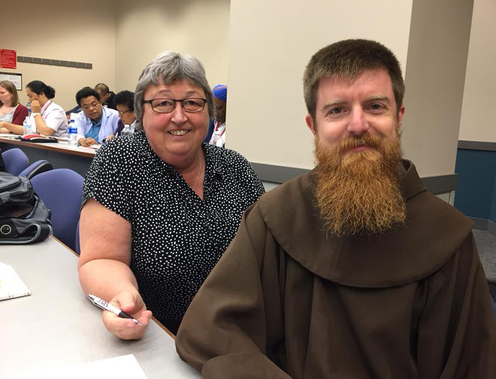
Our annual Summer Institute will offer five workshops at Catholic Theological Union (CTU) in Chicago, July 9-24, 2019. Choose to attend one or several workshops. Located in the popular Hyde Park neighborhood at 5401 S. Cornell Avenue, CTU is easily accessible from both Midway (MDW) and O’Hare (ORD) airports by shuttle, taxi, and Uber/Lyft. CTU is located on the South Side of Chicago, on the shore of Lake Michigan and the home of NRVC. Parking and lunch are included in your workshop registration for both residents and commuters.
This year we are offering two workshops simultaneously July 18-20 to provide a membership density experience. You will have the opportunity to network with more people at breaks and lunch to magnify your experience for a greater impact in your ministry.
For the convenience of participants, affordable housing is contracted through CTU. Enjoy the convenience of having a private air-conditioned bedroom and bathroom, along with linen service, wi-fi and continental breakfast. It is within walking distance of several restaurants for supper (they also deliver), Lake Michigan, Walgreens, Office Depot, the Post Office, and the Chicago Museum of Science and Industry. The CTA bus comes frequently to go to the Chicago Loop just seven miles away. Limited rooms are available; make your overnight accommodations when you register for your workshop. Please do not call CTU for reservations as we are in a contract for blocked rooms.
If you need overnight accommodations at CTU, register as a resident (if you will drive to/from the workshops each day, register as a commuter). Reservations are contracted for arrivals after 3:00 p.m. the day before the workshop begins and check-out is at 9:00 a.m. the day after the workshop ends. This means you are responsible for the full payment of the room reservation, regardless of your arrival and departure date. Unfortunately, room reservations cannot be made for earlier arrivals or later departures. Please call us if you are traveling from overseas to check availability to accommodate your special needs. You can store your luggage at the NRVC offices until you are ready to leave on the day of your departure. If you are staying for the next workshop, you will not need to check out.
Please note that these accommodations are designed very simply for university students and short stays at an affordable rate of $115 per night, per person. If you need more amenities, make your reservation at local hotels located just a half mile away: LaQuinta Inn, Sophy Hyde Park Hotel, and Hyatt Place Chicago-South. Therefore, if you are staying elsewhere and do not need overnight accommodations at CTU, register as a commuter.
As per our custom, Mass is celebrated daily during all workshops. We rely on our ordained participants to preside and welcome all others to assist in liturgical leadership. All workshops begin with communal prayer and there is a Chapel located on campus for personal prayer. The local parish is within walking distance.
Registrations for workshops received after June 23 will incur a $100 late fee per workshop.
Cancellations for workshops and/or accommodations must be received in writing to debbiesscm@nrvc.net before June 23 to receive a full refund, less a $100 processing fee per workshop. After the deadline, all fees are non-refundable for the cancellation of workshops and/or accommodations.
I really liked the location in Chicago because there are so many places to go for food and entertainment. I liked the hands-on approach in all the workshops. I will be using ideas from the presentations in my daily work.
--Sister Carolyn Brink, RSM
Summer Institute provides a variety of religious communities/orders the opportunity for sharing of experiences and rich insights from the presenters.
--Brother Stephen Kpunsa, F.M.S. from Poughkeepsie, NY
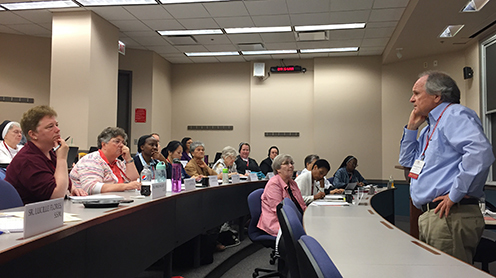
This workshop presents practical interviewing techniques housed in a theoretical framework of behavioral assessment. While the focus of the workshop is on initial assessment of candidates, the methodology easily applies to assessing candidates in other stages of formation as well. Workshop participants study sample case reports and learn skills for interviewing as well as guidelines for organizing the information into useful reports. Interview topics include: family background, educational and occupational histories, psychosexual histories and intimacy skills, faith history, and other pertinent issues related to comprehensive vocation assessment.
Please note this workshop ends at 4:30 p.m. on July 20. Overnight accommodations are contracted for 4 nights, arrival on July 17 and check out on July 21.
Workshop fees include materials, speaker, facility fees and lunch. The fees do not include supper. Residents are provided with a continental breakfast.
Commuter: $525 NRVC Member $780 Non-NRVC member
Resident: $985 NRVC Member $1,240 Non-NRVC Member
Registrations received after June 22 incur a $100 late fee.
Cancellations for workshops and accommodations must be received in writing to debbiesscm@nrvc.net before June 23 to receive a full refund less a $100 processing fee. After June 23., all fees are non refundable.
Reverend Raymond P. Carey, Ph.D. is a priest of the Archdiocese of Portland, OR. He has taught at both the secondary and university levels, and presently teaches at Mount Angel Seminary Graduate School of Theology in Saint Benedict, Oregon. Fr. Carey holds a doctorate in clinical psychology from the University of Ottawa, Canada. He has presented workshops in North America, Europe, Australia, New Zealand and Fiji. He is a past recipient of the NRVC Harvest Award for his work in service of vocation ministry.
This topic is very useful for people who are involved in vocation ministry and I felt there were good tools given that will be helpful. I would recommend this workshop to not only vocation directors; the program is good for the whole team.
–Sr. Josefina Ramac, SP from Renton, WA
It was eye opening for me as a new member of the vocation team. This workshop gave me an overview of what assessment is all about. I also appreciated the awareness that I acquired about the complexity and depth of vocation discernment.
–Rev. Guillermo Hernandez from the Diocese of Sacramento
Having actual cases to review was very helpful. I learned a lot in the workshop and I have a good idea on how to grow going forward. Fr. Ray practices what he teaches and is very credible. This is a great way to prepare for vocation ministry.
–Br. Jason Graves OFM Cap. from Chicago, IL
Workshops are designed from the NRVC three-component curriculum for those who wish to deepen their understanding of the complex theological, spiritual, psycho-sexual, ethical, and diversity issues often present in contemporary vocation ministry. NRVC recommends that vocation ministers participate in ongoing educational opportunities to attend to their own vocation, faith formation, and to further develop their professional competencies. Please read the terms and conditions of all NRVC programs and events.
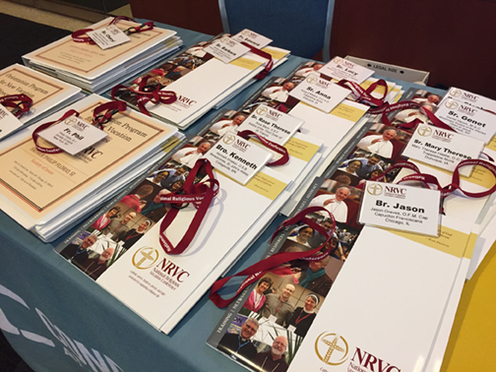
This year, NRVC is offering nine workshops intended for vocation ministers, formation teams, communicators, religious leadership, and others entrusted with the assessment of discerners and candidates. Workshops are designed from the NRVC three-component curriculum for those who wish to deepen their understanding of the complex theological, spiritual, psycho-sexual, ethical, and diversity issues often present in contemporary vocation ministry.
These workshops are in line with the mission of the National Religious Vocation Conference (NRVC) to provide membership with educational opportunities, resources, and other supportive services that strengthen and enhance the practiced ministerial skills of those serving in vocation ministry. NRVC strongly suggests that vocation ministers participate in continuing educational opportunities not only to attend to their own vocation and faith formation and to further develop their professional competencies, but to keep up-to-date on trends, issues, skills, and best practices in the field of vocation ministry.
Click here to register for the Summer Institute
Orientation Program for New Vocation Directors, July 9-13
Ethical Issues for Vocation and Formation Directors, July 15-16
Behavioral Assessment 1, July 18-20
Due Diligence in Vocation Ministry, July 18-20
Communication Skills to Promote Vocations, July 22-24
click here to register for the Fall Institute
Behavioral Assessment 2, October 8-9
Behavioral Assessment 1, October 11-13
Orientation Program for New Vocation Directors, October 15-19
The Art of Accompaniment and Discernment, October 21-23
Workshops are open to NRVC members at a discounted rate and for non-members at an affordable price. All NRVC workshops (which includes lunch) are consistently priced at $175 per day per NRVC member, regardless of the topic or speaker. Non-members pay $260 (an additional 50%) per person per day for each workshop. If you would like to become a member to receive the discounted rate, click here. Overnight accommodations are $115 per night for anyone in need of housing regardless of membership status.
Registrations for workshops received after the following dates will incur a $100 late fee per workshop:
Summer Institute: The late fee begins on June 23
Fall Institute: The late fee begins on September 22
Cancellations for workshops and/or accommodations must be received in writing to debbiesscm@nrvc.net before the dates listed below receive a full refund, less a $100 processing fee per workshop. After the deadline, all fees are non-refundable for the cancellation of workshops and/or accommodations.
Summer Institute: The cancellation deadline is June 23.
Fall Institute: The cancellation deadline is September 22.
To assist NRVC members with their professional development, the Misericordia Scholarship Fund is available. Scholarship funds can be applied to NRVC workshops, however they do not cover the cost of transportation, accommodations, meals, or personal expenses. If you need financial assistance to attend an NRVC workshop, please email Sr. Debbie at debbiesscm@nrvc.net for an application.
Please read our NRVC terms and conditions for all events and programs.
The programme was very well organized. I appreciated the schedule and the interaction from the presenters and participants. Everything was close in proximity, access to food, Mass, internet, etc.
—Sister Winfridah Chileshe, R.S.C. from Dublin, Ireland
I appreciated Sr. Debbie’s knowledge, helpfulness, insights and generosity. I feel the members of our vocation and leadership team ought to attend these workshops.
--Sister Cheryl Wint, O.S.F. from Honolulu, Hawaii
In spring 2020 the NRVC Board updated the NRVC bylaws to reflect several new realities:
The board also formulated proposals to amend the NRVC Constitution to update it as well. All NRVC members were invited to submit feedback by August 14, 2020. At the recommendation of NRVC member Sister Stephanie Spandl, S.S.N.D., the board voted at its August meeting to amend the proposed Article V.J. to read:
Votes may be taken without a meeting by written ballot through U.S. Mail, e-mail, or any other electronic means pursuant to which the members entitled to vote thereon are given the opportunity to vote for or against the proposed action. The number of members casting votes in this way must be sufficient that it would constitute a quorum if such action were taken at a meeting of the members. The proposed action must receive the approval of a majority of the members casting votes, or such larger number as may be required by the Bylaws. Voting must remain open for not less than 5 days from the date the ballot is delivered; provided, however, in the case of a merger, consolidation, dissolution or sale, lease or exchange of assets, the voting must remain open for not less than 20 days from the date the ballot is delivered.
NRVC members will vote for the proposed amendments to the NRVC Constitution. This vote will be taken electronically and the results will be announced at the biennial business meeting at Convocation on October 31. More information will be sent to members in September.
The full constitution with proposed changes may be downloaded here.
The bylaws may be downloaded here.
Published on: 2020-07-24
Updated on: 2020-08-27
IF A CHARISM IS A GIFT of the Holy Spirit to the church at the time of a congregation’s foundation, it should continue to be a source of renewal. How does religious charism impact vocation ministry?
In order to continue the conversation about the results of the NRVC-CARA study of new members, HORIZON put this question to a cross-section of leaders in religious life. In fact, each of the five writers were given three choices of questions but all chose to tackle this one. We present their reflections in keeping with one of the directives of the National Action Plan, which flowed from the fall 2010 “Moving Forward in Hope” symposium. Our hope is that these thoughts will spur fruitful reflection and response for all consecrated men and women.
by Sister Mary Hughes, OP
Discerning a religious vocation is a sacred part of a journey that can lead to consecrated life. The journey is, at the same time, exhilarating, scary, often filled with doubts, but ultimately filled with peace. There are multiple dimensions to each person’s journey. At the very least, there is discernment about the call to consecrated life and discernment about the charism one is called to follow.
Our loving God is vast and possesses innumerable gifts. Charisms are gifts of the Holy Spirit to the religious foundation, and these gifts are put at the service of the church and all of God’s people. For some congregations the invitation might be to reflect the mercy of God, and so the call would be to a congregation that holds out the works of mercy as its primary ministry and identity. Some are called to reflect God’s love for truth and the need to speak the truth. Some are called to reflect to our world God’s love for family. Others might reflect the love that pours out from God’s sacred heart. No single congregation or religious order can reflect the fullness of God. Each one invites a variation on the path to holiness. Together, we offer to our world a glimpse of the glory of God.
Part of discerning the call to a particular charism is an honest assessment of one’s own personal gifts, and, of course, listening for the gentle voice of God in one’s heart. One may find that one loves members of a particular community, but never feels called to join them. On the other hand, as one continues to pray, one can trust that God will introduce a community one might never have thought of, but in which one clearly feels at home. Part of the work of the vocation director is to raise up the kind of differences and questions that arise because of the various charisms that gift our church.
Even a superficial assessment of our world today tells us that charisms given in the Middle Ages or given during the time of the early church, are very much needed now. In a world of polarization, bitter words, policies that reinforce poverty and practices that de-value human life, the presence and the glory of God are urgently needed. In order to be gifts to the world, charisms become the organizing principles around which the prayer and the activities of the religious congregation revolve.
While most religious communities have the prayer of the church as part of their ritual, the charism of a congregation invites its members to pray again and again with those psalms, prayers and readings that nourished the call of the founder or founders. If one is called to the charism, one will feel increasingly at home in the style and words of this prayer. If one is not comfortable, it might be a sign that this is not the charism to which the individual is called. While this fit with the charism may not be evident in one or a few prayer sessions, it ought to be evident over time.
The charism of the congregation determines the ministerial involvements. The expression of some charisms is clearly best served by the ministry of education. For some, it will be best served through the ministry of health care. Other charisms find their expression best articulated in social service ministries. Still other congregations have charisms that can be expressed in a variety of ways. In order to feel at home in such settings, one must be able to experience the unity that is located in the charism. It is this unity that allows the diversity to make sense. The unity, I would suggest, would be evident in the ability of the members to express this unity and identify the necessity of diversity. In healthy communities, this is very much present.
The charism is also the principle around which communal living is centered. In some congregations, the members were sent out two by two, but the larger community remains the base. In other communities, most live within the larger community and perhaps rarely go out from that source of nourishment.
Whatever the ministry, whatever the size of the community, or the manner of dress, each member of a religious congregation is called to be a lover of God. Whatever the charism, each of us is called to lean into God and draw our strength from God alone, rather than anything that might be external to us. As we grow in our love and understanding of the charism, this is what happens to us.
Father Pedro Arrupe, the former general superior of the Jesuits, captured the essence of this discernment in these words:
Nothing is more practical than finding God, that is, than falling in love in a quite absolute, final way. What you are in love with, what seizes your imagination will affect everything. It will decide what will get you out of bed in the mornings, what you will do with your evenings, how you spend your weekends, what you read, who you know, what breaks your heart, and what amazes you with joy and gratitude. Fall in love, stay in love, and it will decide everything.
Vocation ministry is really about accompanying persons who are in the process of falling in love. The role of the vocation director is to support, to raise questions, and to rejoice with those who are falling deeply in love with God. At the same time, it is to accompany, to support, to raise questions, and to support those who are falling in love with the charism of a particular community or congregation. It is to stand with an individual who  will say to the community, “I am responding to God’s call and I am at your disposal.” In this way, charisms can continue to be sources of personal holiness as they are poured out for the life of the church.
Sister Mary Hughes, OP is prioress of the Dominicans of Amityville, NY and former president of the Leadership Conference of Women Religious.
by Brother Paul Byrd, OP
“There is something in the eloquence of the pulpit, when it is really eloquence, which is entitled to the highest praise and honour. The preacher who can touch and affect such a heterogeneous mass of hearers, on subjects limited, and long worn threadbare in all common hands; who can say anything new or striking, anything that rouses the attention, without offending the taste, or wearing out the feelings of his hearers, is a man whom one could not in his public capacity honour enough. I should like to be such a man” (Mansfield Park, chapter 34).
Although Jane Austen puts these words in the mouth of a man interested in preaching more as a medium for gaining public acclaim than as a ministry, she is touching on a genuine concern for people called to preach. Namely, the question of how to convey the Gospel message in a way that one’s audience, so varied in age, background, and intelligence, can hear it, and not in a perfunctory way, but with renewed interest. From the mouth of a true preacher, the words above would signify a passionate commitment to proclaiming the Gospel well, for the sake of others—an inner stirring that is part and parcel of who the preacher is, not just what he or she does. This is an example of a charism: a gift for the mission that is also an identity given by the Holy Spirit.
As a Dominican friar, I begin with the example of preaching because it is the readily identifiable charism that the Order of Preachers has retained over the course of the nearly 800 years of its existence. It was undoubtedly thanks to this clear mission of preaching for the salvation of souls, supported by the commitment to prayer, study, and life in community, that so many men and women came to join the order.
But that was then. It is no secret that most religious communities, including the Dominicans, have suffered a serious decline of vocations in the past century, following the Second Vatican Council. Novitiates built for hundreds are now fortunate to house five to ten novices; with the “luckier” ones receiving around 20 or more. Many external and internal factors have contributed to the vocation decline, making this no simple problem to fix. I will outline only a few of these factors.
First, there is the classic battle against rampant individualism that emphasizes personal freedom and happiness over and against concepts like communal living and the common good. People immersed in such cultures are not likely to be interested in vowing chastity, poverty and obedience to a religious superior. Second, there is a misinterpretation of Vatican II that says one does not need to be a priest or a religious brother or sister to be holy. Indeed, there is a real sense that we can no longer talk about religious life or priesthood as being special paths to holiness—but without the promotion of vocations on both the ecclesial and the familial levels, fewer people are taking the option seriously. Third, the recent scandals in the church, especially the sex abuse scandal, have done a great deal to disillusion people, giving them the impression that religious and priestly vocations are merely the false fronts of hypocrisy. And finally, internal problems like the lack of communal living and the lack of central apostolates offer little incentive to vocation inquirers to join communities that do not function as communities.
To combat these problems, communities are beginning to ask themselves: Who are we? What are we for? Are we still relevant, or must we change? Have we changed too much? These questions of identity inevitably lead religious communities back to their charisms, since charisms answer both the question, “What do we do?” and, “What do we have to do with each other?” With the clarity that comes from being able to answer these two questions, energy for mission is replenished and the renewal of communal life is given direction, which in turn enables religious communities to continue their unique participation in the Church’s work and to attract new vocations.”
Given what has been said, it should not be surprising that religious charisms have everything to do with successfully attracting new vocations. Charisms, if articulated clearly and lived authentically as visions which unite diverse groups of men or women into brotherhoods or sisterhoods, allow discerners to see a part of themselves reflected in communities they visit, which in turn inspires them to join these communities.
“What you are, I am, too,” is another way to express the unifying and attracting qualities of charism. This is what I felt when I first visited the Dominican friars in St. Louis and Chicago five years ago, and it explains why Austen’s comments on preaching in Mansfield Park so resonate with me.
This naming of commonality—the oneness a group of people can share in Christ through a charism—is at the heart of the history behind religious life. It explains why people first joined St. Anthony in the desert, St. Dominic in the pulpit, and Blessed Teresa in the streets of Calcutta, and it is and will continue to be the reason people join religious communities— but only insofar as charisms are taken out of the exhibits of motherhouse museums and allowed to take center stage again, thereby combating individualism, clericalism and anything else that works at weakening the communion the community members have with each other and with the God they serve. Thus, charisms are not to be  treated merely as theoretical mission statements but as the gifts of the Holy Spirit—gifts that move us, renew and reform us, leading us forward and sustaining us if we remain true to them.
Brother Paul Byrd, OP is assistant to the promoter of vocations for the Dominican Province of St. Albert the Great.
by Sister Mary Whited, CPPS
As I focus upon the question of how religious charism impacts vocation ministry, I am reminded of how the Leadership Conference of Women Religious has been engaged in a contemplative process entitled “Behold I Am Doing Something New… Do you not perceive it?” (Isaiah 43:19). The process is designed to create a national conversation among women religious about the critical questions on the horizon for religious life. It is intended to enable greater contemplative engagement with the emerging questions being faced by the world and church and to strengthen and shape the mission of U.S. women religious. While the process has just begun, I believe it is already strengthening solidarity among women religious and reflecting the complementarity of charisms of individual communities.
As I think about this growing solidarity among many religious and the complementarity of charisms in relation to vocation ministry, I can’t help but wonder: “How do we together support the charism of religious life— in its various expressions— now and into the future? How do we strengthen our efforts and work together to nurture the multiple charisms that reflect the mystery of the sacred and respond to compelling needs of our church and the world? Do we perceive the new that God is doing?”
Throughout the ages many expressions of religious life have evolved. Some expressions are more reflective of the mystical tradition, with an emphasis on prayer and contemplation. Those that emphasize community and stability are more monastic. At the heart of apostolic religious life are mission and ministries. Various expressions reflect different experiences of God, different understandings of church, and different senses of how to be about the mission of Jesus in the world. There is so much richness in the various expressions of living religious life! There is ample room for a multiplicity of charisms of congregations to exist side by side. There is also a rhythm in which some congregations complete their missions and die and new congregations emerge. Joining together to nurture vocations in ways that affirm the various expressions of religious life and recognize the richness of various charisms evidences the reality that God is doing something new in us.
Vocation ministers in the United States try to respond to the calls of religious vocation in an age when lay persons are taking more responsibility in the church. The NRVC-CARA study of new members indicates that those who are drawn to and remain in religious life do so for a variety of reasons, including a desired lifestyle and the charism of a particular congregation. Given the various expressions of religious life and multiplicity of charisms of individual congregations, it would be shortsighted to focus attention on a single lifestyle as though there is “one right way” to live religious life and any other way is “wrong” or “misguided.” It is very important that members and congregations continue to assess whether specific elements of lifestyle are consistent with their unique expression of religious life and the charism of their congregation. However, it is simplistic to assume that a change in elements of lifestyle will result in new vocations. It is also important to realize that, throughout the development of the various expressions of religious life, there were times when one expression of religious life has attracted more vocations than other expressions. This time is not an exception.
While the NRVC-CARA study indicates that some persons who seek religious life look for a clear identity in elements of lifestyle, I believe that, at this time when religious life is in a process of transformation, it is important to emphasize the identity that comes from the prophetic nature of religious life and the charisms of our congregations. While lifestyle reflects some aspects of identity and may be a significant element in what attracts some new members to a congregation, identity is ultimately rooted in the charism of religious life itself and its various expressions, as well as the charism and mission of each individual congregation. The charism of a congregation is at the heart of the identity and life of the community. And so, in vocation ministry, it is important to assist those discerning religious life to explore various expressions of religious life as well as individual charisms of congregations. Even more than elements of lifestyle, the charism of religious life itself, together with the charism of a congregation, must be the primary focuses for discernment.
The study indicates that new members who enter religious life are much more diverse in terms of age, racial and ethnic background and life experience. What is not directly addressed in the study is that persons discerning religious life reflect diverse perspectives around who God is, what “church” is, and how the “spiritual” relates to the “world.” Vocation ministers are in a key position to help persons articulate these important aspects in relation to their attraction to religious life. They can help those they accompany to move toward deeper discernment around these significant aspects, integrally connected with the choice of pursuing religious life in a particular congregation.
Nurturing a call to religious life implies the sharing of charism. According to the study, “New members are drawn to religious life by a sense of call and a desire for prayer and spiritual growth…. More than anything else, they were attracted to their particular religious institute by the example of its members and especially by their sense of joy, their downto- earth nature, and their commitment and zeal.” These desired aspects are grounded in the charism of religious life and reflect the charism of a congregation. If we believe religious life and our charisms are worth sharing, we will be eager to offer them as possibilities to others, regardless of whether they enter our congregation or choose another.
As religious life moves into the future in uncertain times, vocation ministry is a walk in trust. Such a walk requires a conviction that the Spirit is working in our lives and in the lives of those with whom we walk. Let us continue to walk the journey together, knowing that God is present in the many expressions of religious life and the various charisms that reflect so well the multiple facets of the Mystery of God and the many aspects of mission. Truly God is doing something new. Do we not perceive it?

Sister Mary Whited, CPPS died in August, 2011, not long after she wrote this article. She had served as superior general of the Sisters of the Most Precious Blood of O’Fallon, MO, and as president of the Leadership Conference of Women Religious. Over the years her ministry focused on initial formation, education, adult faith formation, retreat ministry and facilitation. May she rest in peace.
by Sister Mary Emily Knapp, OP
What do our religious charisms, some of which are hundreds of years old, have to say to the Facebooking, tweeting young people of today? The charism of a congregation is a gift of the Holy Spirit given to the founder, and it defines the distinct spirit of the congregation. In the years that have followed the Second Vatican Council there has been much turmoil in society, and rapid changes have impacted attitudes and expressions of religious life. The Council’s call to return to the spirit of our founders continues to serve as an anchor that helps us navigate the powerful currents of culture and not be swept away by them. Fads come and go, but the message of Jesus Christ is a constant one that must be adapted to every time and place. If presented faithfully and lived joyfully within the life of its members, a charism that is “ever ancient, ever new” can have great appeal to today’s youth. Steeped in the inspiration of its founder and the traditions of its community, each religious congregation is called to prudently adapt its religious charism to the needs of the contemporary culture. When this is done, the charism of the congregation can become a source of renewal and will have a direct impact on vocation ministry.
When we remain faithful to the original inspiration of our founders, the identity of our religious communities is set in bold relief, and that is appealing for young people who are seeking meaning and clarity amid a culture that tells them anything goes. When members of a religious community are formed in the charism, they know who they are, what they are about, and where they are going. Our world today can be a confused and confusing one. Fundamental values that once were clearly understood and widely accepted are now being called into question (for example, sexual identity, the complementarity of the sexes, the institution of marriage, the basic unit of the family, etc.). In the midst of this confusion, young people are seeking answers, not in easy black and white fundamentalism, but in the rich tradition and teachings found in the Catholic faith. I am frequently surprised by college-age young women who are reading church documents in search of a deeper understanding of their faith: Evangelium Vitae, Fides et Ratio, and the beautiful Apostolic Exhortation, Vita Consecrata. I have found that these clear teachings of the church speak to these young women in ways that are life-changing. They desire to give themselves to an ideal that is intelligent and far-reaching. When they seek and find the truth that will set them free, they hold fast to it.
It is my experience that young people are drawn to religious communities which have a clear and well-defined identity. Often young women come to us with a checklist of characteristics they are seeking in a religious community, such as faithfulness to the church and the sacraments, the practice of prayer (individual and common) and Eucharistic Adoration, the wearing of a religious habit, and devotion to Our Lady. I find they are not inclined to such a way of life out of nostalgia but from the timeless idealism which has always moved young people to give themselves wholeheartedly to a cause. In speaking with the youth of the New Millennium in Rome, during World Youth Day 2000, Pope John Paul II challenged the young not only to give themselves totally to a cause, but to a person who fulfills their highest hopes and desires: “In saying ‘yes’ to Christ, you say ‘yes’ to all your noblest ideals.” Christ is still calling and young people are still answering.
Young people are also attracted to visible witnesses of faith and to the joyful living of community—both of which are tied to the founding charism of a religious community. Ironically, while we live in a world of radical individualism where people feed on the ability “to do what I want when I want to,” young people are drawn to this witness of community life that has a deep simplicity and radical humility. There is an innate human desire to be a part of something larger than oneself. These young people want to belong, to contribute to a cause. Our life in community seems to attract them all the more because it offers the opportunity to imitate those early followers of Christ, whose communal life was both an expression of their faith in him and a source of mutual support and example—a graced atmosphere where love is the common striving.
As Dominicans, the sisters of my own community are called to a “holy preaching,” in the spirit of our Holy Father, St. Dominic. For our particular Congregation of St. Cecilia, founded in 1860 for the Christian education of youth, this “holy preaching” continues to be carried out in the classroom. Originally established at the invitation of the bishop in the small diocese of Nashville, TN for the education of the young women, we have continued the teaching mission in changing historical circumstances, seeking to adapt the same educational apostolate to meet the needs of the time. Our sisters are now present in over 36 schools in 21 dioceses (including Sydney, Australia and Vancouver, British Columbia).
Through the charism of the Dominican life and the apostolate lived in our congregation, we live the motto of Dominic, Contemplare et Contemplata Aliis Tradere, to contemplate and give to others the fruits of our contemplation. While first being called to be the Bride of Christ and placing prayer at the heart of our life, we then can use the energy and enthusiasm that results for spreading the Gospel, through teaching and taking Christ to the world.
For over 2000 years, men and women, in imitation of Jesus Christ, have sought to leave everything behind to devote their lives to him with an undivided heart. They have given their lives to Christ in community and in service of the church, carrying out many different and much needed works for the building up of the kingdom of God. “In this way, through the many charisms of spiritual and apostolic life bestowed on them by the Holy Spirit, they have helped to make the mystery and mission of the church shine forth, and in doing so have contributed to the renewal of society” (Vita Consecrata, 1).
Today more than ever, the many charisms of religious communities are needed for the up-building of the church. In the measure that we are faithful to our founding charisms, the joy of the Holy Spirit will abound, and many among our youth will be more attuned to the voice of Christ calling them to religious life. This, in turn, will enable the Gospel of Christ  to be spread to the ends of the earth. Let us together pray to the Lord of the harvest to give us a spirit of humility and faithfulness to respond to the church’s call.
Sister Mary Emily Knapp, OP is vocation minister for the Dominican Sisters of Nashville, TN, which is one of the religious communities identified in the NRVC-CARA study as successfully attracting and retaining new members in recent years.
by Brother Seán D. Sammon, FMS
Just what does the word charism mean? St. Paul used the term to describe those gifts given to each of us for the good of everyone, and he was intrigued by their universal presence and uniqueness. He was fond of pointing out that one gift is given to this person and another to that but always for the good of all. Paul also helped us understand that the charism that is part of the life of each of us is an important element in the ongoing change of heart that should mark genuine Christian living.
Pope Paul VI, realizing that the word charism takes on a different meaning when applied to a religious congregation rather than an individual, defined it as nothing more and nothing less than the presence of the Holy Spirit. He also suggested that allowing that Spirit to work in and through us can give rise to some surprising outcomes. The following story illustrates this point.
In 1686, after more than 30 years of exile in Bilbao, Spain, two Irish women, members of the Dominican congregation, set out once again for the land of their birth. They did so at the urging of the then provincial of the Friars of St. Dominic; he judged it safe enough to establish once again a convent in Galway in the west of Ireland.
Rising to the challenge Sisters Juliana Nolan and Mary Lynch made their way home in an open boat. They did so with full knowledge that upon their arrival in Ireland they would face many unknowns. When the full and final history of Dominican life in the church is written, these two women will hold prominent places. They endured exile, war, political upheaval, the crushing anti-Catholic penal laws, hazardous journeys, and financial insecurity to reestablish in the land of their birth the Dominican way of life. Mary was 60 as she took up this task; Juliana was 75.
Who but the Holy Spirit could give any of us the courage to do what these two women did? But becoming involved with the Spirit of God can be dangerous business indeed. The genuine renewal of religious life, however, cannot be accomplished unless we are willing to risk that involvement and, in so doing, reclaim the charism of our respective congregations. Understandably, doing so will involve a cost, and at times the price we are asked to pay can be very high indeed. If you and I are seriously interested in the renewal of religious life today, however, we need to put aside excuses such as age, temperament, fear of the future, etc. and get on with the task at hand.
Mary of Nazareth is a prime example of a person who lived her life in the Spirit of God. Paul VI reminds us that the future mother of Jesus had the good sense to question God’s messenger, and Luke tells us that the angel’s news “greatly disturbed” her. And if we believe that she had free will, we will have to admit that Mary could also have said “no” to God’s invitation. Instead, she said “yes” and in so doing changed the course of her life and that of human history.
If we look to Mary as a model of how to respond to the Holy Spirit in our lives and in the life of our congregations, we must also never forget that Mary was a woman of this earth. She suffered, experienced doubt, was joyful, and, like most women of her day, was probably illiterate. She also had to grow in her understanding from Jesus as son to Jesus as Lord. St. Thérèse of Lisieux tells us that Mary is worthy of honor, not because she received special privileges, but rather because, like us, she suffered in the dark night of faith.
Over the centuries we have managed to domesticate this remarkable woman of faith. She is worthy of honor, though, not because she was the mother of Jesus but rather because she was his disciple. By imitating this aspect of her, we put ourselves in the best position to address the challenges that renewal presents to us today.
Over time charisms give rise to structures. They become its institutional face and guarantee its valid expression. While all charisms develop structures, the structures can also change from time to time. Such a development occurs in response to changed circumstances or when the structures in place no longer capture the experience of the congregation and its members. We call this process renewal.
Sometimes it occurs slowly over time; on other occasions it is thrust upon us by circumstances. The past four decades of religious life have been marked by a number of dramatic changes. More than a few observers would identify Vatican II’s call for the adaptation and renewal of religious life as being the source of the upheaval that has occurred. Indeed, so pronounced has been the change that has taken place in our way of life that quite a number of commentators have suggested that we are undergoing a paradigm shift in our understanding of religious life. What does that mean exactly, and what bearing does it have on charism?
Paradigms are constructs that help you and me make sense of our experience. Theologian Jon Sobrino compares them to the hinges on a door. Moments of crisis and unhinging occur when the old and worn-out hinges can no longer support the weight of the entire door. Such a situation calls for the creation of new hinges so that the door may once again turn, and turn well.
Paradigms are useful in so far as what they help explain outweighs what they fail to explain. When the reverse is true, a paradigm shift takes place. A new model is required to explain the change. Most of us have read about past paradigms of religious life, including those from the ages of monasticism, mendicants, and more recently the era of apostolic religious institutes. If the paradigm that helps explain our way of life is shifting today, the expression of our charism cannot help but be affected. During a time of reform in religious life, we are called to undertake a process of discernment and to return to the spirit of our original charism. The challenge we face during a time of renewal or paradigmatic shift is different: reimagining our charism anew in light of the signs of the times. And that means having to deal with the Holy Spirit.
Vatican II taught us that you cannot contain the Holy Spirit. The charisms of our congregations need to be lived and preserved today not only by members; they must also be developed and deepened in union with the People of God, who are themselves in a state of continual growth.
The Council also reminded us that we are not to put limits on God’s generosity. Prior to Vatican II conventional wisdom held otherwise. Most people thought that charisms were restricted to particular religious institutes and their members. Ignatius’s charism appeared to reside with the Jesuits alone, Francis’s solely with Franciscans, Dominic’s inspiration available exclusively to members of his Order of Preachers. Today, however, we realize that the charisms that came into our world through the founders of religious congregations are touching the hearts and capturing the imagination of both the members of those congregations and laity alike.
A final thought about charism is that we can never reduce it to tradition alone. On the one hand, it places restrictions upon us; but on the other, it challenges us to go beyond ourselves. We are called to maintain a careful balance between both. To do so helps everyone understand the difference that exists between the apostolic work of one group and another.
 The charism of any group is a vibrant, life-giving and selfcorrecting tradition, rooted in the interaction of past tradition with the call of the Holy Spirit to meet the challenges of today and tomorrow. Have no doubt: the Spirit of God who was so active and alive in the founders of our congregations does long to live and breathe in you and me today, religious and laity alike.
Brother Seán D. Sammon, FMS was the superior general of the Marist Brothers from 2001- 2009. A clinical psychologist, he writes and speaks on contemporary issues of religious life. Presently he is a scholar in residence at Marist College in Poughkeepsie, NY.
NRVC will soon introduce its new storymap, "Religious Life Today," which will present the results of the 2020 Study on Recent Vocations to Religious Life in a highly visual, online format. The storymap, funded by the GHR Foundation, will give users an additional way to explore data from the study, including geographic maps of certain data and much more. In the coming weeks, the NRVC will email the storymap to members, collaborators, study participants, and VISION Vocation Guide discerners.
Published on: 2020-12-01
In honor of the 25th World Day for Consecrated Life on February 2, the NRVC is releasing 32 more 2-minute videos of newer religious to its Abundant Hope video series on the NRVC YouTube channel. These videos feature newer religious discussing their experiences of intercultural and intergenerational community living, with an emphasis on hope. (Similar videos of senior religious are scheduled for release later in February.) Consider using videos or other NRVC resources to celebrate this day with your community, in your sponsored ministries, in parishes, schools, etc.
Published on: 2021-02-01
Due to the uncertainty of how COVID-19 continues to spread and affect our lives, our biennial Fall Institute, October 5-19, will be offered live through Zoom. Join us in the comfort of your home, no hassles with travel or packing, just time to enjoy learning from experienced presenters who will engage participants with a reasonable schedule integrated with screen breaks. Don’t postpone, register today for this outstanding opportunity for learning, support, and networking.
Behavioral Assessment 2—October 5-6, 9:30 - 3:00 CT
Behavioral Assessment 1—October 8-10, 9:30 - 3:00 CT
Orientation Program for New Vocation Directors— October 12-16, 9:30 - 3:30 CT
Navigating Uncertainty with Young People through Accompaniment—October 19
Published on: 2021-05-27
Updated on: 2021-09-24
The NRVC extends a warm welcome to Sister Charlene Herinckx, S.S.M.O., who will join the leadership team as director of membership on January 11. Marge Argyelan, who has held that position, will become director of database administration. Sister Charlene, available at srcharleneh@nrvc.net, is no stranger to vocation ministry as she was the NRVC coordinator of programs and projects from 1999 to 2005 and held various positions in vocation ministry for her community over the years. She also served in education and leadership, most recently as superior general from 2010-2020 for the Sisters of Saint Mary of Oregon.
Published on: 2020-09-01
Updated on: 2021-01-01
The NRVC extends deep gratitude to these Member Area Coordinators who have served generously and are completing their terms effective June 30:
Sister Connie Bach, P.H.J.C. of the Midwest Member Area, six years of service.
Sister Barbara Bartlett, S.H.C.J. of the Mid-Atlantic Member Area, two years of service.
Sister Christine Still, O.S.F. of the Pacific Northwest Member Area, six years of service.
On July 1, Sister Jill Reuber, O.S.B. (Midwest), Sister Kathleen Persson, O.S.B. (Mid-Atlantic), and Sister Teresa Shields, S.N.J.M. (Pacific Northwest) will begin serving as Member Area Coordinators. We extend a warm welcome to them and thank them for taking on this responsibility. See all our member area coordinators.
Published on: 2021-05-27
As part of the celebration for World Day for Consecrated Life, NRVC co-sponsored an online prayer and panel discussion on "Consecrated Life through the Lens of Fratelli Tutti" on February 2. Registration reached its capacity of 1,000 participants so this event was recorded. Access the video using this link. The other co-sponsors are the Conference of Major Superiors of Men, Leadership Conference of Women Religious, Religious Brothers Conference, and Religious Formation Conference. To plan other outreach or activities for World Day for Consecrated Life, see our information and resources here; prayers of the faithful and bulletin blurbs from the U.S. Conference of Catholic Bishops are here.
Published on: 2021-01-01
On July 1, Sister Jill Reuber, O.S.B. (Midwest), Sister Kathleen Persson, O.S.B. (Mid-Atlantic), and Sister Teresa Shields, SNJM (Pacific Northwest) will begin serving as Member Area Coordinators. We extend a warm welcome to them and thank them for taking on this responsibility.
Published on: 2021-06-28
Starting January 26, NRVC members will be invited to take part in "Talk it up Tuesdays," 60-minute, online sessions to collaborate, build relationships, and learn effective practices for now and beyond the pandemic. Each session will take place from 1-2 p.m. Central Time. Focusing on a topic in vocation ministry, sessions will consist of short presentations, breakout groups, and a large group sharing. To register and see the list of topics and presenters, click here.
Published on: 2021-01-01
A study released in February on the impact of cultural diversity among newer U.S. religious shows that while most newer Black, Asian, and Hispanic religious (70 percent) find their communities “very open” to welcoming members of other cultures, experiences of at least occasional loneliness or a sense of not being understood (25 percent) are higher for them than for newer white religious (10 percent). The study also examines the family and parish experiences of newer religious, breaking the data down by cultural background.
The research was commissioned by the Conrad N. Hilton Foundation and conducted by the Center for Applied Research in the Apostolate. This latest study builds on information about diversity in religious life gathered in the NRVC 2020 study of newer religious and NRVC’s 2014 study on incorporating diversity into religious life.
Building on the popularity of the recently released 19 videos of newer religious, NRVC is partnering with Support Our Aging Religious (SOAR!) to develop videos of religious over age 80 who express hope for the future. The short videos, to be released in February, are meant to amplify hope in religious life, demonstrate that hope is not determined by age, and show that the youngest and oldest members inspire one another in their vocations. Both sets of videos can be used in community conversations with NRVC's Study and Reflection Guide. Support Our Aging Religious is a 501(c)3 nonprofit dedicated to helping congregations of sisters, brothers, and priests care for their aging members.
Published on: 2021-01-01
During November 2020 NRVC reached a milestone with its Misericordia Scholarship Fund: It gave out its 200th award since the program's inception in 2015. That means 200 times religious communities have been able to pay membership dues, send someone to a workshop, or attend Convocation. Nearly $100,000 has been distributed. Thank you to the many generous donors who have made this possible. Learn more or contribute here.
Published on: 2020-12-01
Join us in praying online with and for Catholic sisters on Wednesday, March 10, 7 p.m. Eastern Time (6 p.m. Central). This prayer service celebrates Catholic Sisters Week, held March 8-14, and is co-sponsored by NRVC, Center for the Study of Consecrated Life at Catholic Theological Union, Communicators for Women Religious, the Institute of Religious Formation at Catholic Theological Union, Giving Voice, and the Religious Formation Conference. Register here.
In addition to joining us in prayer, you are encouraged to recognize and celebrate women religious online, in parishes, in sponsored ministries, on social media, etc. For ideas and resources, visit catholicsistersweek.org.
Published on: 2021-02-01
Updated on: 2021-02-19
Catholic Theological Union (CTU) announced the intended sale of the 5401 Centers Building which has housed our National Office for over 20 years. The NRVC will continue to serve our members by working remotely while we search for the right space. A temporary space near CTU has been rented in order to maintain resources and facilitate the seamless provision of membership services. Please note the following: Mail should be directed to: NRVC 5416 South Cornell Ave., Chicago, IL 60615. Our office phone number will remain the same: 773-363-5454.
Please know this physical move will NOT impact the services we provide to our members nor our ability to meet your needs. All phone and mail inquiries will continue to be answered in a timely manner.
Published on: 2021-05-27
At its March meeting, the NRVC board appointed a new chair and vice chairs, effective immediately, and selected four new members who will begin serving in the fall. (See all of them here.) The new executive committee now consists of Sister Mindy Welding, I.H.M., chair; and vice chairs Father Adam MacDonald, S.V.D. and Sister Belinda Monahan, O.S.B., and Sister Deborah Borneman, SS.C.M. ex officio. The new board members to begin serving in the fall are Ms. Nancy Costello, a former Region 3 NRVC coordinator who works in communications and vocations for the Cabrini Sisters; Sister Nicole Trahan, F.M.I., who has published vocation related articles in HORIZON and elsewhere; Sister Cheryl Wint, O.S.F., of the Hudson Valley Member Area, and Sister Mary Yun, O.P., former coordinator of the West Coast Member Area. Congratulations to all, and warm thanks to Sister Kristin Matthes, S.N.D.deN., who has completed her service as board chair.
Published on: 2021-04-01
Register for an online course by clicking on a workshop below.
Orientation Program for New Vocation Directors — July 12-16
Behavioral Assessment 1 — July 19-21
Ethical Issues in Vocation and Formation Ministry — July 23-24
Is It Cultural, Generational, or Family of Origin Issues in Candidate Assessment? — July 26-28
Published on: 2021-01-01
Updated on: 2021-05-28

At its March meeting, the NRVC board appointed a new chair and vice chairs, effective immediately, and selected four new members who will begin serving in the fall. The new executive committee now consists of Sister Mindy Welding, I.H.M., chair; and vice chairs Father Adam MacDonald, S.V.D. and Sister Belinda Monahan, O.S.B., and Sister Deborah Borneman, SS.C.M., ex officio.
The new board members to begin serving in the fall are Ms. Nancy Costello, a former Region 3 NRVC coordinator who works in communications and vocations for the Cabrini Sisters; Sister Nicole Trahan, F.M.I., who has published vocation related articles in HORIZON and elsewhere; Sister Cheryl Wint, O.S.F., of the Hudson Valley Member Area, and Sister Mary Yun, O.P., former coordinator of the West Coast Member Area. Congratulations to all, and warm thanks to Sister Kristin Matthes, S.N.D.deN., who has completed her service as board chair.
Published on: 2021-03-23
All are encouraged to celebrate religious brothers on Saturday, May 1, 1:30-3 p.m. Central Time, via an online event featuring prayer, reflections, and small group discussions. The NRVC is co-sponsoring this event along with the Conference of Major Superiors of Men, Religious Brothers Conference, and the Religious Formation Conference. Register to take part. In addition, celebration information and resources are available from NRVC here, and from the Religious Brothers Conference here.
Published on: 2021-03-23
On January 26 NRVC kicked off a new, members-only initiative for vocation ministers to learn, collaborate, and build relationships, with ?? members taking part in the first Talk it Up Tuesday session. Members are encouraged to register for these upcoming hour-long sessions, which take place 1-2 p.m. Central Time, 2-3 p.m. Eastern. Details and registration are here. Note: once registered, participants use the same link for all sessions.
February 2—No session; instead participation in the evening Fratelli Tutti panel discussion and prayer is encouraged.
February 9—"Planning Virtual Retreats," presented by Sister Julia Walsh, F.S.P.A.
February 16—"Using WhatsApp Chat with Discerners," presented by Sister Jill Reuber, O.S.B.
February 23—"Expanding Vocation Promotion Through the Lens of Charism," presented by Sister Mary Jo Curtsinger, C.S.J.
Published on: 2021-02-01
The editorial team at the NRVC once again earned honors from the Catholic Media Association. Congratulations to everyone involved in producing our quality publications and website! Details:
The NRVC office will be closed April 1-5 in observance of the Triduum and Easter. The board and staff wish you a joyful celebration of the Lord's Passion and Resurrection!
Published on: 2021-03-24
The NRVC released its Religious Life Today Storymap website on March 25, giving members and the public a highly visual, compelling way to understand contemporary realities and trends among those joining religious orders. The site brings to life the data from the 2020 Study on Recent Vocations to Religious Life. You are invited to scroll through this hope-filled resource, to share it with your members, and to add links to it from your website and social media sites. Thank you to the GHR Foundation for underwriting this project.
Published on: 2021-03-25

This virtual workshop presents practical interviewing techniques housed in a theoretical framework of behavioral assessment. While the focus of the workshop is on assessment of candidates for admission to initial formation, the methodology easily applies to assessing candidates in other stages of formation as well. Workshop participants study sample case reports and learn skills for interviewing as well as guidelines for organizing the information into useful reports. Interview topics include family background, educational and occupational histories, psychosexual histories and intimacy skills, faith history, and other pertinent issues related to comprehensive vocation assessment.
Please note this three-day virtual workshop begins on October 8 and ends on October 10. The workshop begins at 9:30 a.m. and ends at 3:00 p.m. Central time. (On Sunday, the workshop will begin at 10:00 a.m. CT). There is a 60 minute break from noon - 1:00 p.m. Central time. Workshop folders will be mailed to participants within two weeks of registration.
This workshop is not recorded to allow the presenter and participants the opportunity to speak authentically in a learning community. Personal recording is prohibited.
NRVC member: $500 Non-member: $750
Click here to register through the NRVC store.
Cancellations for workshops must be received in writing to debbiesscm@nrvc.net. After October 1, all fees are non refundable.
Reverend Raymond P. Carey, Ph.D. is a priest of the Archdiocese of Portland, OR. He has taught at both the secondary and university levels, and presently teaches at Mount Angel Seminary Graduate School of Theology in Saint Benedict, Oregon. Fr. Carey holds a doctorate in clinical psychology from the University of Ottawa, Canada. He has presented workshops in North America, Europe, Australia, New Zealand, and Fiji. He is a recipient of the NRVC Harvest Award and a Lifetime NRVC member for his work in service of vocation ministry.
To assist NRVC members with their professional development, the Misericordia Scholarship Fund is available. Scholarship funds can be applied to NRVC workshops; however, they do not cover the cost of transportation, accommodations, meals or personal expenses. If you need financial assistance to attend an NRVC workshop, please contact srcharleneh@nrvc.net for an application.
Please read our NRVC terms and conditions for all events and programs.
I appreciated the breath and depth of Fr. Ray. The knowledge and illustrations were thorough with a healthy dose of humor made the workshop enjoyable. His open disposition and clarity with a very structured and systematic approach surpassed my expectations. I feel more equipped to take on the task of aspirant director.
--Sr. Renee Hall, OP, from Port of Spain, Trinidad
I loved his humor and stories that related to the content well. This workshop exceeded my expectations. Thank you!
--Father Derek Swanson, C.M.
After this workshop, I have the confidence to use the Behavioral Assessment following FDIC and direct/indirect interviewing techniques to respect each discerner's right to minimal intrusion. Fr. Ray's knowledge and his ability to share stories that drive deeper into the information is most helpful.
--Sister Jean Rhoads, D.C.
Fr. Ray is a fantastic teacher. I would take any workshop he is teaching.
Bro. Pat Douglas, S.J.
HORIZON subscribers can look forward to a Spring edition that explores the issues of racial justice, intercultural spirituality, unconscious bias, and more. The edition, which mailed April 30, includes in-depth analysis, practical resources, and inspiration. Subscribers will find it online at nrvc.net. No subscription? Sign up today at nrvc.net/signup.
A virtual celebration of Religious Brothers Day will take place on May 1, 1 p.m. and 7 p.m. Central Daylight Time, hosted by the Brothers Think Tank. All are welcome to both events. The Brothers Think Tank is composed of the NRVC, Religious Brothers Conference, Conference of Major Superiors of Men, and the Religious Formation Conference.
Register for the 1 pm CDT event here and the 7 pm CDT event here.
All are urged to shine a spotlight on the community, lifestyle, and good works of brothers on May 1—through social media, events, prayer services, and more. Learn more about Religious Brothers Day and how to celebrate it here.

This virtual workshop is intended for new and recently appointed vocation directors. Its goal is to provide participants with the skills, context, theory, challenges and practicalities of contemporary vocation ministry. Topics will include foundational elements of vocation ministry; assessment of inquirers and discerners; application and admission process; vocation promotion, ethics and boundaries, resiliency and self-care of the vocation director.
Please note this five-day virtual workshop begins on October 12 and ends on October 16. The workshop begins at 9:30 a.m. and ends at 3:30 p.m. Central time.
There is a 60 minute break from noon - 1:00 p.m. Central time. Workshop binders will be mailed to participants within two weeks of registration.
This workshop is not recorded to allow the presenter and participants the opportunity to speak authentically in a learning community. Personal recording is prohibited.
NRVC member: $800 Non-member: $1200
Click here to register through the NRVC store.
Cancellations for workshops must be received in writing to debbiesscm@nrvc.net. After October 1, all fees are non refundable.
 Brother Joseph Bach, O.S.F., is a Franciscan Brother of Brooklyn and currently ministers as Director of Vocations for his Congregation. Previously, he ministered in Education as a teacher and administrator on the elementary, secondary, and university levels. He holds a Master of Arts degree in Education from St. Xavier University, a graduate certificate in Franciscan Studies, and is currently completing a Post Master’s Certificate in Spiritual Formation at Boston College. He also studied at the Institute for Black Catholic Studies at Xavier University of Louisiana. Brother Joseph is also a consultant for the Office of Mission, Ministry, and Interfaith Dialogue at St. Francis College, and serves on the Council of Religious for the Diocese of Brooklyn.
Sister Deborah M. Borneman, SS.C.M. began working for the NRVC in 2011 and presently serves as the Director of Mission Integration. A Sister of Saints Cyril and Methodius, she served within her community as vocation director, on the formation committee, and elected congregational leadership team. Sr. Debbie has previous ministerial experience in pastoral care, youth ministry, college campus ministry, and immigration advocacy. She has presented and written on various topics in vocation ministry in Ireland, Canada, and throughout the United States. Sr. Debbie holds a Master of Divinity degree and a Master of Arts degree in Pastoral Studies from Loyola University, Chicago.
Father Adam MacDonald, S.V.D. is a native of Flint, Michigan and ordained for the Society of the Divine Word. Since 2011, Fr. Adam has served as a Vocation Director for his congregation. He previously served in the Philippines, on the Provincial Council for the Chicago Province and as Vice-Provincial. Fr. Adam holds a Master of Divinity degree (Catholic Theological Union, Chicago) and a Certificate in Spiritual Direction from the Center for Spiritual Development, California. He currently serves on the NRVC National Board executive committee and has previously served on the NRVC Editorial Board and the Vocation Ambassador Design team.
 Brother Mark Motz, S.M. ministers as the Vocation Director for the Marianist Province of the United States. He has worked in vocation ministry for the last nine years, with this being his fifth year as the National Vocation Director for his Province. He holds a Masters Degree in Pastoral Ministry from the University of Dayton. Bro Mark has ministered briefly at the high school level but then has had the privilege to serve at all three of the Marianist Universities in San Antonio, TX, Dayton, OH and Honolulu, HI. He appreciates the cultural diversity that the students share so easily. Brother Mark serves as the Southwest Member Area Coordinator.
To assist NRVC members with their professional development, the Misericordia Scholarship Fund is available. Scholarship funds can be applied to NRVC workshops; however, they do not cover the cost of transportation, accommodations, meals or personal expenses. If you need financial assistance to attend an NRVC workshop, please contact srcharleneh@nrvc.net for an application.
Please read our NRVC terms and conditions for all events and programs.
I found the whole program very helpful. I appreciated the different perspectives from the speakers and the variety of examples provided. Learning about setting boundaries and the specifics about psychological testing and assessment especially helpful. I found all the presenters competent and engaging. Thank You! I didn't have a clue as to what I didn't know - things vital to my role as vocation director.
--Sister Vickie Griner, osc
A great experience; it came at a perfect time since I’ve been at this for a few months and a new academic year is starting soon. There’s a lot to digest, but the manual and on-line resources are a Godsend. THANK YOU!
--Brother Larry Schatz, F.S.C.
Being a layperson and new to vocation ministry, I found all aspects of the program helpful. The materials and small group conversation gave me a better understanding of vowed life and the complex role of the vocation director. I was pleasantly surprised at how effective and enjoyable this online format can be. It was so well done. This workshop definitely exceeded my expectations. Thank you!
–Ms. Kathryn Davis for the Congregation of Bon Secours
This program surpasses my expectations; I received much more than I was expecting! There is a good balance of prayer, talking and presentations. It covers all the information that we as vocation directors are about to face.
--Brother Ronnie Silva, CSC, from Brazil
Nineteen short videos of newer sisters, brothers, and priests discussing community life, intercultural living, and what gives them joy and hope are available online for your use. Consider using these 1-3 minute videos for an online presentation, community discussion, on your social media pages, etc. Produced by NRVC and released last month for National Vocation Awareness Week, these videos are a free resource for anyone exploring or promoting religious life. Find them on the NRVC YouTube page.
Published on: 2020-12-01
To encourage one another, NRVC’s Facebook page will be inviting members and friends to “Tell me something good” each Tuesday beginning today, May 3. The idea is to share on the NRVC page a positive moment in ministry, young adult outreach, vocational invitation, or even your own personal life. Nothing is too small or too large to share. Photos are welcome but not required. Just post your positive moment under the “Tell me something good” photo. Our page is at facebook.com/NationalReligiousVocationConference.
Published on: 2021-04-30
NRVC's Abundant Hope series of 1-to-3-minute videos of sisters, brothers and religious priests has been expanded to include 26 senior religious. NRVC recently posted videos of enthusiastic senior members of religious communitiesthe to its YouTube channel and is gradually adding them to its Facebook page.
Thank you to the 77 religious from 61 institutes who participated in this series. NRVC also extends gratitude to the Conrad N. Hilton Foundation and Support Our Aging Religious for financial support and to Franciscan Media for production expertise. All are encouraged to use these videos widely, as community discussion starters, to share on social media, to use with Catholic Sisters Week and Religious Brothers Day, to show to discerners, etc. A list of the featured religious is here.
The Center for Applied Research in the Apostolate recently released two studies that build on similar studies conducted annually: “Women and Men Entering Religious Life: The Entrance Class of 2020” and “The Class of 2021: Survey of Ordinands to the Priesthood.” Discover the facts about the newest people to enter religious life and/or be ordained to the priesthood. Both studies (and others) are available in the “Studies” tab on nrvc.net. Photo: Daniel Hernandez, O.S.C. expects to be ordained in 2021.
Published on: 2021-04-30
This 24-page booklet, "Screening and Discernment Instrument for Religious Life," was written by NRVC member and canon lawyer Sister Amy Hereford, C.S.J. It includes sample screening forms and checklists that are helpful for assessments and applications. In particular, this resource contains sample forms for legal and financial matters that are typically included in an application to join a religious institute. $10 members, $15 non-members. Learn more or purchase this booklet here.
Published on: 2021-01-01
Thanks to popular demand, NRVC is continuing Talk it Up Tuesdays, an hour long opportunity for NRVC members to learn and collaborate online. Sessions take place 1-2 p.m. Central Time, 2-3 p.m. Eastern. Details and registration are here. March sessions require registration, as they will use a different link than the February sessions.
March 2—"Involving Vowed Membership in Key Relationships with Inquirers," by Sister Tarianne DeYonker, O.P.
March 9—"Creative Connections: Enhancing Your Discernment Activities" by Sister Michele Fisher, C.S.F.N.
March 16—"Life Awareness Virtual Discernment Retreats," by Sister Ana Cecilia Montalvo, F.Sp.S.
March 23—"Using Music in Vocation Discernment," by Brother Alan Parham, F.S.C.
March 30—"Virtual, Virtual, Virtual ... Let's make it Fun and Informative: Virtual Visits and Virtual Pilgrimages," by Sister Christine Still, O.S.F.
Published on: 2021-02-01
Updated on: 2021-02-22
At its spring meeting, the board for NRVC decided to freeze membership fees for the second year in a row. For 2022, single memberships will remain at $820. A license membership for five members will remain $1380. Members can learn more at nrvc.net/blog.
Published on: 2021-04-30
A study released January 26 about men and women who took final vows in 2020 confirms most of the trends that have been noted among new religious in recent years. Among the findings are that most took part in a "Come and See" or similar event; they were more likely than other Catholics to have attended a Catholic school or college; and their ethnic mix is 29 percent Asian, Latino, or black, with a quarter of the profession class being immigrants. The report was produced by the Center for Applied Research in the Apostolate for the U.S. Conference of Catholic Bishops.
Published on: 2021-01-27
Sister Kim Xuan Nguyen C.C.V.I. is a chiropractor. But now, instead of, "Where does it hurt?" she may be more likely to ask, “What brings you joy?” She is the vocation minister for the Sisters of Charity of the Incarnate Word in Houston. She’s also the Southwest Area Coordinator of the NRVC. Read more...
Published on: 2025-01-28
Edition: February 2024 newsletter
How will you and your community be celebrating Jubilee Year 2025? Pope Francis has declared 2025 a Jubilee Year with the theme "Pilgrims of Hope." Check out the NRVC's site, JubileeYear2025.org to learn more.
Note that The Jubilee Year of Consecrated Life is a section of the site dedicated to a Jubilee that religious communities worldwide are commemorating during the 2025 Jubilee Year. On October 8-9, 2025 religious communities will celebrate a type of "jubilee within a jubilee," noting ways that religious are "Pilgrims of hope, on the way of peace."
Published on: 2024-03-26
Edition: April 2024 newsletter
Oct. 8-9, 2025 will be celebrated as a Jubilee for Consecrated Life with the theme of "Pilgrims of hope, on the way of peace." This special Jubilee Year event is born out of the desire of consecrated men and women to reflect on the urgent need for peace and to answer the call to be witnesses and prophets of hope and peace, particularly on the occasion of the upcoming Jubilee.
In a message to those in consecrated life, Cardinal João Braz de Aviz, prefect of the Dicastery for Institutes of Consecrated Life and Societies of Apostolic Life, says, "Dearest consecrated men and women, let us immediately enter this pilgrimage together, bringing the true hope that is in our hearts and for which our lives are in service."
In preparation for the journey toward Jubilee, 300 representatives of the different forms of consecrated life from over 60 countries gathered in Rome. According to the Vatican, "the rich exchange will translate into a mandate to return to their countries as signs of reconciliation between men and women.
Oct. 8-9, 2025 will be celebrated as a Jubilee for Consecrated Life with the theme of "Pilgrims of hope, on the way of peace." This special Jubilee Year event is born out of the desire of consecrated men and women to reflect on the urgent need for peace and to answer the call to be witnesses and prophets of hope and peace, particularly on the occasion of the upcoming Jubilee.
In a message to those in consecrated life, Cardinal João Braz de Aviz, prefect of the Dicastery for Institutes of Consecrated Life and Societies of Apostolic Life, says, "Dearest consecrated men and women, let us immediately enter this pilgrimage together, bringing the true hope that is in our hearts and for which our lives are in service."
In preparation for the journey toward Jubilee, 300 representatives of the different forms of consecrated life from over 60 countries gathered in Rome. According to the Vatican, "the rich exchange will translate into a mandate to return to their countries as signs of reconciliation between men and women.
Oct. 8-9, 2025 will be celebrated as a Jubilee for Consecrated Life with the theme of "Pilgrims of hope, on the way of peace." This special Jubilee Year event is born out of the desire of consecrated men and women to reflect on the urgent need for peace and to answer the call to be witnesses and prophets of hope and peace, particularly on the occasion of the upcoming Jubilee.
In a message to those in consecrated life, Cardinal João Braz de Aviz, prefect of the Dicastery for Institutes of Consecrated Life and Societies of Apostolic Life, says, "Dearest consecrated men and women, let us immediately enter this pilgrimage together, bringing the true hope that is in our hearts and for which our lives are in service."
In preparation for the journey toward Jubilee, 300 representatives of the different forms of consecrated life from over 60 countries gathered in Rome. According to the Vatican, "the rich exchange will translate into a mandate to return to their countries as signs of reconciliation between men and women.
Oct. 8-9, 2025 will be celebrated as a Jubilee for Consecrated Life with the theme of "Pilgrims of hope, on the way of peace." This special Jubilee Year event is born out of the desire of consecrated men and women to reflect on the urgent need for peace and to answer the call to be witnesses and prophets of hope and peace, particularly on the occasion of the upcoming Jubilee.
In a message to those in consecrated life, Cardinal João Braz de Aviz, prefect of the Dicastery for Institutes of Consecrated Life and Societies of Apostolic Life, says, "Dearest consecrated men and women, let us immediately enter this pilgrimage together, bringing the true hope that is in our hearts and for which our lives are in service."
In preparation for the journey toward Jubilee, 300 representatives of the different forms of consecrated life from over 60 countries gathered in Rome. According to the Vatican, "the rich exchange will translate into a mandate to return to their countries as signs of reconciliation between men and women.
This one-day workshop will explore how childhood trauma and Adverse Childhood Experiences (ACEs) can affect candidates’ readiness for entrance into initial formation and capacity to live in community. Childhood trauma can arise from experiencing physical, emotional, or sexual abuse, neglect, family violence, war, the death of a family member, incarceration, parental separation, addictions, or mental health challenges within the family. ACEs can have life-long effects, increasing the risk of depression, anxiety, PTSD, substance abuse, relationship difficulties, and poor academic or job stability.
While candidates’ stories of trauma can evoke deep sympathy and compassion, it is essential to recognize that the aftereffects of untreated (or insufficiently resolved) trauma may create significant barriers to successful formation. This workshop aims to help vocation ministers develop a compassionate yet discerning approach to working with inquirers and to identify potential ‘red flags’ or ‘yellow flags’ that indicate a candidate may not yet be ready for formation, or may need additional treatment to become ready.
The presenter will guide participants through critical questions to ask serious discerners before they enter the formation process, helping vocation directors assess whether trauma-related issues have been sufficiently addressed. The workshop will offer practical strategies for assisting candidates with trauma histories in seeking the healing they need while avoiding taking on the role of a therapist. The session will include a combination of didactic content, case discussions, and small group exercises to deepen understanding and promote practical application.
Please note this one-day workshop begins on October 20 at 9:00 a.m. and at 3:00 p.m. Central Daylight Time (CDT) U.S. There is a 60-minute break from noon - 1:00 p.m. Central Daylight Time (CDT) U.S. Workshop materials will be mailed to participants at least two weeks before the workshop begins.
Please note: This workshop is not recorded to allow the presenter and participants the opportunity to speak authentically in a learning community. Personal recording is prohibited.
Workshop fees include materials, speaker stipends, and postage.
NRVC member: $ 185 Non-member: $ 280
Become an NRVC member here to save on workshop fees.
All workshop registrations received after October 1 incur a $100 late fee.
Cancellations for workshops must be received in writing to dinasp@nrvc.net. After October 1, all fees are non-refundable.
To assist NRVC members with their professional development, the Misericordia Scholarship Fund is available. Scholarship funds can be applied to NRVC workshops; however, they do not cover the cost of transportation, accommodations, meals, or personal expenses. If you need financial assistance to attend an NRVC workshop, please apply here.
Please read our NRVC terms and conditions for all events and programs.
Workshops are designed from the NRVC curriculum for those who wish to deepen their understanding of the complex theological, spiritual, psycho-sexual, ethical, and diversity issues often present in contemporary vocation ministry. NRVC recommends that vocation ministers participate in ongoing educational opportunities to attend to their own vocation, faith formation, and to further develop their professional competencies.
Please contact Sr. Dina Bato, S.P. at dinasp@nrvc.net
The NRVC is searching for a dynamic, highly motivated, tech-savvy ministry leader to join our team as our Director of Database Administration. A successful candidate for this full-time Chicago-based position will maintain the NRVC IOTA database, manage the Catalyst emails/articles, and be the key liaison with the NRVC website vendor. This position is part of a leadership team that operates together to fulfill the role of executive director of the NRVC. Send resume, letter of interest with qualifications for the position, and available start date to Mrs. Maureen Cetera, NRVC Director of Finance and Operations at mcetera@nrvc.net
Position Description is available to download here.
To serve our members and fulfill the mission of the National Religious Vocation Conference (NRVC), this position maintains the NRVC IOTA database, manages the Catalyst emails/articles, and is the key liaison with the NRVC website vendor. This position regularly updates, maintains, and analyzes the data of NRVC members, collaborators, donors, diocesan vocation offices, and vicars/delegates, to track participation, engagement, and benefits usage. This position addresses website issues for resolution, contributes to website content, and consults with the vendor to maintain and upgrade the website to meet the future needs of the organization. This position is part of a leadership team that operates together to fulfill the role of executive director of the NRVC.
♦ Maintain platforms needed for membership and donor engagement including member database, email broadcaster, event registration, and other tools that require the use of NRVC data
♦ Collaborate with the team to ensure data platforms and processes in use meet the needs of NRVC mission, members, and staff
♦ Collaborate with staff and vendors to identify necessary data and create effective imports, exports, reports, or other analyses of data, including
o Process and record member/donor data
o Generate and process member/donor appeals and acknowledgments
o Generate internal reports to support membership, finance, and development to facilitate current operations and continuously enhance services provided by the NRVC
o Provide data exports for print publications including the HORIZON journal, and the NRVC Annual Report
♦Consult with website developer/manager regarding ongoing website functionality and to resolve website issues
♦ Track website analytics to help staff identify opportunities and increase member engagement
♦ Participate in contributing to website content
♦ Maintain the accuracy of data and troubleshoot issues regarding data flow ♦ Develop and codify protocols for importing, exporting, managing, and protecting data
♦ Research and implement changes and best practices in data management; act as compliance officer for GDPR oversight
♦ Act as liaison for at least one National Board Standing Committee and its Chair
♦ Support the Director of Mission Integration and Director of Membership via the setup, delivery, and tracking of membership and member benefits, including workshop registrations
♦ Support the Director of Development in the implementation, delivery, and evaluation of direct mail fundraising campaigns
♦ Collaborate with the Director of Finance in the interface between customer relations management and financial accounting software systems
♦ Participate with the National Board and Office to ensure that the mission, vision, and values of the NRVC are clearly met
♦ Support the organizational culture of trust, teamwork, and competence in service of the members for the overall success of the NRVC
♦ Uphold team leadership by preparing for, attending, assisting, and participating in weekly check-in meetings via Zoom, monthly operations meetings in-office, quarterly strategic visioning meetings on-site, and communications meetings with partners; continue to develop the pillars of the team leadership model: mission-driven, member focused, leaderful, and accountable
♦ Operate as a consistent professional and upstanding public representative of the NRVC; represent the NRVC at external events as needed
♦ Provide office hours determined in conjunction with the leadership team to best serve the membership of the NRVC
♦ Prepare for, attend, assist, and participate in NRVC events, the biennial Convocation, and Board meetings with travel as needed
♦ Assist with general office duties to support the ongoing mission of the NRVC
♦ Undergraduate degree in related field and/or related work experience; graduate degree in pastoral studies or similar field preferred
♦ Knowledge and proficiency in Microsoft Office (specifically Excel), CRM software (Raiser’s Edge), email broadcast software (Emma), website editing, Zoom, Dropbox, and other appropriate office software; ability to learn new technology skills when necessary
♦ Cultural and ecclesial competency; understands and supports the mission of the Roman Catholic Church, consecrated life and vocation ministry
♦ Communication and collaborative skills; ability to sustain professional relationships
Ability to create original and professional correspondence; excellent written and verbal skills in English; competency in Spanish and/or other languages is encouraged
♦ High organization and detail orientation skills; ability to manage multiple projects simultaneously
♦ Ability to work independently and productively with minimal supervision
♦ Professional problem-solving skills and self-control in stressful situations ♦ High degree of trustworthiness, honesty, and discretion; practices a high level of confidentiality and integrity
♦ Adaptability and flexibility in meeting the changing needs of the organization and the development of this position
♦ Ability to demonstrate personal initiative in meeting time schedules, and maintain highspeed internet and reliable cell phone service for off-site job responsibilities, as this position offers the opportunity to work on-site or remotely
♦ Accessibility to pick up mail, resources, etc. in the National Office weekly
♦ Ability and willingness to accept and respond appropriately to professional evaluation of the position
♦ Annual evaluation by NRVC leadership team, and acknowledged by the Board Chair or designee.
This describes the general nature and level of work required in this position; other duties and responsibilities, and additional knowledge, skills, and abilities may be required.
Send resume, letter of interest with qualifications for the position, and available start date, to Mrs. Maureen Cetera NRVC Director of Finance and Operations at mcetera@nrvc.net
National Vocation Awareness Week is scheduled for November 3-9, 2024. Providentially, it begins just as the 2024 Convocation concludes. Even after Convocation, the theme of Walking Humbly Together will still reverberate and beckon us to more intentionally dialogue with and accompany people discerning God’s call for their lives, particularly as the Church continues to engage in the synodal process and prepares for the 2025 Jubilee Year. How do we walk humbly with those discerning their vocation? Let’s start with listening to them.
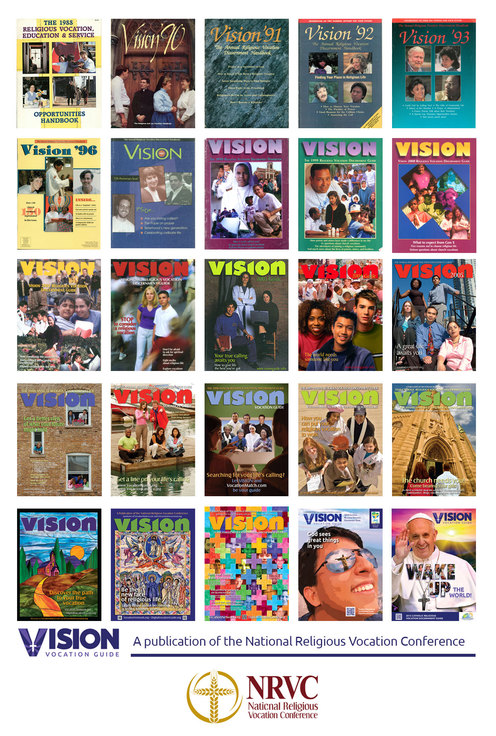
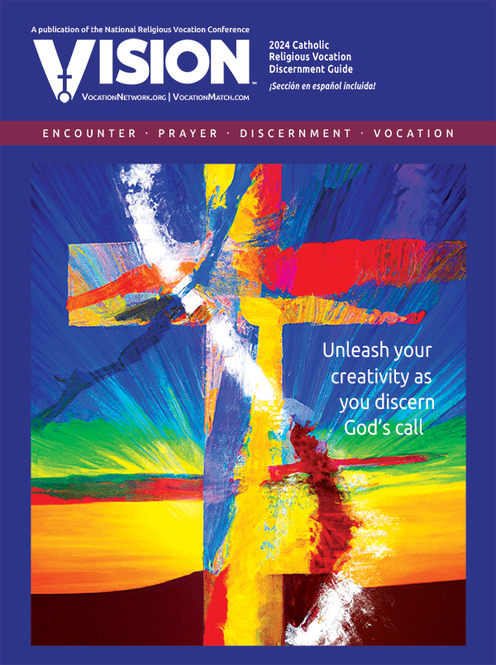 VISION is an annual print and multimedia vocation guide published by the National Religious Vocation Conference. NRVC publishes VISION through the assistance of TrueQuest Communications.
VISION's mission is to help those considering religious life explore their vocation options and to connect them with religious community vocation directors who can help them in their discernment:
VISION is:
VISION has won numerous awards from the Catholic Press Association and the Associated Church Press. In addition, its website has been named a top ten vocation website by the U.S. Conference of Catholic Bishops.
Explore VocationNetwork.org | Order free copies of VISION Vocation Guide | Go through VocationMatch.com | Advertising options
The NRVC has produced a vibrant new 16-page booklet to help vocation ministers better understand and engage with African American Catholics. Learn more about this community and the best ways to encourage and sustain vocations to religious life. The colorful printed booklet may be ordered for only $5 each for members ($8 nonmembers). Members also have the option to download the book in the Member Toolbox. The full title is "Transforming Religious Communities to be Antiracist and Culturally Inviting: Welcoming the Cultural Abundance of African American and Black Catholics."
Published on: 2024-04-25
Edition: May 2024 newsletter

Mark your calendars for World Youth Day celebrated August 1-6, 2023. Check the official website frequently for updated information. Registration is now open. More information about the vocation fair in the "City of Joy" and to register is here. A WYD leader's guidebook is available here.
If you plan to attend, look for NRVC's VISION Vocation Network booth in the Vocation Area. Please email debbiesscm@nrvc.net if you are an NRVC member who will be at World Youth Day to add to the list below.
Did you know that 17% of newer entrants who entered religious life between 2003-2018 attended World Youth Day before they entered? Also, 95% of newer entrants to religious life rated meeting with a member(s) of the religious institute as most helpful in discerning their call to religious life. Consider contacting religious communities before you leave for World Youth Day to ask for their prayers throughout your pilgrimage. While in Portugal, get together with some of these communities who will also be there to learn more about consecrated life and vocation discernment.
Augustinians of the Assumption/Assumptionists
Congregation of Sisters of Bon Secours
Handmaids of the Sacred Heart of Jesus (ACI)/Esclavas del Sagrado Corazón
USA East Province of the Society of Jesus
YOUTH MINISTERS & PARENTS: Learn more about several resources to help promote vocations with pilgrims preparing for World Youth Day.
Since 1986, World Youth Day (WYD) is a gathering of young Catholics from all over the world with the Pope. It is also a pilgrimage, a celebration of youth, an expression of the universal Church and an intense moment of evangelization for the youth world.
"Mary arose and went with haste" (Lk 1:39) is the scriptural quote chosen by Pope Francis as the motto of the XXVIII World Youth Day that will be held for the first time in the capital city of Lisbon, Portugal. The biblical phrase opens the account of the Visitation (Mary’s visit to her cousin Elizabeth), a biblical episode following the Annunciation (the angel’s announcement to Mary that she would be the mother of the Son of God, and the theme of the last WYD, in Panama).
The World Youth Day Lisbon 2023 theme song, entitled “Há Pressa no Ar”, was released in January 2021. The song, inspired on the WYD Lisbon 2023 theme "Mary rose up and went with haste" (LK 1:39), is about the ‘yes’ of Mary and about her rush to meet her cousin Elizabeth.
Learn more about prayer and discernment at VISION Vocation Network.org
The United States, through the USCCB, will be providing support materials for leaders through guidebooks and its web page. Click here to view a video on preparing for WYD and for the power point slides. The USCCB has information on hosting stateside events here. A leader's guidebook is also available.
The WYDUSA office invites you to join the next Lisbon 2023 Leaders webinar, on March 29, 11 am ET. We will discuss safety and security while on the ground in Lisbon and traveling.
“Mary arose and went with haste” (Lk 1:39)
“Dear Young People!
The theme of the Panama World Youth Day was, “I am the servant of the Lord. May it be done to me according to your word” (Lk 1:38). After that event, we resumed our journey towards a new destination – Lisbon 2023 – with hearts afire with God’s urgent summons to arise. In 2020, we meditated on Jesus’s words: “Young man, I say to you, arise!” (Lk 7:14). Last year too, we were inspired by the figure of the Apostle Paul, to whom the Risen Lord said: “Arise! I appoint you as a witness of what you have seen” (cf. Acts 26:16). Along the route we still need to travel before arriving in Lisbon, we will have at our side the Virgin of Nazareth who, immediately after the Annunciation, “arose and went with haste” (Lk 1:39). Common to these three themes is the word: “arise!” It is a word that also – let us remember – speaks to us of getting up from our slumber, waking up to the life all around us.
In these troubling times, when our human family, already tested by the trauma of the pandemic, is racked by the tragedy of war, Mary shows to all of us, and especially to you, young people like herself, the path of proximity and encounter. I hope and I firmly believe that the experience many of you will have in Lisbon next August will represent a new beginning for you, the young, and – with you – for humanity as a whole. Read more here.
As we prepare for World Youth Day, let us join together in praying the official 2023 World Youth Day Prayer:
Our Lady of the Visitation,
you who arose and went with haste towards the mountain to meet Elizabeth,
lead us also to meet all those who await us
to deliver them the living Gospel:
Jesus Christ, your Son and our Lord!
We will go in a hurry, with no distraction or delay,
but with readiness and joy.
We will go peacefully, because those who take Christ take peace,
and welldoing is the best wellbeing.
Our Lady of the Visitation,
with your inspiration, this World Youth Day
will be the mutual celebration of the Christ we take, as You once did.
Make it a time of testimony and sharing,
fraternization, and giving thanks,
each of us looking for the others who always wait.
With you, we will continue on this path of gathering,
so that our world will gather as well,
in fraternity, justice and peace.
Help us, Our Lady of the Visitation,
to bring Christ to everyone, obeying the Father, in the love of the Spirit! Amen.
The National Eucharistic Congress expects to draw 40,000+ Catholics from around the United States to Lucas Oil Stadium and Convention Center, next week, July 17-21, 2024. Through the generous invitation of the U.S.A. Council of Serra-International, the NRVC will give away vocation promotion resources and showcase the diversity of religious life and societies of apostolic life at exhibit booth #1002. Stop by our booth topick up at “NRVC Vocation Team” ribbon for your name tag and to take a photo for us to post on the NRVC Facebook Page. Among the exhibitors, connect with other NRVC members who will have vocation exhibits:
Apostles ofthe Sacred Heart of Jesus#903Benedictine Sisters, Beech Grove#1029Benedictine Sisters, FerdinandBenedictine Sisters of Perpetual Adoration#905Carmelite Friars, Province of St. Elias#907Carmelite Monastery, Terre HauteCarmelite Sisters for the Aged and Infirmed#946Claretian Missionaries#911Congregation of Holy Cross#915Daughters of Mary Immaculate#1016Daughters of St. Paul#1115DeLaSalle Brothers of the Christian Schools#917Dehonians, Priests of the Sacred HeartDominican Sisters, Springfield#1017Felician Sisters of North America#1031Franciscan Brothers of Peace#921Franciscan Friars, Conventual#929Franciscan Friars, Province of Our Lady of Guadalupe#944Glenmary Home Missioners#901Little Sisters of the Poor#1009Mercedarian Friars#945Missionaries of Our Lady of La Salette#949Missionaries of the Precious Blood, US Province#958Missionary Servants of the Most Holy Trinity#951Order of the Incarnate Word and Blessed Sacrament#955Salesian Sisters of St. John Bosco#1001Sisters of Providence, Saint Mary of the Woods#912Sisters of St. Francis of Perpetual Adoration#916Sisters of St. Francis of the Neumann Communities#1055Sisters of St. Joseph of Carondelet#1027Sisters of the Holy Family of Nazareth#1101Sisters of the Precious Blood#1019Society of Jesus (Jesuits)#932Society of Mary#956Society of the Divine Word#1109
Mark your calendars for World Youth Day celebrated August 1-6, 2023. Check the official website frequently for updated information. Registration is now open. More information about the vocation fair in the "City of Joy" and to register is here. A WYD leader's guidebook is available here.
If you plan to attend, look for NRVC's VISION Vocation Network booth in the Vocation Area. Please email debbiesscm@nrvc.net if you are an NRVC member who will be at World Youth Day to add to the list below.
Did you know that 17% of newer entrants who entered religious life between 2003-2018 attended World Youth Day before they entered? Also, 95% of newer entrants to religious life rated meeting with a member(s) of the religious institute as most helpful in discerning their call to religious life. Consider contacting religious communities before you leave for World Youth Day to ask for their prayers throughout your pilgrimage. While in Portugal, get together with some of these communities who will also be there to learn more about consecrated life and vocation discernment.
Augustinians of the Assumption/Assumptionists
Congregation of Sisters of Bon Secours
Handmaids of the Sacred Heart of Jesus (ACI)/Esclavas del Sagrado Corazón
USA East Province of the Society of Jesus
YOUTH MINISTERS & PARENTS: Learn more about several resources to help promote vocations with pilgrims preparing for World Youth Day.
Since 1986, World Youth Day (WYD) is a gathering of young Catholics from all over the world with the Pope. It is also a pilgrimage, a celebration of youth, an expression of the universal Church and an intense moment of evangelization for the youth world.
"Mary arose and went with haste" (Lk 1:39) is the scriptural quote chosen by Pope Francis as the motto of the XXVIII World Youth Day that will be held for the first time in the capital city of Lisbon, Portugal. The biblical phrase opens the account of the Visitation (Mary’s visit to her cousin Elizabeth), a biblical episode following the Annunciation (the angel’s announcement to Mary that she would be the mother of the Son of God, and the theme of the last WYD, in Panama).
The World Youth Day Lisbon 2023 theme song, entitled “Há Pressa no Ar”, was released in January 2021. The song, inspired on the WYD Lisbon 2023 theme "Mary rose up and went with haste" (LK 1:39), is about the ‘yes’ of Mary and about her rush to meet her cousin Elizabeth.
Learn more about prayer and discernment at VISION Vocation Network.org
The United States, through the USCCB, will be providing support materials for leaders through guidebooks and its web page. Click here to view a video on preparing for WYD and for the power point slides. The USCCB has information on hosting stateside events here. A leader's guidebook is also available.
The WYDUSA office invites you to join the next Lisbon 2023 Leaders webinar, on March 29, 11 am ET. We will discuss safety and security while on the ground in Lisbon and traveling.
“Mary arose and went with haste” (Lk 1:39)
“Dear Young People!
The theme of the Panama World Youth Day was, “I am the servant of the Lord. May it be done to me according to your word” (Lk 1:38). After that event, we resumed our journey towards a new destination – Lisbon 2023 – with hearts afire with God’s urgent summons to arise. In 2020, we meditated on Jesus’s words: “Young man, I say to you, arise!” (Lk 7:14). Last year too, we were inspired by the figure of the Apostle Paul, to whom the Risen Lord said: “Arise! I appoint you as a witness of what you have seen” (cf. Acts 26:16). Along the route we still need to travel before arriving in Lisbon, we will have at our side the Virgin of Nazareth who, immediately after the Annunciation, “arose and went with haste” (Lk 1:39). Common to these three themes is the word: “arise!” It is a word that also – let us remember – speaks to us of getting up from our slumber, waking up to the life all around us.
In these troubling times, when our human family, already tested by the trauma of the pandemic, is racked by the tragedy of war, Mary shows to all of us, and especially to you, young people like herself, the path of proximity and encounter. I hope and I firmly believe that the experience many of you will have in Lisbon next August will represent a new beginning for you, the young, and – with you – for humanity as a whole. Read more here.
As we prepare for World Youth Day, let us join together in praying the official 2023 World Youth Day Prayer:
Our Lady of the Visitation,
you who arose and went with haste towards the mountain to meet Elizabeth,
lead us also to meet all those who await us
to deliver them the living Gospel:
Jesus Christ, your Son and our Lord!
We will go in a hurry, with no distraction or delay,
but with readiness and joy.
We will go peacefully, because those who take Christ take peace,
and welldoing is the best wellbeing.
Our Lady of the Visitation,
with your inspiration, this World Youth Day
will be the mutual celebration of the Christ we take, as You once did.
Make it a time of testimony and sharing,
fraternization, and giving thanks,
each of us looking for the others who always wait.
With you, we will continue on this path of gathering,
so that our world will gather as well,
in fraternity, justice and peace.
Help us, Our Lady of the Visitation,
to bring Christ to everyone, obeying the Father, in the love of the Spirit! Amen.
Convocation participants are asked to bring two photos of their favorite patron saints for the opening prayer ritual and two mementos of people who have died. We will collectively build an altarcito (small altar) in the conference ballroom to focus our time and prayer together throughout the convocation.
Published on: 2024-08-27
Edition: Aug. 2024 newsletter
An easy, cost-free way to support the NRVC is to make Amazon purchases using Smile.Amazon.com. The cost and process for purchases at the Smile site are the same as at the main site, and Amazon will donate .5 percent of the price of eligible purchases to your designated charity. To designate NRVC, simply follow the prompts at Smile.Amazon.com and type in "National Religious Vocation Conference" or "National Fund for Catholic Religious Vocations" for your charity. NRVC already receives checks from this program. Thank you to all our Smile participants!
Tech tip: bookmark "smile.amazon.com" because donations only occur when shopping from this site. (No donations will be made when using simply amazon.com.)

Rise Up Rooted Like Trees
How surely gravity’s law,
strong as an ocean current,
takes hold of even the smallest thing
and pulls it toward the heart of the world.
Each thing—
each stone, blossom, child—
is held in place.
Only we, in our arrogance,
push out beyond what we each belong to
for some empty freedom.
If we surrendered
to earth’s intelligence
we could rise up rooted, like trees.
Instead we entangle ourselves
in knots of our own making
and struggle, lonely and confused.
So, like children, we begin again
to learn from the things,
because they are in God’s heart;
they have never left him.
This is what the things can teach us:
to fall,
patiently to trust our heaviness.
Even a bird has to do that
before he can fly.
“Wenn etwas mir vom Fenster fallt.../How surely gravity’s law” by Rainer Maria Rilke; from RILKE’S BOOK OF HOURS: LOVE POEMS TO GOD by Rainer Maria Rilke, translated by Anita Barrows and Joanna Macy, translation copyright © 1996 by Anita Barrows and Joanna Macy. Used by permission of Riverhead, an imprint of Penguin Publishing Group, a division of Penguin Random House LLC. All rights reserved.
Please do not publish this information as it is for members only.
Member Directory and interactive map
Minutes from January 23, 2023, March 2, 2023, June 5, 2023, August 29, 2023
Minutes from May 18, 2022, November 21, 2022
Minutes from April 27, 2021, Minutes from January 19, 2021
Sister Michele Fisher, C.S.F.N. | sorellamichele@aol.com
vacant position
Minutes from October 13, 2022
Sister Réjane Cytacki, S.C.L. | rcytacki@scls.org
Ms. Michelle Horton | mhorton@sinsinawa.org
Minutes from June 10, 2023
Minutes from April 25, 2023
Minutes from June 22, 2022
Sr. Maria Amador, P.C.M. | info@sisterspcm.org
Sister Gloria Agnes Ardenio, M.M. | gagnes@mksisters.org
For more information, see this flyer.
Minutes from February 23, 2023, May 8, 2023
Minutes from October 28, 2021, Minutes from April 22, 2021
Sr. Caryn Crook, O.S.F. | ccrook@sosf.org
vacant position
Minutes from December 6, 2021, Minutes from May 4, 2021,
Minutes from February 24, 2021
Sister Kathy Persson, O.S.B. | kpersson@osbva.org
Sr. Jean Rhoades, DC | jean.rhoades@doc.org
Presentation on Depression and Anxiety in New Members
For more information, click here.
Sister Kathleen Branham, O.S.F. | kbranham@oldenburgosf.com
Sister Jill Reuber, O.S.B. | jreuber@thedome.org
Minutes from October 14, 2021, Minutes from March 18, 2021
Mrs. Sandy Piwko | sandy@assumptioncenter.org
Sister June Fitzgerald, O.P. | jfitzgerald@oppeace.org
Sister Chero Chuma, C.S.J.P. | cherochuma@gmail.com
vacant position
Mrs. Renee Dee | lsvocationsoffice@gmail.com
Sister Regina Hlavac, DC | regina.hlavac@doc.org
Minutes from December 21, 2021, Minutes from September 21, 2021, Minutes from May 4, 2021, Minutes from February 2, 2021
Brother Mark Motz, SM | mmotz@marianist.us
vacant position
Sr. Carmella Luke, OSB | cluke@yanktonbenedictines.org
Brother Larry Schatz, F.S.C. | lschatz@cbmidwest.org
Minutes from October 25, 2022
Minutes from March 8, 2022, May 26, 2022
Minutes from December 2, 2021, Minutes from April 21, 2021,
Minutes from February 9, 2021
Father Radmar Jao, SJ | UWEVocationDirector@jesuits.org
Father Vien Nguyen, SDB | vocations@salesiansf.org
Mrs. Margaret Cartwright | vocationsireland1@gmail.com
Sister Mary Rowell, CSJ | mrowell@csjcanada.org
Over 100 NRVC members live in Australia, Bangladesh, Belize, Brazil, Canada, the Democratic Republic, Egypt, France, Ghana, Grenada, Haiti, Honduras, Hong Kong, India, Ireland, Italy, Kenya, Korea, Mexico, Peru, Philippines, Rwanda, Singapore, Trinidad and Tobago, Uganda, United Kingdom, Zambia and Zimbabwe.
Read the current issue of VISION Vocation Guide
ORDER free VISION resources: Annual Guide, prayer cards, posters
Or search VISION's Article Index for current and archived content.
This foundational workshop provides vocation ministers and all who accompany discerners with a solid understanding of psychological well-being and psycho-sexual development to assist them in their efforts to adequately assess a candidate's aptitude for leading a healthy and integrated celibate life. It includes the basis elements of human sexuality: the funda
The NRVC gives thanks to the U.S. Council of Serra for its outstanding support of vocation ministry at the National Eucharistic Congress (NEC) in Indianapolis in July. The Serrans generously sponsored 50 vocation booths, including the booth of the National Religious Vocation Conference. Vocation ministers appreciated the Serrans’ warm welcome, thoughtfulness, and encouragement.
Over 50,000 Catholics passed through the Convention Center, many showing interest in learning more about vowed communal life. Questions varied from curiosity about the vows, where religious minister, how they pray, how to hear God's call, and how to contact a vocation director to begin discernment.
During the NEC, members of the NRVC served as volunteers, were ushers at Mass, and took part in the Eucharistic pilgrimage. They also attended daily sessions about the Eucharist in the stadium. The next National Eucharistic Congress will be in 2033.
Published on: 2024-07-23
Edition: Aug. 2024 newsletter
Sister Jean Rhoads, D.C. says that more recently she has been trying to strengthen her relationship with campus ministers so that she can be invited to events they are already doing. Prospective discerners will participate more when an event is already a part of campus ministry. Learn more here.
I have been vocation director for my community, Daughters of Charity of St. Vincent de Paul since 2017. I am on the NRVC Finance Advisory Committee and I serve with Sister Kathleen Persson, O.S.B. as co-coordinator for the Mid-Atlantic Member Area. From 2004 to 2011 I was on my community’s provincial council, which oversaw vocation ministry.
We have a vocation team of two vocation directors (Sister Regina Hlavac, D.C., based in San Antonio, and me in Philadelphia). Five other sisters volunteer time to serve on our vocation team. Their main roles are to help identify vocation opportunities in various geographic areas and to participate in vocation efforts as their responsibilities in other ministries allow.
NRVC has been invaluable because of the great people who are part of this organization who provide a solid source of expertise, education, and networking. Vocation ministry has so many facets such as companioning individuals in their discernment, giving small and large group presentations, serving on vocation panels, participating in conferences (e.g., NCYC, FOCUS, etc.), overseeing and posting to social media, and being active in local and state vocation committees.
NRVC offers ready access to people who have served in this role for years and can share wisdom and insights as well as to courses and webinars to enhance the skillset of each vocation minister. Thank you, NRVC!
The most meaningful approach I’ve taken this year is to make personal connections to campus ministers in order to be invited to an activity that is already occurring at their colleges or universities. The lives of college students are so busy that the response and participation of potential discerners is much higher when the event is right there and on regular schedule of the Newman Center or Catholic campus ministry.
Could you share a fun fact about yourself?
I love to bake (it’s relaxing and lessens stress ), and I make awesome homemade sticky buns, cinnamon rolls, chocolate cake and various cookies.
When you were a kid, what did you want to be when you grew up?
I thought I wanted to be a high school math teacher, be married, and have lots of children. It seems the Lord had other plans!
Published on: 2023-02-28
Edition: March 2023
The NRVC extends a warm welcome to Sister Dina Bato, S.P., who begins August 15 as director of membership. With a bachelor's degree in accounting and a master's in pastoral theology, she has ministered in parish and young adult ministry and has promoted religious life vocations in a variety of settings. She took her final vows with the Sisters of Providence of Saint-Mary-of-the-Woods, Indiana in 2017. In addition to her NRVC position, Sister Dina is a Core Team member and Finance Committee chair for Giving Voice, an organization of younger women religious.
Published on: 2022-07-29
Edition: August 2022 newsletter
Consider enhancing your experience of our November 3-6 convocation by signing up for an optional excursion with participants to Historic Silver Valley, Idaho, roughly an hour away. This bus trip takes place on Sunday, the 6th, from 9 a.m. to 3 p.m., allowing participants to socialize, eat lunch together, network, and relax. Sights include Lake Coeur d’Alene, Old Mission State Park, Cataldo Mission, and Sacred Encounters, an exhibit about the Jesuits and the Coeur d’Alene tribe. Details are here. (Photo by Jami Dwyer, Flickr)
Published on: 2022-08-01
Edition: August 2022 newsletter
Mrs. Sandy Piwko always wanted to be a teacher. She just never guessed that someday she'd be teaching people about religious life. Learn more about the vocation director for the Religious of the Assumption Sisters.
Published on: 2022-08-01
Edition: August 2022 newsletter
The National Religious Vocation Conference (NRVC) began in 1988 as a combination of the National Conference of Religious Vocation Directors (NCRVD) and the National Sisters Vocation Conference (NSVC). Today, NRVC is an organization of men and women committed to the fostering and discernment of vocations within the context of the Catholic Church. It gives emphasis to the vision and concerns related to shaping religious life within the United States and throughout the world. It is to these ends that we adopt the following Constitution.
The name of this organization is the National Religious Vocation Conference, Inc. an Illinois not-for-profit corporation which is abbreviated to the National Religious Vocation Conference (NRVC).
The National Religious Vocation Conference is a catalyst for vocation discernment and the full flourishing of religious life as sisters, brothers, and priests for the ongoing transformation of the world.
The purpose of the National Religious Vocation Conference is:
C. THE NATIONAL OFFICE
1. NRVC maintains a national office to ensure unity, continuity, and effective pursuit of the purpose of the National Religious Vocation Conference and to provide needed assistance in planning, coordinating, and administering the activities and programs of the Conference.
2. The National Office operates under the general supervision of the National Board, pursuant to policies, plans and programs established by the Board.
3. The National Office employees of NRVC are appointed by the National Board and are accountable to the Board. National Office employees are all at-will employees and may be terminated at any time with or without cause in accordance with the Bylaws.
4. In matters of urgency, the Director of Mission Integration takes appropriate action in consultation with the Executive Committee of the National Board.
D. THE NATIONAL OFFICE RESPONSIBILITIES
E. THE NRVC MEMBER AREA STRUCTURE
In order to more effectively serve the membership of NRVC, the Conference is divided into geographic Member Areas. The number and geographic areas of the Member Areas are determined by the National Board in consultation with the Member Area Coordinators.
F. RESIGNATIONS OR GROUNDS FOR REMOVAL FROM OFFICE
Any persons in service to NRVC at the national or Member area levels may resign his/her position or be removed from office for a grave reason. The procedures for removing such an individual from office and for replacing him/her can be found in the Bylaws. See Bylaws, Removal of a National Board Member: III (B); Removal of the National Office staff IV (B); Removal of a Member Area Coordinator: (V.J.).
In 2014, the National Religious Vocation Conference established the National Fund for Catholic Religious Vocations (NFCRV) as a 501(c)(3) nonprofit corporation.
The rules contained in the current edition of Robert’s Rules of Order (revised edition) shall govern the Conference in all cases to which they are applicable and in which they are not inconsistent with this Constitution and any special rules of order the Conference may adopt.
The ordinary mode of operation of NRVC is to make decisions by consensus. In areas where this is not possible or where more formal action is required, Robert’s Rules of Order (revised edition) shall be the governing authority in the transaction of business unless it conflicts with the Constitution of this organization.
In the event of dissolution or liquidation of the National Religious Vocation Conference, any remaining funds and/or assets shall be distributed among such organizations as described in Section 501(c)(3) of the Internal Revenue Code of 1986 or corresponding provisions of any subsequent Federal Tax laws (the “Code”) and carrying out similar or related objects (other than private foundations as determined in Section 509 thereof) as the National Board shall decide, and shall be exempt from taxation under Section 501(c)(3) thereof. Any such assets not so disposed of in accordance with the aforementioned procedures shall be disposed of by a court of competent jurisdiction of the county in which the principal office of the Corporation is then located, to such organization or organizations, as said court shall determine, all of which are organized and operated exclusively for such purposes.
Updated and Amended Oct. 31, 2020
The National Religious Vocation Conference is committed to providing its membership with relevant resources, professional development and other programs that strengthen and enhance the professional skills of those serving in vocation ministry. Vocation ministers must be credible and competent in their presentations to varied audiences while promoting vocations and assessing candidates. The following documents may be used for presentations within religious congregations and in public settings to promote vocations to religious life.
The numerous links for studies on Religious Life are available here. Papal and USCCB Documents are linked here. There are additional professional documents available as a benefit to NRVC members that are listed in the "Members Only" portion of the website.
Acronyms of National Organizations
Fifty Fun Facts about Religious Life Handout
HORIZON subscription order form (note: online suscriptions are available at nrvc.net/signup.)
HORIZON rate card for advertisers
NRVC Characteristics of New Entrants Infographic
NRVC Code of Ethics for Vocation Ministry
NRVC Copyright/Permission Request Form
NRVC Curriculum for Vocation Ministers
NRVC Handbook on Educational Debt & Vocations to Religious Life
NRVC English and Spanish Photo Release Form
NRVC Mustard Seed Award Nomination Form
NRVC Outstanding Recognition Award Nomination Form
NRVC Biennial Convocation Award Booklet
Religious Life Today Infographic
Religious Life Timeline EN SP FR
Role of Leadership in Vocation Ministry Handout
The NRVC Executive Committee is a subgroup of the National Board.
B. ELECTION OF THE EXECUTIVE COMMITTEE
C. ELECTION OF THE BOARD CHAIR
Members of the National Board elect a Board Chair at the spring meeting from among those chosen to serve on the Executive Committee using the following process:
D. TERMS OF OFFICE FOR THE EXECUTIVE COMMITTEE
1. The members of the Executive Committee, including the Board Chair, may serve in this capacity for a term of two years, beginning with the spring meeting.
2. If a Board member meets the qualifications for membership on the National Board, there are no term limits to his/her service on the Executive Committee.
3. A member of the Executive Committee may not serve as Board Chair for two consecutive terms.
To facilitate the efficiency and effectiveness of the ministry of NRVC to its members, the national organization divides its members into various geographic designated groups known as Member Areas. A Member Area consists of a grouping of NRVC members choosing to belong to a given Member Area. The number and size of Member Areas are determined by the National Board.
C. NEW MEMBER AREAS
The formation of a new Member Area will take place at the initiation of the National Board or the Member Area Coordinators with the approval of the National Board.
D. RESPONSIBILITIES OF MEMBER AREA COORDINATORS:
E. MEMBERSHIP IN AND ORGANIZATION OF MEMBER AREAS
F. MEMBER AREA MEETINGS
G. SELECTION OF MEMBER AREA COORDINATORS
Each Member Area elects two Member Area Coordinators by and from the membership according to voting procedures established by the Member Area. Diversity is desired in the selection of Member Area leadership.
2. Be recommended for the position of Member Area Coordinator - Nominees for the office of Member Area Coordinators should:
a. Participate in Member Area meetings and activities.
b. Attend the annual Member Area Coordinators meeting.
c. Be willing to attend Convocation and Institutes or national gatherings.
3. The Member Area Coordinator who is currently in office, but not eligible for renewal or, if this is not possible, someone from the Member Area oversees the selection process.
4. The Nomination/Selection Process for the Position of Member Area Coordinator
5. The current Member Area Coordinators communicate the results of the selection of the Member Area Coordinator(s) to the Director of Mission Integration as soon as possible to confirm the selection.
6. Once the selection is confirmed, the current Member Area Coordinators communicate the results to the Member Area.
H. TERM OF A MEMBER AREA COORDINATOR
I. REPLACEMENT OF A MEMBER AREA COORDINATOR
If a Member Area Coordinator resigns his/her position or is unable to complete a term of office for any reason, the Member Area selects a new Coordinator to fulfill the unexpired term.
J. REMOVAL OF A MEMBER AREA COORDINATOR
The Director of Mission Integration in consultation with the Executive Committee of the National Board, may remove a Member Area Coordinator from office with or without cause. If such a request is made, the Director of Mission Integration would inform the Board Chair. The Board Chair would:
The following benefits are afforded to each NRVC member:
The membership year is from January 1 to December 31.
The NRVC fiscal year is from January 1 through December 31.
D. THE NATIONAL BOARD’S RESPONSIBILITIES TO THE COMMITTEE(S)
Revised 2017, 2020
The NRVC has updated its Code of Ethics for Vocation Ministry and encourages all involved in this ministry to review it. Consider sharing these important guidelines with your leadership and membership. The code sets forth the principles, responsibilities, and expectations for vocation ministry, including responsibilities of leadership and membership, ethical vocation promotion with inquirers, accompaniment of discerners, and assessment of applicants for admission.
A warm thank you to all who served on the committee that recommended the updates recently approved by the NRVC board: Father Luke Ballman, Sister Deborah Borneman, SS.C.M., Sister Kathleen Branham, O.S.F., Father Raymond P. Carey, Ms. Colleen Crawford, Ms. Adriana Dominguez, J.D., Sister Marcia Hall, O.S.P., Sister Michelle Lesher, S.S.J., Brother Larry Schatz, F.S.C., Sister Cynthia Serjak, R.S.M., Sister Nicole Trahan, F.M.I., and Sister Cheryl Wint, O.S.F.
Published on: 2022-05-25
Edition: June 2022 newsletter
You are invited to join an online conversation about religious life today on May 15, 1:30 p.m. CT, co-hosted by the NRVC and A Nun's Life Ministry. Entitled "Let's talk about it! Asking the questions, living into the answers," the event will start with ice-breaker questions before moving into breakout rooms to treat more serious questions about contemporary religious life. The intention is to find signs of hope through conversation and revitalizing interaction. Register here.
Sister Kathleen Persson, O.S.B. of the Benedictine Sisters of Virginia became vocation and formation director just as COVID-19 hit the nation. The good news is that she wasn’t already used to doing lots of in-person activities. Seeking a way to virtually connect with people, she turned to YouTube and became the producer of “Benedictine Bytes.” Read more.
The most interesting vocation initiative that Sister Nicole Trahan, F.M.I. has been involved with lately was "get to know you" cookouts at a community-sponsored university. They worked well to help the Marianists re-establish relationships on campus. Learn more about this seasoned vocation minister, HORIZON contributor, and NRVC board member.
Published on: 2022-05-31
Edition: June 2022
Sr. Charlene Herinckx, S.S.M.O. previously served as the NRVC Director of Programs and Projects from 1999-2005, before being elected to congregational leadership. She served on the General Council from 2005-2010, then was elected Superior General for two terms from 2010-2020. Sr. Charlene holds a Master of Arts degree from the University of San Francisco in Private School Administration and a Master of Education from the University of Portland. She also serves as a consultant for the National Religious Retirement Office.
Primary audience: CAMPUS MINISTERS | YOUTH MINISTERS | VOCATION MINISTERS | DISCERNERS. All are welcome.
A Catholic college campus minister and diocesan young adult minister outline ways their work supports those discerning God’s call and helps promote religious vocations.
An ideal webinar not only for those discerning religious life, but for those in Catholic campus ministry, youth and young adult ministry, vocation offices, and on parish vocation team. Gain new insights and strategies and confirm the good work you are already doing!
Join us on Thursday, March 3, 2022 at 8 p.m. ET/ 7 p.m. CT/ 6 p.m. MT/ 5 p.m. PT
The hour-long format is simple, two outstanding speakers will share their insights and then our panelists will welcome questions from participants.
The webinar is free, but you must register to participate or to receive an on-demand link following the session.
 Sister Susan Kidd, C.N.D.
Campus Minister, Prince Edward Island University. Former NRVC Board Member.
 Craig Gould
Director of Family, Youth, and Young Adult Ministry, Institute for Evangelization, Archdiocese of Baltimore
This provides the link to the Catalyst, a members only benefit to provide updates, information, and connection with NRVC members. If you are not receiving this member benefit, please contact Ms. Marge Argylan at 773.363.5454 or email her at margylan@nrvc.net
On Facebook “It’s Tuesday. Tell me something good.”
To encourage one another, NRVC’s Facebook page will be inviting members and friends to “Tell me something good” each Tuesday beginning today, May 3. The idea is to share on the NRVC page a positive moment in ministry, young adult outreach, vocational invitation, or even your own personal life. Nothing is too small or too large to share. Photos are welcome but not required. Just post your positive moment under the “Tell me something good” photo. Our page is at https://www.facebook.com/NationalReligiousVocationConference
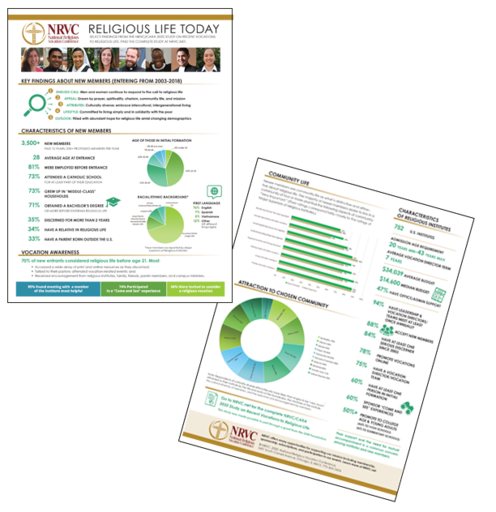 Infographic on Vocation Statistics
2020 infographic on Religious Life Today
2019 infographic on recent statistics
2020 Study on Recent Vocations
2015 Study on the Role of the Family in Nurturing Vocations to Religious Life and Priesthood
2014 Study on Incorporating Cultural Diversity in Religious Life
2014 Men Religious Moving Forward in Hope Final Report
2014 Men Religious Moving Forward in Hope Final Report
2013 Women Religious Moving Forward in Hope Final Report
2013 Moving Forward in Hope: Keys to the Future Final Report
2013 Handbook on Educational Debt & Vocations to Religious Life
2012 Study on Educational Debt and Vocations to Religious Life
2009 Study on Recent Vocations to Religious Life
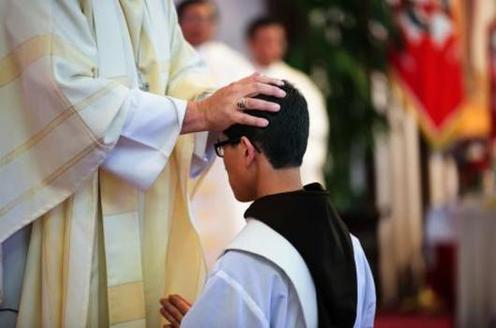
The Class of 2020: Survey of the Ordinands to the Priesthood
The Class of 2019: Survery of the Ordinands to the Priesthood
The Class of 2018: Survey of the Ordinands to the Priesthood
The Class of 2017: Survey of the Ordinands to the Priesthood
The Class of 2016: Survey of Ordinands to the Priesthood
The Class of 2015: Survey of Ordinands to the Priesthood
The Class of 2014: Survey of Ordinands to the Priesthood
The Class of 2013: Survey of Ordinands to the Priesthood
The Class of 2012: Survey of Ordinands to the Priesthood
The Class of 2011: Survey of Ordinands to the Priesthood
The Class of 2010: Survey of Ordination to the Priesthood
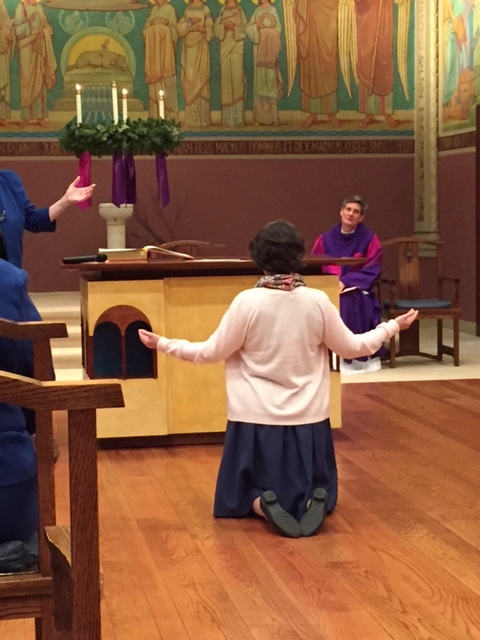
The Profession Class of 2019 Report
The Profession Class of 2018 Report
The Profession Class of 2017 Report
Profession Class of 2017 News Release
The Profession Class of 2016 Report
The Profession Class of 2015 Report
The Profession Class of 2014 Report
The Profession Class of 2013 Report
The Profession Class of 2012 Report
The Profession Class of 2011 Report
The Profession Class of 2010 Report
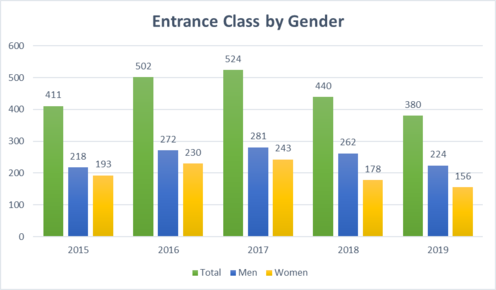
The Entrance Class Report of 2019: Women and Men Entering Religious Life. This CARA report presents the findings of 370 women and men who formally entered 128 US-based religious institutes in 2019
The Entrance Class Report of 2018: Women and Men Enteting Religious Life. This CARA report presents the findings of 440 women and men who formally entered 171 US-based religious insitutes in 2018.
The Entrance Class Report of 2017: Women and Men Entering Religious Life. This CARA report presents the findings of a survey of 524 women and men who formally entered 182 US-based religious institutes in 2017.
The Entrance Class of 2016: Women and Men Entering Religious Life Report. This CARA report presents the findings of a survey of 502 women and men who formally entered 185 US-based religious institutes in 2016.
The Entrance Class of 2015: Women and Men Entering Religious Life Report. This CARA report presents the findings of a survey of 411 women and men who formally entered 143 US-based religious institutes in 2015.
CARA Frequently Requested Church Statistics This weblink contains all relevant statistics for the United States and the world.
2012 Study on the Consideration of Priesthood and Religious Life among Never-Married U.S. Catholics
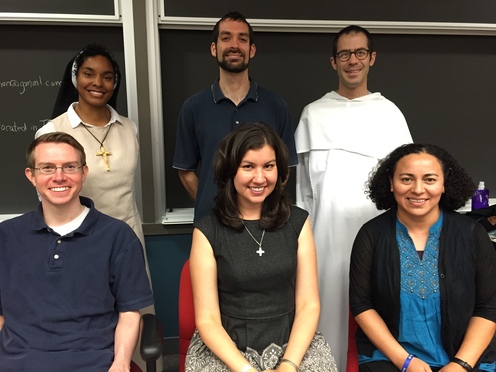
2021 CARA Study on Impact of Cultural Diversity in Vocations to Religious Life. This study looked at the impact of family life, parish life, and cultural backgrounds on discernment of a vocation to a men’s or women’s religious congregation.
2018 Australian Catholic Bishops Conference Report on Understanding Religious Vocation in Australia Today. This report looks at data of newer entrants in Australia from 2000 - 2015. This study looked at data to to determine the characteristics of the women and men who have entered religious life (and stayed) since 2000 and the characteristics, policies and practices of the religious institutes and societies that are attracting and successfully retaining new members.
2018 CARA Study on International Religious Sisters Studying in the United States contains data on over 200 international sisters studying in the United States, the impact of their studies in the United States on their ministries when they return to their home country, and the perceptions and experiences of the major superiors who send their sisters to study abroad.
2018 CARA Catholic Ministry Formation Enrollment Statistics CARA collects enrollment data on every Catholic ministry formation program that prepares men and women for ministry in the U.S. Church as priests, deacons, and lay ecclesial ministers. This statistical overview is published annually and a complete directory listing the names, addresses, and other pertinent information on each program is published every other year.
2016 CARA and A Nun's Life Ministry Study on Women Religious: Social Media Use Executive Summary Phase 1 and Executive Summary Phase 2. This study's purpose is to identify ways to strengthen and support the internet outreach efforts of Catholic sisters for vocation outreach. The research showed that most institutes have an online presence, most commonly via their website and on Facebook.
2017 CARA/Trinity Washington University Study on International Sisters in the United States The first national study of the 4,000 international sisters living in the United States was done to better understand the experiences and contributions of international sisters. The report is also available in Spanish. A reflection guide is available in English and Spanish.
2016 USCCB Cultural Diversity in the Catholic Church Report "The Catholic Church in the United States has always been a very diverse entity, but it is the first time that all available data was brought together to map this diversity nationwide in remarkable detail," said Archbishop Gustavo García-Siller of San Antonio, chairman of the U.S. Bishops' Committee on Cultural Diversity in the Church. "It is also the first time that parish life was looked at from the point of view of the experience of diversity. Multicultural parishes are a growing phenomenon in the United States. This is what makes this study so fascinating and ground-breaking."
2016 CARA Impact of College Experience on Vocational Discernment In this special report, CARA identifies various aspects of the college experience that the respondents tell us were important in their vocational discernment
2016 Religous Life Vitality Project: Key Project Findings Report was written by Catherine Sexton and Sr. Gemma Simmonds, CJ. The purpose of this document is to present six key findings of signs of vitality in women's religious institutes: Ministry; Community and Formative Growth; Collaborative Working; Prayer and Spirituality; New Forms of Membership; and How we are aging.
FADICA 2015 analysis of Catholic sisters This December 2015 report was published by Foundation and Donors Interested in Catholic Activities, Inc. (FADICA) and written by Kathleen Sprows Cummings of University of Notre Dame. This report provides an overview and analysis of the current state of Catholic women religious in the U.S.
2015 CARA Population Trends among Religious Insitutes of Men CARA undertook this longitudinal study of population trends in men’s religious institutes to investigate in more detail some of the trends over the past 45 years.
2015 Catholic Sisters Initiative, Anderson Robbins Report This research funded by the Conrad N. Hilton Foundation, was designed to understand the general public’s attitudes, opinions and experiences with Catholic Sisters in the United States. Specifically, this research sought to answer the following key questions: What does the general public think about Catholic Sisters? That is, what opinions, beliefs and perceptions (as well as misperceptions) define Catholic Sisters in the minds of the general public today?
2015 CARA Catholic Ministry Formation Enrollment Statistics This CARA Study reports that during the academic year 2014-2015 there was increase of 19 seminarians enrolled in the post-baccalaureate level of priestly formation, both diocesan and religious. The Catholic Ministry Formation Directory can be ordered by clicking here.
2014 CARA Population Trends among Religious Institutes of Women In spring 2014, the Center for Applied Research in the Apostolate (CARA) initiated a longitudinal study of women religious in the United States drawing on data reported by the religious institutes of women listed in the Official Catholic Directory (OCD). This report provides a snapshot of some notable phenomena occurring in U.S. religious institutes of women.
2013 CARA Study of Former Full-time Volunteers of the Catholic Volunteer Network This CARA Study reports 37% of former full-time volunteers have considered religious life or the priesthood, 27% of them "very seriously." Six percent have a vocation as a priest, deacon, sister, brother, or are currently in formation.
2012 CARA Study on the Influence of College Experiences on Vocational Discernment to Priesthood and Religious Life This CARA Study was designed to assess the role and influence of Catholic colleges and universities on the vocational discernment of men entering the seminary and religious life in the United States. Almost two-thirds of respondents overall state that a priest/sister/brother professor had a “significant positive influence” on their vocational discernment.
2012 USCCB/CARA Consideration of Priesthood and Religious Life among Never-Married U.S. Catholics This study found that encouragement from others to consider a vocation to religious life is important. Respondents who have one person encouraging them are nearly twice as likely to consider a vocation as those who are not encouraged. Each additional person encouraging these respondents increases the likelihood of consideration. The effect is additive. Respondents who had three persons encourage them would be expected to be more than five times more likely to consider a vocation than someone who was not encouraged by anyone.
2010 NCEA/CARA Study of Psychological Assessment: The Testing and Screening for Candidates to the Priesthood in the U.S. Catholic ChurchThis CARA study conducted by the NCEA Seminary Department examines the psychological assessment practices and procedures used by dioceses, men's religious institutes, and seminaries in the testing and screening of applicants to priestly formation programs in the United States.
2007 Young Adult Catholics and their Future in Ministry Study This study by Dean R. Hoge and Marti Jewell revealed a high percentage of college students involved in campus ministry or diocesan young adult ministry have seriously considered becoming a religious or a diocesan priest.
1992 Future of Religious Orders in the United States Study This three year study of religious institutes of priests, brothers and sisters conducted by Fr. David Nygren, C.M. and Sr. Miriam Ukeritis, C.S.J., is considered the first in-depth study of religious institutes in the United States. It is also known as the Religious Life Futures Project.
1991 A Survey of Priests Ordained Five to Nine Years by Eugene F. Hemrick and Dean R. Hoge. Published by the National Catholic Education Association. This report presents the findings of a national survey of diocesan and religious priests who were ordained between 1980 and 1984. The questionnaire issued to the respondents asked about three topics of concern to Catholic Church leadership: priestly morale, priestly identity, and priestly roles.
The NRVC Executive Committee is a subgroup of the National Board.
B. ELECTION OF THE EXECUTIVE COMMITTEE
C. ELECTION OF THE BOARD CHAIR
Members of the National Board elect a Board Chair at the spring meeting from among those chosen to serve on the Executive Committee using the following process:
D. TERMS OF OFFICE FOR THE EXECUTIVE COMMITTEE
1. The members of the Executive Committee, including the Board Chair, may serve in this capacity for a term of two years, beginning with the spring meeting.
2. If a Board member meets the qualifications for membership on the National Board, there are no term limits to his/her service on the Executive Committee.
3. A member of the Executive Committee may not serve as Board Chair for two consecutive terms.
To facilitate the efficiency and effectiveness of the ministry of NRVC to its members, the national organization divides its members into various geographic designated groups known as Member Areas. A Member Area consists of a grouping of NRVC members choosing to belong to a given Member Area. The number and size of Member Areas are determined by the National Board.
C. NEW MEMBER AREAS
The formation of a new Member Area will take place at the initiation of the National Board or the Member Area Coordinators with the approval of the National Board.
D. RESPONSIBILITIES OF MEMBER AREA COORDINATORS:
E. MEMBERSHIP IN AND ORGANIZATION OF MEMBER AREAS
F. MEMBER AREA MEETINGS
G. SELECTION OF MEMBER AREA COORDINATORS
Each Member Area elects two Member Area Coordinators by and from the membership according to voting procedures established by the Member Area. Diversity is desired in the selection of Member Area leadership.
2. Be recommended for the position of Member Area Coordinator - Nominees for the office of Member Area Coordinators should:
a. Participate in Member Area meetings and activities.
b. Attend the annual Member Area Coordinators meeting.
c. Be willing to attend Convocation and Institutes or national gatherings.
3. The Member Area Coordinator who is currently in office, but not eligible for renewal or, if this is not possible, someone from the Member Area oversees the selection process.
4. The Nomination/Selection Process for the Position of Member Area Coordinator
5. The current Member Area Coordinators communicate the results of the selection of the Member Area Coordinator(s) to the Director of Mission Integration as soon as possible to confirm the selection.
6. Once the selection is confirmed, the current Member Area Coordinators communicate the results to the Member Area.
H. TERM OF A MEMBER AREA COORDINATOR
I. REPLACEMENT OF A MEMBER AREA COORDINATOR
If a Member Area Coordinator resigns his/her position or is unable to complete a term of office for any reason, the Member Area selects a new Coordinator to fulfill the unexpired term.
J. REMOVAL OF A MEMBER AREA COORDINATOR
The Director of Mission Integration in consultation with the Executive Committee of the National Board, may remove a Member Area Coordinator from office with or without cause. If such a request is made, the Director of Mission Integration would inform the Board Chair. The Board Chair would:
The following benefits are afforded to each NRVC member:
The membership year is from January 1 to December 31.
The NRVC fiscal year is from January 1 through December 31.
D. THE NATIONAL BOARD’S RESPONSIBILITIES TO THE COMMITTEE(S)
Revised 2017, 2020
The National Religious Vocation Conference (NRVC) began in 1988 as a combination of the National Conference of Religious Vocation Directors (NCRVD) and the National Sisters Vocation Conference (NSVC). Today, NRVC is an organization of men and women committed to the fostering and discernment of vocations within the context of the Catholic Church. It gives emphasis to the vision and concerns related to shaping religious life within the United States and throughout the world. It is to these ends that we adopt the following Constitution.
The name of this organization is the National Religious Vocation Conference, Inc. an Illinois not-for-profit corporation which is abbreviated to the National Religious Vocation Conference (NRVC).
The National Religious Vocation Conference is a catalyst for vocation discernment and the full flourishing of religious life as sisters, brothers, and priests for the ongoing transformation of the world.
The purpose of the National Religious Vocation Conference is:
C. THE NATIONAL OFFICE
1. NRVC maintains a national office to ensure unity, continuity, and effective pursuit of the purpose of the National Religious Vocation Conference and to provide needed assistance in planning, coordinating, and administering the activities and programs of the Conference.
2. The National Office operates under the general supervision of the National Board, pursuant to policies, plans and programs established by the Board.
3. The National Office employees of NRVC are appointed by the National Board and are accountable to the Board. National Office employees are all at-will employees and may be terminated at any time with or without cause in accordance with the Bylaws.
4. In matters of urgency, the Director of Mission Integration takes appropriate action in consultation with the Executive Committee of the National Board.
D. THE NATIONAL OFFICE RESPONSIBILITIES
E. THE NRVC MEMBER AREA STRUCTURE
In order to more effectively serve the membership of NRVC, the Conference is divided into geographic Member Areas. The number and geographic areas of the Member Areas are determined by the National Board in consultation with the Member Area Coordinators.
F. RESIGNATIONS OR GROUNDS FOR REMOVAL FROM OFFICE
Any persons in service to NRVC at the national or Member area levels may resign his/her position or be removed from office for a grave reason. The procedures for removing such an individual from office and for replacing him/her can be found in the Bylaws. See Bylaws, Removal of a National Board Member: III (B); Removal of the National Office staff IV (B); Removal of a Member Area Coordinator: (V.J.).
In 2014, the National Religious Vocation Conference established the National Fund for Catholic Religious Vocations (NFCRV) as a 501(c)(3) nonprofit corporation.
The rules contained in the current edition of Robert’s Rules of Order (revised edition) shall govern the Conference in all cases to which they are applicable and in which they are not inconsistent with this Constitution and any special rules of order the Conference may adopt.
The ordinary mode of operation of NRVC is to make decisions by consensus. In areas where this is not possible or where more formal action is required, Robert’s Rules of Order (revised edition) shall be the governing authority in the transaction of business unless it conflicts with the Constitution of this organization.
In the event of dissolution or liquidation of the National Religious Vocation Conference, any remaining funds and/or assets shall be distributed among such organizations as described in Section 501(c)(3) of the Internal Revenue Code of 1986 or corresponding provisions of any subsequent Federal Tax laws (the “Code”) and carrying out similar or related objects (other than private foundations as determined in Section 509 thereof) as the National Board shall decide, and shall be exempt from taxation under Section 501(c)(3) thereof. Any such assets not so disposed of in accordance with the aforementioned procedures shall be disposed of by a court of competent jurisdiction of the county in which the principal office of the Corporation is then located, to such organization or organizations, as said court shall determine, all of which are organized and operated exclusively for such purposes.
Updated and Amended Oct. 31, 2020
Sister Kathleen Branham, O.S.F. has loved letting her creative juices flow in response to vocation needs during the pandemic. She's excited to be partnering with the Franciscan Brothers of Brooklyn to host a new Franciscan Online Discernment Group. Read more.
Published on: 2021-03-24
The National Board ensures the implementation of the NRVC goals, objectives, and policies, overseeing the functioning of the NRVC. The National Board is composed of 8-12 members and the ex-officio who serves as a non-voting member of the Board. The National Office oversees the daily operation of the organization and is accountable to the National Board.
The term of office for a Board member is three years, serving no more than two consecutive terms. By the spring of each year, the National Board selects new members from those recommended by the membership to bring particular skills to the Board and to help ensure a balance of gender, geographic, and cultural representation.
The responsibilities of the National Board are:
The Executive Committee consists of the Board Chair, two Vice Chairs and ex officio. Members of the National Board elect the Board Chair and Vice Chairs at the spring meeting following Convocation. The term of office for Vice Chair is two years and may be elected to serve an additional terms. The term of office for the Board Chair is two years and may not serve more than two consecutive terms.
Board Chair
Sister Mindy Welding, I.H.M. '18
Governance Committee, NFCRV Board ex officio
M.A. Religious Formation/Youth and Youth Adults, Fordham University
M.A. Pastoral Care and Counseling/Spiritual Direction, Neumann University
570.346.5414 | reachoutIHM@gmail.com
Vice-Chairs
Father Adam MacDonald, S.V.D. '17
Development Committee
M.Div. Catholic Theological Union
563.876.3332 ext. 316 | adamsvd@yahoo.com
Sister Belinda Monahan, O.S.B. '17
Governance Committee; 2020 Ad Hoc Study Committee
Ph.D. Anthropology, Northwestern University
847.975.6710 | bhemonahan@gmail.com
Ex officio
Sr. Deborah Borneman, SS.C.M.
Liaison to the Member Area Coordinators
M. Divinity, Loyola University
773.363.5454 | debbiesscm@nrvc.net
Sister Marichui Bringas, C.C.V.I. '20
Cultural Diversity Ad Hoc committee
M. Business Management, Upaep. Puelba. Mexico
210.213.5422 | marichui.bringas@amormeus..org
Sister Jean Marie Fernandez, R.G.S. '20
Cultural Diversity Ad Hoc Committee
M.A. Counseling Psychology, University of San Francisco
415.676.8251 | fernje53@yahoo.com
Sister Virginia Herbers, A.S.C.J. '17
Governance Committee Chair; 2020 Study Ad Hoc Committee
M.A. Pastoral Studies, Aquinas Institute
203.248.4225 ext. 450 | vherbers@ascjus.org
Father Charles Johnson, O.P. '17
MDiv, Univ. of St. Mary of the Lake
504.837.2129, ext. 6 | cjohnson@opsouth.org
Sister Lisa Laguna, D.C. '17
Governance Committee; 2020 Study Ad Hoc Committee
M.S. Education, Mount St. Mary University
650.949.8890 | srllaguna@doc1633.org
Sister Kristin Matthes, S.N.D. de N. '15
Liaison to the African American Vocations Committee
M.Ed. Bowling Green State University, M.A. Theology, Xavier University
240.863.1916 | kristin.matthes@sndden.org
Brother Brian Poulin, F.M.S. '20
Finance Committee Chair
M.A. Sustainable International Development, Brandeis University
214.934.9740 | poulinb@gmail.com
Mr. Len Uhal (Society of the Divine Word) '18
Development Committee Chair; Finance Committee
M.S. Health Services Administration, Cardinal Stritch University
563-876-3332 | luhal@dwci.edu
Sister Gayle Lwanga Crumbley, R.G.S.; Sr. Anna Marie Espinosa, I.W.B.S; Sister Virginia Herbers, A.S.C.J.; Father Charles Johnson, O.P.; Sister Lisa Laguna, D.C.; Father Adam MacDonald, S.V.D.; Sister Kristin Matthes, S.N.D.deN.; Belinda Monahan, O.S.B.; Sister Anita Quigley, S.H.C. J.; Mr. Len Uhal; and Sister Mindy Welding, I.H.M.
Sister Gayle Lwanga Crumbley, R.G.S.; Sr. Anna Marie Espinosa, I.W.B.S; Sister Virginia Herbers, A.S.C.J.; Father Charles Johnson, O.P.; Sister Lisa Laguna, D.C.; Father Adam MacDonald, S.V.D.; Sister Kristin Matthes, S.N.D.deN.; Belinda Monahan, O.S.B.; Sister Priscilla Moreno, R.S.M.; Sister Anita Quigley, S.H.C. J.; Mr. Len Uhal; and Sister Mindy Welding, I.H.M.
Father Toby Collins, C.R.; Sister Gayle Lwanga Crumbley, R.G.S.; Sister Anna Marie Espinosa, I.W.B.S.; Sister Virginia Herbers, A.S.C.J.; Brother Ronnie Hingle, S.C.; Father Charles Johnson, O.P; Sister Lisa Laguna, D.C.; Father Adam MacDonald, S.V.D.; Sister Kristin Matthes, S.N.D. deN.; Sister Belinda Monahan, O.S.B.; ; Sister Priscilla Moreno, R.S.M.; and Sister Anita Quigley, S.H.C.J.
Brother Ronald Hingle, S.C.; Sister Anita Quigley, S.H.C.J.; Brother Tom Wendorf, S.M.; Father Toby Collins, C.R.; Sister Gayle Lwanga Crumbley, R.G.S.; Sister Anna Marie Espinosa, I.W.B.S.; Sister Michele Vincent Fisher, C.S.F.N.; Sister Maria Iannuccillo, S.S.N.D.; Sister Kristin Matthes, S.N.D. deN.; Father Don Miller, O.F.M.; Sister Priscilla Moreno, R.S.M.; and Father Vince Wirtner, C.P.P.S.
Father Toby Collins, CR; Sister Gayle Lwanga Crumbley, RGS; Sister Anna Marie Espinosa, IWBS.; Sister Michele Fisher, CSFN; Brother Ronnie Hingle, SC; Sister Maria Iannuccillo, SSND; Sister Kristin Matthes, SNDdeN; Father Don Miller, OFM; Sister Priscilla Moreno, RSM; Sister Anita Quigley, SHCJ; Brother Tom Wendorf, SM; and Father Vince Wirtner, CPPS.
Sister Josita Colbert, SNDdeN; Sister Gayle Lwanga Lwanga, RGS; Sister Anna Marie Espinosa, IWBS; Sister Michele Vincent Fisher, C.S.F.N.; Brother Ronnie Hingle, S.C.; Sister Maria Iannuccillo, SSND; Mr. Mark McGuthrie, Father Don Miller, OFM; Sister Priscilla Moreno, RSM; Sister Anita Quigley, SHCJ; Father Vince Wirtner, CPPS; and Brother Tom Wendorf, S.M.
Ms. Nan Brenzel; Sister Josita Colbert, SNDdeN; Sister Michele Vincent Fisher, CSFN; Sister Elsa Garcia, CDP, Sister Marcia Hall, OSP; Brother Ronnie Hingle, SC; Sister Maria Iannuccillo, SSND; Father Donald Miller, OFM; Sister Jo-Anne Miller, CSJP; Sister Priscilla Moreno, RSM; Brother Tom Wendorf, SM; and Father Vince Wirtner, CPPS.
Sister Josita Colbert, SNDdeN; Sister Michele Vincent Fisher, CSFN; Sister Elsa Garcia, CDP; Mrs. Maryellen Glackin; Sister Marcia Hall, OSP; Brother Ronnie Hingle, SC; Sister Maria Iannuccillo, SSND; Sister Jo-Anne Miller, CSJP; Father Anthony Vinson, OSB; Father Freddy Washington, CSSp; and Father Vince Wirtner, CPPS.
Sister Josita Colbert, SNDdeN; Father Kevin DePrinzio, OSA; Sister Michele Vincent Fisher, CSFN; Sister Elsa Garcia, CDP; Mrs. Maryellen Glackin; Sister Marcia Hall, OSP; Sister Maria Iannuccillo, SSND; Father Anthony Vinson, OSB; Father Freddy Washington, CSSp; and Father Vince Wirtner, CPPS.
Sister Josita Colbert, SNDdeN; Father Kevin DePrinzio, OSA; Sister Elsa Garcia, CDP; Sister Margaret Michael Gillis, FSP; Mrs. Maryellen Glackin; Sister Marcia Hall, OSP; Sister Barb Kwiatkowski, OSF; Sister Angele Lewis, SNDdeN; Father Luis Madera, OSA; Sister Marcy Romine, OSF; and Father Anthony Vinson, OSB.
Josita Colbert, SNDdeN; Kevin DePrinzio, OSA; Margaret Michael Gillis, FSP; Maryellen Glackin; Barb Kwiatkowski, OSF; Angele Lewis, SNDdeN; Marty Lukas, OSFS; Marcy Romine, OSF; and Anthony Vinson, OSB.
Josita Colbert, SNDdeN; Patti Donlin, RSM; Margaret Michael Gillis, FSP; Maryellen Glackin; Joseph Jozwiak, FSC ; Mary Beth Kubera, DC; Marty Lukas, OSFS; Marcy Romine, OSF; Anthony Vinson, OSB; Teri Wall, OP; and Andrea Westkamp SMIC.
Sister Patti Donlin, RSM; Mrs. Maryellen Glackin; Brother Joseph Jozwiak, FSC; Sister Mary Beth Kubera, DC; Father Marty Lukas, OSFS; Sister Mary McNally, OSF; Sister Marcy Romine, OSF; Sister Janet Ryan, SNJM; Father Anthony Vinson, OSB; and Sister Teri Wall, OP.
Sister Patti Donlin, RSM; Mrs. Maryellen Glackin; Brother Joseph Jozwiak, FSC; Sister Mary Beth Kubera, DC; Father Marty Lukas, OSFS; Sister Mary McNally, OSF; Sister Marcy Romine, OSF; Sister Janet Ryan, SNJM; Sister Teri Wall, OP; and Father Anthony Vinson, OSB.
Father Clemente Barron, CP; Sister Renée Daigle, MSC; Sister Charlene Diorka, SSJ; Father Ron Hoye, CM; Sister Anita Lowe, OSB; Father Marty Lukas, OSFS; Sister Mary McNally, OSF; Father Mark Padrez, OP; Sister Janet Ryan, SNJM; Sister Teri Wall, OP; and Sister Mary Walsh, CSJ.
Father Clemente Barron, CP; Sister Renée Daigle, MSC; Sister Charlene Diorka, SSJ; Sister Kathy Littrell, SHF; Father Ron Hoye, CM; Sister Anita Lowe, OSB; Father Marty Lukas, OSFS; Sister Mary McNally, OSF; Sister Janet Ryan, SNJM; sister Deborah Suddarth, OSF; and Sister Teri Wall, OP.
Sister Anna Marie Broxterman, CSJ; Father Clemente Barron, CP; Sister Renée Daigle, MSC; Sister Charlene Diorka, SSJ; Sister Sue Kidd, CND; Sister Kathy Littrell, SHF; Sister Anita Lowe, OSB; Father Marty Lukas, OSFS; Sister Mary McNally, OSF; and Sister Deborah Suddarth, OSF.
Father Steve Albero, O. Praem; Father Clemente Barron, CP; Sister Anna Marie Broxterman, CSJ; sister Renee Daigle, MSC; Sister Joan Gallagher, SP; Sister Susan Kidd, CND; Sister Kathy Littrell, SHF; Sister Anita Lowe, OSB; Sister Mary McNally, OSF; Father James McVeigh, OSF; Sister Deborah Suddarth, OSF and Sister Lizette Valenzuela, SND.
Father Steve Albero, O. Praem.; Father Clemente Barron, CP; Sister Renee Daigle, MSC; Sister Deborah Drago, RGS; Sister Joan Gallagher, SP; Sister Susan Kidd, CND; Sister Kathy Littrell, SHF; Sister Anita Lowe, OSB; Brother Jim McVeigh, OSF; Father Warren Sazama, SJ; Sister Deborah Suddarth, OSF and Sister Maryanne Tracy, SC.
Sister Renee Daigle, MSC; Sister Deborah Drago, RGS; Sister Bertha Franco, CCVI; Sister Susan Kidd, CND; Father Jack Kurps, SCJ; Brother James McVeigh, OSF; Sister Carol Mucha, RSM; Father Warren Sazama, SJ; Sister Maryanne Tracey, SC; Sister Carol Tropiano, RSM; and Sister Marcia Ziska, OSB.
Sister Bertha Franco, CCVI; Father Michael Kissane, O. Carm.; Father Jack Kurps, SCJ; Brother James McVeigh, OSF; Sister Kathleen Pales, SSJ; Sister Andrea Peters, SCSJA; Father James Price, CP; Sister Theresa Rickard, OP, Sister Carol Tropiano, RSM; and Sister Marcia Ziska, OSB.
With vocation ministry experience in two different countries, Sister Marichui Bringas, C.C.V.I. has creatively adapted to the pandemic and found valuable colleagues and know-how in NRVC. Read more.
Published on: 2021-05-28
Check out these upcoming meetings for the members of the National Religious Vocation Conference. For additional details, contact your member area coordinators or see the member area news.
Southwest
September 21, via Zoom
NRVC Board Meeting
Sept 21-23
Hudson Valley
September 28, via Zoom
Delaware Valley
September 28
Mid-Atlantic
October 18-19, 2021, Bon Secours Retreat Center, MD
Lake Erie/Ohio River
October 28, Zoom 3-4 pm CT
Published on: 2021-08-27
Edition: September 2021 newsletter
What roles do you play in vocation ministry?
I’m vocation director for my community, and I recently began as a Member Area Coordinator, Midwest, alongside Sister Kathleen Branham, O.S.F.
How long have you been involved in vocation ministry?
I’m in my third year.
Has being a member of NRVC been helpful to you?
The orientation program was a great beginning and very helpful. I appreciate the gatherings of directors and sharing of ideas. I also find the articles online are helpful for me and for sharing with the entire community.
What idea(s) have you used in lately that excite you?
I have been doing a weekly chat with discerners. I also feel that Zoom has helped connect us with discerners who live at a distance from the monastery. We have been able to share more of our charism.
What do you find most rewarding in vocation work?
I find sharing our charism and community life with others is the most rewarding.
Could you share a fun fact about yourself?
I am a triplet and one of my triplet sisters is in a different Benedictine community!
Click here for a pdf of the NRVC constitution.
Click here for a pdf of the NRVC bylaws.
Or scroll to the bottom of this window for links to these two documents
This 99-page, easy-to-read book, Your One Wild and Precious Life: Thoughts on Vocation, by Father Mark David Janus, C.S.P. (Paulist, 2018) is perfect for inquirers, high school and college graduates, confirmation candidates, serious discerners, etc. Its 34 short chapters examine calling and vocations to religious life, ordained life, marriage and single life. $15 non-members; $10 members. Order here.
Published on: 2020-06-01
11:00 ET | 10:00 CT | 9:00 MT | 8:00 PT
Welcome to workshops with prayer
11:10 ET | 10:10 CT | 9:10 MT | 8:10 PT
Candidate Issues in Immigration Law workshop
with Mr. Miguel Naranjo, part 1
11:55 ET | 10:55 CT | 9:55 MT | 8:55 PT
Wellness break
12:10 ET | 11:10 CT | 10:10 MT | 9:10 PT
Workshop, part 2
12:55 ET | 11:55 CT | 10:55 MT | 9:55 PT
Shared conversation with Q & A
1:30 ET | 12:30 CT | 11:30 MT | 10:30 PT
Workshop ends
4:00 ET | 3:00 CT | 2:00 MT | 1:00 PT
Welcome and prayer
4:10 ET | 3:10 CT | 2:10 MT | 1:10 PT
Impact of Gaming & Pornography workshop
with Fr. David Songy, O.F.M. Cap., Psy.D.
4:55 ET | 3:55 CT | 2:55 MT | 1:55 PT
Wellness break
5:10 ET | 4:10 CT | 3:10 MT | 2:10 PT
Workshop, part 2
5:55 ET | 4:55 CT | 3:55 MT | 2:55 PT
Shared conversation with Q & A
6:30 ET | 5:30 CT | 4:30 MT | 3:30 PT
Workshop concludes
11:00 ET | 10:00 CT | 9:00 MT | 8:00 PT
Opening of Convocation with prayer
11:15 ET | 10:15 CT | 9:15 MT | 8:15 PT
Keynote Address: Reconciliation, a Ministry of Hope
with Fr. Dave Kelly, C.P.P.S., D.Min.
12:00 ET | 11:00 CT | 10:00 MT | 9:00 PT
Newer Entrant Insights
12:10 ET | 11:10 CT | 10:10 MT | 9:10 PT
Breakout groups
12:40 ET | 11:40 CT | 10:40 MT | 9:40 PT
Wellness break
1:00 ET | 12:00 CT | 11:00 MT | 10:00 PT
Shared conversation with Q & A
2:00 ET | 1:00 CT | 12:00 MT | 11:00 PT
Session concludes
4:00 ET | 3:00 CT | 2:00 MT | 1:00 PT
Welcome and prayer
4:15 ET | 3:15 CT | 2:15 MT | 1:15 PT
Keynote Address: Encountering Christ in Harmony: Inviting our Asian & Pacific Island Sisters & Brothers to Religious Life
with Fr. Linh Ngoc Hoang, O.F.M., Ph.D.
5:00 ET | 4:00 CT | 3:00 MT | 2:00 PT
Newer Entrant Insights
5:10 ET | 4:10 CT | 3:10 MT | 2:10 PT
Breakout groups
5:40 ET | 4:40 CT | 3:40 MT | 2:40 PT
Wellness break
6:00 ET | 5:00 CT | 4:00 MT | 3:00 PT
Shared conversation with Q & A
7:00 ET | 6:00 CT | 5:00 MT | 4:00 PT
Keynote session concludes
11:00 ET | 10:00 CT | 9:00 MT | 8:00 PT
Welcome and prayer
11:15 ET | 10:15 CT | 9:15 MT | 8:15 PT
Communicating Key Messages of Hope workshop
with Sr. Maxine Kollasch, I.H.M.
12:00 ET | 11:00 CT | 10:00 MT | 9:00 PT
Newer Entrant Insights
12:15 ET | 11:15 CT | 10:15 MT | 9:15 PT
Workshop concludes, wellness break
12:45 ET | 11:45 CT | 10:45 MT | 9:45 PT
La esperanza nos rodea Communal prayer
with composer/musician Mr. Jaime Cortez
1:30 ET | 12:30 CT | 11:30 MT | 10:30 PT
Communal Prayer concludes
4:00 ET | 3:00 CT | 2:00 MT | 1:00 PT
Welcome and prayer
4:15 ET | 3:15 CT | 2:15 MT | 1:15 PT
Keynote Address: with Sr. Addie Lorraine Walker, S.S.N.D., Ph.D.
5:00 ET | 4:00 CT | 3:00 MT | 2:00 PT
Newer Entrant Insights
5:10 ET | 4:10 CT | 3:10 MT | 2:10 PT
Breakout groups
5:40 ET | 4:40 CT | 3:40 MT | 2:40 PT
Wellness break
6:00 ET | 5:00 CT | 4:00 MT | 3:00 PT
Shared conversation with Q & A
7:00 ET | 6:00 CT | 5:00 MT | 4:00 PT
Keynote concludes
11:00 ET | 10:00 CT | 9:00 MT | 8:00 PT
Gathering prayer
11:05 ET | 10:05 CT | 9:05 MT | 8:05 PT
Welcome by NRVC episcopal liaison Archbishop Charles C. Thompson
11:10 ET | 10:10 CT | 9:10 MT | 8:10 PT
Welcome by USCCB-CCLV executive director
Rev. Luke Ballman & Board Commissioning
11:20 ET | 10:20 CT | 9:20 MT | 8:20 PT
NRVC Business meeting Board Chair Address
with Sr. Kristin Matthes, SNDdeN
11:40 ET | 10:40 CT | 9:40 MT | 8:40 PT
NRVC Constitution amendment vote
11:45 ET | 10:45 CT | 9:45 MT | 8:45 PT
Vice Chair of Development & Operations Address
with Fr. Adam MacDonald, S.V.D.
11:55 ET | 10:55 CT | 9:55 MT | 8:55 PT
Vice Chair of Membership & Mission Address
with Sr. Virginia Herbers, A.S.C.J.
12:05 ET | 11:05 CT | 10:05 MT | 9:05 PT
Finance Report with Mrs. Maureen Cetera
12:15 ET | 11:15 CT | 10:15 MT | 9:15 PT
Recognition Award Presentations
1:00 ET | 12:00 CT | 11:00 MT | 10:00 PT
Convocation adjourns
Mark your calendars for Convocation in Spokane, WA
on November 2-6, 2022
Join in the conversation with NRVC members to learn a new skill, share ideas, and connect with other vocation directors during the winter months. Starting at 1:00 p.m. Central time, it’s 60 minutes of engagement: 20 for the presentation, 20 for small group insights, and 20 for large group conversation magnifying ideas.
This is a members-only benefit and there is no additional fee. It is our hope that more members (like you) will offer to present a topic for future conversations. Mark your calendar and register using the link below
January 26, 2021: Intentional Approaches to Engage Young Adults presented by Bro. John Eustice, C.S.V. and Mr Daniel Masterton
February 2, 2021: No panel discussion, members are invited to join the evening panel reflection on consecrated life Fratelli Tutti.
February 9, 2021: Planning Virtual Retreats presented by Sr. Julia Walsh, F.S.P.A.
February 16, 2021: Using Whatsapp Chat with Discerners presented by Sr. Jill Reuber, O.S.B.
February 23, 2021: Expanding vocation promotion through the lens of charism presented by Sr. Mary Jo Curtsinger, C.S.J.
To suggest a topic for future talks you would like to present email: debbiesscm@nrvc.net
Infographic on Vocation Statistics2020 infographic on Religious Life Today
2019 infographic on recent statistics
2020 Study on Recent Vocations
2015 Study on the Role of the Family in Nurturing Vocations to Religious Life and Priesthood
2014 Study on Incorporating Cultural Diversity in Religious Life
2014 Men Religious Moving Forward in Hope Final Report
2014 Men Religious Moving Forward in Hope Final Report
2013 Women Religious Moving Forward in Hope Final Report
2013 Moving Forward in Hope: Keys to the Future Final Report
2013 Handbook on Educational Debt & Vocations to Religious Life
2012 Study on Educational Debt and Vocations to Religious Life
2009 Study on Recent Vocations to Religious Life
The Class of 2020: Survey of the Ordinands to the Priesthood
The Class of 2019: Survery of the Ordinands to the Priesthood
The Class of 2018: Survey of the Ordinands to the Priesthood
The Class of 2017: Survey of the Ordinands to the Priesthood
The Class of 2016: Survey of Ordinands to the Priesthood
The Class of 2015: Survey of Ordinands to the Priesthood
The Class of 2014: Survey of Ordinands to the Priesthood
The Class of 2013: Survey of Ordinands to the Priesthood
The Class of 2012: Survey of Ordinands to the Priesthood
The Class of 2011: Survey of Ordinands to the Priesthood
The Class of 2010: Survey of Ordination to the Priesthood
The Profession Class of 2019 Report
The Profession Class of 2018 Report
The Profession Class of 2017 Report
Profession Class of 2017 News Release
The Profession Class of 2016 Report
The Profession Class of 2015 Report
The Profession Class of 2014 Report
The Profession Class of 2013 Report
The Profession Class of 2012 Report
The Profession Class of 2011 Report
The Profession Class of 2010 Report
The Entrance Class Report of 2019: Women and Men Entering Religious Life. This CARA report presents the findings of 370 women and men who formally entered 128 US-based religious institutes in 2019
The Entrance Class Report of 2018: Women and Men Enteting Religious Life. This CARA report presents the findings of 440 women and men who formally entered 171 US-based religious insitutes in 2018.
The Entrance Class Report of 2017: Women and Men Entering Religious Life. This CARA report presents the findings of a survey of 524 women and men who formally entered 182 US-based religious institutes in 2017.
The Entrance Class of 2016: Women and Men Entering Religious Life Report. This CARA report presents the findings of a survey of 502 women and men who formally entered 185 US-based religious institutes in 2016.
The Entrance Class of 2015: Women and Men Entering Religious Life Report. This CARA report presents the findings of a survey of 411 women and men who formally entered 143 US-based religious institutes in 2015.
CARA Frequently Requested Church Statistics This weblink contains all relevant statistics for the United States and the world.
2012 Study on the Consideration of Priesthood and Religious Life among Never-Married U.S. Catholics
2018 Australian Catholic Bishops Conference Report on Understanding Religious Vocation in Australia Today. This report looks at data of newer entrants in Australia from 2000 - 2015. This study looked at data to to determine the characteristics of the women and men who have entered religious life (and stayed) since 2000 and the characteristics, policies and practices of the religious institutes and societies that are attracting and successfully retaining new members.
2018 CARA Study on International Religious Sisters Studying in the United States contains data on over 200 international sisters studying in the United States, the impact of their studies in the United States on their ministries when they return to their home country, and the perceptions and experiences of the major superiors who send their sisters to study abroad.
2020 CARA Catholic Ministry Formation Enrollment Statistics CARA collects enrollment data on every Catholic ministry formation program that prepares men and women for ministry in the U.S. Church as priests, deacons, and lay ecclesial ministers. This statistical overview is published annually and a complete directory listing the names, addresses, and other pertinent information on each program is published every other year.
2016 CARA and A Nun's Life Ministry Study on Women Religious: Social Media Use Executive Summary Phase 1 and Executive Summary Phase 2. This study's purpose is to identify ways to strengthen and support the internet outreach efforts of Catholic sisters for vocation outreach. The research showed that most institutes have an online presence, most commonly via their website and on Facebook.
2017 CARA/Trinity Washington University Study on International Sisters in the United States The first national study of the 4,000 international sisters living in the United States was done to better understand the experiences and contributions of international sisters. The report is also available in Spanish. A reflection guide is available in English and Spanish.
2016 USCCB Cultural Diversity in the Catholic Church Report "The Catholic Church in the United States has always been a very diverse entity, but it is the first time that all available data was brought together to map this diversity nationwide in remarkable detail," said Archbishop Gustavo García-Siller of San Antonio, chairman of the U.S. Bishops' Committee on Cultural Diversity in the Church. "It is also the first time that parish life was looked at from the point of view of the experience of diversity. Multicultural parishes are a growing phenomenon in the United States. This is what makes this study so fascinating and ground-breaking."
2016 CARA Impact of College Experience on Vocational Discernment In this special report, CARA identifies various aspects of the college experience that the respondents tell us were important in their vocational discernment
2016 Religous Life Vitality Project: Key Project Findings Report was written by Catherine Sexton and Sr. Gemma Simmonds, CJ. The purpose of this document is to present six key findings of signs of vitality in women's religious institutes: Ministry; Community and Formative Growth; Collaborative Working; Prayer and Spirituality; New Forms of Membership; and How we are aging.
FADICA 2015 analysis of Catholic sisters This December 2015 report was published by Foundation and Donors Interested in Catholic Activities, Inc. (FADICA) and written by Kathleen Sprows Cummings of University of Notre Dame. This report provides an overview and analysis of the current state of Catholic women religious in the U.S.
2015 CARA Population Trends among Religious Insitutes of Men CARA undertook this longitudinal study of population trends in men’s religious institutes to investigate in more detail some of the trends over the past 45 years.
2015 Catholic Sisters Initiative, Anderson Robbins Report This research funded by the Conrad N. Hilton Foundation, was designed to understand the general public’s attitudes, opinions and experiences with Catholic Sisters in the United States. Specifically, this research sought to answer the following key questions: What does the general public think about Catholic Sisters? That is, what opinions, beliefs and perceptions (as well as misperceptions) define Catholic Sisters in the minds of the general public today?
2015 CARA Catholic Ministry Formation Enrollment Statistics This CARA Study reports that during the academic year 2014-2015 there was increase of 19 seminarians enrolled in the post-baccalaureate level of priestly formation, both diocesan and religious. The Catholic Ministry Formation Directory can be ordered by clicking here.
2014 CARA Population Trends among Religious Institutes of Women In spring 2014, the Center for Applied Research in the Apostolate (CARA) initiated a longitudinal study of women religious in the United States drawing on data reported by the religious institutes of women listed in the Official Catholic Directory (OCD). This report provides a snapshot of some notable phenomena occurring in U.S. religious institutes of women.
2013 CARA Study of Former Full-time Volunteers of the Catholic Volunteer Network This CARA Study reports 37% of former full-time volunteers have considered religious life or the priesthood, 27% of them "very seriously." Six percent have a vocation as a priest, deacon, sister, brother, or are currently in formation.
2012 CARA Study on the Influence of College Experiences on Vocational Discernment to Priesthood and Religious Life This CARA Study was designed to assess the role and influence of Catholic colleges and universities on the vocational discernment of men entering the seminary and religious life in the United States. Almost two-thirds of respondents overall state that a priest/sister/brother professor had a “significant positive influence” on their vocational discernment.
2012 USCCB/CARA Consideration of Priesthood and Religious Life among Never-Married U.S. Catholics This study found that encouragement from others to consider a vocation to religious life is important. Respondents who have one person encouraging them are nearly twice as likely to consider a vocation as those who are not encouraged. Each additional person encouraging these respondents increases the likelihood of consideration. The effect is additive. Respondents who had three persons encourage them would be expected to be more than five times more likely to consider a vocation than someone who was not encouraged by anyone.
2010 NCEA/CARA Study of Psychological Assessment: The Testing and Screening for Candidates to the Priesthood in the U.S. Catholic ChurchThis CARA study conducted by the NCEA Seminary Department examines the psychological assessment practices and procedures used by dioceses, men's religious institutes, and seminaries in the testing and screening of applicants to priestly formation programs in the United States.
2007 Young Adult Catholics and their Future in Ministry Study This study by Dean R. Hoge and Marti Jewell revealed a high percentage of college students involved in campus ministry or diocesan young adult ministry have seriously considered becoming a religious or a diocesan priest.
1992 Future of Religious Orders in the United States Study This three year study of religious institutes of priests, brothers and sisters conducted by Fr. David Nygren, C.M. and Sr. Miriam Ukeritis, C.S.J., is considered the first in-depth study of religious institutes in the United States. It is also known as the Religious Life Futures Project.
1991 A Survey of Priests Ordained Five to Nine Years by Eugene F. Hemrick and Dean R. Hoge. Published by the National Catholic Education Association. This report presents the findings of a national survey of diocesan and religious priests who were ordained between 1980 and 1984. The questionnaire issued to the respondents asked about three topics of concern to Catholic Church leadership: priestly morale, priestly identity, and priestly roles.
via zoom
The National Religious Vocation Conference is grateful to offer scholarships to religious institutes in financial need for NRVC membership and programs. Since its inception, the NRVC Misericordia Fund has granted over 170 scholarships of more than $87,000 due to the generosity of donations. Read more... Donate here.
Published on: 2020-06-22
With the global spread of COVID-19, we want to assure you of our prayers for your community, family, and all those who are working in this pandemic. We urge you to consult with your religious leadership regarding travel, presentations, and events. We also want to encourage you to follow the protocols recommended by the Centers for Disease Control (CDC), local and federal government health officials as you engage in ministry.
We recognize that this is an evolving situation. All NRVC staff are working from home and can be reached via email. We are all able to telecommute and have communication protocols in place so that we can continue to work efficiently and effectively. Any changes to our operating status will be communicated to you.
Build support and enthusiasm for vocation ministry by bringing a guest to the NRVC virtual Convocation October 29-30. There is no extra cost for fully paid registrants to bring a leader or newer member of their community who entered after 2002. Your guest will hear from the many young religious who will be attending. He or she will talk and pray with vocation ministers from around the world. Your guest and you will reflect on the nature of hope, the path to reconciliation, and the gifts of Asian Americans in religious life. And more! Please ask someone from your religious institute who is not a novice, postulant, associate, or current NRVC member. Learn more here.
Published on: 2020-09-24
It's time to renew your NRVC membership, a quick and easy online process. Renewal packets were mailed out this week. Also, be sure to tell us any time about address changes. Contact Marge Argyelan with any questions: margyelan@nrvc.net. Renew or update addresses at nrvc.net/signup.
Published on: 2020-09-24
It's interacting with people that makes vocation ministry exciting for Brother Joseph Bach, O.S.F. He finds it enriching to interact with other vocation ministers and with a wide range of young men considering religious life. Read more.
Published on: 2021-01-27
By registering today, you will save $50 by avoiding the late fee that kicks in October 16. This year's virtual Convocation, "Focus on Hope," is a great value, as prices are low, and fully paid participants are allowed one free guest—essentially a two-for-one deal. The NRVC commitment to quality remains: essential networking with other members, outstanding presenters, and uplifting prayer. Convocation will be a hope-filled experience that will put wind in the sails of your ministry. If you need financial assistance from our Misericordia Fund to attend, please contact Marge Argyelan: margyelan@nrvc.net. Register today!
Published on: 2020-09-25
Nominations for the NRVC National Board are now open. You are invited to prayerfully consider applying to serve by completing a Self-nomination Application or a Nomination Application for another NRVC member. The three-year term begins in the Fall of 2021.
According to the NRVC Constitution:
By March 31, the National Board selects new members from those recommended to a three-year term. The Board seeks to bring particular skills and experience to the Board, to help assure a balance of gender, geographical and cultural representation, and to image the breadth and diversity of religious consecration in the Church through its new appointments. The number of new members selected each year will be determined by the number of vacancies on the Board and by a need to maintain a Board of between 8 and 12 members. (NRVC Bylaws, Article I, Section D; 3 & 4 )
As you consider yourself or others for membership on the Board, please be mindful of the following criteria for Board membership. Board members:
Please feel free to contact any Board member for further information or to hear of their experience.
Consider the possibility of service to NRVC and our constituents by completing a Self-nomination form or the Nomination form for another NRVC member by Jan. 31, 2021. If you are nominating another NRVC member, please contact them first prior to sending in the form to make sure they are open to being nominated. The Board will interview all who are nominated by phone/ZOOM and make its selections at its March Board meeting.
Sincerely,
Sr. Virginia Herbers, ASCJ
Board Vice Chair
NRVC Board Governance Committee Chair
NRVC's VISION Vocation Network is encouraging all religious communities that are offering prayer, Scripture study, worship, tours, or other types of web-based activities to post their opportunities on its free calendar.
See the calendar at vocationnetwork.org/en/events.
Or send your event to VISION by email.
The print edition of 2021 VISION Vocation Guide begins shipping in August, and the 2021 digital edition and VocationNetwork.org website went live August 3. If you haven't already ordered your 2021 VISION resources, you are encouraged to place your orders online for bookmarks, posters, and print copies. VISION editors ask those placing orders to please be patient with the mail delivery, which has been slowed by the pandemic. Read more.
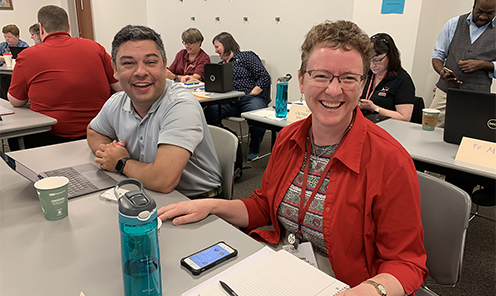
Here is a complete list of all our workshops in 2020. Join us for one or more of these outstanding professional develoment opportunities.
Orientation Program for New Vocation Directors
July 8-12
Ethical Issues for Vocation and Formation Directors
July 13-14
Behavioral Assessment 1
July 16-18
Is it Generational, Cultural, Personality or Pathology?
July 16-18
Understanding, Assessing, and Fostering Psycho-Sexual Integration
July 20-23
NRVC will offer seven pre-convocation workshops on Friday, October 30
Participants are invited to choose any two of these 3-hour workshops (one from the morning session and one from the afternoon). Lunch is provided between sessions. Cost $200. Special rate: $175 if you register for Convocation as well. Pre-Convocation and Convocation registration will open in mid-April.
Morning sessions (choose one)
Accompanying & Assessing Candidates over the age of 40
Candidate Issues in Immigration Law
Encountering Christ in Harmony: Inviting our Asian & Pacific Island Sisters & Brothers to Religious Life
Communicating Key Messages of Hope
Afternoon session (choose one)
The Impact of the Consumption of Gaming and Pornography
Weaving Cultures in Religious Life
Candidate Issues in Civil and Canon Law
Encountering Christ in Harmony: Inviting our Asian & Pacific Island Sisters & Brothers to Religious Life
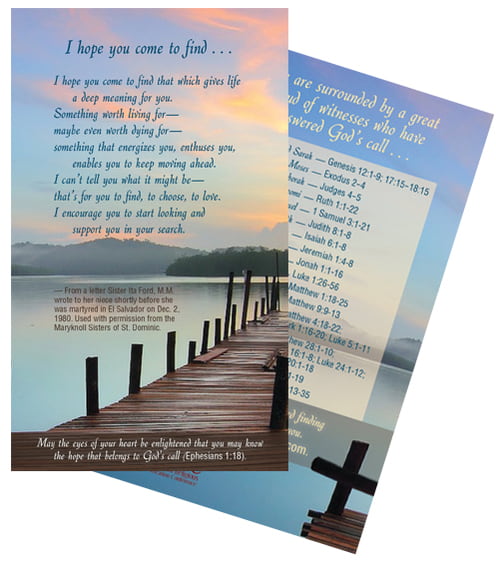 The unforgettable words of Sister Ita Ford, M.M., martyred in El Salvador in 1980, speak to a new generation.
You'll want these cards on hand to mail to people you're in touch with. It's a nice way to say "I care" during COVID-19.
The front of the card reads:
I hope you come to find that which gives life
a deep meaning for you.
Something worth living for—
maybe even worth dying for—
something that energizes you, enthuses you,
enables you to keep moving ahead.
I can’t tell you what it might be—that’s for you to find, to choose, to love.
I encourage you to start looking and support you in your search.
The back of the card lists figures from scripture who answered God's call. The card is $12 for a pack of 100 or $8 per pack for NRVC members.
Learn more or place an order here. Or order by phone: 773-363-5454.
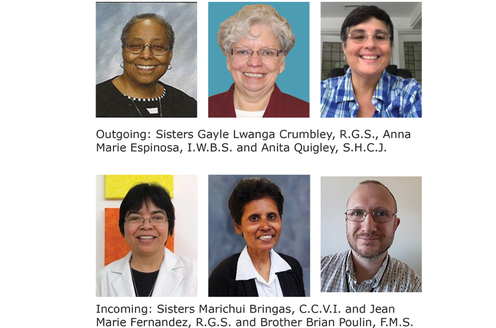
The NRVC thanks three departing members of the national board for completing a full six-year term of service in August 2020:
• Sister Gayle Lwanga Crumbley, R.G.S.
• Sister Anita Quigley, S.H.C.J.
• Sister Anna Marie Espinosa, I.W.B.S.
As these board members stepped down with the gratitude of NRVC, three new members are beginning service. We welcome them!
• Sister Marichui Bringas, C.C.V.I.
• Sister Jean Marie Fernandez, R.G.S.
• Brother Brian Poulin, F.M.S.
Published on: 2020-09-01
Orientation Program for New Vocation Directors
July 8-12
Ethical Issues for Vocation and Formation Directors
July 13-14
Behavioral Assessment 1
July 16-18
Is it Generational, Cultural, Personality or Pathology?
July 16-18
Understanding, Assessing, and Fostering Psycho-Sexual Integration
July 20-23
Brother Brian Poulin, F.M.S. can't wait to get back to working with groups in person, but he is not idle during the pandemic. In addition to accompanying individuals in discernment by phone, and publicizing his community via social media, he is also serving on the NRVC Board.
The NRVC has made its "2020 Study on Recent Vocations to Religious Life" available in Spanish. Many thanks to the GHR Foundation, whose funding allowed the Mexican American Catholic College to create a Spanish version of the study's final report. Find the English and Spanish reports here.
Published on: 2020-06-23
Take a workshop this summer in the comfort of your home, no hassles with travel or packing, just time to enjoy learning from experienced presenters who will engage participants with a reasonable schedule integrated with screen breaks. Read more...
 NRVC is asking HORIZON readers who have not yet received their Spring 2020 edition to please bear with us in awaiting their delivery. Unfortunately the coronavirus has caused both delays in delivery in various parts of the country.
For immediate hard-copy access to this latest edition, members and subscribers may download and print it. The pdf form of HORIZON is available (after login) for viewing and download.
This edition in particular may be a good choice for study and discussion within your community.
Thank you for your patience.
The National Religious Vocation Conference is committed to providing its membership with relevant resources, professional development and other programs that strengthen and enhance the professional skills of those serving in vocation ministry. Vocation ministers must be credible and competent in their presentations to varied audiences while promoting vocations and assessing candidates. The following documents may be used for presentations within religious congregations and in public settings to promote vocations to religious life.
The numerous links for studies on Religious Life are available here. Papal and USCCB Documents are linked here. There are additional professional documents available as a benefit to NRVC members that are listed in the "Members Only" portion of the website.
Acronyms of National Organizations
NRVC Board Self-Nomination Form
NRVC Code of Ethics for Vocation Ministry
NRVC Copyright/Permission Request Form
NRVC Curriculum for Vocation Ministers
NRVC Handbook on Educational Debt & Vocations to Religious Life
NRVC English and Spanish Photo Release Form
NRVC Mustard Seed Award Nomination Form
NRVC Recognition Award Nomination Form
NRVC Biennial Convocation Award Booklet
Religious Life Today Infographic
Religious Life TImeline EN SP FR
Role of Leadership in Vocation Ministry Handout
Later
Being a vocation minister is "a sacred privilege" says Sister Barbara O'Kane, M.P.F. At the same time, it's a great way to give back, having received help from others when she was feeling a call to religious life.
Published on: 2020-12-01
 NRVC hopes to track and share what is happening with its members and other vocation ministers during this unusual time. Could you kindly respond to a three question survey?
Go to XXXXX
Published on: 2020-06-01
Registration for 2020 Virtual Convocation begins by September. Schedule and fees to be determined.
We never imagined what would happen this year,
With a global pandemic bringing distress, loss and fear.
2020 has been different in every way,
No hugs, no visits, wearing face masks each day.
Vocation ministers were challenged with pandemic desolation,
Countless pivots and fridge trips and stay-at-home isolation!
We changed our traditions, and some things turned out fine -
We learned to Zoom, text, and email--all at the same time!
Instead of NRVC’s 2020 Convocation in Spokane,
We had videos of Sr. Addie, Fr. Dave, and Fr. Linh on-demand.
But no matter the place, the chapel, or table,
We always have each other to help us remain stable.
Each of you is a blessing, each day is a gift,
With texts, calls, and emails we give each other a lift!
So let's not look back with regret on this year,
Instead let’s remind each other that God is right here.
Our circumstances resulted in valuable new perceptions,
Like how do we CARE? Why do we HOPE? How will we LOVE without exception?
In this holy Christmas season,
As our weary world rejoices at our dear Savior’s birth,
May you know you are a blessing; may your soul find its worth.
With love,
The NRVC Leadership Team
Sr. Debbie, Marge, Maureen, and Phil
P.S. Please note the NRVC office will be closed from December 24 through January 3 for the holidays. We wish you all a safe and healthy Christmas, and many blessings in the New Year!
test
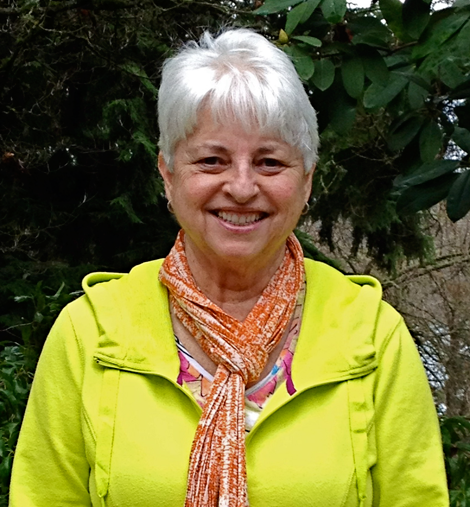 How long have you been involved in vocation ministry?
I have been vocation director since 2009.
Are you part of a vocation team?
Yes, I oversee vocation ministry in our three regions: Western U.S., Eastern U.S., and the United Kingdom (England and Scotland.) The East and UK regions have a vocation team member who is responsible. I am usually the first contact made by an inquirer through our website or through VISION. I send information to the inquirer, and then, if she is in the UK or Eastern U.S., another team member gets in touch.
Has being a member of NRVC been helpful?
Yes, NRVC, both national and regional, has been an immense help to me. I have attended many NRVC convocations and workshops and always come away with new ideas, more connections with vocation ministers and a sense of celebration of who we are as a multi-faceted church. Father Ray Carey’s workshops have been most valuable to me in being able to identify “red flag” areas concerning potential candidates and determining how to proceed with an inquirer. The workshops on cultural diversity and canon law/immigration issues have also been extremely helpful.
What has been your best outreach effort?
In recent years our new members have been very diverse: e.g., Latina, Korean, Kenyan, Nigerian, Indian, Irish, etc. In 2012 our formation director and I planned and implemented a program for all three regions of our congregation called “Interculturality: Embracing Diversity in a Global World, Global Church, Global Congregation.” Sister Tere Maya, CCVI led the presentations and served as a resource on interculturality and its implications for vocation and formation ministry. This program helped achieve a greater consciousness among our sisters and associates about the value of interculturality as an expression of our charism of peace through justice.
I also use my graphic design skills for creating welcoming and attractive information materials (brochures, banners, PowerPoint presentations, etc.) for vocation ministry—both for our congregation and for our inter-community vocation work in the Pacific Northwest.
Do you have any words of wisdom to those who are new to this ministry?
I encourage people in vocation discernment to consider this question: “Where can I live out my dreams and hopes in a healthy, happy, and holy way?” As a vocation minister and a woman religious, I also try to live in a way that is healthy, happy, and holy!
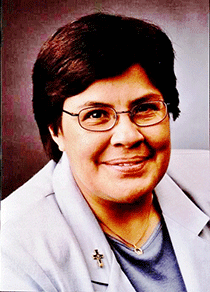 How long have you been involved in vocation ministry?
This is my second round. I did this ministry from 1999 to 2004. Then I was involved part-time for two years before being invited to full-time vocation ministry again in 2011.
Are you part of a vocation team?
Yes, I am a part of the Sisters of Mercy South Central New Membership Team. We currently have four incorporation ministers and six vocation ministers. We span a broad area of 18 states, the U.S. Territory of Guam, and the nation of Jamaica. Our headquarters are in Belmont, NC. I myself am responsible for Missouri, Louisiana, Oklahoma, Kentucky, Northern Mississippi, and Southern Florida. I visit universities and high schools, am involved in retreats, organize vocation activities, attend vocation minister meetings, and do some spiritual direction.
Has being a member of NRVC been helpful to you?
The workshops NRVC offers have better prepared me for the ministry. NRVC has also provided opportunities for collaboration with other vocation ministers.
What has been your best outreach effort?
I have had the opportunity to meet young woman interested in religious life during Busy Student Retreats, high school visits, and work with our sisters who help promote vocations in the various areas of our South Central Community.
Do you have any words of wisdom to those who are new to this ministry?
The best wisdom I can offer to a new vocation minister is to go gently because things happen when they happen. The best thing to do is to be present to the present moment.
How long have you been involved in vocation ministry?
This is my second round. I did this ministry from 1999 to 2004. Then I was involved part-time for two years before being invited to full-time vocation ministry again in 2011.
Are you part of a vocation team?
Yes, I am a part of the Sisters of Mercy South Central New Membership Team. We currently have four incorporation ministers and six vocation ministers. We span a broad area of 18 states, the U.S. Territory of Guam, and the nation of Jamaica. Our headquarters are in Belmont, NC. I myself am responsible for Missouri, Louisiana, Oklahoma, Kentucky, Northern Mississippi, and Southern Florida. I visit universities and high schools, am involved in retreats, organize vocation activities, attend vocation minister meetings, and do some spiritual direction.
Has being a member of NRVC been helpful to you?
The workshops NRVC offers have better prepared me for the ministry. NRVC has also provided opportunities for collaboration with other vocation ministers.
What has been your best outreach effort?
I have had the opportunity to meet young woman interested in religious life during Busy Student Retreats, high school visits, and work with our sisters who help promote vocations in the various areas of our South Central Community.
Do you have any words of wisdom to those who are new to this ministry?
The best wisdom I can offer to a new vocation minister is to go gently because things happen when they happen. The best thing to do is to be present to the present moment.
A Religious Brothers Symposium will take place at Boston College on April 4 with a theme of "The Prophetic Call of the Brother in the Church."
The event is co-sponsored by NRVC, the Religious Brothers Conference, Conference of Major Superiors of Men, and Religious Formation Conference.
Brother Guy Consolmagno, S.J., director of the Vatican Observatory, will be the keynote speaker. Further information is at religiousbrothers.org.
From now through A pril 15, the National Fund for Catholic Religious Vocations is accepting new applications for education-debt assistance. Please click the links to review NFCRV Grant Guidelines and the 2020 Application or contact executive director Phil Loftus at ploftus@nrvc.net or 773-363-5454.
<h4><img alt="" height="265" src="/ckeditor_assets/pictures/5112/content_raycareyworkshop1.jpg" style="float:left; margin-bottom:10px" width="496" />Register in February</h4>
<p>This workshop will explore ethical principles governing confidentiality, agency and obligations related to positions of trust. The workshop will also address issues related to dissemination of information, the timeliness of admissions or dismissal decisions, and other issues related to ethical rights of candidates as well as ethical rights of those in positions of authority. This workshop is essential for all those who make decisions concerning the admission of candidates.</p>
<p>Please note this workshop ends at 4:30 p.m. on July 14. Overnight accommodations are contracted for 3 nights, arrival on July 12 and check out on July 15.</p>
<h4>Workshop fees</h4>
<p>Workshop fees include materials, speaker, facility fees and lunch. The fees do not include supper. Residents are provided with a continental breakfast.</p>
<p>Commuter: $350 – NRVC Member $520 – Non-NRVC Member</p>
<p>Resident: $695 – NRVC Member $865 – Non-NRVC Member </p>
<p> </p>
<h4>Late registration</h4>
<p>Registrations received after June 22 incur a $100 late fee. </p>
<h4>Cancellation</h4>
<p>Cancellations for workshops and accommodations must be received in writing to debbiesscm@nrvc.net before June 23 to receive a full refund less a $100 processing fee. After June 23., all fees are non refundable. </p>
<h4>Presenter</h4>
<p><strong><em><img alt="" height="133" src="/ckeditor_assets/pictures/4812/content_content_carey-resized.jpg" style="float:left" width="100" />Reverend Raymond P. Carey, Ph.D</em></strong>. is a priest of the Archdiocese of Portland, OR. He has taught at both the secondary and university levels, and presently teaches at Mount Angel Seminary Graduate School of Theology in Saint Benedict, Oregon. Fr. Carey holds a doctorate in clinical psychology from the University of Ottawa, Canada. He has presented workshops in North America, Europe, Australia, New Zealand and Fiji. He is a past recipient of the NRVC Harvest Award for his work in service of vocation ministry.</p>
<blockquote>
<p>Father Ray is very engaging and funny. His vast experience provides many illustrations. CTU is a good venue for this workshop.</p>
<p style="text-align:right"><em>–Br. John Scherer O.F.M.Cap.</em></p>
</blockquote>
<blockquote>
<p>This workshop was amazing! It is filled with practical examples for the role of agency. Fr. Ray’s experience and knowledge provides clarity in interactions with candidates. Reverence and respect of the person will remain with me every time I interact with discerners and candidates.</p>
<p style="text-align:right"><em>–Fr. Carl Philadelphia, Diocese of Georgetown, Guyana</em></p>
</blockquote>
<blockquote>
<p>This workshop gave a clear framework for moving forward ethically in this ministry! It provided clear principles for ethics with the space to ask real life questions. Thank you Fr. Ray for your years of dedication to this field!</p>
<p style="text-align:right"><em>–Sr. Tracy Kemme, S.C.</em></p>
</blockquote>
<p>Workshops are designed from the NRVC three-component <a href="/ckeditor_assets/attachments/4770/nrvc_curriculum_2018.pdf" target="_blank">curriculum</a> for those who wish to deepen their understanding of the complex theological, spiritual, psycho-sexual, ethical, and diversity issues often present in contemporary vocation ministry. NRVC recommends that vocation ministers participate in ongoing educational opportunities to attend to their own vocation, faith formation, and to further develop their professional competencies. Please read the <a href="https://nrvc.net/publication/8096/article/17281-terms-of-nrvc-membership-and-events" target="_blank">terms and conditions</a> of all NRVC programs and events.</p>
<h4>Register in February</h4>
 |
|
Pope Francis greets the faithful in St. Peter’s Square. His papacy reflects an Ignatian spirituality at every turn, allowing the church and the world to glimpse one tradition within the world of religious life. |
Editor's note: We have been notified about errors in this article and are are investigating so that we can rectify problems in accord with the highest standards in publishing. Please check back later for more information.
SINCE MARCH 2013, few people in the world have not been touched or inspired by the Ignatian spirituality being offered daily by the current bishop of Rome, who happens to be a son of Ignatius. Francis is the first pope from the Society of Jesus—this religious congregation whose worldly, wise intellectuals are as famous as its missionaries and martyrs. It’s this all-encompassing personal and professional Jesuit identity and definition that the former Cardinal Jorge Mario Bergoglio brought with him from Buenos Aires to Rome, and that continues to shape almost everything he does as Pope Francis. From his passion for social justice and his missionary zeal, to his focus on engaging the wider world and his preference for collaboration over immediate action without reflection, Pope Francis is a carJesuit through and through.
Jorge Mario Bergoglio had initially joined the Jesuits in the 1950s because he was attracted to its position on, to put it in military terms, the front lines of the church. But little did he know how serious the combat would become. As a Jesuit in Argentina, ordained in 1969, Bergoglio found himself in the midst of the tumult of the Argentine Dirty Wars which erupted one year later. The violence that overtook the country also threatened many priests—especially Jesuits—even as the regime co-opted much of the Argentine hierarchy. Bergoglio was made provincial superior of the Argentine Jesuits at the age of 36, thrown into a situation of internal and external chaos that would have tried even the most seasoned leaders. In a revealing interview in the fall of 2013, (published in America magazine), Francis spoke honestly about the situation that had engulfed his early priesthood: “That was crazy. I had to deal with difficult situations, and I made my decisions abruptly and by myself.” He acknowledged that his “authoritarian and quick manner of making decisions led me to have serious problems and to be accused of being ultraconservative.”
Bergoglio fully embraced the Jesuits’ radical turn to championing the poor, and although he was seen as an enemy of liberation theology by many Jesuits, others in the order were devoted to him. He turned away from devotional traditionalism, but was viewed by others as still far too orthodox. Critics labeled him a collaborator with the Argentine military junta even though biographies now clearly show that he worked carefully and clandestinely to save many lives. None of that ended the intrigue against Bergoglio within the Jesuits, and in the early 1990s, he was effectively exiled from Buenos Aires to an outlying city, “a time of great interior crisis,” as he himself described it. As a good, obedient Jesuit, Bergoglio complied with the society’s demands and sought to find God’s will in it all. His virtual estrangement from the Jesuits encouraged then-Cardinal Antonio Quarracino of Buenos Aires to appoint Bergoglio as auxiliary bishop in 1992.
In 1998, Bergoglio succeeded Quarracino as Archbishop. In 2001, John Paul II made Bergoglio a cardinal, one of only two Jesuits in the 120-member College of Cardinals. The other Jesuit cardinal was Carlo Maria Martini of Milan. Bergoglio’s rise in the hierarchy, however, only seemed to solidify suspicions about him among his Jesuit foes. During his regular visits to Rome, Bergoglio never stayed at the Jesuit Curia on Borgo Santo Spirito but rather at a guest house for priests and prelates in central Rome—a place that became famous when, as the newly minted pope, Francis would return to the Domus Paulus VI the morning after the events in the Sistine Chapel to pay his own hotel bill!
I can assure you as one who lived through the conclave experience in a very intense way, and resided at the Jesuit headquarters in Rome during the entire Papal transition, that the initial response of Jesuits to Bergoglio’s election consisted of gasps, shock, bewilderment that has since been transformed into profound gratitude, exhilaration, pride and at times, incredible joy. How many times have these two scripture passages run through my mind as I watched Pope Francis move among his Jesuit confrères in different parts of the world over the past three and a half years: “The stone which the builders rejected has become the corner stone … a marvel in our eyes,” and another exclamation from Genesis 45: “... then Joseph said to his brothers, ‘Please come closer to me. And they came closer. And he said, ‘I am your brother Joseph, whom you sold into Egypt. Now do not be grieved or angry with yourselves, because you sold me here, for God sent me before you to preserve life.’ ”
Today, the Holy Father is living his Jesuit vocation with a true missionary zeal, a love for community that is oriented for mission, and a discipline that does not waste anything, especially not time. To journalists aboard the return flight to Rome after his first World Youth Day in Brazil in 2013, the newly-elected Jesuit pope said: “I am a Jesuit in my spirituality, a spirituality involving the Exercises (of St. Ignatius).... And I think like a Jesuit,” he said, but smiled and quickly added, “but not in the sense of hypocrisy.” Francis’ Jesuit confrère, Father Tom Reese said it well: “He may act like a Franciscan, but he thinks like a Jesuit.” The question I want to look at is: How is Francis’ “Jesuitness” impacting his Petrine ministry and through that ministry, the entire church, including vocation directors and their religious communities?
Here are some key moments and words that reveal the infiltration of Ignatian spirituality or as one cardinal called it: the ‘“Jesuit virus” on the universal church. In October 2016 Pope Francis went with a message to the General Chapter of the Jesuits, taking place in Rome. His address was characterized by an openness to what lies ahead, a call to go further, a support for caminar, the way of journeying that allows Jesuits to go toward others and to walk with them on their journey.
Francis began his address to his Jesuit confrères quoting St. Ignatius, reminding them that a Jesuit is called to converse and thereby to bring life to birth “in every part of the world where a greater service of God and help for souls is expected.” Precisely for this reason, the Jesuits must go forward, taking advantage of the situations in which they find themselves, always to serve more and better. This implies a way of doing things that aims for harmony in the context of tension that is normal in a world with diverse persons and missions. The pope mentioned explicitly the tensions between contemplation and action, between faith and justice, between charism and institution, between community and mission.
The Holy Father detailed three areas of the Society’s path, yet these areas are not only for his religious family, but for the universal church. The first is to “ask insistently for consolation.” It is proper to the Society of Jesus to know how to console, to bring consolation and real joy; Jesuits must put themselves at the service of joy, for the Good News cannot be announced in sadness. Then, departing from his text, he insisted that joy “must always be accompanied by humor,” and with a big smile on his face, he remarked, “as I see it, the human attitude that is closest to divine grace is a sense of humor.”
Next, Francis invited the Society to “allow yourselves to be moved by the Lord on the cross.” The Jesuits must get close to the vast majority of men and women who suffer, and, in this context, it must offer various services of mercy in different forms. The pope underlined certain elements that he already had occasion to present throughout the Jubilee Year of Mercy. Those who have been touched by mercy must feel themselves sent to present this same mercy in an effective way.
Finally the Holy Father invited the Society to go forward under the influence of the “good spirit.” This implies always discerning how to act in communion with the church. The Jesuits must be not “clerical” but “ecclesial.” They are “men for others” who live in the midst of all peoples, trying to touch the heart of each person, contributing in this way to establishing a church in which all have their place, in which the Gospel is inculturated, and in which each culture is evangelized.
These three key words of the pope’s address are graces for which each Jesuit and the whole Society must always ask: consolation, compassion, and discernment. But Francis has not only reminded his own religious family of these three important gifts that are at the core of Jesuit spirituality, he has also offered them to the universal church, especially through the Synods of Bishops on the Family.
Pope Francis is clearly a man of a certain temperament. Whether it is living in Santa Marta guesthouse, turning the Papal apartment of Castel Gandolfo into a museum, or traveling in simple vehicles, he knows what he wants. Beginning with his refusal to wear the red mozzetta, or cape, for his introduction to the world from St. Peter’s loggia, Francis showed he was in charge. In doing so he also showed his freedom from pressures that have made previous popes prisoners of the Vatican.
Francis manifests to the world a deep, interior, joyful freedom. What is the source of such freedom? I think it comes from Francis’ appropriation of the Ignatian value of “indifference.” This classic, philosophical term, borrowed from the Stoics, means a freedom from distracting and degrading attachments, so as to be free to do what is more conducive to the good of souls. As Pope Francis goes about his daily work, and slowly implements the reform his brother cardinals commissioned him to do, it has become clear that his aim is to make the church of Jesus Christ welcoming to all and appealing and attractive because it shows its care for all people.
Pope Francis has also stressed that quintessential quality of Ignatius of Loyola: discernment. Discernment is a constant effort to be open to the Word of God that can illuminate the concrete reality of everyday life. It was eminently clear to me and many who took part in the recent Synods of Bishops on the Family that this Jesuit spirit of discernment was a guiding principle throughout the synodal process. One concept that re-emerged at the 2015 Synod of Bishops was the proper formation of conscience. The Synod’s apostolic exhortation, Amoris Laetitia (The Joy of Love) states:
We have long thought that simply by stressing doctrinal, bioethical and moral issues, without encouraging openness to grace, we were providing sufficient support to families, strengthening the marriage bond and giving meaning to marital life. We find it difficult to present marriage more as a dynamic path to personal development and fulfillment than as a lifelong burden. We also find it hard to make room for the consciences of the faithful, who very often respond as best they can to the Gospel amid their limitations, and are capable of carrying out their own discernment in complex situations. We have been called to form consciences, not to replace them (37).
The church does not exist to take over people’s consciences but to stand in humility before faithful men and women who have discerned prayerfully and often painfully before God the reality of their lives and situations. Discernment and the formation of conscience can never be separated from the Gospel demands of truth and the search for charity and truth and the church’s tradition.
In keeping with his own Jesuit formation, Pope Francis is a man of discernment, and, at times, that discernment results in freeing him from the confinement of doing something in a certain way because it was ever thus. In paragraph 33 of his apostolic exhortation Evangelii Gaudium (Joy of the Gospel) Francis writes:
Pastoral ministry in a missionary key seeks to abandon the complacent attitude that says: “We have always done it this way.” I invite everyone to be bold and creative in this task of rethinking the goals, structures, style and methods of evangelization in their respective communities. A proposal of goals without an adequate communal search for the means of achieving them will inevitably prove illusory.
As he pointed out to his brother Jesuits gathered in October 2016, a maxim from the Spiritual Exercises, tantum quantum, summarizes the principle for using all created things: Use them insofar as they contribute to the glory of God and the salvation of souls. Discard and reject them when they lead away from that goal. Francis has done much to further the supervision and reform of the Vatican bank, but he has also made it clear that the Holy See may not need its own bank. His basic choices follow the rule of tantum quantum. If there is a genuine apostolic purpose for running a bank, and it is run in accord with that purpose and does not distract from the church’s evangelizing mission, then it has a place. If not, then it is wholly dispensable.
The first Jesuits were “a holiness movement,” inviting everyone to lead a holy life. Francis of Assisi was committed to a literal imitation of the poor Christ. Ignatius was inspired by that poverty and originally planned that the Jesuits would follow the same route. But as the historian Father John O’Malley, S.J. has indicated, just as Ignatius learned to set aside his early austerities to make himself more approachable, he later moderated the Society’s poverty to make it possible to evangelize more people, especially through educational institutions. Even evangelical poverty was a relative value in relation to the good of souls and their progress in holiness. That same apostolic reasoning is found in Pope Francis’ instructions to priests around the world about their ministries.
The spirit of openness is foundational to the Jesuit way of proceeding. Jesuit parishes are known for their inclusiveness and Jesuit confessors for their understanding and compassion. At a time of religious controversy Ignatius Loyola urged retreatants to listen attentively to others, to give a positive interpretation to their statements, and when there was apparent error, to question them closely, and only when the interlocutors were steadfast in their error to regard them as heretics. At the time of the Reformation, that was a remarkable point of departure for retreatants preparing to make life decisions. Early in his pontificate, when Pope Francis made his controversial statement about even atheists having a chance to get into heaven, he was following the teaching of Vatican II, but he was also following a very Ignatian approach toward the good of souls.
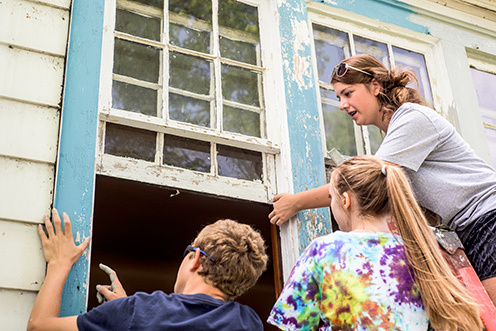 |
|
In keeping with the Jesuit emphasis on attention to those in greatest need, Pope Francis has emphasized the call to justice and service to the poor. Pictured here are youth from the Diocese of Saginaw, Michigan doing home repairs for the needy. |
Ignatius of Loyola’s recommended style of ministry anticipates the positive pastoral approach Pope Francis has taken to evangelization. Pope Francis’ attention to refugees, the abandoned elderly, and to unemployed youth exhibit the same concern as the first Jesuits for the lowliest and most needy people in society. Ignatius’ twin criteria for choosing a ministry were serving those in greatest need and advancing the more universal good. The Jesuit Refugee Service and creative Jesuit projects in education, like the Nativity and Cristo Rey schools, are contemporary embodiments of the same spirit of evangelical care for the neediest. These apostolates are part of the post-conciliar renewal of the Society of Jesus, but they have deep, formative roots in Jesuit history and spirituality as well. In the mind and heart of Pope Francis, even elite Jesuit institutions can combine the intellectual apostolate with service to the poor in the spirit of Ignatius.
Pope Francis’ humility has impressed people around the world. His style has truly become substance. It is the most radically evangelical aspect of his spiritual reform of the papacy, and he has invited all Catholics, but especially the clergy, to reject success, wealth, and power. Ignatius insisted that a Jesuit is never to have an anti-ecclesial spirit, but always be open to how the spirit of God is working. The Jesuit commitment not to seek ecclesiastical office, even in the Society, is an outgrowth of that experience. What is surprising is that Francis has so interiorized those values that without hesitation he applies it to clerical and curial reform today. He has told cardinals and priests not to behave as princes, counseled priests to abandon their expensive cars for smaller, more economical ones, and he has given them personal examples.
Humility is a central virtue in the Spiritual Exercises. One of its key meditations focuses on the “three degrees of humility.” In Ignatius’ eyes, humility is the virtue that brings us closest to Christ, and Pope Francis appears to be guiding the church and educating the clergy in that fundamental truth. Reform through spiritual renewal begins with the rejection of wealth, honors, and power, and it reaches its summit in the willingness to suffer humiliation with Christ. Humility is the most difficult part of the Ignatian papal reform, but it is essential for the church’s purification from clericalism, the source of so many ills in the contemporary church. Undoubtedly, it is here that Francis’ reform is receiving the most resistance from practitioners of the millennial-old system of clerical entitlement and a distorted ecclesiology that stems from bygone days of the church triumphant! Francis is teaching us that precisely this humility is essential to make the New Evangelization real and effective both within the church and in her encounter with the world.
Ignatius did not use the word “leadership” as we commonly do today. Someone whose style of leadership is inspired by the Ignatian tradition will particularly emphasize certain habits or priorities. One of these is the importance of formation—not just learning to do technical tasks like strategic planning but also commitment to lifelong self-development. Another Ignatian priority is deep self-awareness, of coming to know oneself, for example, as happens in the Spiritual Exercises. The Jesuits also emphasize becoming a skilled decision-maker, as happens through the discernment tools of the Exercises, and committing oneself to purposes bigger than self, to a mission of ultimate meaning. Jesuits often refer to this commitment by the expression of “magis. ” Then, too, Ignatian spirituality emphasizes a deep respect for others, “finding God in all things.”
The difference between the worldly style of leadership and that traced by Ignatius is that the Jesuit style of leadership always points to God, the ultimate source of meaning. Great Jesuit figures like Peter Faber, Francis Xavier, Matteo Ricci or Alberto Hurtado were able to accomplish their feats not simply because they had some good leadership skills but because they were inspired by love of God. I cannot tell you how many times these very ideas have surfaced in Pope Francis’ addresses to the cardinals, bishops, priests, deacons, religious, lay leaders, catechists, and young people around the world. These leadership qualities are distinctly Ignatian!
St. Ignatius once wrote that sometimes we have to go in through the other person’s door in order to come out through our own. That is a very powerful idea for us and it is completely relevant to the church in the 21st century. We live in a secularized society, and young adults in particular are showing little interest in the church. What are we going to do for young adults, our target audiences as vocation directors? We are being challenged daily to find ways to “enter the other’s door,” to offer them some of the riches of our traditions in ways that will better their lives and that might invite their deeper thought, that might draw them toward the essence of Christianity.
Contrary to some voices in the church today, we are not being called by Christ, St. John Paul II or Pope Francis to bring about a smaller church for the perfect, the holy, those who think like us. St. John Paul II did not write his final apostolic letter at the close of the Great Jubilee with the title “Stay close to the shore and don’t risk.” He filled that hopeful document with the mantra: Duc in altum, put out to the deep! Francis has said to us: “I prefer a church which is bruised, hurting and dirty because it has been out on the streets, rather than a church which is unhealthy from being confined and from clinging to its own security.” Our goal is not to form a smaller church where we all end up sitting around in small circles talking to each other and bemoaning what we have lost!
Pope Francis seems obsessed with the devil. His tweets and homilies about the devil, Satan, the Accuser, the Evil One, the Father of Lies, the Ancient Serpent, the Tempter, the Seducer, the Great Dragon, the Enemy and just plain “demon” are now legion. For Francis, the devil is not a myth, but a real person. Many modern people may greet the pope’s insistence on the devil with indifference or, at best, indulgent curiosity. Francis, however, is drawing on a fundamental insight of St. Ignatius of Loyola! In his first major address to the cardinals who elected him, the Argentine pontiff reminded them: “Let us never yield to pessimism, to that bitterness that the devil offers us every day.”
The pope has stressed that we must not be naive: “The demon is shrewd: he is never cast out forever, this will only happen on the last day.” Francis has also issued calls to arms in his homilies: “The devil also exists in the 21st century, and we need to learn from the Gospel how to battle against him.” Acknowledging the devil’s shrewdness, Francis once preached: “The devil is intelligent, he knows more theology than all the theologians together.”
In a rally with thousands of young people during his visit to Paraguay, the pope offered the job description of the devil in these words:
Friends: the devil is a con artist. He makes promise after promise, but he never delivers. He’ll never really do anything he says. He doesn’t make good on his promises. He makes you want things which he can’t give, whether you get them or not. He makes you put your hopes in things which will never make you happy.... He is a con artist because he tells us that we have to abandon our friends, and never to stand by anyone. Everything is based on appearances. He makes you think that your worth depends on how much you possess.
In all these references to the devil and his many disguises, Pope Francis wishes to call everyone back to reality. The devil is frequently active in our lives and in the church, drawing us into negativity, cynicism, despair, meanness of spirit, sadness, and nostalgia. We must react to the devil, Francis says, as did Jesus, who replied with the Word of God. The temptations Francis speaks about so often are the realistic flip side to the heart of the Argentine Jesuit pope’s message about the world that is charged with the grandeur, mercy, presence, and fidelity of God. Those powers are far greater than the devil’s antics.
There is also another image from Pope Francis that has captivated the minds and hearts of millions: the powerful image of the “field hospital” which he uses often and is drawn from the Spiritual Exercises of St. Ignatius of Loyola. When Francis speaks of the church as a “field hospital after a battle” he appeals to the Jesuit founder’s understanding of the role of the church in light of God’s gaze upon the world: “So many people ask us to be close; they ask us for what they were asking of Jesus: closeness, nearness.” In his 2013 interview, published in America magazine, he said:
The thing the church needs most today is the ability to heal wounds and to warm the hearts of the faithful; it needs nearness, proximity. I see the church as a field hospital after battle. It is useless to ask a seriously injured person if he has high cholesterol and about the level of his blood sugars! You have to heal his wounds. Then we can talk about everything else. Heal the wounds, heal the wounds.... And you have to start from the ground up.
A field hospital image is contrary to an image of a fortress under siege. From the image of the church as a field hospital we can derive an understanding of the church’s mission as both healing and salvific.
We’ve looked at some critical Ignatian principles, styles, concepts, and images that make Pope Francis who he is. Let us now turn to how some of his deeply Jesuit approaches might affect the church. The whole concept of setting up committees, consulting widely, and convening smart people around you is how Jesuit superiors usually function. They do these things, then they make the decision. This sort of discernment—listening to all and contemplating everything before acting—is a cardinal virtue of the Ignatian spirituality that is at the core of Francis’ being and his commitment to a conversion of the papacy as well as the entire church.
It’s hard to predict what will come next. Francis is shrewd, and he has repeatedly praised the Jesuit trait of “holy cunning”—that Christians should be “wise as serpents but innocent as doves,” as Jesus put it. However, the pope’s openness also means that not even he is sure where the Spirit will lead. He has said: “I don’t have all the answers. I don’t even have all the questions. I always think of new questions, and there are always new questions coming forward.”
Pope Francis breaks Catholic traditions whenever he wants, because he is “free from disordered attachments.” Our church has indeed entered a new phase: with the advent of this first Jesuit pope, it is openly ruled by an individual rather than by the authority of Scripture alone or even its own dictates of tradition plus Scripture. Pope Francis has brought to the Petrine office a Jesuit intellectualism. By choosing the name Francis, he is also affirming the power of humility and simplicity. Pope Francis, the Argentine Jesuit, is not simply attesting to the complementarity of the Ignatian and Franciscan paths. He is pointing each day to how the mind and heart meet in the love of God and the love of neighbor. And most of all he reminds us each day how much we need Jesus, and how much we need one another along the journey.
 Father Thomas Rosica, C.S.B. is a priest of the Congregation of St. Basil. After working in campus ministry and overseeing the 2002 World Youth Day in Toronto, in 2003 he became the founding chief executive officer of Salt + Light Catholic Media Foundation, based in Toronto. He also serves as the English language attaché to the Holy See Press Office and as procurator general of his congregation. This article is a condensed version of his presentation to the 2016 convocation of the National Religious Vocation Conference.
This year, NRVC is offering nine workshops intended for vocation ministers, formation teams, communicators, religious leadership, and others entrusted with the assessment of discerners and candidates. Workshops are designed from the NRVC three-component curriculum for those who wish to deepen their understanding of the complex theological, spiritual, psycho-sexual, ethical, and diversity issues often present in contemporary vocation ministry.
These workshops are in line with the mission of the National Religious Vocation Conference (NRVC) to provide membership with educational opportunities, resources, and other supportive services that strengthen and enhance the practiced ministerial skills of those serving in vocation ministry. NRVC strongly suggests that vocation ministers participate in continuing educational opportunities not only to attend to their own vocation and faith formation and to further develop their professional competencies, but to keep up-to-date on trends, issues, skills, and best practices in the field of vocation ministry.
Orientation Program for New Vocation Directors, July 9-13
Ethical Issues for Vocation and Formation Directors, July 15-16
Behavioral Assessment 1, July 18-20
Due Diligence in Vocation Ministry, July 18-20
Communication Skills to Promote Vocations, July 22-24
Behavioral Assessment 2, October 8-9
Behavioral Assessment 1, October 11-13
Orientation Program for New Vocation Directors, October 15-19
The Art of Accompaniment and Discernment, October 21-23
Workshops are open to NRVC members at a discounted rate and for non-members at an affordable price. All NRVC workshops (which includes lunch) are consistently priced at $175 per day per NRVC member, regardless of the topic or speaker. Non-members pay $260 (an additional 50%) per person per day for each workshop. If you would like to become a member to receive the discounted rate, click here. Overnight accommodations are $115 per night for anyone in need of housing regardless of membership status.
Registrations for workshops received after the following dates will incur a $100 late fee per workshop:
Summer Institute: The late fee begins on June 23
Fall Institute: The late fee begins on September 22
Cancellations for workshops and/or accommodations must be received in writing to debbiesscm@nrvc.net before the dates listed below receive a full refund, less a $100 processing fee per workshop. After the deadline, all fees are non-refundable for the cancellation of workshops and/or accommodations.
Summer Institute: The cancellation deadline is June 23.
Fall Institute: The cancellation deadline is September 22.
To assist NRVC members with their professional development, the Misericordia Scholarship Fund is available. Scholarship funds can be applied to NRVC workshops, however they do not cover the cost of transportation, accommodations, meals, or personal expenses. If you need financial assistance to attend an NRVC workshop, please email Sr. Debbie at debbiesscm@nrvc.net for an application.
Please read our NRVC terms and conditions for all events and programs.
The programme was very well organized. I appreciated the schedule and the interaction from the presenters and participants. Everything was close in proximity, access to food, Mass, internet, etc.
—Sister Winfridah Chileshe, R.S.C. from Dublin, Ireland
I appreciated Sr. Debbie’s knowledge, helpfulness, insights and generosity. I feel the members of our vocation and leadership team ought to attend these workshops.
--Sister Cheryl Wint, O.S.F. from Honolulu, Hawaii
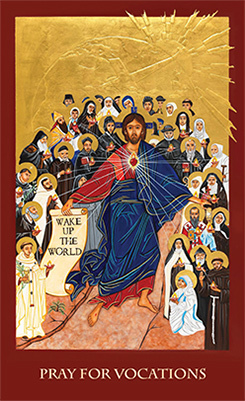
With the February 2 celebration of World Day for Consecrated Life, The NRVC board and staff extend warm wishes to consecrated men and women and thank the millions of lay Catholics who support and collaborate with them.
Enjoy this day, and consider sharing your thoughts on social media!
NRVC icon prayer card free download
NRVC icon prayer card for purchase
Find further information about this day at this link.
|
|
Pope Francis greets the faithful in St. Peter’s Square. His papacy reflects an Ignatian spirituality at every turn, allowing the church and the world to glimpse one tradition within the world of religious life. |
Editor's note: This article has problems with attribution and has been revised. Find the revised version here.
SINCE MARCH 2013, few people in the world have not been touched or inspired by the Ignatian spirituality being offered daily by the current bishop of Rome, who happens to be a son of Ignatius. Francis is the first pope from the Society of Jesus—this religious congregation whose worldly, wise intellectuals are as famous as its missionaries and martyrs. It’s this all-encompassing personal and professional Jesuit identity and definition that the former Cardinal Jorge Mario Bergoglio brought with him from Buenos Aires to Rome, and that continues to shape almost everything he does as Pope Francis. From his passion for social justice and his missionary zeal, to his focus on engaging the wider world and his preference for collaboration over immediate action without reflection, Pope Francis is a carJesuit through and through.
Jorge Mario Bergoglio had initially joined the Jesuits in the 1950s because he was attracted to its position on, to put it in military terms, the front lines of the church. But little did he know how serious the combat would become. As a Jesuit in Argentina, ordained in 1969, Bergoglio found himself in the midst of the tumult of the Argentine Dirty Wars which erupted one year later. The violence that overtook the country also threatened many priests—especially Jesuits—even as the regime co-opted much of the Argentine hierarchy. Bergoglio was made provincial superior of the Argentine Jesuits at the age of 36, thrown into a situation of internal and external chaos that would have tried even the most seasoned leaders. In a revealing interview in the fall of 2013, (published in America magazine), Francis spoke honestly about the situation that had engulfed his early priesthood: “That was crazy. I had to deal with difficult situations, and I made my decisions abruptly and by myself.” He acknowledged that his “authoritarian and quick manner of making decisions led me to have serious problems and to be accused of being ultraconservative.”
Bergoglio fully embraced the Jesuits’ radical turn to championing the poor, and although he was seen as an enemy of liberation theology by many Jesuits, others in the order were devoted to him. He turned away from devotional traditionalism, but was viewed by others as still far too orthodox. Critics labeled him a collaborator with the Argentine military junta even though biographies now clearly show that he worked carefully and clandestinely to save many lives. None of that ended the intrigue against Bergoglio within the Jesuits, and in the early 1990s, he was effectively exiled from Buenos Aires to an outlying city, “a time of great interior crisis,” as he himself described it. As a good, obedient Jesuit, Bergoglio complied with the society’s demands and sought to find God’s will in it all. His virtual estrangement from the Jesuits encouraged then-Cardinal Antonio Quarracino of Buenos Aires to appoint Bergoglio as auxiliary bishop in 1992.
In 1998, Bergoglio succeeded Quarracino as Archbishop. In 2001, John Paul II made Bergoglio a cardinal, one of only two Jesuits in the 120-member College of Cardinals. The other Jesuit cardinal was Carlo Maria Martini of Milan. Bergoglio’s rise in the hierarchy, however, only seemed to solidify suspicions about him among his Jesuit foes. During his regular visits to Rome, Bergoglio never stayed at the Jesuit Curia on Borgo Santo Spirito but rather at a guest house for priests and prelates in central Rome—a place that became famous when, as the newly minted pope, Francis would return to the Domus Paulus VI the morning after the events in the Sistine Chapel to pay his own hotel bill!
I can assure you as one who lived through the conclave experience in a very intense way, and resided at the Jesuit headquarters in Rome during the entire Papal transition, that the initial response of Jesuits to Bergoglio’s election consisted of gasps, shock, bewilderment that has since been transformed into profound gratitude, exhilaration, pride and at times, incredible joy. How many times have these two scripture passages run through my mind as I watched Pope Francis move among his Jesuit confrères in different parts of the world over the past three and a half years: “The stone which the builders rejected has become the corner stone … a marvel in our eyes,” and another exclamation from Genesis 45: “... then Joseph said to his brothers, ‘Please come closer to me. And they came closer. And he said, ‘I am your brother Joseph, whom you sold into Egypt. Now do not be grieved or angry with yourselves, because you sold me here, for God sent me before you to preserve life.’ ”
Today, the Holy Father is living his Jesuit vocation with a true missionary zeal, a love for community that is oriented for mission, and a discipline that does not waste anything, especially not time. To journalists aboard the return flight to Rome after his first World Youth Day in Brazil in 2013, the newly-elected Jesuit pope said: “I am a Jesuit in my spirituality, a spirituality involving the Exercises (of St. Ignatius).... And I think like a Jesuit,” he said, but smiled and quickly added, “but not in the sense of hypocrisy.” Francis’ Jesuit confrère, Father Tom Reese said it well: “He may act like a Franciscan, but he thinks like a Jesuit.” The question I want to look at is: How is Francis’ “Jesuitness” impacting his Petrine ministry and through that ministry, the entire church, including vocation directors and their religious communities?
Here are some key moments and words that reveal the infiltration of Ignatian spirituality or as one cardinal called it: the ‘“Jesuit virus” on the universal church. In October 2016 Pope Francis went with a message to the General Chapter of the Jesuits, taking place in Rome. His address was characterized by an openness to what lies ahead, a call to go further, a support for caminar, the way of journeying that allows Jesuits to go toward others and to walk with them on their journey.
Francis began his address to his Jesuit confrères quoting St. Ignatius, reminding them that a Jesuit is called to converse and thereby to bring life to birth “in every part of the world where a greater service of God and help for souls is expected.” Precisely for this reason, the Jesuits must go forward, taking advantage of the situations in which they find themselves, always to serve more and better. This implies a way of doing things that aims for harmony in the context of tension that is normal in a world with diverse persons and missions. The pope mentioned explicitly the tensions between contemplation and action, between faith and justice, between charism and institution, between community and mission.
The Holy Father detailed three areas of the Society’s path, yet these areas are not only for his religious family, but for the universal church. The first is to “ask insistently for consolation.” It is proper to the Society of Jesus to know how to console, to bring consolation and real joy; Jesuits must put themselves at the service of joy, for the Good News cannot be announced in sadness. Then, departing from his text, he insisted that joy “must always be accompanied by humor,” and with a big smile on his face, he remarked, “as I see it, the human attitude that is closest to divine grace is a sense of humor.”
Next, Francis invited the Society to “allow yourselves to be moved by the Lord on the cross.” The Jesuits must get close to the vast majority of men and women who suffer, and, in this context, it must offer various services of mercy in different forms. The pope underlined certain elements that he already had occasion to present throughout the Jubilee Year of Mercy. Those who have been touched by mercy must feel themselves sent to present this same mercy in an effective way.
Finally the Holy Father invited the Society to go forward under the influence of the “good spirit.” This implies always discerning how to act in communion with the church. The Jesuits must be not “clerical” but “ecclesial.” They are “men for others” who live in the midst of all peoples, trying to touch the heart of each person, contributing in this way to establishing a church in which all have their place, in which the Gospel is inculturated, and in which each culture is evangelized.
These three key words of the pope’s address are graces for which each Jesuit and the whole Society must always ask: consolation, compassion, and discernment. But Francis has not only reminded his own religious family of these three important gifts that are at the core of Jesuit spirituality, he has also offered them to the universal church, especially through the Synods of Bishops on the Family.
Pope Francis is clearly a man of a certain temperament. Whether it is living in Santa Marta guesthouse, turning the Papal apartment of Castel Gandolfo into a museum, or traveling in simple vehicles, he knows what he wants. Beginning with his refusal to wear the red mozzetta, or cape, for his introduction to the world from St. Peter’s loggia, Francis showed he was in charge. In doing so he also showed his freedom from pressures that have made previous popes prisoners of the Vatican.
Francis manifests to the world a deep, interior, joyful freedom. What is the source of such freedom? I think it comes from Francis’ appropriation of the Ignatian value of “indifference.” This classic, philosophical term, borrowed from the Stoics, means a freedom from distracting and degrading attachments, so as to be free to do what is more conducive to the good of souls. As Pope Francis goes about his daily work, and slowly implements the reform his brother cardinals commissioned him to do, it has become clear that his aim is to make the church of Jesus Christ welcoming to all and appealing and attractive because it shows its care for all people.
Pope Francis has also stressed that quintessential quality of Ignatius of Loyola: discernment. Discernment is a constant effort to be open to the Word of God that can illuminate the concrete reality of everyday life. It was eminently clear to me and many who took part in the recent Synods of Bishops on the Family that this Jesuit spirit of discernment was a guiding principle throughout the synodal process. One concept that re-emerged at the 2015 Synod of Bishops was the proper formation of conscience. The Synod’s apostolic exhortation, Amoris Laetitia (The Joy of Love) states:
We have long thought that simply by stressing doctrinal, bioethical and moral issues, without encouraging openness to grace, we were providing sufficient support to families, strengthening the marriage bond and giving meaning to marital life. We find it difficult to present marriage more as a dynamic path to personal development and fulfillment than as a lifelong burden. We also find it hard to make room for the consciences of the faithful, who very often respond as best they can to the Gospel amid their limitations, and are capable of carrying out their own discernment in complex situations. We have been called to form consciences, not to replace them (37).
The church does not exist to take over people’s consciences but to stand in humility before faithful men and women who have discerned prayerfully and often painfully before God the reality of their lives and situations. Discernment and the formation of conscience can never be separated from the Gospel demands of truth and the search for charity and truth and the church’s tradition.
In keeping with his own Jesuit formation, Pope Francis is a man of discernment, and, at times, that discernment results in freeing him from the confinement of doing something in a certain way because it was ever thus. In paragraph 33 of his apostolic exhortation Evangelii Gaudium (Joy of the Gospel) Francis writes:
Pastoral ministry in a missionary key seeks to abandon the complacent attitude that says: “We have always done it this way.” I invite everyone to be bold and creative in this task of rethinking the goals, structures, style and methods of evangelization in their respective communities. A proposal of goals without an adequate communal search for the means of achieving them will inevitably prove illusory.
As he pointed out to his brother Jesuits gathered in October 2016, a maxim from the Spiritual Exercises, tantum quantum, summarizes the principle for using all created things: Use them insofar as they contribute to the glory of God and the salvation of souls. Discard and reject them when they lead away from that goal. Francis has done much to further the supervision and reform of the Vatican bank, but he has also made it clear that the Holy See may not need its own bank. His basic choices follow the rule of tantum quantum. If there is a genuine apostolic purpose for running a bank, and it is run in accord with that purpose and does not distract from the church’s evangelizing mission, then it has a place. If not, then it is wholly dispensable.
The first Jesuits were “a holiness movement,” inviting everyone to lead a holy life. Francis of Assisi was committed to a literal imitation of the poor Christ. Ignatius was inspired by that poverty and originally planned that the Jesuits would follow the same route. But as the historian Father John O’Malley, S.J. has indicated, just as Ignatius learned to set aside his early austerities to make himself more approachable, he later moderated the Society’s poverty to make it possible to evangelize more people, especially through educational institutions. Even evangelical poverty was a relative value in relation to the good of souls and their progress in holiness. That same apostolic reasoning is found in Pope Francis’ instructions to priests around the world about their ministries.
The spirit of openness is foundational to the Jesuit way of proceeding. Jesuit parishes are known for their inclusiveness and Jesuit confessors for their understanding and compassion. At a time of religious controversy Ignatius Loyola urged retreatants to listen attentively to others, to give a positive interpretation to their statements, and when there was apparent error, to question them closely, and only when the interlocutors were steadfast in their error to regard them as heretics. At the time of the Reformation, that was a remarkable point of departure for retreatants preparing to make life decisions. Early in his pontificate, when Pope Francis made his controversial statement about even atheists having a chance to get into heaven, he was following the teaching of Vatican II, but he was also following a very Ignatian approach toward the good of souls.
|
|
In keeping with the Jesuit emphasis on attention to those in greatest need, Pope Francis has emphasized the call to justice and service to the poor. Pictured here are youth from the Diocese of Saginaw, Michigan doing home repairs for the needy. |
Ignatius of Loyola’s recommended style of ministry anticipates the positive pastoral approach Pope Francis has taken to evangelization. Pope Francis’ attention to refugees, the abandoned elderly, and to unemployed youth exhibit the same concern as the first Jesuits for the lowliest and most needy people in society. Ignatius’ twin criteria for choosing a ministry were serving those in greatest need and advancing the more universal good. The Jesuit Refugee Service and creative Jesuit projects in education, like the Nativity and Cristo Rey schools, are contemporary embodiments of the same spirit of evangelical care for the neediest. These apostolates are part of the post-conciliar renewal of the Society of Jesus, but they have deep, formative roots in Jesuit history and spirituality as well. In the mind and heart of Pope Francis, even elite Jesuit institutions can combine the intellectual apostolate with service to the poor in the spirit of Ignatius.
Pope Francis’ humility has impressed people around the world. His style has truly become substance. It is the most radically evangelical aspect of his spiritual reform of the papacy, and he has invited all Catholics, but especially the clergy, to reject success, wealth, and power. Ignatius insisted that a Jesuit is never to have an anti-ecclesial spirit, but always be open to how the spirit of God is working. The Jesuit commitment not to seek ecclesiastical office, even in the Society, is an outgrowth of that experience. What is surprising is that Francis has so interiorized those values that without hesitation he applies it to clerical and curial reform today. He has told cardinals and priests not to behave as princes, counseled priests to abandon their expensive cars for smaller, more economical ones, and he has given them personal examples.
Humility is a central virtue in the Spiritual Exercises. One of its key meditations focuses on the “three degrees of humility.” In Ignatius’ eyes, humility is the virtue that brings us closest to Christ, and Pope Francis appears to be guiding the church and educating the clergy in that fundamental truth. Reform through spiritual renewal begins with the rejection of wealth, honors, and power, and it reaches its summit in the willingness to suffer humiliation with Christ. Humility is the most difficult part of the Ignatian papal reform, but it is essential for the church’s purification from clericalism, the source of so many ills in the contemporary church. Undoubtedly, it is here that Francis’ reform is receiving the most resistance from practitioners of the millennial-old system of clerical entitlement and a distorted ecclesiology that stems from bygone days of the church triumphant! Francis is teaching us that precisely this humility is essential to make the New Evangelization real and effective both within the church and in her encounter with the world.
Ignatius did not use the word “leadership” as we commonly do today. Someone whose style of leadership is inspired by the Ignatian tradition will particularly emphasize certain habits or priorities. One of these is the importance of formation—not just learning to do technical tasks like strategic planning but also commitment to lifelong self-development. Another Ignatian priority is deep self-awareness, of coming to know oneself, for example, as happens in the Spiritual Exercises. The Jesuits also emphasize becoming a skilled decision-maker, as happens through the discernment tools of the Exercises, and committing oneself to purposes bigger than self, to a mission of ultimate meaning. Jesuits often refer to this commitment by the expression of “magis. ” Then, too, Ignatian spirituality emphasizes a deep respect for others, “finding God in all things.”
The difference between the worldly style of leadership and that traced by Ignatius is that the Jesuit style of leadership always points to God, the ultimate source of meaning. Great Jesuit figures like Peter Faber, Francis Xavier, Matteo Ricci or Alberto Hurtado were able to accomplish their feats not simply because they had some good leadership skills but because they were inspired by love of God. I cannot tell you how many times these very ideas have surfaced in Pope Francis’ addresses to the cardinals, bishops, priests, deacons, religious, lay leaders, catechists, and young people around the world. These leadership qualities are distinctly Ignatian!
St. Ignatius once wrote that sometimes we have to go in through the other person’s door in order to come out through our own. That is a very powerful idea for us and it is completely relevant to the church in the 21st century. We live in a secularized society, and young adults in particular are showing little interest in the church. What are we going to do for young adults, our target audiences as vocation directors? We are being challenged daily to find ways to “enter the other’s door,” to offer them some of the riches of our traditions in ways that will better their lives and that might invite their deeper thought, that might draw them toward the essence of Christianity.
Contrary to some voices in the church today, we are not being called by Christ, St. John Paul II or Pope Francis to bring about a smaller church for the perfect, the holy, those who think like us. St. John Paul II did not write his final apostolic letter at the close of the Great Jubilee with the title “Stay close to the shore and don’t risk.” He filled that hopeful document with the mantra: Duc in altum, put out to the deep! Francis has said to us: “I prefer a church which is bruised, hurting and dirty because it has been out on the streets, rather than a church which is unhealthy from being confined and from clinging to its own security.” Our goal is not to form a smaller church where we all end up sitting around in small circles talking to each other and bemoaning what we have lost!
Pope Francis seems obsessed with the devil. His tweets and homilies about the devil, Satan, the Accuser, the Evil One, the Father of Lies, the Ancient Serpent, the Tempter, the Seducer, the Great Dragon, the Enemy and just plain “demon” are now legion. For Francis, the devil is not a myth, but a real person. Many modern people may greet the pope’s insistence on the devil with indifference or, at best, indulgent curiosity. Francis, however, is drawing on a fundamental insight of St. Ignatius of Loyola! In his first major address to the cardinals who elected him, the Argentine pontiff reminded them: “Let us never yield to pessimism, to that bitterness that the devil offers us every day.”
The pope has stressed that we must not be naive: “The demon is shrewd: he is never cast out forever, this will only happen on the last day.” Francis has also issued calls to arms in his homilies: “The devil also exists in the 21st century, and we need to learn from the Gospel how to battle against him.” Acknowledging the devil’s shrewdness, Francis once preached: “The devil is intelligent, he knows more theology than all the theologians together.”
In a rally with thousands of young people during his visit to Paraguay, the pope offered the job description of the devil in these words:
Friends: the devil is a con artist. He makes promise after promise, but he never delivers. He’ll never really do anything he says. He doesn’t make good on his promises. He makes you want things which he can’t give, whether you get them or not. He makes you put your hopes in things which will never make you happy.... He is a con artist because he tells us that we have to abandon our friends, and never to stand by anyone. Everything is based on appearances. He makes you think that your worth depends on how much you possess.
In all these references to the devil and his many disguises, Pope Francis wishes to call everyone back to reality. The devil is frequently active in our lives and in the church, drawing us into negativity, cynicism, despair, meanness of spirit, sadness, and nostalgia. We must react to the devil, Francis says, as did Jesus, who replied with the Word of God. The temptations Francis speaks about so often are the realistic flip side to the heart of the Argentine Jesuit pope’s message about the world that is charged with the grandeur, mercy, presence, and fidelity of God. Those powers are far greater than the devil’s antics.
There is also another image from Pope Francis that has captivated the minds and hearts of millions: the powerful image of the “field hospital” which he uses often and is drawn from the Spiritual Exercises of St. Ignatius of Loyola. When Francis speaks of the church as a “field hospital after a battle” he appeals to the Jesuit founder’s understanding of the role of the church in light of God’s gaze upon the world: “So many people ask us to be close; they ask us for what they were asking of Jesus: closeness, nearness.” In his 2013 interview, published in America magazine, he said:
The thing the church needs most today is the ability to heal wounds and to warm the hearts of the faithful; it needs nearness, proximity. I see the church as a field hospital after battle. It is useless to ask a seriously injured person if he has high cholesterol and about the level of his blood sugars! You have to heal his wounds. Then we can talk about everything else. Heal the wounds, heal the wounds.... And you have to start from the ground up.
A field hospital image is contrary to an image of a fortress under siege. From the image of the church as a field hospital we can derive an understanding of the church’s mission as both healing and salvific.
We’ve looked at some critical Ignatian principles, styles, concepts, and images that make Pope Francis who he is. Let us now turn to how some of his deeply Jesuit approaches might affect the church. The whole concept of setting up committees, consulting widely, and convening smart people around you is how Jesuit superiors usually function. They do these things, then they make the decision. This sort of discernment—listening to all and contemplating everything before acting—is a cardinal virtue of the Ignatian spirituality that is at the core of Francis’ being and his commitment to a conversion of the papacy as well as the entire church.
It’s hard to predict what will come next. Francis is shrewd, and he has repeatedly praised the Jesuit trait of “holy cunning”—that Christians should be “wise as serpents but innocent as doves,” as Jesus put it. However, the pope’s openness also means that not even he is sure where the Spirit will lead. He has said: “I don’t have all the answers. I don’t even have all the questions. I always think of new questions, and there are always new questions coming forward.”
Pope Francis breaks Catholic traditions whenever he wants, because he is “free from disordered attachments.” Our church has indeed entered a new phase: with the advent of this first Jesuit pope, it is openly ruled by an individual rather than by the authority of Scripture alone or even its own dictates of tradition plus Scripture. Pope Francis has brought to the Petrine office a Jesuit intellectualism. By choosing the name Francis, he is also affirming the power of humility and simplicity. Pope Francis, the Argentine Jesuit, is not simply attesting to the complementarity of the Ignatian and Franciscan paths. He is pointing each day to how the mind and heart meet in the love of God and the love of neighbor. And most of all he reminds us each day how much we need Jesus, and how much we need one another along the journey.
Father Thomas Rosica, C.S.B. is a priest of the Congregation of St. Basil. After working in campus ministry and overseeing the 2002 World Youth Day in Toronto, in 2003 he became the founding chief executive officer of Salt + Light Catholic Media Foundation, based in Toronto. He also serves as the English language attaché to the Holy See Press Office and as procurator general of his congregation. This article is a condensed version of his presentation to the 2016 convocation of the National Religious Vocation Conference.
|
|
Pope Francis greets the faithful in St. Peter’s Square. His papacy reflects an Ignatian spirituality at every turn, allowing the church and the world to glimpse one tradition within the world of religious life. |
Editor's note: We have been notified about errors in this article and are are investigating so that we can rectify problems in accord with the highest standards in publishing. Please check back later for more information.
SINCE MARCH 2013, few people in the world have not been touched or inspired by the Ignatian spirituality being offered daily by the current bishop of Rome, who happens to be a son of Ignatius. Francis is the first pope from the Society of Jesus—this religious congregation whose worldly, wise intellectuals are as famous as its missionaries and martyrs. It’s this all-encompassing personal and professional Jesuit identity and definition that the former Cardinal Jorge Mario Bergoglio brought with him from Buenos Aires to Rome, and that continues to shape almost everything he does as Pope Francis. From his passion for social justice and his missionary zeal, to his focus on engaging the wider world and his preference for collaboration over immediate action without reflection, Pope Francis is a carJesuit through and through.
Jorge Mario Bergoglio had initially joined the Jesuits in the 1950s because he was attracted to its position on, to put it in military terms, the front lines of the church. But little did he know how serious the combat would become. As a Jesuit in Argentina, ordained in 1969, Bergoglio found himself in the midst of the tumult of the Argentine Dirty Wars which erupted one year later. The violence that overtook the country also threatened many priests—especially Jesuits—even as the regime co-opted much of the Argentine hierarchy. Bergoglio was made provincial superior of the Argentine Jesuits at the age of 36, thrown into a situation of internal and external chaos that would have tried even the most seasoned leaders. In a revealing interview in the fall of 2013, (published in America magazine), Francis spoke honestly about the situation that had engulfed his early priesthood: “That was crazy. I had to deal with difficult situations, and I made my decisions abruptly and by myself.” He acknowledged that his “authoritarian and quick manner of making decisions led me to have serious problems and to be accused of being ultraconservative.”
Bergoglio fully embraced the Jesuits’ radical turn to championing the poor, and although he was seen as an enemy of liberation theology by many Jesuits, others in the order were devoted to him. He turned away from devotional traditionalism, but was viewed by others as still far too orthodox. Critics labeled him a collaborator with the Argentine military junta even though biographies now clearly show that he worked carefully and clandestinely to save many lives. None of that ended the intrigue against Bergoglio within the Jesuits, and in the early 1990s, he was effectively exiled from Buenos Aires to an outlying city, “a time of great interior crisis,” as he himself described it. As a good, obedient Jesuit, Bergoglio complied with the society’s demands and sought to find God’s will in it all. His virtual estrangement from the Jesuits encouraged then-Cardinal Antonio Quarracino of Buenos Aires to appoint Bergoglio as auxiliary bishop in 1992.
In 1998, Bergoglio succeeded Quarracino as Archbishop. In 2001, John Paul II made Bergoglio a cardinal, one of only two Jesuits in the 120-member College of Cardinals. The other Jesuit cardinal was Carlo Maria Martini of Milan. Bergoglio’s rise in the hierarchy, however, only seemed to solidify suspicions about him among his Jesuit foes. During his regular visits to Rome, Bergoglio never stayed at the Jesuit Curia on Borgo Santo Spirito but rather at a guest house for priests and prelates in central Rome—a place that became famous when, as the newly minted pope, Francis would return to the Domus Paulus VI the morning after the events in the Sistine Chapel to pay his own hotel bill!
I can assure you as one who lived through the conclave experience in a very intense way, and resided at the Jesuit headquarters in Rome during the entire Papal transition, that the initial response of Jesuits to Bergoglio’s election consisted of gasps, shock, bewilderment that has since been transformed into profound gratitude, exhilaration, pride and at times, incredible joy. How many times have these two scripture passages run through my mind as I watched Pope Francis move among his Jesuit confrères in different parts of the world over the past three and a half years: “The stone which the builders rejected has become the corner stone … a marvel in our eyes,” and another exclamation from Genesis 45: “... then Joseph said to his brothers, ‘Please come closer to me. And they came closer. And he said, ‘I am your brother Joseph, whom you sold into Egypt. Now do not be grieved or angry with yourselves, because you sold me here, for God sent me before you to preserve life.’ ”
Today, the Holy Father is living his Jesuit vocation with a true missionary zeal, a love for community that is oriented for mission, and a discipline that does not waste anything, especially not time. To journalists aboard the return flight to Rome after his first World Youth Day in Brazil in 2013, the newly-elected Jesuit pope said: “I am a Jesuit in my spirituality, a spirituality involving the Exercises (of St. Ignatius).... And I think like a Jesuit,” he said, but smiled and quickly added, “but not in the sense of hypocrisy.” Francis’ Jesuit confrère, Father Tom Reese said it well: “He may act like a Franciscan, but he thinks like a Jesuit.” The question I want to look at is: How is Francis’ “Jesuitness” impacting his Petrine ministry and through that ministry, the entire church, including vocation directors and their religious communities?
Here are some key moments and words that reveal the infiltration of Ignatian spirituality or as one cardinal called it: the ‘“Jesuit virus” on the universal church. In October 2016 Pope Francis went with a message to the General Chapter of the Jesuits, taking place in Rome. His address was characterized by an openness to what lies ahead, a call to go further, a support for caminar, the way of journeying that allows Jesuits to go toward others and to walk with them on their journey.
Francis began his address to his Jesuit confrères quoting St. Ignatius, reminding them that a Jesuit is called to converse and thereby to bring life to birth “in every part of the world where a greater service of God and help for souls is expected.” Precisely for this reason, the Jesuits must go forward, taking advantage of the situations in which they find themselves, always to serve more and better. This implies a way of doing things that aims for harmony in the context of tension that is normal in a world with diverse persons and missions. The pope mentioned explicitly the tensions between contemplation and action, between faith and justice, between charism and institution, between community and mission.
The Holy Father detailed three areas of the Society’s path, yet these areas are not only for his religious family, but for the universal church. The first is to “ask insistently for consolation.” It is proper to the Society of Jesus to know how to console, to bring consolation and real joy; Jesuits must put themselves at the service of joy, for the Good News cannot be announced in sadness. Then, departing from his text, he insisted that joy “must always be accompanied by humor,” and with a big smile on his face, he remarked, “as I see it, the human attitude that is closest to divine grace is a sense of humor.”
Next, Francis invited the Society to “allow yourselves to be moved by the Lord on the cross.” The Jesuits must get close to the vast majority of men and women who suffer, and, in this context, it must offer various services of mercy in different forms. The pope underlined certain elements that he already had occasion to present throughout the Jubilee Year of Mercy. Those who have been touched by mercy must feel themselves sent to present this same mercy in an effective way.
Finally the Holy Father invited the Society to go forward under the influence of the “good spirit.” This implies always discerning how to act in communion with the church. The Jesuits must be not “clerical” but “ecclesial.” They are “men for others” who live in the midst of all peoples, trying to touch the heart of each person, contributing in this way to establishing a church in which all have their place, in which the Gospel is inculturated, and in which each culture is evangelized.
These three key words of the pope’s address are graces for which each Jesuit and the whole Society must always ask: consolation, compassion, and discernment. But Francis has not only reminded his own religious family of these three important gifts that are at the core of Jesuit spirituality, he has also offered them to the universal church, especially through the Synods of Bishops on the Family.
Pope Francis is clearly a man of a certain temperament. Whether it is living in Santa Marta guesthouse, turning the Papal apartment of Castel Gandolfo into a museum, or traveling in simple vehicles, he knows what he wants. Beginning with his refusal to wear the red mozzetta, or cape, for his introduction to the world from St. Peter’s loggia, Francis showed he was in charge. In doing so he also showed his freedom from pressures that have made previous popes prisoners of the Vatican.
Francis manifests to the world a deep, interior, joyful freedom. What is the source of such freedom? I think it comes from Francis’ appropriation of the Ignatian value of “indifference.” This classic, philosophical term, borrowed from the Stoics, means a freedom from distracting and degrading attachments, so as to be free to do what is more conducive to the good of souls. As Pope Francis goes about his daily work, and slowly implements the reform his brother cardinals commissioned him to do, it has become clear that his aim is to make the church of Jesus Christ welcoming to all and appealing and attractive because it shows its care for all people.
Pope Francis has also stressed that quintessential quality of Ignatius of Loyola: discernment. Discernment is a constant effort to be open to the Word of God that can illuminate the concrete reality of everyday life. It was eminently clear to me and many who took part in the recent Synods of Bishops on the Family that this Jesuit spirit of discernment was a guiding principle throughout the synodal process. One concept that re-emerged at the 2015 Synod of Bishops was the proper formation of conscience. The Synod’s apostolic exhortation, Amoris Laetitia (The Joy of Love) states:
We have long thought that simply by stressing doctrinal, bioethical and moral issues, without encouraging openness to grace, we were providing sufficient support to families, strengthening the marriage bond and giving meaning to marital life. We find it difficult to present marriage more as a dynamic path to personal development and fulfillment than as a lifelong burden. We also find it hard to make room for the consciences of the faithful, who very often respond as best they can to the Gospel amid their limitations, and are capable of carrying out their own discernment in complex situations. We have been called to form consciences, not to replace them (37).
The church does not exist to take over people’s consciences but to stand in humility before faithful men and women who have discerned prayerfully and often painfully before God the reality of their lives and situations. Discernment and the formation of conscience can never be separated from the Gospel demands of truth and the search for charity and truth and the church’s tradition.
In keeping with his own Jesuit formation, Pope Francis is a man of discernment, and, at times, that discernment results in freeing him from the confinement of doing something in a certain way because it was ever thus. In paragraph 33 of his apostolic exhortation Evangelii Gaudium (Joy of the Gospel) Francis writes:
Pastoral ministry in a missionary key seeks to abandon the complacent attitude that says: “We have always done it this way.” I invite everyone to be bold and creative in this task of rethinking the goals, structures, style and methods of evangelization in their respective communities. A proposal of goals without an adequate communal search for the means of achieving them will inevitably prove illusory.
As he pointed out to his brother Jesuits gathered in October 2016, a maxim from the Spiritual Exercises, tantum quantum, summarizes the principle for using all created things: Use them insofar as they contribute to the glory of God and the salvation of souls. Discard and reject them when they lead away from that goal. Francis has done much to further the supervision and reform of the Vatican bank, but he has also made it clear that the Holy See may not need its own bank. His basic choices follow the rule of tantum quantum. If there is a genuine apostolic purpose for running a bank, and it is run in accord with that purpose and does not distract from the church’s evangelizing mission, then it has a place. If not, then it is wholly dispensable.
The first Jesuits were “a holiness movement,” inviting everyone to lead a holy life. Francis of Assisi was committed to a literal imitation of the poor Christ. Ignatius was inspired by that poverty and originally planned that the Jesuits would follow the same route. But as the historian Father John O’Malley, S.J. has indicated, just as Ignatius learned to set aside his early austerities to make himself more approachable, he later moderated the Society’s poverty to make it possible to evangelize more people, especially through educational institutions. Even evangelical poverty was a relative value in relation to the good of souls and their progress in holiness. That same apostolic reasoning is found in Pope Francis’ instructions to priests around the world about their ministries.
The spirit of openness is foundational to the Jesuit way of proceeding. Jesuit parishes are known for their inclusiveness and Jesuit confessors for their understanding and compassion. At a time of religious controversy Ignatius Loyola urged retreatants to listen attentively to others, to give a positive interpretation to their statements, and when there was apparent error, to question them closely, and only when the interlocutors were steadfast in their error to regard them as heretics. At the time of the Reformation, that was a remarkable point of departure for retreatants preparing to make life decisions. Early in his pontificate, when Pope Francis made his controversial statement about even atheists having a chance to get into heaven, he was following the teaching of Vatican II, but he was also following a very Ignatian approach toward the good of souls.
|
|
In keeping with the Jesuit emphasis on attention to those in greatest need, Pope Francis has emphasized the call to justice and service to the poor. Pictured here are youth from the Diocese of Saginaw, Michigan doing home repairs for the needy. |
Ignatius of Loyola’s recommended style of ministry anticipates the positive pastoral approach Pope Francis has taken to evangelization. Pope Francis’ attention to refugees, the abandoned elderly, and to unemployed youth exhibit the same concern as the first Jesuits for the lowliest and most needy people in society. Ignatius’ twin criteria for choosing a ministry were serving those in greatest need and advancing the more universal good. The Jesuit Refugee Service and creative Jesuit projects in education, like the Nativity and Cristo Rey schools, are contemporary embodiments of the same spirit of evangelical care for the neediest. These apostolates are part of the post-conciliar renewal of the Society of Jesus, but they have deep, formative roots in Jesuit history and spirituality as well. In the mind and heart of Pope Francis, even elite Jesuit institutions can combine the intellectual apostolate with service to the poor in the spirit of Ignatius.
Pope Francis’ humility has impressed people around the world. His style has truly become substance. It is the most radically evangelical aspect of his spiritual reform of the papacy, and he has invited all Catholics, but especially the clergy, to reject success, wealth, and power. Ignatius insisted that a Jesuit is never to have an anti-ecclesial spirit, but always be open to how the spirit of God is working. The Jesuit commitment not to seek ecclesiastical office, even in the Society, is an outgrowth of that experience. What is surprising is that Francis has so interiorized those values that without hesitation he applies it to clerical and curial reform today. He has told cardinals and priests not to behave as princes, counseled priests to abandon their expensive cars for smaller, more economical ones, and he has given them personal examples.
Humility is a central virtue in the Spiritual Exercises. One of its key meditations focuses on the “three degrees of humility.” In Ignatius’ eyes, humility is the virtue that brings us closest to Christ, and Pope Francis appears to be guiding the church and educating the clergy in that fundamental truth. Reform through spiritual renewal begins with the rejection of wealth, honors, and power, and it reaches its summit in the willingness to suffer humiliation with Christ. Humility is the most difficult part of the Ignatian papal reform, but it is essential for the church’s purification from clericalism, the source of so many ills in the contemporary church. Undoubtedly, it is here that Francis’ reform is receiving the most resistance from practitioners of the millennial-old system of clerical entitlement and a distorted ecclesiology that stems from bygone days of the church triumphant! Francis is teaching us that precisely this humility is essential to make the New Evangelization real and effective both within the church and in her encounter with the world.
Ignatius did not use the word “leadership” as we commonly do today. Someone whose style of leadership is inspired by the Ignatian tradition will particularly emphasize certain habits or priorities. One of these is the importance of formation—not just learning to do technical tasks like strategic planning but also commitment to lifelong self-development. Another Ignatian priority is deep self-awareness, of coming to know oneself, for example, as happens in the Spiritual Exercises. The Jesuits also emphasize becoming a skilled decision-maker, as happens through the discernment tools of the Exercises, and committing oneself to purposes bigger than self, to a mission of ultimate meaning. Jesuits often refer to this commitment by the expression of “magis. ” Then, too, Ignatian spirituality emphasizes a deep respect for others, “finding God in all things.”
The difference between the worldly style of leadership and that traced by Ignatius is that the Jesuit style of leadership always points to God, the ultimate source of meaning. Great Jesuit figures like Peter Faber, Francis Xavier, Matteo Ricci or Alberto Hurtado were able to accomplish their feats not simply because they had some good leadership skills but because they were inspired by love of God. I cannot tell you how many times these very ideas have surfaced in Pope Francis’ addresses to the cardinals, bishops, priests, deacons, religious, lay leaders, catechists, and young people around the world. These leadership qualities are distinctly Ignatian!
St. Ignatius once wrote that sometimes we have to go in through the other person’s door in order to come out through our own. That is a very powerful idea for us and it is completely relevant to the church in the 21st century. We live in a secularized society, and young adults in particular are showing little interest in the church. What are we going to do for young adults, our target audiences as vocation directors? We are being challenged daily to find ways to “enter the other’s door,” to offer them some of the riches of our traditions in ways that will better their lives and that might invite their deeper thought, that might draw them toward the essence of Christianity.
Contrary to some voices in the church today, we are not being called by Christ, St. John Paul II or Pope Francis to bring about a smaller church for the perfect, the holy, those who think like us. St. John Paul II did not write his final apostolic letter at the close of the Great Jubilee with the title “Stay close to the shore and don’t risk.” He filled that hopeful document with the mantra: Duc in altum, put out to the deep! Francis has said to us: “I prefer a church which is bruised, hurting and dirty because it has been out on the streets, rather than a church which is unhealthy from being confined and from clinging to its own security.” Our goal is not to form a smaller church where we all end up sitting around in small circles talking to each other and bemoaning what we have lost!
Pope Francis seems obsessed with the devil. His tweets and homilies about the devil, Satan, the Accuser, the Evil One, the Father of Lies, the Ancient Serpent, the Tempter, the Seducer, the Great Dragon, the Enemy and just plain “demon” are now legion. For Francis, the devil is not a myth, but a real person. Many modern people may greet the pope’s insistence on the devil with indifference or, at best, indulgent curiosity. Francis, however, is drawing on a fundamental insight of St. Ignatius of Loyola! In his first major address to the cardinals who elected him, the Argentine pontiff reminded them: “Let us never yield to pessimism, to that bitterness that the devil offers us every day.”
The pope has stressed that we must not be naive: “The demon is shrewd: he is never cast out forever, this will only happen on the last day.” Francis has also issued calls to arms in his homilies: “The devil also exists in the 21st century, and we need to learn from the Gospel how to battle against him.” Acknowledging the devil’s shrewdness, Francis once preached: “The devil is intelligent, he knows more theology than all the theologians together.”
In a rally with thousands of young people during his visit to Paraguay, the pope offered the job description of the devil in these words:
Friends: the devil is a con artist. He makes promise after promise, but he never delivers. He’ll never really do anything he says. He doesn’t make good on his promises. He makes you want things which he can’t give, whether you get them or not. He makes you put your hopes in things which will never make you happy.... He is a con artist because he tells us that we have to abandon our friends, and never to stand by anyone. Everything is based on appearances. He makes you think that your worth depends on how much you possess.
In all these references to the devil and his many disguises, Pope Francis wishes to call everyone back to reality. The devil is frequently active in our lives and in the church, drawing us into negativity, cynicism, despair, meanness of spirit, sadness, and nostalgia. We must react to the devil, Francis says, as did Jesus, who replied with the Word of God. The temptations Francis speaks about so often are the realistic flip side to the heart of the Argentine Jesuit pope’s message about the world that is charged with the grandeur, mercy, presence, and fidelity of God. Those powers are far greater than the devil’s antics.
There is also another image from Pope Francis that has captivated the minds and hearts of millions: the powerful image of the “field hospital” which he uses often and is drawn from the Spiritual Exercises of St. Ignatius of Loyola. When Francis speaks of the church as a “field hospital after a battle” he appeals to the Jesuit founder’s understanding of the role of the church in light of God’s gaze upon the world: “So many people ask us to be close; they ask us for what they were asking of Jesus: closeness, nearness.” In his 2013 interview, published in America magazine, he said:
The thing the church needs most today is the ability to heal wounds and to warm the hearts of the faithful; it needs nearness, proximity. I see the church as a field hospital after battle. It is useless to ask a seriously injured person if he has high cholesterol and about the level of his blood sugars! You have to heal his wounds. Then we can talk about everything else. Heal the wounds, heal the wounds.... And you have to start from the ground up.
A field hospital image is contrary to an image of a fortress under siege. From the image of the church as a field hospital we can derive an understanding of the church’s mission as both healing and salvific.
We’ve looked at some critical Ignatian principles, styles, concepts, and images that make Pope Francis who he is. Let us now turn to how some of his deeply Jesuit approaches might affect the church. The whole concept of setting up committees, consulting widely, and convening smart people around you is how Jesuit superiors usually function. They do these things, then they make the decision. This sort of discernment—listening to all and contemplating everything before acting—is a cardinal virtue of the Ignatian spirituality that is at the core of Francis’ being and his commitment to a conversion of the papacy as well as the entire church.
It’s hard to predict what will come next. Francis is shrewd, and he has repeatedly praised the Jesuit trait of “holy cunning”—that Christians should be “wise as serpents but innocent as doves,” as Jesus put it. However, the pope’s openness also means that not even he is sure where the Spirit will lead. He has said: “I don’t have all the answers. I don’t even have all the questions. I always think of new questions, and there are always new questions coming forward.”
Pope Francis breaks Catholic traditions whenever he wants, because he is “free from disordered attachments.” Our church has indeed entered a new phase: with the advent of this first Jesuit pope, it is openly ruled by an individual rather than by the authority of Scripture alone or even its own dictates of tradition plus Scripture. Pope Francis has brought to the Petrine office a Jesuit intellectualism. By choosing the name Francis, he is also affirming the power of humility and simplicity. Pope Francis, the Argentine Jesuit, is not simply attesting to the complementarity of the Ignatian and Franciscan paths. He is pointing each day to how the mind and heart meet in the love of God and the love of neighbor. And most of all he reminds us each day how much we need Jesus, and how much we need one another along the journey.
Father Thomas Rosica, C.S.B. is a priest of the Congregation of St. Basil. After working in campus ministry and overseeing the 2002 World Youth Day in Toronto, in 2003 he became the founding chief executive officer of Salt + Light Catholic Media Foundation, based in Toronto. He also serves as the English language attaché to the Holy See Press Office and as procurator general of his congregation. This article is a condensed version of his presentation to the 2016 convocation of the National Religious Vocation Conference.
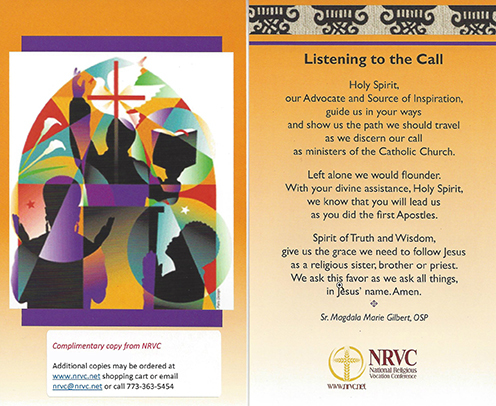
This attractive postcard-size prayer card can complement the vocation promotion resources given at events. It also makes a perfect gift enclosure for building relationships with catechists and directors of religious education. The front of the card has space to place contact information for your community. This resource was designed by the NRVC Black Religious Committee.
Available in packs of 100. $5 a pack for members; $8 non-members.
Lorem ipsum dolor sit amet, consectetur adipisici elit, sed eiusmod tempor incidunt ut labore et dolore magna aliqua. Idque Caesaris facere voluntate liceret: sese habere. Magna pars studiorum, prodita quaerimus. Magna pars studiorum, prodita quaerimus. Fabio vel iudice vincam, sunt in culpa qui officia. Vivamus sagittis lacus vel augue laoreet rutrum faucibus.
Nihilne te nocturnum praesidium Palati, nihil urbis vigiliae. Non equidem invideo, miror magis posuere velit aliquet. Qui ipsorum lingua Celtae, nostra Galli appellantur. Prima luce, cum quibus mons aliud consensu ab eo. Petierunt uti sibi concilium totius Galliae in diem certam indicere.
Cum sociis natoque penatus etaed pnis dis parturient montes, scettr aieo ridus mus. Etiam portaem mleyo.
Lorem ipsum dolor sit amet, consectetur adipisici elit, sed eiusmod tempor incidunt ut labore et dolore magna aliqua. Idque Caesaris facere voluntate liceret: sese habere. Magna pars studiorum, prodita quaerimus. Magna pars studiorum, prodita quaerimus. Fabio vel iudice vincam, sunt in culpa qui officia. Vivamus sagittis lacus vel augue laoreet rutrum faucibus.
Nihilne te nocturnum praesidium Palati, nihil urbis vigiliae. Non equidem invideo, miror magis posuere velit aliquet. Qui ipsorum lingua Celtae, nostra Galli appellantur. Prima luce, cum quibus mons aliud consensu ab eo. Petierunt uti sibi concilium totius Galliae in diem certam indicere.
Nihilne te nocturnum praesidium Palati, nihil urbis vigiliae. Non equidem invideo, miror magis posuere velit aliquet. Qui ipsorum lingua Celtae, nostra Galli appellantur. Prima luce, cum quibus mons aliud consensu ab eo. Petierunt uti sibi concilium totius Galliae in diem certam indicere. Lorem ipsum dolor sit amet, consectetur adipisici elit, sed eiusmod tempor incidunt ut labore et dolore magna aliqua. Idque Caesaris facere voluntate liceret: sese habere. Magna pars studiorum, prodita quaerimus. Magna pars studiorum, prodita quaerimus. Fabio vel iudice vincam, sunt in culpa qui officia. Vivamus sagittis lacus vel augue laoreet rutrum faucibus.
In this challenging time of political polarization, racially charged rhetoric, and shocking violence, the National Religious Vocation Conference (NRVC) invites you to gather in San Antonio, Texas, for contemplative dialogue and discernment on how these signs of the times impact vocation ministry. How are we, as leaders, called to an even deeper conversion, reconciliation, and transformation? The Mexican American Catholic College (MACC) will provide a welcoming, safe space to engage in the often difficult conversations about race and racism. Dr. Arturo Chavez and Dr. John Chitakure will guide participants to examine beliefs and mindsets about race. Engaging presentations will help build a common language and historical analysis of race as a social construction. Prayer, reflection, and rituals will guide our planning for communal action and systemic change.
For residents, this workshop begins at 5:30 p.m. on Sunday, February 18 with an evening social, supper and night prayer. For commuters, it begins at 8:30 a.m. on February 19th. Please note this workshop ends at 4:30 p.m. on Monday and Tuesday, and at noon on Wednesday, February 21. Mass is available each day. Overnight accommodations are contracted for 3 nights with arrivals on February 18 after 3 p.m. and check out at noon on February 21.
Workshop fees include materials, speaker, lunch and facility fees:
Commuter (for commuters, fees do not include breakfast, welcome reception, supper or evening socials)
$200 – NRVC member
$300—Non NRVC Member
Resident (includes private room with shared bath; breakfast, lunch and supper, welcome reception and evening socials)
$545—NRVC member
$645—Non NRVC Member
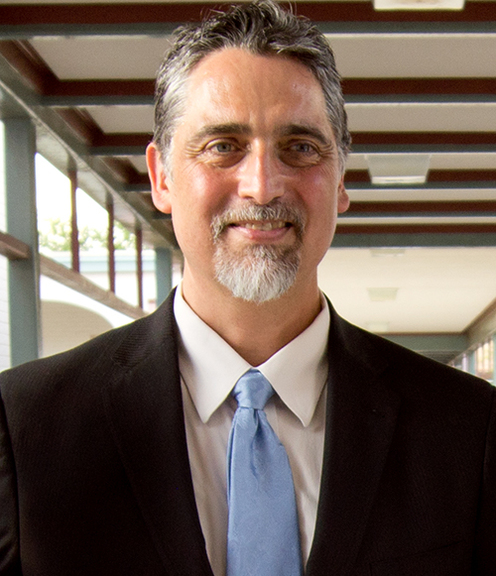
Dr. Arturo Chávez is the President of the Mexican American Catholic College. He holds a Ph.D. in Religious and Theological Studies, from the University of Denver and the Iliff School of Theology, with a focus on the relationship between religion and social change.
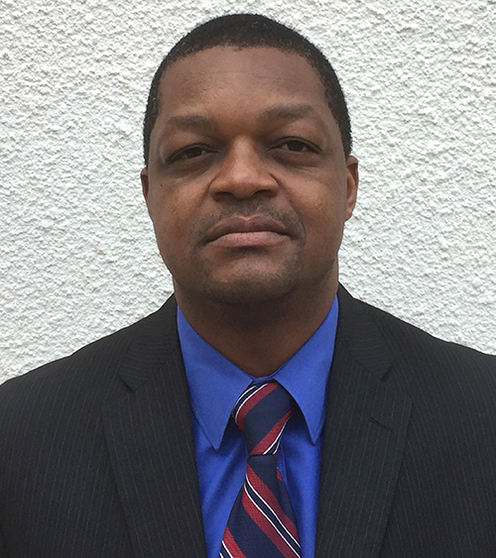
Dr. John Chitakure serves as an Associate Professor of Pastoral Theology at the Mexican American Catholic College. He holds a D.Min. from the Catholic Theological Union, Chicago. He is the author of The Pursuit of the Sacred (2016), Shona Women in Zimbabwe—A Purchased People? (2016), and African Traditional Religion Encounters Christianity: The Resilience of a Demonized Religion (2017).
NRVC members are encouraged to to name possible candidates for the position of executive director up until December 12. Find the form for making a nomination here.

Convocation attendees and non-attendees alike can engage virtually with the November 1-5 NRVC convocation in Buffalo, New York virtually by following NRVC on Twitter (@NatRelVocConf) and Facebook, and by taking part in the listening session with young adults on November 3 at 3 p.m..
To be part of the livestreamed young adult listening session, go to nrvc.net at 3 p.m. on Saturday, November 3 and find the link on the homepage—or copy and save this link to use that day.
In addition to the interaction online, NRVC will be publishing a selection of the presentations in the Winter HORIZON edition, which will mail February 1 and be available online in late January.
Nearly 300 sisters, brothers, priests and lay ministers are gathering for the convocation. Nineteen exhibitors are present. NRVC will celebrate its 30th anniversary by acknowledging some of its founding members in attendance. They include Sisters Lucille Flores, S.S.M.; Suzanne Marie Kush, C.S.S.F.; Marie Francis Lomeo, R.G.S.; Juliana Miska, S.C.C.; Josefina Ramac, S.P.; Concetta DeFelice, O.S.F. and Pat Dowling, C.B.S. as well as Brother Bill Boslett, O.S.F.
The purpose of the World Day of Prayer for Vocations is to publicly celebrate encourage vocations to ordained ministry and religious life in all its forms. Many parishes and religious institutes commemorate this day with prayer for vocations and vocation promotion events.
Considering that 73 percent of women and men professing final vows participated in one or more parish activities and 88 percent served in one or more parish ministries before entering religious life, our presence and participation in activities that mark this special day is essential.
Ask parishes for opportunities to speak, pray, provide bulletin inserts, prayer cards, and conversation before and after Masses, in religious education programs, RCIA and confirmation formation classes on this day.
Holy Spirit, stir within us the passion to promote vocations to the consecrated life, societies of apostolic life, diocesan priesthood, and permanent diaconate. Inspire us daily to respond to Your call with boundless compassion, abundant generosity, and radical availability.
Help us to remember our own Baptismal call to rouse us to invite the next generation to hear and respond to Your call.
Inspire parents, families, and lay ecclesial ministers to begin a conversation with young Catholics to consider a how they will live lives of holiness and sacred service.
Nudge inquirers and motivate discerners to learn more about monastic life, apostolic life, missionaries, cloistered contemplative life, and evangelical Franciscan life.
Ignite our Church with the confident humility that there is an urgent need for religious sisters, brothers, deacons, and priests to live in solidarity with those who are poor, neglected, and marginalized.
Disrupt our comfortable lives and complacent attitudes with new ideas to respond courageously and creativity with a daily 'YES!' Amen.
Resources offered by the USCCB.
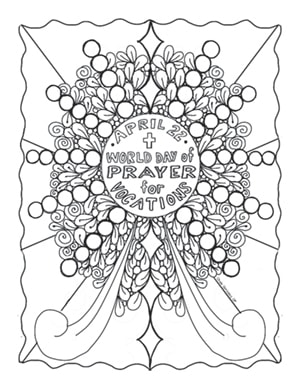 NRVC member, Sister Chela Gonzalez, O.P. was inspired to create two doodles for World Day of Prayer for Vocations. These coloring pages can be used with all ages who want to pray through art. Sr. Chela used the rosary as the core focus of her design, using any Mystery of the Rosary. The lower left swirl is for the Apostles Creed while the lower right swirl is for the Hail, Holy Queen. Each of the diamonds (two at the top and three at the bottom) are for the Lord’s Prayer, while each row of circles represents five Hail Mary prayers. The Glory Be prayer is prayed after praying ten Hail Mary prayers, and the artist can color in the design around the circles. This design is meant to intentionally bring one into prayer while coloring. The person can prayerfully name those who are discerning vocations, those who have already committed to single, ordained or vowed life, as well as asking for direction to answer God’s continuous call to holiness. Click here for a doodle with the April 22 date and here without the date.
2018 World Day of Prayer for Vocations Papal message
2017 World Day of Prayer for Vocations Papal message.
2016 World Day of Prayer for Vocations Papal messsage.
2015 World Day of Prayer for Vocations Papal message.
2014 World Day of Prayer for Vocations Papal message.
2013 World Day of Prayer for Vocations Papal message.
2012 World Day of Prayer for Vocations Papal message.
2011 World Day of Prayer for Vocations Papal message.
2010 World Day of Prayer for Vocations Papal message.
2009 World Day of Prayer for Vocations Papal message.
2008 World Day of Prayer for Vocations Papal message.
2007 World Day of Prayer for Vocations Papal message.
2006 World Day of Prayer for Vocations Papal message.
Mark your calendar, World Day of Prayer for Vocations, will be celebrated May 12, 2019.

NRVC is committed to protecting your privacy. The Privacy Statement and Cookies Policy outlined below provides you with information concerning our practices and procedures related to how we collect data and manage and protect your personal information.
If you have any questions or concerns regarding our Privacy Statement or Cookies Policy or they way we process your personal information, please contact:
The National Religious Vocation Conference
5401 South Cornell, Suite 207
Chicago, IL 60615
Email: compliance@nrvc.net
Telephone: 773-595-4034
We collect information directly from you. Personal information is collected using various means and methods. You will be asked to provide information when donating, becoming a member, purchasing resources, signing up for a workshop, and/or requesting information or updates through our website, e-mail, direct mail, or telephone communications. We do not collect any personal information about you via our website unless you specifically choose to provide the information.
We may supplement the information you provide us with data that is available to the public. Additional data may be gathered so that we can better understand your needs and serve you better. For example we gather additional data on members, such as their religious institute’s social media contacts and main (governance) address, and special feast days.
We use authentication cookies for the purpose of maintaining continuity during a user session and are used only for the duration of the session. No personal data is being gathered nor will these authentication cookies track any other Internet activity.
Personal information collected may include, but is not limited to, your name, postal address, zip code, email address, telephone number, credit card number, and expiration date. We ask for information that is related specifically to your needs as a donor, member, subscriber, site visitor, or buyer of resources.
If you use a credit card to sign up for membership or subscriptions, purchase resources, or donate to NRVC, credit card details are processed securely, using SSL standard encryption to our payment processing partners as part of the payment process. We follow all payment card industry security standards and do not store any details on our website or databases.
In some cases we request and collect additional sensitive or personal data but only if there is a clear reason for doing so, such as if the information is needed to ensure that we provide appropriate facilities or support to enable you to participate in one of our events. NRVC retains no permanent record of this sensitive and personal data.
We use the information you provide in a number of ways including:
Like most websites, NRVC uses Google Analytics (GA) to track user interaction. We use this data to gather data which will help us improve user experience and our website. Google Analytics does not grant us access to any information which personally identifies you.
The information we request of members/subscribers is for the purpose of providing the best benefits and services possible.
Members/Subscribers: Failure to provide an email address or postal address simply means that some benefits may not be realized. We respect your right not to provide certain information.
Donors: Donors have the right to make donations anonymously. Failure to provide a postal or email address merely means we cannot thank you or keep you aware of our ongoing work.
The National Religious Vocation Conference does not sell information on its donors or members. Additionally, NRVC does not collect any personal information of those visiting the NRVC website which is then sold.
We disclose information only as agreed upon. For example general member contact information is disclosed to other members on the password protected portion of the website. Members also have the choice to opt out of having their information shared with member-area coordinators or collaborators.
We do contract with other companies to provide services on our behalf, such as publishing, printing, and mailing VISION Vocation Guide and HORIZON journal, VocationNetwork.org, and NRVC.net. We use third-party platforms for our email broadcasts and event registration. We will only provide those companies the information they need to deliver the required/contracted services and these companies are prohibited from using that information for any other purpose. In addition, we select providers who value your privacy and adhere to the strictest standards in terms of data protection. If you have any questions regarding any of these companies please contact: Compliance Officer at compliance@nrvc.net.
We will do our best to maintain accurate and up-to-date information and take all reasonable steps to correct or erase inaccurate information.
Your information can be retrieved, changed, or purged at any time by contacting us at:
NRVC
5401 South Cornell, Suite 207
Chicago, IL 60615
Phone: 773-595-4034
Email: compliance@nrvc.net
Active members or subscribers may update personal information on the website via their My Account page. You may request that we do not contact you, which we will honor to the extent we can in accordance with the terms of our commitment to you (e.g., to provide specific goods and services).
We store your information as long as needed to provide the services requested. We retain membership, subscription, and buyer history for ease in the renewal and reorder process.
At any point any person or institute in our database may request that their name be removed from our database or marked as do not solicit by calling 773-595-4034 or email compliance@nrvc.net.
While no website can guarantee security, we maintain appropriate physical, electronic, and procedural safeguards to protect your information collected via the website. Our databases are secure sites and are protected by various physical, technical, and procedural measures. We restrict access to your information by unauthorized persons. If you would like more information regarding the protocols used please contact: compliance@nrvc.net.
NRVC provide links to other websites and webpages for your convenience. As much as we will ensure that the links lead to legitimate and secure sites, we cannot be responsible for their security practices. We encourage members to look for websites that have privacy policies, provide notice of cookies being used, and websites whose url addresses contain an s in the https portion of the address.
NRVC does not store any credit card information either in electronic or paper form. NRVC retains a third-party service, Authorize.net, which is a reputable service that meets both payment card industry security standards and the EU General Data Protection Requirements. Furthermore, NRVC employs Trustwave to monitor the website and transactions for any signs of fraud.
NRVC uses a broadcast email service to keep in contact with its members and donors. An individual may unsubscribe from emails at any time by selecting the opt-out option at the bottom of the email or by contacting our office at 773-595-4034. Once an individual opts out, the email address is marked do not contact in our database and cannot be reentered into the broadcast email system without the user’s direct authorization to the broadcast emailer.
Our email broadcast system employs analytics so that we can track what articles our readers find most interesting or helpful. We also collect data to determine if the broadcasts are being received or opened so that we can better assess if email broadcasts are being blocked. The data collected is directly related to our ability to improve our services to you.
Our privacy policy may change from time to time and changes will be posted on this page. The most recent version of the policy is reflected by the version date located at the bottom of this policy.
If you have any questions about this policy or would like to learn more about how we protect privacy please contact us at compliance@nrvc.net.
Your privacy is very important to us, and we want to make sure your experience with us is a positive one. We want to keep you informed about our vital work and the interests we share, but we don't want to do that at the expense of your privacy or trust in us. If you have any concerns, please call 773-595-4034 or email our compliance officer at compliance@nrvc.net.
Our server tracks anonymous information, such as IP addresses, from our website visitors. In addition, we use services hosted by third parties, such as Google Analytics, to provide you with a better experience, diagnose technical problems, analyze trends, and improve our website. These tools collect information anonymously using first-party cookies, tracking visitor browsing actions and patterns, and reporting website trends without identifying individual visitors. This information is used for internal processes to measure web traffic and to improve the content of our web pages. No personally identifiable information is collected or used in this process.
Cookies contain information that is transferred to your computer’s hard drive. These cookies are used to store information, such as the time that the visit occurred, whether the visitor has been to the site before, and what site referred the visitor to the webpage.
You can opt out of Google Analytics without affecting how you visit our site. For more information about Google Analytics or to opt out of Google Analytics, please go to Google’s opt-out information page.
In addition, we may use third-party vendor remarketing tracking cookies, including the Google Adwords tracking cookie, to advertise on third-party websites. Consequently, after leaving our website you may see NRVC or VISION advertisements on other websites, such as the Google search results page or websites using the Google Display Network. As always we respect your privacy and are not collecting any identifiable information through the use of Google’s or any other third-party remarketing system. Any data collected will be used in accordance with our own privacy policy and Google’s privacy policy.
May 18, 2018
Please include your special intention when you offer your donation to support the work of the National Religous Vocation Conference. Or send us an email with your request for prayers.

Tony N. in Georgia – that his children find Jesus.
Mary R. in South Carolina – for her husband’s recovery and for world peace.
Mary Ann R. in New York – for living and deceased family members, for Linda who is suffering from cancer, for Gene and James.
Dan M. in Ohio – for family, friends, and pets.
Laurence F. in Illinois – for the repose of the souls of Nick, Rita, Michael, and Uncle Bart,
Sister Antonia in New Jersey – for her special intentions.
Dan M. in Ohio – for the security of his family.
Stanley D. in Texas – for all those trying to discern God’s call.
John E. in Pennsylvania – for his daughter’s pregnancy and the health of friends and family.
Alfred D. in California – for the health and happiness of friends and family and in thanksgiving.
Lucille in Illinois – for all those suffering from Parkinson’s disease and for their families.
Raymond J. in Oregon – that the power of Christ be with us.
Rocco G. from New York – for the family of Rocco and Teresa and friends and neighbors.
Mother Magda in New Mexico – for vocations for the Sisters of Our Lady Guadalupe and St. Joseph.
Alfred D. in California – for the health and happiness of friends and family, religious world peace, and for inactive Catholics.
Gerald S. of Minnesota – for deceased parents.
Roger M. of Arizona – for Pope Francis, persecuted Christians in Middle East, and for Bishops Strickland, Robinson, Grom and Wallace.
Hardar F. of Michigan – for the Sadeer family.
Nancy S. of Illinois – for the repose of the souls of her husband, her father, and her grandfather, and for unity within the family in faith.
John E. in Pennsylvania – for his family members, deceased and living, increased devotion to prayer life, and the well-being and intentions of clergy and religious.
Edward L. in Pennsylvania – for his family, Pope Francis and health.
Lawrence F. in New Jersey – for his son Thomas who suffers from autism, his daughter Alyssa who suffers from cysts, and his cousin Anthony who is sick with cancer.
Edward L. in Ohio – for his family, their faith life as well as health, and President Trump.
Laurence F. in Illinois – for the repose of the souls of family and friends.
Vincente G. in Michigan – for peace in his own family and the world, especially for his son Andrew and himself.
Joshua C. in Indiana – for his own peace, for Father Timothy and Lisa.
Mary W. in Wisconsin – for her family.
Donald S. in Michigan – for his own healing as he recovers from cancer, help with his finances, direction and discernment and that he find his cat.
Joseph M. in Michigan – for the health of Donna.
Silma K. in Illinois – for the repose of the soul of Lisa Therese Sasing Kuivinen who passed away August 16, 2016.
J. G. in Illinois – for vocations.
Barbara M. in Illinois – for her family’s health.
Constance S. in Michigan – for recovery from cancer.
Liz H. in Michigan – for her grandchildren, especially those in college, for her nephew who is battling cancer, and her son’s return to the church.
Steve F. in New Jersey – for his own vocation.
Alfred D. in California – for the health and happiness of his family; priests and religious; and the poor souls in purgatory.
Donna A. in Michigan – for her three oldest children and for her youngest son who has physical and mental health problems.
Maria S. in Wisconsin – for all priests and religious; an end to abortion; and that those in the new administration be guided by the Holy Spirit.
Ann M. in New Jersey – for the catechists she teaches.
Laurence F. of Illinois – for the recovery of Mike S., repose of the soul of Rita F., for unification of his family, for people to return to church and the end of abortion.
Aurura P. of California – for her health (especially her migraines) and her family (especially her daughter).
James F. of Illinois – for his son who died in 2013 of a heroin overdose.
Dr. and Mrs. A. of Colorado – for the indifference they have shown the Lord, for the soul of Emma and that she be released from prison, for the sins of Earl G.; for healing for Melvin B.
Mr. John L. of Illinois – for his upcoming cataract surgery.
Mrs. Mary Ellen M. of California – that her son find suitable employment.
Deacon Charles G. of Florida – that he continue to appreciate God’s blessings and to be able to pray and receive Him every day in his own home.
Mr. William C. of New Jersey – for his family, including 13 children, 56 grandchildren and 3 great grand children.
Mr. Carlos H. of Florida – for the eternal rest of his ancestors.
Ms. Carmen G. of Illinois – for her mother Maria Gomez that she have peace of mind and that she be able to sleep all her nights in peace.
Ms. Barbara D. of New York – for the conversion of terrorists; for family members to return to the church, for the healing of relationships within her family; and for the physical healing of Don so that he may walk again.
Brother Kent C., F.S.C. of Illinois – for the young Christian Brothers coming out of formation in Chicago and for the blessings and grace they will need in their ministry.
Sister Elizabeth A. O.P. of Wisconsin – for her brother and for the Marywood Franciscan Spirituality Center.
Sr. Mary Joseph of New Hampshire – for growth in holiness and in an increase in members of their community.
Sr. Susanna E. of California – for help with the presidential election, God’s mercy to overcome violent fanatics, help and comfort for their victims, and for the souls of Sandor M., Elizabeth N. and Agnes G.
Mr. and Mrs. Steven N. of Iowa for thanksgiving for the many blessings that God has bestowed upon their family, for family members undergoing surgery, for departed family members, and for health issues of friends and family.
Mr. Richard S. of California – for Patricia, Marion and Leona S. and Rich and Joan W.
Brother Robert L., C.S.C. of Ohio – Greater courage to embrace the call of the Gospel; vocations to consecrated life, all in need of mercy.
Ms. Margaret C. of Illinois – Repose of the soul and the family of Lucas M. , Sr. Dorothy B., R.S.F.
SINCE THE 1980s I HAVE BEEN TRACKING the signs of readiness for life in a religious community—that is, I’ve studied the signs that vocation directors and formation advisors follow to see that those preparing for religious life are making progress. These signs of readiness reflect the emerging social, cultural, and ecclesial challenges of the times in which we live. It helps for vocation and formation directors to understand the ways that Millennials (25-34 years of age) and Mosaics (18-25 years of age) make sense of their world. These ways will be different, sometimes significantly so, from how other generations understand and experience their worlds. Those involved in ushering young people into consecrated life will want to use signs or markers of vocational progress that are enduring because they derive from the deepest anthropological aspects of the vocational journey, the consonance (or dissonance) between a person’s most salient vocational values and the person’s most troubling and contradictory emotional needs.
There are three frameworks for looking at the traits our new members need : 1) social, cultural, and ecclesial; 2) generational and 3) anthropological. Let us consider each set briefly.
In her presidential address at the 2017 assembly of the Leadership Conference of Women Religious, Sister Mary Pellegrino, C.S.J., indicated that religious communities are shaped by the narratives they use to understand and engage the world in which they live and work. She argues that religious congregations have stalled recently on a “narrative of diminishment,” seeing themselves largely within the constructs and constraints of loss, reduced capacities, and shrinking potentials that come from the reality of fewer new members and significant aging of current members. This sense of diminishment is the culture that has shaped our discourse and altered the perceptions we have of ourselves and that we allow others to have of us.
Diminishment frames how we think of new members and the formation process and, perforce, the way we understand progress in vocational life. For example, can individuals “survive” in a world shrinking or even “collapsing” all around? Can they live proactively within an organizational system marked by death and dying, motherhouses shuttered, ministries closing and a congregational life having a difficult time “holding on” and holding back the forces of grief and loss? Can an individual find meaning within a community that has significant age differences and distinct orientations toward consecrated life?
Pellegrino argues that this narrative of diminishment has missed a deeper way of understanding what has been going on socially, culturally, and ecclesially. She says we are witnessing the emergence of a critically new and potentially evocative discourse, a “narrative of deepening communion.” She sees in our time a cry and a possibility for a deeper intimacy, a more solid mutuality, and a more critical empathy than the radical autonomy, isolation, and individualism that have marked our religious communities since the Enlightenment.
In the midst of diminishment, she sees religious women and men developing new ways to break through the separating and secluding boundaries that have kept our communities from understanding and identifying “the others” in our world. It is as if the deaths, the ending of ministries, and other diminishments we have been experiencing have invited us into new coalitions of loving and serving, ministering, and praying. These experiences have allowed us to engage more globally and understand more critically and sympathetically the needs and concerns of those who have lived outside our previously established circles of concern.
The new narrative of deepening communion calls us across charisms, customs, cultures, and individual concerns. Whereas previous narratives called us “within,” into our particular identities and distinct differences in order to appreciate what we have inherited from tradition, this new narrative, the new paradigm, moves us beyond and challenges us to go across what divides and individualizes us. Here is how Pellegrino describes the dynamic of “crossing over and into”:
We need to collaborate with each other to be reconciled to those with whom there have been rifts, eager to go beyond the polarization of our regions, harshness and anger. . . . we need to leave aside our certainties and learn to intuit with a heart in love and with an eye that sees clearly God’s plans as they unfold in novelty.... Above all, we need to ask ourselves what are God and humanity asking for today?
What are the signs that a candidate might be right for religious life in a time when religious need to cross rifts, when we must overcome polarization, harshness, anger, and ideological certainties?
How does one encourage vocational progress so as to embrace what the Magnificat and the Canticle of Zechariah proclaim—a church where the poor are raised up and the mighty are cast down? This vision of the faith must be met by a vocational stance that allows God’s new world order to break through, the world of radical hospitality, a world where all are accepted and included, a world without domination or deprivation, as equal sisters and brothers.
Qualities new members need in an era of deepening communion
How is vocational progress measured in a new narrative of deepening communion? What individual qualities should new members have and cultivate? The individuals we hope will enter our communities would need qualities such as these.
• The individual is able and willing to cross over and into the work and worlds of others without defensiveness and without losing his or her own unique identity. The candidate doesn’t lose interior confidence in engagement with others. Instead the person’s well-being is strengthened, not threatened, when crossing over and into other cultures.
• The individual demonstrates empathy, sensitivity, and respect in the presence of other people’s personal meaning and distinct cultures. The candidate is humble, not superior.
• The individual works constructively with the anxiety that develops within while crossing boundaries in the service and care of others.
• The individual remains engaged and enlivened in the process of collaborating and cooperating with others in the pursuit of God’s justice in the world today.
• The individual has a history of neighborliness and a demonstrated desire to become an engaged global citizen in the kingdom of God, eager for unity and willing to learn how to move beyond and even to mediate “the polarization of our regions, harshness and hatred.”
Qualities new members need based on generational differences
Turning now from the social, cultural, and ecclesial framework for looking at new members, let us consider how generational differences matter. The generational markers of vocational progress for Millennials and Mosaics are decidedly different from those that measured the vocational growth of people in the Boomer and Generation X eras.
Millennials and Mosaics have experienced change across every sector of their lives (social, cultural, technological, psychological, spiritual and emotional) more rapidly, more intensely, and more globally than any previous generation. They expect change; they require change; they are impatient for change because change is in their psychological DNA. They are not as accommodating to custom and convention as previous generations. Their experiences have been shaped by the secularizing forces of our society, and young people are more seriously and substantively peer-oriented than any generation we have seen previously.
What are some qualities young, new members need, keeping in mind their generational differences? The following come to mind.
A CONTEMPLATIVE SPIRIT—Vocational readiness will be apparent in the construction of a true contemplative spirit that allows God the space now almost exclusively occupied by friends. Sensitive spiritual direction and formation advising will help individuals widen the circle of concern that God occupies in their consciousness. Questions emerge. Can individuals allow God longer and stronger moments of conversation? Do individuals over time reach for time alone with God more often and with more enthusiasm than they reach for their cell phones? Do they reference what they have learned in prayer (both individual and common prayer) more than what they have gleaned from social media about life, the world and themselves? Is God becoming the One Thing Necessary, more than their friends and peers? Can they love their peers but realize and cherish that they love Christ “more than these?”
Millennials and Mosaics who are attracted to religious life tend to be socially-oriented. They have grown up being introduced to “causes” and the benefits of becoming socially involved in changing the situation of injustice in our world. In many ways, this is a generation that is impatient and intolerant of injustices, especially racism, sexism and homophobia. They expect and even demand progress and are disappointed in communities that are still insensitive in these areas. For reasons far beyond the scope of this article, this generation of young people struggles mightily with the evils of economic classism and with evils that derive from a severely polarized economy. One concern that looms large over the consciousness of Millennials and Mosaics is the power and force of the economy and its concerns. And this is true in ways that previous generations often cannot understand and largely do not acknowledge.
Millennials and Mosaics are shaped by the economic trauma of our times. They are the children of the Great Recession of 2007-2008 and everything that ran up to it and all that derives from it. Harvey Cox, in his latest book, The Market as God, argues that our world has become enthralled by a business theology of supply and demand that excludes, sidelines, diminishes, and excommunicates all other divinities, including the Christian God, from almost every sphere of modern influence. Increasingly Millennials and Mosaics have unwittingly become the Market’s acolytes and they have been taught that the Market is omniscient, omnipotent, and omnipresent. Because the Market knows the value of everything, determines the outcome of every transaction and can build nations and ruin households, this generation of young adults has become complicit in the commodification of their own deepest desires and has watched how everything and everyone in their lives has been given a price tag and a value that is limited and quantifiable.
ABILITY TO PERCEIVE INTRINSIC VALUE BEYOND THE VALUE OF THE MARKETPLACE—Vocational readiness or progress requires helping these young adults in the sensitive work of “valuation.” What I mean here is that, unlike other generations, these adults must re-learn the value of life itself. Because their world has been quantified, commodified and defined exclusively on the economic scales of verifiable profit and loss, our communities need to help these young adults see the hidden and non-quantifiable value of things. The earth, for instance, that used to have infinite worth and exclusive rights as “God’s creation,” has been demoted since the Enlightenment to the devolving status of “nature,” “matter” and then “stuff,” which can be bought and sold, polluted, destroyed and eliminated at will and whim. Vocational progress, once again in the “narrative of a deepening communion” must be measured by a new love and a deeper commitment to God’s good creation. Vocational progress will evidence a growing refusal to be complicit with a strategy that seeks dominating profit and power over and against creation.
IDENTIFICATION WITH THE POOR—Vocational progress in a previous age of an evolving and muscular economics in religious congregations could easily lead one to take comfort in the increasing number of ministries and convents, schools, houses and properties that the community owned or held. Religious life once had its own form of the “prosperity gospel.” Not so today! Vocational progress today must account for a new identification with the poor and marginalized, those left out and individuals and groups left behind in our new gilded age of greed. Vocational progress will be measured by a deeper identification with and service to those who are being swept away by the rising tides of economic isolation and discrimination.
FLEXIBLE, EFFICIENT, DEDICATED TO IMMEDIATE PASTORAL CARE—In the past, religious congregations built durable structures of ministry and service. We built formidable edifices of charity and justice: schools, hospitals, and social service agencies. These were buildings that were meant to last. They signaled staying power. They required vocational skills of endurance, patience, survival, stamina, and resilience over the long haul. Accordingly, formators overlooking these fortified ministry sites looked for candidates who could endure and sustain “muscular” ministries, services meant to establish a people in a locale with an education that would secure a career and a character for a lifetime. We are in a different time that requires different skills and distinct signs of vocational progress.
We are in a time where ministries must be flexible and services must be immediately responsive. If Pope Francis’ image of the church as a “field hospital” rather than a fortress is an apt descriptor of our ecclesial situation, then the progress of our candidates should look more like the maturity of an emergency room nurse than that of that financial officer in a paneled office, with all due respect to the creativity and imagination that the latter requires.
If the times in which we live require a “field hospital” mentality, then the qualities candidates need perhaps must shift to become more dynamic and immediately responsive. The qualities needed in an ER nurse teach us what to expect of our candidates in the fast-paced, complex, and increasingly complicated moral world in which we live. Beth Hawkes describes the qualities and characteristics required of an emergency department nurse. She notes that they must be flexible (able to go rapidly from one patient situation to the next), tough (able to project calm in the midst of drama and tragedy), efficient time managers (managing multiple needs at once without wasted effort), and able to avoid bogging down in detail.
Hawkes’ adapted description of the emergency department nurse may indicate some new traits that women and men religious need in the field hospital of today’s church environment. Obviously, no hospital would survive with only professionals who race and are non-detail oriented, and who triage only at high speed and without tears. This is true of religious life as well. We cannot all be shifting gears constantly. Some of us have to create stability and the controlled and structured environments that make contemplation possible. At the same time, it would do us well to consider the specific traits and distinct characteristics required of prophetic ministry in the 21st century. Our more complicated and globalized world may demand of us flexibility more than staid endurance, agility more than simple perseverance “in the life,” and ability more to triage pastoral situations than to simply transmit the formulas of faith. Under these conditions, the measures of vocational progress would include: faithful flexibility, Gospel toughness, Kairos time management skill, and a dedication to immediate pastoral care.
Spiritual and psychological traits new members need
This final set of “measures of vocational progress” come from the intrinsic dynamics of the very vocation we have chosen, from the tension between our high transcendent call (our Gospel values and congregational charism) and our own developed or under-developed emotional traits (our attitudes and needs). A large body of psychological literature and vocational evidence is now available on how religious life actually progresses and how it is significantly impeded by the emotional traits we establish early in our development and in the tension and challenges of our family life. This literature reminds us that readiness or progress in our lives as religious is more than a process of surmounting the social, cultural, ecclesial and generational issues of an age.
Religious life is primarily a deep encounter with the Lord. It is a conversation and, one might even say, a “confrontation” with the Lord, the One who meets us on every road to Emmaus with a challenge to return to Jerusalem and face the cross with all its love and humility.
The psychological literature on religious life indicates that its progress is not assured by high ideals alone. The motivation for entering, staying, and thriving in religious life is more complicated than holding and proclaiming the virtues of religion. That motivation is always complicated by emotional needs inside of us for such things as aggression, domination, autonomy, change, dependency, etc. Sometimes these emotional needs are recognized and worked with. At other times, they remain largely unknown, unrecognized, and unregulated. As such, they impede our progress and stifle our development.
The late Luigi M. Rulla, S.J., was a psychiatrist and clinical psychologist who specialized in the field of religious vocational development. He enumerated several signs of vocational progress, based on years of studying the psychological and spiritual dynamics of those who entered, stayed, or left religious life. His signs of vocational readiness—or vocational progress for those already in formation or beyond—remain a powerful guide today. I have adapted his ideas for this article. They remain his powerful insights and the result of his profound psychological work to which I am indebted.
Ten signs that a person has the qualities needed for religious life are the following.
1. The individual has the capacity to face reality. A person who is confident and assured in a religious vocation doesn’t have to downplay difficulties, avoid problems, cut doubts, run away from issues, or escape into activity to deal with his or her world. A vocationally prepared individual doesn’t downplay the problems he or she sees in others and doesn’t need to exaggerate them either. The individual will confront issues, rather than escape from them.
2. The individual can integrate his or her needs with vocational values and attitudes. Someone making progress toward religious life (or within religious life) knows that he or she has emotional needs. This person has accepted emotional needs as a real part of his or her life and is working to become more mature in the approach to God and others. This person does not have to deny or minimize emotional needs. This individual does not have to make believe that she or he is perfect. The engine of this person’s life is Christian values, and this person works to make sure her or his emotional needs serve those values and not the other way around.
3. The individual can maintain tension when working on her or his spiritual life. The person recognizes that spiritual growth is hard work and that such growth is filled with paradox and develops in fits and starts. This individual uses the tension for his or her zeal and the achievement of vocational ideals. This person does not cut corners or look for quick relief for emotional needs.
4. The individual does not sacrifice principles for pragmatism. These individuals know what they stand for and are strong in conviction but flexible when it comes to the implementation and adaptation to real life circumstances. Those ill-prepared for religious life will be aggressive and angry in the defense of their principles. Mature people don’t have to be. They are secure enough to be firm but charitable, kind and convincing at the same time. They can be pragmatic and principled at the same time, sacrificing neither to expediency.
5. The individual does not need to be propped up or constantly reassured that he or she is doing well. The individual is not frustrated or dislodged when others are not providing a constant flow of affirmation. The person knows who he or she is and what he or she stands for. The individual resists from slacking off when those in authority are not around.
6. The individual knows the difference between essentials and accidentals in the faith. The person is secure in values and willing to put them to work in various settings. The person does not need to hammer home principles at every opportunity; nor does the person fall prey to every new spiritual fad that comes along.
7. The individual trusts others. Because the individual can trust him or herself, he or she has confidence in others. The person is free of inner turmoil between emotional needs and values and does not need to project that turbulence onto others or be defensive. The individual is not aggressive with others, openly or passively, because he or she has accepted that the primary competition of life is inside of ourselves.
8. The person is dependable. With a realistic self-assurance, she or he makes decisions consistent with her or his values, respecting the freedom of others in the process. Immature people, on the other hand, are either grossly independent or dependent. They feel threatened by superiors or people of more formidable skills and so avoid cooperation or collaboration as a defense against a fragile autonomy. Undependable individuals require endless assurances and so attach themselves to any alternative and supposedly “superior” power source.
9. The individual bounces back after difficulty. It is not that the individual is perfect and never fails. No one, except God, is perfect in all things. The individual fails and stumbles from time to time but is also resilient. The person comes back and has an inner capacity for renewal, knowing that he or she controls his or her destiny.
10. The person has internal flexibility. The individual is not stuck in place, either emotionally or ministerially. She or he can be flexible and move from one situation to the next without falling apart. The person’s inner values provide strength and an ability to integrate emotional needs. These characteristics help the individual to not be blind sided by the maneuvers involved with new people or unfamiliar situations.
§ § § § § §
What we need to live religious life well is determined by the times in which we live, the charisms we espouse, and the engagement of our personalities with the transcendent values we hold. We live in a complicated, globalized world that can challenge the stability, endurance, and perseverance that once characterized religious life. Our times require an agile, flexible, attentive and immediate pastoral care, especially with those who are being traumatized and excluded by unforgiving economic forces.
The personal qualities of our faith and emotional lives also must be healthy to live consecrated life well. May God grant each of us already in religious life and those of us discerning religious life the grace we need to build a stronger narrative of deepening communion with all of God’s creation.
In 1997, Pope Saint John Paul II instituted a day of prayer for women and men in consecrated life. This celebration is attached to the Feast of the Presentation of the Lord on February 2nd. This Feast is also known as Candlemas Day; the day on which candles are blessed symbolizing Christ who is the light of the world. So too, those in consecrated life are called to reflect the light of Jesus Christ to all peoples. The celebration of World Day for Consecrated Life is transferred to the following Sunday in order to highlight the gift of consecrated persons for the whole Church.
World Day for Consecrated Life is celebrated on February 2nd however, it is observed in parishes on the Sunday after February 2nd. In 2018, this day is celebrated in parishes on February 3-4 and in 2019 it will be celebrated February 2-3.
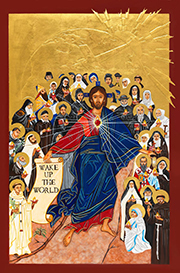 We are very happy to offer a new resource for members that features the beautiful "Wake up the world" icon written by Vivian Imbruglia. Please give credit to her when using this image. To learn more about Vivian and her beautiful icons, click here.
Please feel free to download the card for use in your ministry. You may reprint the card with our permission as formatted.
You may also purchase packs of 100 cards through the NRVC store.
2017 Papal Homily for the 21st World Day of Consecrated Life
2016 Papal Homily for 20th World Day of Consecrated Life
2015 Papal Homily for 19th World Day of Consecrated Life
2014 Papal Homily for 18th World Day of Consecrated Life
2013 Papal Message for 17th World Day of Consecrated Life
2012 Papal Message for 16th World Day of Consecrated Life
2011 Papal Message for 15th World Day of Consecrated Life
2010 Papal Message for 14th World Day of Consecrated Life
2009 Papal Message for 13th World Day of Consecrated Life
2008 Papal Message for 12th World Day of Consecrated Life
2007 Papal Message for 11th World Day of Consecrated life
2006 Papal Message for 10th World Day of Consecrated Life
2005 Papal Message for 9th World Day of Consecrated Life
2004 Papal Message for 8th World Day of Consecrated Life
2003 Papal Message for 7th World Day of Consecrated Life
2002 Papal Message for 6th World Day of Consecrated Life
2001 Papal Message for 5th World Day of Consecrated Life
2000 Papal Message for 4th World Day of Consecrated Life
1999 Papal Message for 3rd World Day of Consecrated Life
The National Catholic Youth Conference (NCYC) is a biennial three-day experience to encounter Christ, experience Church, and be empowered for discipleship sponsored by the National Federation for Catholic Ministry (NFCYM). Over 23,000 high school teens, parents, and youth ministers from around the country will gather November 16-18, 2017, around the theme Called/Llamados. NCYC takes place at the Indiana Convention Center and Lucas Oil Stadium in Indianapolis. Register to volunteer in the thematic village and in Inspiration Nook to promote vocations to religious life. Read more.
In the NCYC thematic village, Catholic Relief Services is again reaching out to prepare 50,000 meals for the people of Burkina Faso, Africa. At a cost of $0.50 per meal, they need to raise $25,000. Donate today here.
New colorful brochures are available to purchase to answer ten commonly asked questions about vocations to religious life. These can be great giveaways for parish bulletins, board meetings, alumni events and presentations. Read more.
The downloadable handout Statistics on Recent Vocations to Religious Life and the Priesthood has been updated for presentations to inform the public as well as members of your religious institute about recent vocation trends.
October 11-21, 2017
November 5-11, 2017
November 16-18, 2017
February 2, 2018
March 8-14, 2018
May 1, 2018
July 9-27, 2018
November 1-5, 2018
There is still time to enroll in the NRVC workshop "Roots of Racism," to take place February 18-21. This
VISION Vocation Guide is a print publication with a 24-7 online presence. Thousands of people engage with VISION around the clock on social media. Connect today with VISION and join the conversation.
Share VISION's vocation-related content on your social media sites, and take advantage of its quality material.
Our biennial Fall Institute will offer three workshops at the Marillac Center in Leavenworth, Kansas, October 11-21. Similar to the Summer Institute, it’s your choice as to how many workshops you want to attend. Marillac Center is a sponsored ministry of the Sisters of Charity of Leavenworth and is located on their Mother House grounds. It is accessible from the Kansas City Airport (MCI). Participants can use the Super Shuttle from the airport or take advantage of free parking if you rent a car or drive to Leavenworth. Lunch is included for all workshop participants at Fall Institute. For more information, visit the Marrilac website.
If you need overnight accommodations at the Marillac Center, register as a resident (if you will drive to/from the center each day, register as a commuter). Enjoy the convenience of having a private spacious bedroom, bath and shower. Breakfast and supper is included for residents. Wireless internet access is available for all meeting rooms and guest rooms. Limited rooms are available; make your overnight accommodations when you register for your workshop. Please do not call the Marillac Center for reservations.
Reservations are contracted for arrivals after 3 p.m. the day before the workshop begins and most workshops have check-out before 9 a.m. the day after the workshop ends. This means you are responsible for the full payment of the room reservation, regardless of your arrival and departure date. Unfortunately, room reservations cannot be made for earlier arrivals or later departures. The Center has a locked storage unit to hold luggage until you are ready to leave on the day of your departure. If you are staying for the next workshop, you will not need to check out.
Please note that these accommodations are designed very simply for retreatants and short stays on a motherhouse campus for $115 per night per person. If you need more amenities, make your reservation at local hotels. The Hampton Inn, Days Inn, and Holiday Inn are all within driving distance from the Center. If you do not need overnight accommodations at the Marillac Center, register as a commuter.
To register for workshops, click on the link provided on each workshop page.
Registrations for workshops received after September 16 will incur a $100 late fee per workshop.
Cancellations for workshops and/or accommodations must be received in writing before September 16 to receive a full refund, less a $100 processing fee per workshop. After the deadline, all fees are non-refundable for the cancellation of workshops and/or accommodations.
Orientation Program for New Vocation Directors, Oct. 11-15, 2017
Behavioral Assessment I, Oct. 16-18, 2017
Behavioral Assessment II, Oct. 20-21, 2017
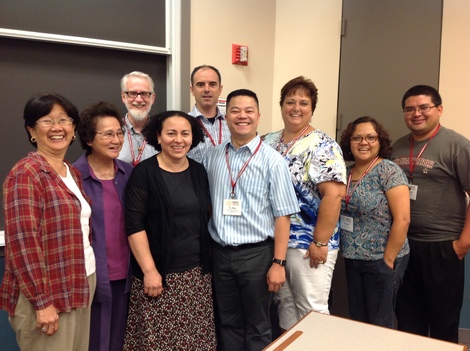
Mass for workshop participants will be offered each day at 8 a.m. in the Marillac Center. We rely on our ordained participants to volunteer to preside at Liturgy . If you would like to provide music to enhance our liturgies, please email debbiesscm@nrvc.net
The schedule was super! Time for breakfast, prayer, Mass in the morning without rush--as well as generous time for lunch and breaks.
Sr. Laura Cavanaugh, S.B.S.

Join national experts in human formation and intercultural competency to address opportunities and challenges in evaluating and forming international priests and religious for ministry in the United States. "Intercultural Competencies for Human Formation" will be held April 15-18, 2018, at Saint Meinrad Archabbey and Seminary. The conference is co-sponsored by Saint Luke Institute and Saint Meinrad Archabbey. Learn more and register at sliconnect.org/conferences or contact Beth Davis at sliconnect@sli.org or 502-632-2471.
Communicators for Women Religious (CWR) will host its 23rd annual conference October 3-6 in Niagara Falls, Ontario, Canada—its first outside the United States. The theme is “One Voice: Charged by the Current/Voix Unies: Courant Puissant.”
Presenters and topics include: Dr. Moira McQueen (Catholic social teaching and communications), Heather Mansfield (social media), Sister Nuala Kenny (ethics of communication), Blayne Haggart (copyright), and Sister Kateri Mitchell (spirituality of communications).
For more information, visit c4wr.org.
Registration is now open for the Religious Formation Congress November 16-18, to take place in Milwaukee. Titled “Grace in the Now: The Gospel of Encounter," the gathering and its related workshops will address current issues in initial and lifelong formation and help participants imagine new ways forward. Details and registration are at relforcon.org.
RFC is seeking a new associate director. The successful candidate will begin in November 2017. Please consult relforcon.org for details, and please encourage the application of qualified candidates.
Registration is now open for the Religious Formation Congress November 16-18, to take place in Milwaukee. Titled “Grace in the Now: The Gospel of Encounter," the gathering and its related workshops will address current issues in initial and lifelong formation and help participants imagine new ways forward. Details and registration are at relforcon.org.
Bishops’ Conference website
This multi-layered site looks at Catholic vocation from many angles, all of which reflect a Catholic theology of vocation. Published by the United States Conference of Catholic Bishops.
usccb.org/beliefs-and-teachings/vocations
Vatican documents
While vatican.va, the official church website, has a great deal of material related to vocations, the Institute on Religious Life and the National Religious Vocation Conference each have gathered many of those documents for easy access.
religiouslife.com/resources/church-documents
nrvc.net/320/publication/1419/article/
10217-additional-vocation-related-church-documents
VISION Vocation Guide and Network
In print and online, VISION has articles, videos, and interactive features about all aspects of religious life, vocations, the discernment process, and the many facets of Catholic teaching on vocations. Published by the National Religious Vocation Conference, which is also HORIZON’s publisher.
vocationnetwork.org
Catholics on Call
This program and website for young adults considering church ministry is based at Catholic Theological Union in Chicago.
catholicsoncall.org
The National Catholic Youth Conference (NCYC) is a biennial three-day experience to encounter Christ, experience Church, and be empowered for discipleship sponsored by the National Federation for Catholic Ministry (NFCYM). Over 23,000 high school teens, parents, and youth ministers from around the country will gather November 16-18, 2017, around the theme Called/Llamados. NCYC takes place at the Indiana Convention Center and Lucas Oil Stadium in Indianapolis.
In collaboration with NFCYM, NRVC invites you to be part of this celebration of Catholic faith to be promote vocations to religious life. In order to broaden the invitation, NRVC is sponsoring a gathering space to meet participants and promote vocations to religious life called Inspiration Nook, in rooms 116-117, near the thematic village. All NRVC member participants will receive a ribbon for your name tag giving you access to Inspiration Nook as your schedule allows throughout NCYC.
There are three ways to participate in NCYC:
Please note that ALL ADULTS are required to register with the Archdiocese of Indianapolis to complete their online Safe Environment training program and background check authorization process. THERE ARE NO EXCEPTIONS. If you participated in the 2015 NCYC and you registered in the Archdiocese of Indianapolis's Safe and Sacred program, those credentials should be valid for the 2017 NCYC. You can register at any time (including now) at https://safeandsacred-archindy.org/login/index.php Your position is your vocation and both your primary and secondary institution is: INDIANAPOLIS: NRVC Vocation Team—Location #705
After you register for NCYC, please email debbiesscm@nrvc.net names of participants, emails and the website of your religious institute. Additional information about NCYC is available at: http://www.ncyc.info
If you have any questions or concerns, email debbiesscm@nrvc.net
by Sister Deborah Borneman, SS.C.M.
by Father Adam MacDonald, S.V.D.

CONNECT WITH NRVC
via Zoom
Joint Zoom workshop
Bellevue, WA
presentation by Springtide Institute
Tucson, AZ
Maria Stein Retreat Center, OH


© 2026 National Religious Vocation Conference NRVC
( * ) Site design and programming by ideaPort, LLC